

Introduction
Hello! This is [Daily Korean], here to upgrade your Korean skills to an intellectual level!
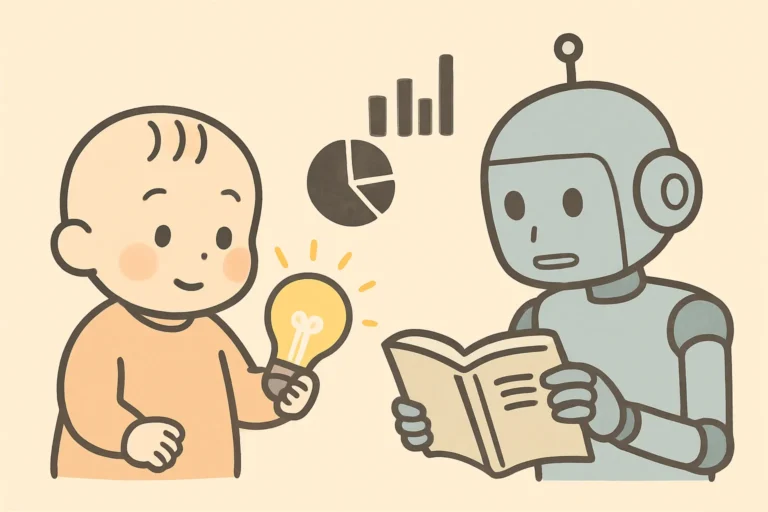
Today, we are diving into a fascinating topic within the Philosophy of Language. Have you ever wondered how we learn to speak? Is it something we are born with, or is it purely a result of learning?
Why this topic now?
Recently, with the explosion of Generative AI (like ChatGPT), the debate on “Human Language vs. Machine Language” has become a hot trend in Korea. Intellectuals and students are revisiting Noam Chomsky’s theory of Universal Grammar to argue whether AI truly “knows” language or just mimics it.
This lesson is perfect for C1 (Advanced) learners who want to participate in high-level discussions about philosophy, technology, and human nature. Let’s master the vocabulary you need to sound like a pro in a debate!
Key Expressions
Here are 3 essential expressions to discuss the nature of language.
1. 선천적 (Innate / Inborn)
- Pronunciation: [Seon-cheon-jeok]
- Meaning: Innate, inborn, native
- Detail: This is a crucial academic term. It describes traits or abilities that exist from birth, rather than being learned. In our context, it refers to the idea that humans have a “language gene.”
- Example: “언어 능력은 선천적이다.” (Language ability is innate.)
- 💡 Pronunciation Tip:
- Pronounce each syllable clearly: [seon-cheon-jeok].
- Note that ‘선(seon)’ and ‘천(cheon)’ both end with the ‘ㄴ(n)’ sound. Make sure your tongue touches the gum ridge behind your upper teeth for a clear ‘n’ sound.
2. 습득하다 (To acquire)
- Pronunciation: [Seup-tteu-ka-da]
- Meaning: To acquire (usually language or a skill)
- Detail: Unlike ‘배우다’ (to learn), ‘습득하다’ implies a natural process of picking something up, often used specifically for “Language Acquisition” (언어 습득).
- 💡 Pronunciation Tip:
- This word has two sound changes!
- Rule 1 (Tensification): The ‘ㅂ(p)’ in 습 meets the ‘ㄷ(t)’ in 득. The ‘ㄷ’ hardens into a tense sound [ㄸ (tt)]. -> [seup-tteuk]
- Rule 2 (Aspiration): The ‘ㄱ(k)’ in 득 meets the ‘ㅎ(h)’ in 하. They merge to form a strong aspirated sound [ㅋ (k)]. -> [ka]
- Final Result: Don’t say ‘seup-deuk-ha-da’. Say [seup-tteu-ka-da]!
3. 반박하다 (To refute / To counter)
- Pronunciation: [Ban-ba-ka-da]
- Meaning: To refute, to rebut, to counter an argument
- Detail: Essential for debates. You use this when you want to present evidence to prove an opposing argument wrong.
- 💡 Pronunciation Tip:
- Rule (Aspiration – 격음화): Similar to the word above, the ‘ㄱ(k)’ in 박 meets the ‘ㅎ(h)’ in 하.
- ‘ㄱ’ + ‘ㅎ’ = ‘ㅋ’ [k].
- Final Result: It flows smoothly as [ban-ba-ka-da].
Real-Life Dialogue
Let’s see how these words are used in a discussion between two university students, Min-su and Ji-eun, discussing a recent AI documentary.
(Context: Discussing whether AI disproves Chomsky’s theory)
Min-su: “Did you see the news about the new AI model? It learned a new language in hours just by analyzing data.”
(이번에 나온 새로운 AI 모델 뉴스 봤어? 데이터 분석만으로 몇 시간 만에 새로운 언어를 배웠대.)Ji-eun: “Yeah, it’s amazing. But Chomsky would refute that idea.”
(응, 놀랍더라. 하지만 촘스키라면 그 생각에 반박했을 거야.)Min-su: “Why? The AI proves you don’t need innate grammar to speak, right?”
(왜? AI가 말하는 걸 보면 굳이 선천적인 문법이 없어도 된다는 걸 증명하는 거 아냐?)Ji-eun: “Well, AI just calculates probabilities. Humans acquire language naturally with very little data. That’s the difference.”
(글쎄, AI는 그저 확률을 계산할 뿐이잖아. 인간은 아주 적은 데이터로도 언어를 자연스럽게 습득하니까. 그게 차이점이지.)
Culture Tip & Trend Analysis
🧐 The “Humanities Boom” (인문학 열풍) in the AI Era
In Korea, as AI technology advances rapidly, there is paradoxically a growing interest in the Humanities (인문학).
* Why? People are asking, “If AI can write, code, and translate, what makes humans special?”
* The Trend: Many Korean YouTubers and podcasters are now explaining complex theories like Chomsky’s Universal Grammar (보편 문법) to the general public. They compare the human brain’s innate (선천적) creativity with AI’s data processing.
* Pro Tip: If you are in a business meeting or a seminar in Korea regarding tech, mentioning that “AI lacks the innate understanding of context” will make you sound very sophisticated and culturally aware!
Conclusion & Practice
Today, we explored the fascinating world of Language Philosophy. We learned how to discuss innate abilities, language acquisition, and how to refute an argument.
📝 Mini Quiz
Fill in the blanks with the correct form of the words we learned today:
- Chomsky argues that language ability is __________. (촘스키는 언어 능력이 [ ]이라고 주장한다.)
- Children __________ language naturally from their parents. (아이들은 부모로부터 자연스럽게 언어를 [ ].)
(Answers: 1. 선천적, 2. 습득한다)
Challenge: Do you think language is innate or learned? Leave a comment in Korean using today’s expressions!
See you in the next lesson!
[Daily Korean]







