

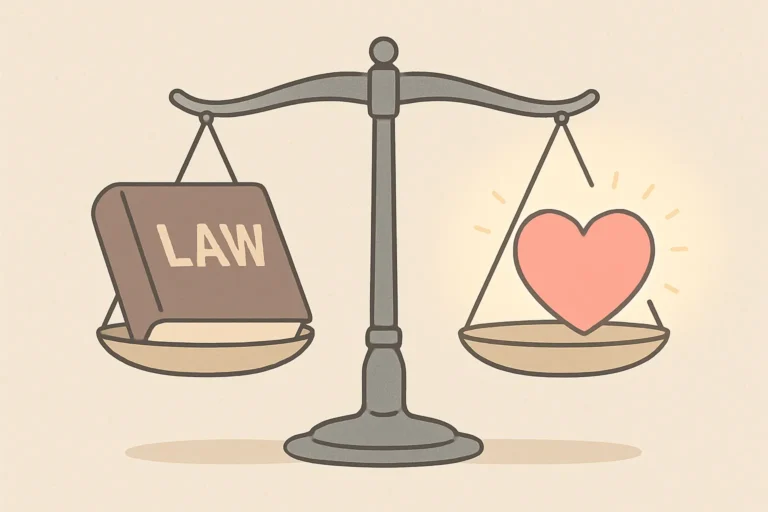
Civil Disobedience: Justice vs Law
Introduction
Hello! This is [Maeil Hangul], here to upgrade your Korean skills to the next level! 🌟
Today, we are diving into a high-level topic suitable for advanced learners: Social Movements and Civic Engagement. Specifically, we will learn how to discuss the philosophical background of civil disobedience.
In Korea recently, debates regarding climate justice protests and disability rights demonstrations have been heating up in the news and on social media. You might hear people asking, “Is it okay to inconvenience others for a greater cause?” or “Should the law be absolute?”
To participate in these intellectual debates like a native speaker, you need more than just daily vocabulary. You need the language of logic and philosophy. Let’s master the sophisticated expressions used in news editorials and academic discussions today!
Key Expressions
Here are 4 high-level expressions to help you sound professional and logical.
1. 시민 불복종 (Simin bulbokjong)
- Pronunciation: [Simin bulbokjong]
- English Meaning: Civil disobedience
- Detailed Explanation: This is the core term for today. It refers to the active refusal to obey certain laws, demands, and commands of a government or an occupying international power. It is distinct from a mere riot because it usually involves non-violent resistance (비폭력 저항) and has a clear public purpose.
- 💡 Pronunciation Tip:
- Pronounce it clearly as written. However, be careful with ‘종 (jong)’. Since it follows ‘복 (bok)’, keep the ‘j’ sound soft but clear.
- Rule: In standard Korean, there isn’t a complex sound change here, but ensure the ‘ㄹ’ in ‘불’ flows smoothly into the ‘ㅂ’.
2. 정당성을 확보하다 (Jeongdangseong-eul hwakbohada)
- Pronunciation: [Jeongdangseong-eul hwakppohada]
- English Meaning: To secure legitimacy / To gain justification
- Detailed Explanation: In a debate, claiming that an action is “right” isn’t enough. You need to argue that it has ‘legitimacy’ (정당성). This phrase is used when an action meets ethical or moral standards, even if it might be controversial.
- 💡 Pronunciation Tip:
- Tensing (Tensification): When ‘학 (hak)’ meets ‘보 (bo)’, the ‘ㅂ’ sound changes to a tense ‘ㅃ (pp)’ sound.
- So, it is not ‘hwak-bo-ha-da’, but [hwak-ppo-ha-da]. This makes your speech sound much more natural and emphatic!
3. 법적 처벌을 감수하다 (Beopjeok cheobeol-eul gamsu-hada)
- Pronunciation: [Beopjjeok cheobeoreul gamsu-hada]
- English Meaning: To willingly accept/risk legal punishment
- Detailed Explanation: A key philosophical component of civil disobedience is the willingness to accept the consequences. ‘감수하다’ means to bear or put up with something difficult. This expression emphasizes the sincerity of the protestor.
- 💡 Pronunciation Tip:
- Tensing: In ‘법적 (beopjeok)’, the ‘ㅈ’ becomes ‘ㅉ (jj)’ because of the preceding ‘ㅂ’. Pronounce it as [beop-jjeok].
- Linking: The ‘ㄹ’ in ‘처벌을’ carries over to the next vowel. Pronounce it as [cheo-beo-reul].
4. 공익을 대변하다 (Gong-ik-eul daebyeonhada)
- Pronunciation: [Gong-igeul daebyeonhada]
- English Meaning: To represent the public interest
- Detailed Explanation: Civil disobedience isn’t about personal gain. It must be for the ‘public good’ (공익). ‘대변하다’ means to speak for or represent a group or cause.
- 💡 Pronunciation Tip:
- Linking: The final consonant ‘ㅇ’ in ‘공’ and ‘ㄱ’ in ‘익’ link smoothly.
- Crucially, ‘익을’ is pronounced as [i-geul] because the ‘ㄱ’ moves to the empty vowel spot. So, say it like [Gong-i-geul].
Example Dialogue
Let’s see how these C2-level expressions are used in a serious discussion about a recent environmental protest in Seoul.
Min-ji: Did you see the news about the climate activists blocking the road yesterday?
(어제 기후 활동가들이 도로를 점거했다는 뉴스 봤어?)
Hyun-woo: Yes. I understand their message, but breaking the law makes me uncomfortable.
(응. 메시지는 이해하지만, 법을 어기는 건 좀 불편하더라고.)
Min-ji: True, but that is the essence of civil disobedience. They are trying to represent the public interest regarding the climate crisis.
(맞아, 하지만 그게 **시민 불복종의 본질이잖아. 기후 위기에 대해 공익을 대변하려는 거지.)**
Hyun-woo: But can illegal actions really secure legitimacy?
(하지만 불법적인 행동이 과연 **정당성을 확보할 수 있을까?)**
Min-ji: I think so. Because they are willingly accepting legal punishment to show how urgent the situation is. That sincerity moves people.
(난 그렇다고 봐. 상황이 얼마나 절박한지 알리기 위해 **법적 처벌을 감수하는 거니까. 그 진정성이 사람들의 마음을 움직이는 거지.)**
Culture Tip & Trend Analysis
🧐 How does Korean Society View Civil Disobedience?
In modern Korea, the concept of ‘촛불집회’ (Candlelight Vigil) has shaped the public’s view of protests. It proved that peaceful gathering can change the country. However, recent trends show a divide in opinion regarding ‘inconvenience’ (민폐).
- The “Rule of Law” Trend: Recently, online communities in Korea often debate whether protests that cause traffic jams (like subway protests by disability rights groups) are effective. While the philosophical cause (명분) is respected, the method is often scrutinized.
- Advanced Tip: When discussing this, if you use the phrase “목적의 정당성뿐만 아니라 수단의 적절성도 필요하다” (Legitimacy of purpose, as well as appropriateness of means, is needed), you will sound like a sophisticated political commentator!
Wrap-up & Practice
Today, we explored the philosophical language surrounding Civil Disobedience. These expressions are essential for understanding Korean news editorials and participating in high-level social discussions.
📝 Practice Quiz
Fill in the blanks with the correct expressions we learned today!
- Civil disobedience is an act intended to ___________ (represent the public interest).
- True activists are ready to ___________ (accept legal punishment).
Answers:
1. 공익을 대변하다 (Gong-ik-eul daebyeonhada)
2. 법적 처벌을 감수하다 (Beopjeok cheobeol-eul gamsu-hada)
Did you enjoy today’s advanced lesson? Try using one of these expressions in the comments below to share your opinion on protests!
See you next time! 👋
Frequently Asked Questions (FAQ)
Q: What does "'촛불집회'" mean in Korean and how do you pronounce it?
A: In Korean, "'촛불집회'" is pronounced [Candlelight Vigil] and means: has shaped the public's view of protests. It proved that peaceful gathering can change the country. However, recent trends show a divide in opinion regarding






