

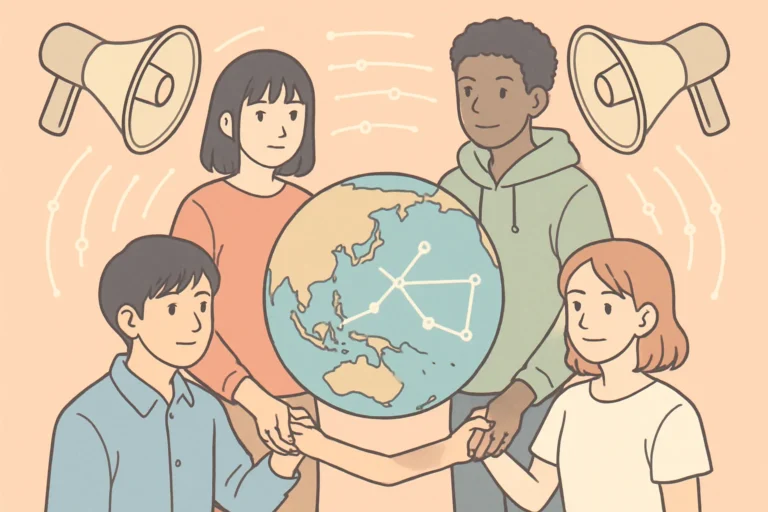
Talking Global Issues in Korean
Introduction
Hello! I’m [Maeil Hangul], here to upgrade your Korean skills to the next level! 👋
Today, we are going to dive into a slightly more advanced but very meaningful topic: Discussing Global Social Movements.
Globalization isn’t just about economy or travel; it’s also about sharing values and fighting for justice together. Whether it’s #MeToo, #BlackLivesMatter, or Climate Action, these movements cross borders rapidly.
These days in Korea, the “MZ Generation” (Millennials + Gen Z) is very active in expressing their opinions on social media. They don’t just watch the news; they participate in global trends to create a better society. Knowing how to discuss these topics will help you have deep, intellectual conversations with your Korean friends or colleagues.
Let’s learn how to express your thoughts on these important issues! 🌍
Key Expressions (3~5)
Here are 4 essential expressions to help you discuss social movements and solidarity.
1. 연대하다 (To stand in solidarity)
- Pronunciation: [Yeondaehada]
- English Meaning: To stand in solidarity with / To band together
- Detailed Explanation: This is a key word for B2 learners interested in social issues. It means joining forces with others to support a cause. You will see this often in news articles or on protest signs. It is a bit formal but very powerful.
- 💡 Pronunciation Tip:
- Pronounce it clearly as written.
- Example: ‘우리는 그들과 연대합니다.’ (We stand in solidarity with them.)
2. 선한 영향력 (Positive influence)
- Pronunciation: [Seonhan yeong-hyang-nyeok]
- English Meaning: Good/Positive influence
- Detailed Explanation: This is a huge trend word in Korea right now. It refers to using one’s fame or platform (like K-pop idols or influencers) to encourage people to do good deeds, such as donating or supporting a movement.
- 💡 Pronunciation Tip:
- Pay close attention to 영향력 (influence). It is NOT pronounced [yeong-hyang-ryeok].
- Due to the Nasalization rule, the ‘ㄹ(r/l)’ sound changes to ‘ㄴ(n)’ when following the ‘ㅇ(ng)’ sound.
- So, say it as [영향녁 (yeong-hyang-nyeok)]. It flows much smoother!
3. 목소리를 내다 (To speak out)
- Pronunciation: [Moksorireul naeda]
- English Meaning: To speak out / To raise one’s voice (metaphorically)
- Detailed Explanation: Literally, it means “to make a voice,” but idiomatically, it means to express one’s opinion publicly, especially regarding social injustice or political issues.
- 💡 Pronunciation Tip:
- In 목소리 (voice), the ‘ㅅ’ becomes a tense sound [ㅆ (ss)] because of the ‘ㄱ’ (k) sound before it.
- Pronounce it as [목쏘리 (mok-sso-ri)]. This is called Tensification (Glottalization).
4. 공감하다 (To empathize / To relate)
- Pronunciation: [Gong-gamhada]
- English Meaning: To empathize / To agree emotionally
- Detailed Explanation: In social movements, logic is important, but emotional connection is key. Use this when you want to say, “I feel the same way” or “I understand their pain/cause.”
- 💡 Pronunciation Tip:
- The ‘ㅇ’ (ng) and ‘ㄱ’ (g) flow together naturally. Keep the rhythm steady.
Example Dialogue
Let’s see how these words are used in a conversation between two friends, Minji and Alex, discussing a recent global campaign.
Alex: 민지 씨, 요즘 SNS에서 유행하는 해시태그 운동 봤어요?
(Minji, did you see the hashtag movement trending on social media these days?)Minji: 네, 봤어요. 전 세계 사람들이 차별에 반대하며 목소리를 내는 모습이 정말 인상적이었어요.
(Yes, I saw it. It was really impressive to see people around the world speaking out against discrimination.)Alex: 맞아요. 한국 연예인들도 많이 참여해서 선한 영향력을 주고 있더라고요.
(That’s right. Many Korean celebrities are participating too, spreading a positive influence.)Minji: 저도 그 취지에 깊이 공감해요. 작은 힘이지만 우리도 함께 연대하면 세상을 바꿀 수 있겠죠?
(I deeply empathize with that purpose too. It’s a small effort, but if we stand in solidarity together, we can change the world, right?)
Culture Tip & Trend Deep Dive
🧐 How Koreans Participate in Global Movements: “Challenge Culture”
In Korea, global social movements often spread through “Challenges” (챌린지).
You might remember the Ice Bucket Challenge. In Korea, this evolved into various forms like the “Thanks To Challenge” (thanking medical workers during COVID-19) or campaigns supporting environmental issues like #ZeroWaste.
- Why is this important?
Koreans value “Chemyon” (face/reputation), so speaking out alone can be difficult. However, when a movement becomes a “Challenge” led by celebrities exercising 선한 영향력 (positive influence), it lowers the barrier for everyone to join in. - Tip: If you see a Korean friend posting a hashtag related to a global issue, commenting “좋은 취지에 공감해요!” (I empathize with the good cause!) is a perfect, culturally appropriate way to show support.
Wrap-up & Practice
Today, we learned how to discuss meaningful global topics in Korean. These expressions will help you sound more intellectual and connected to current events!
📝 Mini Quiz
Fill in the blanks with the expressions we learned today:
- Many K-pop idols are using their fame to spread _______________ (positive influence).
- It is important to _______________ (speak out) against injustice.
(Answers: 1. 선한 영향력, 2. 목소리를 내다)
Did you enjoy today’s post?
If there is a social movement you support, try writing a sentence using “연대하다” or “공감하다” in the comments below! I’d love to hear your thoughts.
See you next time! 안녕히 계세요! 👋
Frequently Asked Questions (FAQ)
Q: What does "영향력" mean in Korean and how do you pronounce it?
A: In Korean, "영향력" is pronounced [influence] and means: . It is
Q: What does "목소리" mean in Korean and how do you pronounce it?
A: In Korean, "목소리" is pronounced [voice] and means: , the 'ㅅ' becomes a tense sound
Q: What does "선한 영향력" mean in Korean and how do you pronounce it?
A: In Korean, "선한 영향력" is pronounced [positive influence] and means: , it lowers the barrier for everyone to join in.







