

Introduction
Hello! It’s [Daily Korean], here to upgrade your Korean proficiency to a professional level!
Today, we are diving into a rather heavy but intellectually stimulating topic: “The Definition and Historical Origins of Welfare States” (복지 국가의 정의와 역사적 기원). While this might sound like a graduate school lecture, these concepts are essential for understanding current affairs in Korea.
Why is this important now? Recently in Korea, due to the severe “Low Birth Rate and Aging Society” (저출산 고령화) crisis, debates about the sustainability of the national pension and health insurance systems are hotter than ever. Turn on any news channel, and you will hear experts comparing different welfare models to find a solution for Korea’s future. Mastering these expressions will allow you to participate in high-level discussions about society, politics, and economics.
Let’s equip you with the language tools to discuss these complex issues fluently!
Key Expressions
Here are 4 high-level expressions essential for discussing welfare state models.
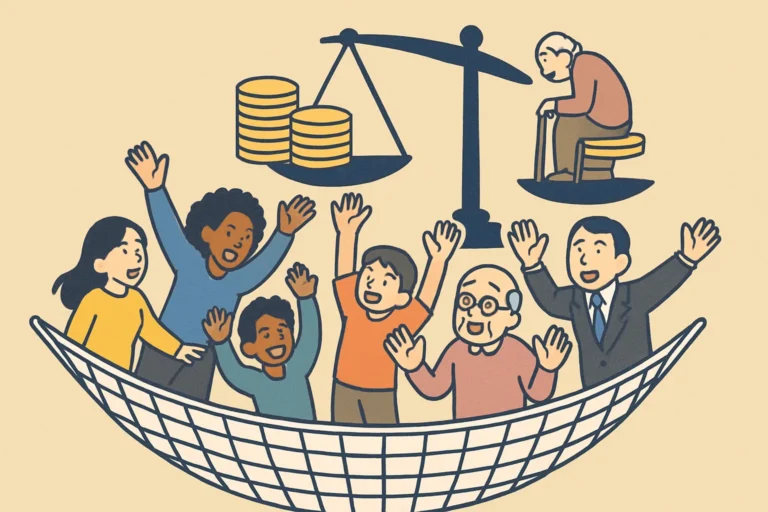
1. 사회 안전망 (Social Safety Net)
- Pronunciation: [Sa-hoe an-jeon-mang]
- English Meaning: Social Safety Net
- Detailed Explanation: This refers to the institutional mechanism designed to protect members of society from risks such as unemployment, poverty, and illness. In C2-level texts, you will often see it used in phrases like “사회 안전망을 확충하다” (to expand the social safety net). It implies the government’s minimum responsibility to its citizens.
- 💡 Pronunciation Tip:
- Pay attention to 안전망 [an-jeon-mang].
- While written as ‘안전’ + ‘망’, the pronunciation is standard. However, be careful with the ‘ㅎ’ in 사회. In rapid speech, the ‘ㅎ’ (h) between vowels often becomes very weak or silent. So, [sa-hoe] often sounds like [sa-oe]. This is a phenomenon known as ‘h-deletion’ in casual but fast speech, though in formal speech, enunciating the ‘h’ is clearer.
2. 보편적 복지 vs. 선별적 복지 (Universal vs. Selective Welfare)
- Pronunciation: [Bo-pyeon-jeok bok-jji vs. Seon-byeol-jeok bok-jji]
- English Meaning: Universal Welfare vs. Selective (Residual) Welfare
- Detailed Explanation: These are the two main opposing concepts in welfare history.
- 보편적 복지: Welfare benefits provided to all citizens regardless of income (e.g., free school lunches).
- 선별적 복지: Welfare provided only to those who prove they are in need (e.g., subsidies for low-income families).
- Understanding the nuance between these two is key to understanding Korean political debates.
- 💡 Pronunciation Tip:
- Look at 복지. It is written as ‘bok-ji’ but pronounced [bok-jji].
- This is due to ‘Tensification’ (경음화). When the stop sound ‘ㄱ’ (k) in the batchim meets the ‘ㅈ’ (j), the ‘ㅈ’ hardens into a tense sound ‘ㅉ’ (jj). Always pronounce it strongly as [bok-jji]!
3. 재정 건전성 (Fiscal Soundness/Integrity)
- Pronunciation: [Jae-jeong geon-jeon-sseong]
- English Meaning: Fiscal Soundness / Financial Stability of the State
- Detailed Explanation: This is a crucial term when discussing the history and limitations of welfare states. It refers to the health of the government’s finances. Critics of expanded welfare often cite “worsening fiscal soundness” (재정 건전성 악화) as a major concern.
- 💡 Pronunciation Tip:
- 건전성 is pronounced [geon-jeon-sseong].
- Similar to the rule above, the ‘ㄴ’ (n) sound can sometimes trigger tensification in Sino-Korean words involving specific suffixes like ‘-성’ (nature/quality). Here, ‘성’ becomes [썽]. This helps emphasize the concept of ‘quality’ or ‘state’.
4. 인구 절벽 (Demographic Cliff)
- Pronunciation: [In-gu jeol-byeok]
- English Meaning: Demographic Cliff
- Detailed Explanation: Originally an economic term, in Korea, it is widely used to describe the sudden drop in the working-age population due to low birth rates. This phenomenon forces a re-evaluation of traditional welfare models designed during periods of high growth.
- 💡 Pronunciation Tip:
- 절벽 is pronounced [jeol-byeok].
- Make sure to pronounce the ‘ㄹ’ (l/r) in ‘절’ clearly. When ‘ㄹ’ is in the batchim position, strictly pronounce it as a lateral ‘l’ sound (like in ‘ball’), not the rolling ‘r’.
Example Dialogue
Let’s see how these expressions are used in a discussion about the future of the Korean welfare system.
Min-ji: 최근 뉴스에서 인구 절벽 문제가 심각해지면서 국민연금 개혁이 시급하다는 보도가 계속 나오고 있어요.
(Recently, news reports keep saying that pension reform is urgent as the demographic cliff problem worsens.)
Hyeon-woo: 맞아요. 과거의 복지 모델은 고성장 시기에 맞춰져 있어서, 지금 같은 저성장 시대에는 재정 건전성을 유지하기가 쉽지 않죠.
(That’s right. Past welfare models were tailored to high-growth periods, so it’s not easy to maintain fiscal soundness in this current low-growth era.)
Min-ji: 그렇다고 복지를 줄일 수는 없잖아요? 오히려 사회 안전망을 더 촘촘하게 만들어야 한다고 생각해요.
(But we can’t just reduce welfare, can we? I think we actually need to make the social safety net tighter/denser.)
Hyeon-woo: 동의해요. 다만, 모든 사람에게 혜택을 주는 보편적 복지로 갈 것인지, 정말 필요한 계층에 집중하는 선별적 복지로 갈 것인지에 대한 사회적 합의가 먼저 필요할 것 같습니다.
(I agree. However, I think we first need a social consensus on whether to go for universal welfare that benefits everyone, or selective welfare that focuses on the classes that truly need it.)







