

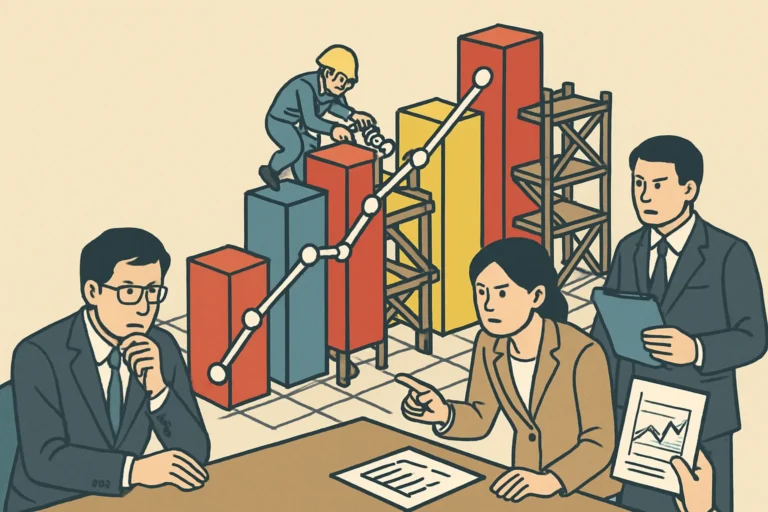
Mastering Korean Debates: Economic Reform Talk
Introduction
Hello! It’s [Daily Hangul], here to upgrade your Korean skills to the next level!
Today, we are going to tackle a somewhat serious but incredibly important topic: Discussing structural reform policies to overcome economic crises.
Does this sound too difficult? Don’t worry! Recently in Korea, news about high inflation, interest rates, and the future of the national pension is everywhere. From news anchors to office workers at lunchtime, everyone is talking about the economy. Being able to participate in these discussions will prove that your Korean skills are truly at an Advanced (C1) level.
Let’s learn the expressions you need to sound like a pro during a serious debate!
Key Expressions
Here are 4 key expressions often used in economic policy discussions.
1. 구조 개혁 (Structural Reform)
- Pronunciation: [Gujo gaehyeok]
- English Meaning: Structural reform
- Detailed Explanation: This is a fundamental term in economics. It refers to changing the basic framework of an economy or organization to improve efficiency. You will hear this often regarding labor markets (노동 시장) or pensions (연금). It is a formal term suitable for reports and debates.
- 💡 Pronunciation Tip:
- Pronounce each syllable clearly.
- Pay attention to ‘혁 (hyeok)’. The ‘yeo’ sound should be distinct. It is not ‘heok’.
2. 불가피하다 (To be inevitable/unavoidable)
- Pronunciation: [Bulgapihada]
- English Meaning: To be inevitable / unavoidable
- Detailed Explanation: This adjective is used to argue that a certain policy or pain is necessary because there is no other choice. It is very useful when defending a difficult decision.
- Example: “Change is inevitable.” (변화는 불가피합니다.)
- 💡 Pronunciation Tip:
- [Bulgapihada]: Read it naturally.
- Be careful not to drop the ‘h’ sound in ‘ha’ too much in formal speech, although in very fast speech it might sound softer.
3. 재정 건전성 (Fiscal Soundness/Health)
- Pronunciation: [Jaejeong geonjeonseong]
- English Meaning: Fiscal soundness / Financial health (of a government)
- Detailed Explanation: This refers to the health of the government’s finances. When a country has too much debt, people worry about its ‘재정 건전성’. It is a high-level vocabulary word essential for policy discussions.
- 💡 Pronunciation Tip:
- This word has many nasal sounds (ng/n).
- ‘건전성’ is pronounced [geonjeonseong]. Make sure the ‘n’ (ㄴ) patchim and ‘ng’ (ㅇ) patchim are distinguished clearly.
4. ~는 방안을 모색하다 (To seek a plan/way to…)
- Pronunciation: [~neun bang-aneul mosaekada]
- English Meaning: To seek a solution / To look for a way to…
- Detailed Explanation: Instead of just saying “find a way” (방법을 찾다), use this phrase in formal settings like meetings or presentations. ‘모색하다’ implies a careful and active search for a solution.
- 💡 Pronunciation Tip:
- Aspiration Rule (격음화): When the patchim ‘ㄱ (k)’ meets the initial consonant ‘ㅎ (h)’, they merge into the strong ‘ㅋ (k)’ sound.
- Therefore, ‘모색하다’ is actually pronounced [mosaekada] (모새카다). Doing this makes your flow much smoother!
Example Dialogue
Let’s see how these expressions are used in a conversation between two colleagues, Min-su and Ji-eun, discussing the current economic situation.
Min-su: 요즘 뉴스 보면 물가도 오르고 경제가 정말 걱정이에요. ‘3고 시대(High exchange rate, interest, and prices)’라는 말이 실감 나요.
(Watching the news lately, I’m really worried about the economy with prices rising. I can really feel the ‘3 Highs Era’.)
Ji-eun: 맞아요. 그래서 정부에서도 위기 극복을 위해 구조 개혁이 시급하다고 하잖아요.
(That’s right. That’s why the government says structural reform is urgent to overcome the crisis.)
Min-su: 하지만 개혁 과정에서 국민들의 고통이 따를 텐데, 괜찮을까요?
(But there will be pain for the public during the reform process. Will it be okay?)
Ji-eun: 당장은 힘들겠지만, 국가의 재정 건전성을 회복하려면 불가피한 선택이라고 생각해요.
(It will be hard right now, but I think it’s an inevitable choice to restore the nation’s fiscal soundness.)
Min-su: 동의해요. 대신 부작용을 최소화할 수 있는 방안을 모색해야겠죠.
(I agree. Instead, we must seek ways to minimize the side effects.)
Culture Tip & Trend Deep Dive
📈 The “3 Highs Era” (3고 시대) and the MZ Generation
In the dialogue, Min-su mentioned ‘3고 시대’ (Sam-go sidae). This is a buzzword often used in Korean news recently. It refers to the simultaneous occurrence of three economic difficulties:
1. High Prices (고물가)
2. High Interest Rates (고금리)
3. High Exchange Rates (고환율)
Because of this economic pressure, discussions about Structural Reform (구조 개혁), especially regarding the National Pension (국민연금), are very hot topics among the MZ generation in Korea. Young professionals are actively debating these policies because it directly affects their future.
Using words like ‘재정 건전성’ and ‘불가피하다’ when discussing these trends will make you sound like an intellectual Korean local!
Wrap-up & Practice
Today, we learned high-level expressions to discuss economic crises and policy responses. These words are perfect for writing reports or discussing current events with Korean colleagues.
📝 Mini Quiz: Fill in the blanks!
- To overcome the economic crisis, fundamental ( ________ ) is needed.
(경제 위기를 극복하기 위해 근본적인 [구조 개혁]이 필요합니다.) -
Raising taxes is sometimes an ( ________ ) choice for the government.
(세금을 인상하는 것은 때때로 정부에게 [불가피한] 선택입니다.)
Answers: 1. 구조 개혁, 2. 불가피한
How would you describe the economic situation in your country using these words? Leave a comment below using today’s expressions!
See you next time with more useful Korean tips! 👋
Frequently Asked Questions (FAQ)
Q: What does "'3고 시대'" mean in Korean and how do you pronounce it?
A: In Korean, "'3고 시대'" is pronounced [Sam-go sidae] and means: . This is a buzzword often used in Korean news recently. It refers to the simultaneous occurrence of three economic difficulties:






