

Find Restrooms in Seoul Cafes!
Introduction
Hello! It’s [Daily Korean] here to upgrade your Korean skills! 👋
Are you planning a trip to Korea soon? Lately, “Cafe Hopping” (visiting trendy cafes) is a huge trend among tourists in Seoul. From Seongsu-dong to Hongdae, there are so many beautiful places to visit!
But wait—after drinking all that iced americano, you might face an urgent situation. 😅 In Korea, finding a restroom isn’t always straightforward, especially in small cafes. Today, we will learn the essential survival phrases to find a restroom and handle the unique “password system” you might encounter!
Key Expressions
Here are the 3 most important phrases you need to know:
1. 화장실이 어디에 있어요?
- Pronunciation: [Hwajangshiri eodie isseoyo?]
- English Meaning: Where is the restroom?
- Detail: This is the standard, polite way to ask for the location of the bathroom. You can use this anywhere—restaurants, subway stations, or on the street.
- 💡 Pronunciation Tip (Liaison):
- Notice that ‘화장실(Hwajangshil)’ ends with the consonant ‘ㄹ(l)’. When followed by the vowel ‘이(i)’, the sound carries over.
- So, it is not pronounced as [sil-i] separately. It sounds like [si-ri].
- Try to say it smoothly: [Hwajangshi-ri]. It sounds much more natural!
2. 비밀번호가 뭐예요?
- Pronunciation: [Bimilbeonhoga mwoyeyo?]
- English Meaning: What is the password?
- Detail: This is crucial! In many Korean buildings and cafes, restrooms are locked to keep them clean. You often need a code to enter.
- 💡 Pronunciation Tip (Vowel Combination):
- The word ‘뭐(mwo)’ is a combination of ‘ㅁ(m)’ + ‘ㅜ(u)’ + ‘ㅓ(eo)’.
- Beginners often say “mo”, but try to round your lips for ‘u’ and open them for ‘eo’ quickly. [Mwo]!
3. 저쪽에 있어요.
- Pronunciation: [Jeojjoge isseoyo.]
- English Meaning: It is over there.
- Detail: This is likely the answer you will hear. The person might point their finger while saying this.
- 💡 Pronunciation Tip (Tensing):
- ‘쪽(jjok)’ uses a “double consonant” sound. It is stronger and higher in pitch than a soft ‘j’.
- Also, because of the Liaison rule we learned earlier, ‘쪽(jjok)’ + ‘에(e)’ becomes [jjo-ge].
Example Dialogue
Imagine you are at a trendy cafe in Hongdae. You need to use the restroom!
- You (A): 저기요, 화장실이 어디에 있어요? (Excuse me, where is the restroom?)
- Staff (B): 문 나가서 저쪽에 있어요. (Go out the door, it’s over there.)
- You (A): 아, 잠시만요! 비밀번호가 뭐예요? (Ah, wait! What is the password?)
- Staff (B): 1234예요. (It’s 1234.)
- You (A): 감사합니다! (Thank you!)
Culture Tip & Trend Deep Dive 🇰🇷
🗝️ Why do I need a password?
In Korea, many cafes and restaurants are located in shared commercial buildings. To maintain cleanliness and safety for their customers, owners often install digital door locks on the restrooms.
👀 Look at the Receipt!
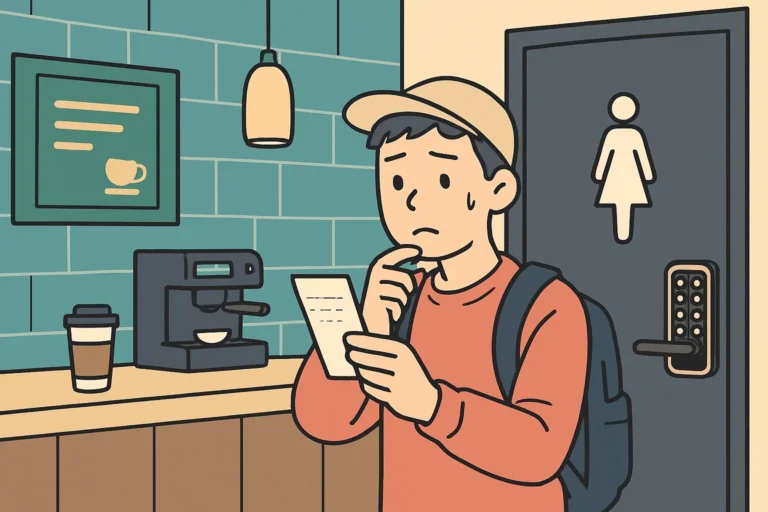
Nowadays, instead of asking the staff, check your receipt (yeongsujeung)! Many trendy cafes print the Wi-Fi password and the Restroom password at the bottom of your receipt.
* Trend Alert: Some places even have a cute doll or a large object attached to a physical key hanging near the counter. You have to take that doll with you to the bathroom! It’s a funny sight often shared on Instagram. 📸
Wrap-up & Practice
Today we learned how to survive your cafe tour by asking for the restroom and the password!
📝 Mini Quiz
Fill in the blank to complete the sentence:
“Excuse me, where is the restroom?”
________이 어디에 있어요?
- 비밀번호 (Password)
- 화장실 (Restroom)
Leave your answer in the comments below! Start practicing now, and you’ll be ready for your trip to Korea. See you next time! 👋






