

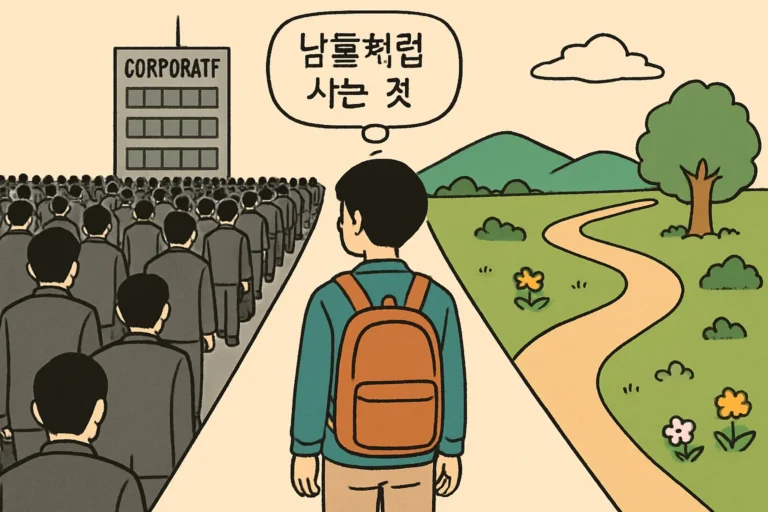
Sartre in Seoul: Is “No Choice” a Choice? Unmasking Bad Faith in Korean
Hello! This is Everyday Korean, here to upgrade your Korean skills from fluent to truly profound!
Today, we’re moving beyond simple grammar and vocabulary to tackle a deep philosophical concept that you see every day in Korean life: Jean-Paul Sartre’s “Bad Faith,” or 자기기만 (jagi-giman). Ever felt trapped by expectations, saying “I have no choice”? That’s exactly what we’re exploring. In today’s hyper-competitive Korean society, where conforming to the norm is often encouraged, understanding the language of self-deception is key to grasping the subtle undercurrents of daily conversations. Let’s find out how to talk about this complex human condition like a native speaker!
Core Expressions: The Language of (In)Authenticity
Here are some key phrases that reveal the struggle between societal pressure and individual freedom.
1. 자기기만 (Jagi-giman)
- Pronunciation [Romanization]: Jagi-giman
- English Meaning: Self-deception; Bad Faith
- Detailed Explanation: This is the core concept. It’s a compound word from 자기 (jagi), meaning ‘self’, and 기만 (giman), meaning ‘deception’. In a Sartrean sense, 자기기만 is the act of lying to oneself to escape the anxiety of absolute freedom. It’s when you pretend you are a thing without choice (like a rock or a tool) instead of a human being defined by your choices. This is an advanced, academic term, perfect for adding depth to a discussion or essay.
- 💡 Pronunciation Tip: The ‘ㄱ’ (g/k) in 기만 is unaspirated. It’s a soft sound that sits between the English ‘g’ and ‘k’. Avoid a hard ‘k’ sound like in “king.”
2. 어쩔 수 없다 (Eojjeol su eopda)
- Pronunciation [Romanization]: Eojjeol su eopda
- English Meaning: “It can’t be helped”; “There’s nothing I can do.”
- Detailed Explanation: This is the most common, everyday expression of Bad Faith. While it can express genuine helplessness, it’s often used as a shield to avoid responsibility. For example, “I hate my job, but I have to support my family, so 어쩔 수 없어.” Sartre would argue that this is a choice—prioritizing family security over personal fulfillment. This phrase denies that agency, framing the situation as inevitable.
- 💡 Pronunciation Tip: Notice the sound change here. The ‘ㄹ’ in 어쩔 links with the ‘ㅅ’ in 수, making the ‘ㅅ’ a tense sound. So, instead of ‘eojjeol su’, the natural pronunciation is [어쩔쑤 / eojjeol-ssu]. This is a rule called ‘된소리되기’ (tensing).
3. 남들처럼 살다 (Namdeul-cheoreom salda)
- Pronunciation [Romanization]: Namdeul-cheoreom salda
- English Meaning: To live like others; to live an ordinary/conventional life.
- Detailed Explanation: This phrase captures the essence of conforming to societal roles. 남들 means ‘other people’, and -처럼 means ‘like’. The desire to 남들처럼 살다—get a stable job, marry by a certain age, buy an apartment—can be a form of 자기기만 if it’s done not from authentic desire, but from a fear of forging one’s own unique, and therefore uncertain, path.
- 💡 Pronunciation Tip: The ‘ㅊ’ (ch) in 처럼 (cheoreom) is an aspirated consonant. Make sure to release a strong puff of air, as in the English word “chart.” It’s much stronger than the ‘ㅈ’ (j) sound.
4. 체면을 차리다 (Chemyeon-eul charida)
- Pronunciation [Romanization]: Chemyeon-eul charida
- English Meaning: To save face; to maintain one’s social dignity.
- Detailed Explanation: 체면 (chemyeon) is the concept of one’s social image or reputation, a crucial element in Korean culture. To 체면을 차리다 means to act in a way that preserves this image. This can lead to Bad Faith when your actions are dictated solely by what others will think, rather than what you truly believe. For instance, pretending to be fine when you’re struggling, just to maintain appearances.
- 💡 Pronunciation Tip: The sound flows smoothly from 체면 to 을. The final consonant ‘ㄴ’ (n) of ‘체면’ links directly to the vowel ‘으’ (eu), so you pronounce it as one fluid unit: [체며늘 / chemyeoneul]. This is called 연음 (yeon-eum) or liaison.
Example Dialogue: A Coffee Shop Confession
Let’s see these expressions in a real-life conversation between two friends.
A: 요즘 회사 다니기 너무 힘들어. 내 길이 아닌 것 같아. (Work is so tough these days. I don’t think this is the right path for me.)
B: 그럼 그만두고 하고 싶은 일을 찾아봐. (Then quit and find something you want to do.)
A: 말은 쉽지. 부모님 기대도 있고… 그냥 남들처럼 사는 게 제일 편한 것 같아. 어쩔 수 없어. (Easier said than done. There are my parents’ expectations… I think it’s easiest to just live like others. It can’t be helped.)
B: 그건 일종의 자기기만 아니야? 남들 체면 때문에 네 인생을 포기하는 건 좀 그렇지. (Isn’t that a form of self-deception? It’s not right to give up your life just to save face for others.)
Culture Tip: “Hell Joseon” and the Pressure to Conform
Why are these expressions so relevant in Korea today? The immense social pressure, often described by the term “헬조선” (Hell Joseon), creates a fertile ground for Bad Faith.
- The Societal Ladder: From the university entrance exam (입시 전쟁) to the job hunt (취업 전쟁), there’s a socially-accepted “golden path” (e.g., SKY university → a job at Samsung). Straying from this path requires immense courage, so many convince themselves they have “no choice” but to follow it.
- K-Drama Tropes: You’ll see this constantly in K-dramas! Think of the chaebol heir who secretly wants to be an artist but must take over the family company (“어쩔 수 없어!”), or the public servant who endures a toxic workplace to maintain a stable image (체면을 차리려고). Dramas like “My Liberation Notes” (나의 해방일지) brilliantly explore characters suffocated by this pressure, yearning for authenticity. Recognizing these moments will add a whole new layer to your viewing experience!
Let’s Review and Practice!
Today, we connected a deep philosophical concept, 자기기만 (Bad Faith), with everyday Korean expressions. We learned that phrases like 어쩔 수 없어 are not just simple statements, but can reveal a profound struggle with freedom and responsibility.
Now, it’s your turn to practice!
- Fill in the Blank: A person who continues a miserable but prestigious job purely to maintain their social standing is prioritizing _______. (Hint: A two-syllable word related to social image).
- Your Turn: Think of a time you told yourself “어쩔 수 없어.” Was it truly a situation without choice, or was it a form of 자기기만? Describe the situation in one or two Korean sentences.
We’d love to see your answers! Share your thoughts and practice sentences in the comments below
Frequently Asked Questions (FAQ)
Q: What does "자기기만" mean in Korean and how do you pronounce it?
A: In Korean, "자기기만" is pronounced [jagi-giman] and means: . Ever felt trapped by expectations, saying "I have no choice"? That's exactly what we're exploring. In today's hyper-competitive Korean society, where conforming to the norm is often encouraged, understanding the language of self-deception is key to grasping the subtle undercurrents of daily conversations. Let's find out how to talk about this complex human condition like a native speaker!
Q: What does "자기" mean in Korean and how do you pronounce it?
A: In Korean, "자기" is pronounced [jagi] and means: , meaning 'self', and
Q: What does "기만" mean in Korean and how do you pronounce it?
A: In Korean, "기만" is pronounced [giman] and means: , meaning 'deception'. In a Sartrean sense,
Q: What does "처럼" mean in Korean and how do you pronounce it?
A: In Korean, "처럼" is pronounced [cheoreom] and means: is an aspirated consonant. Make sure to release a strong puff of air, as in the English word "chart." It's much stronger than the 'ㅈ' (j) sound.







