

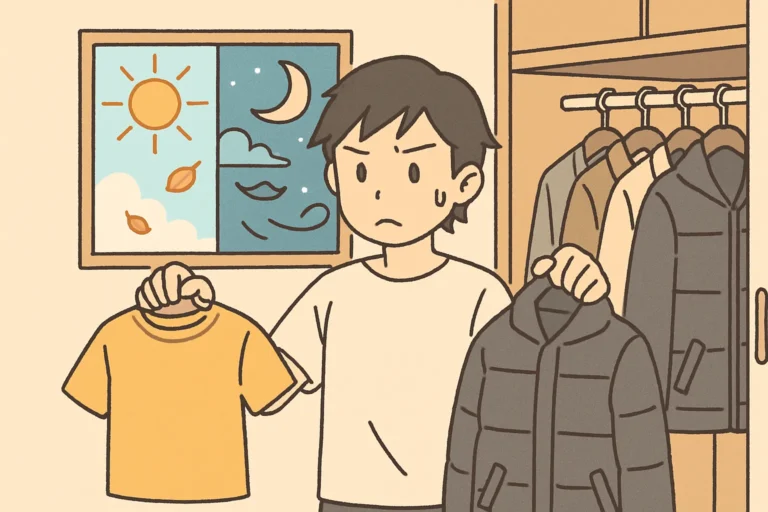
Master Korean Weather & Style!
Hello! This is Maeil Hangeul, here to upgrade your Korean skills!
Have you ever looked out the window in Seoul, seen the sunshine, and walked out in a t-shirt, only to find yourself shivering by the evening? You’re not alone! Today, we’re tackling a super practical topic: how to talk about what to wear based on the weather in Korea. This will help you ask for advice, understand recommendations, and never be underdressed or overdressed again!
Lately in Korea, the weather has been so unpredictable! One day it’s warm, the next it’s chilly. This ‘in-between season’ weather, or 간절기 (ganjeolgi), has made “what to wear today” a hot topic on social media. Let’s learn how to talk about it like a local!
Core Expressions You Need to Know
Here are three essential phrases to help you conquer Korean weather and fashion.
1. 오늘 뭐 입지? (What should I wear today?)
- Pronunciation [Romanization]: Oneul mwo ipji?
- English Meaning: What should I wear today?
- Detailed Explanation: This is a very common, informal phrase you can use when talking to yourself or a close friend.
입지? (~ipji?)is a casual ending that expresses wondering or contemplating something. It’s the perfect phrase to say while looking at your closet in the morning. -
💡 Pronunciation Tip:
The final sound in입지 (ipji)is [ji], not [chi]. In Korean, the letterㅈhas a ‘j’ sound, like in “jam.” Be careful not to mix it up withㅊ, which has a stronger, airy ‘ch’ sound, like in “churros.” So, it’s a softip-ji, not a strongip-chi.
2. 겉옷 챙겨. (Take an outer layer.)
- Pronunciation [Romanization]: Geodot chaenggyeo.
- English Meaning: Take an outer layer/jacket. (Literally: Pack/take an outer garment.)
-
Detailed Explanation:
겉옷 (geodot)means “outerwear” or “outer clothing” – anything from a cardigan to a jacket or coat.챙기다 (chaenggida)is a fantastic verb that means to pack, to take something with you, or to look after something/someone. This phrase is friendly, casual advice you’d give to a friend or family member. -
💡 Pronunciation Tip:
Listen closely!겉옷is spelled ‘geot-ot’ but pronounced [geodot]. Why? When a consonant at the end of a syllable (like theㅌin겉) is followed by a syllable that starts with a vowel (like theㅇin옷), the consonant sound “moves over” to the next syllable. This rule is called 연음 (yeoneum), or liaison. It makes the pronunciation flow smoothly fromgeot-ottogeo-dot.
3. 일교차가 커. (The daily temperature range is big.)
- Pronunciation [Romanization]: Ilgyochaga keo.
- English Meaning: The daily temperature range is big.
-
Detailed Explanation: This is the ultimate phrase for Korea’s spring and fall seasons!
일교차 (ilgyocha)means the difference between the highest and lowest temperature in a day.크다 (keuda)means “to be big.” When you hear this, it’s a clear sign that you need to dress in layers. -
💡 Pronunciation Tip:
The first sound in커 (keo)comes from the letterㅋ. This is an “aspirated” or “strong” consonant. To make this sound correctly, you should feel a strong puff of air escape your mouth, as if you’re saying the ‘k’ in “kite.” It’s much stronger than theㄱsound in기억 (gieok), which is softer, like the ‘g’ in “go.” Practice saying [Keo!] with energy!
Example Dialogue
Let’s see how these expressions are used in a real conversation.
A: 아, 오늘 뭐 입지? 날씨가 애매하네.
(A: Ah, what should I wear today? The weather is tricky.)
[A, oneul mwo ipji? Nalssiga aemaehane.]
B: 낮에는 따뜻한데 저녁엔 추울 거야. 일교차가 크대.
(B: It’s warm during the day, but it’ll be cold in the evening. They say the temperature range is big.)
[Najeneun ttatteuthande jeonyeogen chuul geoya. Ilgyochaga keudae.]
A: 그럼 반팔에 카디건 입을까?
(A: Then should I wear a short-sleeved shirt and a cardigan?)
[Geureom banpare kadigeon ibeulkka?]
B: 좋아! 이따 저녁에 한강 공원 갈 거니까 겉옷 꼭 챙겨.
(B: Sounds good! Since we’re going to the Han River Park later this evening, make sure to take an outer layer.)
[Joa! Itta jeonyeoge hangang gong-won gal geonikka geodot kkok chaenggyeo.]
🇰🇷 Culture Tip: Mastering “Ganjeolgi” (간절기) Fashion!
The word you heard earlier, 간절기 (ganjeolgi), is key to understanding Korean daily life in spring and autumn. It refers to these tricky “in-between seasons.”
On Korean social media like Instagram, you’ll see thousands of posts with hashtags like #간절기코디 (ganjeolgi kodi – in-between season outfit) or #OOTD (Outfit Of The Day) where people share their layering ideas. The secret to surviving ganjeolgi is layering (레이어드 – leieodeu). That’s why the phrase “겉옷 챙겨” is more than just advice; it’s a Korean survival strategy for these seasons! If you want to sound like a real local, mention the ilgyocha and recommend taking a geodot. You’ll fit right in!
Let’s Review and Practice!
Great job today! We learned how to figure out what to wear for Korea’s unpredictable weather using essential phrases like “오늘 뭐 입지?”, “겉옷 챙겨”, and “일교차가 커.”
Now, let’s test your knowledge!
- Fill in the blank:
It’s chilly in the morning and evening, but warm in the afternoon. The _______________ is big.
(Hint: The daily temperature range) -
Your Turn!
You see your friend about to leave the house in just a t-shirt on a cool autumn day. What friendly advice would you give them using a phrase we learned today?
You’re doing amazing! What’s the weather like where you are? Tell us what you’re wearing in the comments using today’s expressions! We’d love to see you practice
Frequently Asked Questions (FAQ)
Q: What does "간절기" mean in Korean and how do you pronounce it?
A: In Korean, "간절기" is pronounced [ganjeolgi] and means: , has made "what to wear today" a hot topic on social media. Let's learn how to talk about it like a local!
Q: What does "연음" mean in Korean and how do you pronounce it?
A: In Korean, "연음" is pronounced [yeoneum] and means: , or liaison. It makes the pronunciation flow smoothly from
Q: What does "간절기" mean in Korean and how do you pronounce it?
A: In Korean, "간절기" is pronounced [ganjeolgi] and means: , is key to understanding Korean daily life in spring and autumn. It refers to these tricky "in-between seasons."







