

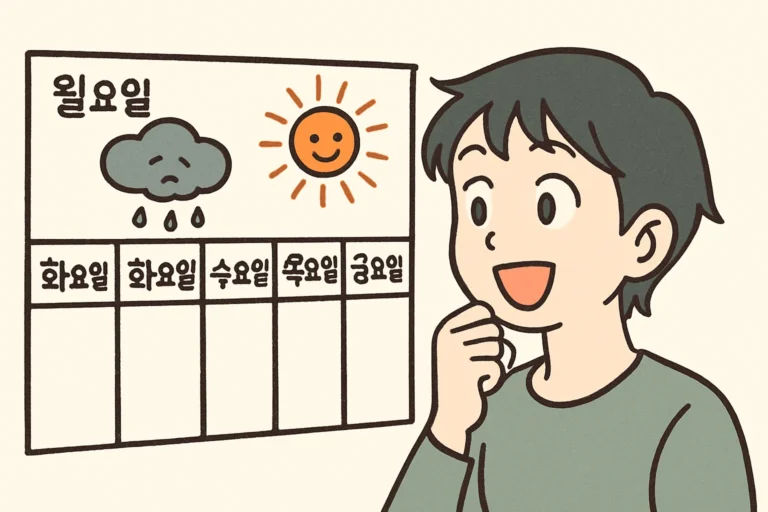
Korean Weather Forecast: From Wol-yoil to Il-yoil!
Hello! Welcome to [Maeil Hangeul], here to upgrade your Korean skills!
Have you ever wanted to check the weather in Seoul for your future trip or just to feel more connected to Korea? Today, we’re going to learn the Korean days of the week so you can understand the weather forecast like a local! Lately in Korea, the weather has been so unpredictable, so knowing the forecast for each day is super useful. It’s the perfect way to plan your week, whether you’re hoping for a sunny day to visit a palace or a cozy, rainy day to watch K-dramas. Let’s get started!
Core Expressions You Need to Know
Here are the essential words to master this week’s weather forecast!
1. 월요일 (Wol-yo-il)
- Pronunciation [Romanization]: Wol-yo-il
- English Meaning: Monday
- Detailed Explanation: This is the word for Monday.
요일 (yoil)means “day of the week,” and월 (wol)comes from the character for “moon” (月). In Korea, many people talk about having 월요병 (wol-yo-byeong), which means “Monday sickness” or the “Monday blues.” It’s a very common feeling after a fun weekend! -
💡 Pronunciation Tip:
The letter ‘ㄹ’ (l/r) can be tricky. When it’s at the end of a syllable like in ‘월’, it makes a clear ‘L’ sound. Make sure to touch the tip of your tongue to the back of your front teeth. So, it’s [Wol]-yo-il, not Wo-yo-il.
2. 금요일 (Geum-yo-il)
- Pronunciation [Romanization]: Geum-yo-il
- English Meaning: Friday
-
Detailed Explanation: TGIF!
금요일is Friday.금 (geum)comes from the character for “gold” or “metal” (金). This is everyone’s favorite day because it signals the start of the weekend. Young Koreans often call it 불금 (bulgeum), which means “Burning Friday” or “Fiery Friday,” because they go out to have fun and release stress. -
💡 Pronunciation Tip:
The first letter ‘ㄱ’ (g/k) is pronounced like a soft ‘g’ at the beginning of a word, similar to the ‘g’ in “go.” So, you say [Geum], not “Keum.”
3. 주말 (Jumal)
- Pronunciation [Romanization]: Ju-mal
- English Meaning: Weekend
-
Detailed Explanation: This is a super useful word!
주말means “weekend.” It’s a combination of주 (ju), meaning “week,” and말 (mal), meaning “end.” So, it literally means “week-end.” You can use this word to ask friends about their weekend plans. -
💡 Pronunciation Tip:
The final consonant ‘ㄹ’ in말 (mal)is a clear ‘L’ sound, just like in월 (wol). Practice saying [Ju-mal] with a distinct ‘L’ at the end.
4. 이번 주 날씨 (Ibeon ju nalssi)
- Pronunciation [Romanization]: I-beon ju nal-ssi
- English Meaning: This week’s weather
-
Detailed Explanation: This phrase is your key to unlocking the forecast. Let’s break it down:
이번 (ibeon)means “this,”주 (ju)means “week,” and날씨 (nalssi)means “weather.” Put them all together, and you can ask about the weather for the current week! -
💡 Pronunciation Tip:
Theㅆ (ss)in날씨 (nalssi)is a tensed consonant. It’s stronger and higher-pitched than a singleㅅ (s). To make this sound, tense the back of your tongue and push the air out forcefully, like the ‘ss’ sound in “hiss.” It’s not [nal-si], but [nal-ssi].
Example Dialogue
Let’s see how these expressions are used in a real conversation. Imagine two friends planning their week.
A: 이번 주 날씨 어때요?
[Ibeon ju nalssi eottaeyo?]
How’s the weather this week?
B: 음… 월요일은 맑고, 금요일은 비가 온대요.
[Eum… Wol-yo-ireun makgo, Geum-yo-ireun biga ondaeyo.]
Hmm… They say Monday will be sunny, and it will rain on Friday.
A: 아, 정말요? 금요일에 새로 생긴 드라마 촬영지 카페 가려고 했는데…
[A, jeongmallyo? Geum-yo-ire saero saenggin deurama chwaryeongji kape garyeogo haetneunde…]
Oh, really? I was planning to go to the new K-drama filming location cafe on Friday…
B: 그럼 주말은 어때요? 주말은 날씨가 좋대요!
[Geureom jumareun eottaeyo? Jumareun nalssiga jotdaeyo!]
Then how about the weekend? They say the weather will be good on the weekend!
Culture Tip & Trend Deep Dive
In Korea, talking about the day of the week is deeply connected to daily life and social culture.
- The Dreaded ‘월요병’ (Wol-yo-byeong): The “Monday Sickness” is a real cultural phenomenon. You’ll often see K-pop idols and celebrities posting on social media on Monday morning, saying things like “Let’s overcome 월요병 together!” It’s a relatable way to connect with fans about the shared struggle of starting a new week.
-
The Excitement of ‘불금’ (Bulgeum): “Burning Friday” is the complete opposite! On social media, especially Instagram, you’ll see tons of posts with the hashtag #불금. It’s all about sharing pictures of delicious food, fun nights out with friends, or exciting plans to kick off the weekend. If you use this word, you’ll sound just like a local!
Let’s Wrap It Up & Practice!
Great job today! You’ve learned how to say Monday (월요일), Friday (금요일), the weekend (주말), and how to ask about “this week’s weather” (이번 주 날씨). Now you’re ready to understand a basic Korean weather report!
Time for a quick quiz!
- What do you call the feeling of “Monday blues” in Korean? (Hint: It ends with 병).
- Fill in the blank: I am excited for the __________. (주말 / 월요일)
Leave your answers and your own practice sentences in the comments below! For example, try telling us your plans for this 주말! We’d love to see what you’ve learned.
Frequently Asked Questions (FAQ)
Q: What does "월요병" mean in Korean and how do you pronounce it?
A: In Korean, "월요병" is pronounced [wol-yo-byeong] and means: , which means "Monday sickness" or the "Monday blues." It's a very common feeling after a fun weekend!
Q: What does "불금" mean in Korean and how do you pronounce it?
A: In Korean, "불금" is pronounced [bulgeum] and means: , which means "Burning Friday" or "Fiery Friday," because they go out to have fun and release stress.
Q: What does "The Dreaded '월요병'" mean in Korean and how do you pronounce it?
A: In Korean, "The Dreaded '월요병'" is pronounced [Wol-yo-byeong] and means: The "Monday Sickness" is a real cultural phenomenon. You'll often see K-pop idols and celebrities posting on social media on Monday morning, saying things like "Let's overcome 월요병 together!" It’s a relatable way to connect with fans about the shared struggle of starting a new week.
Q: What does "The Excitement of '불금'" mean in Korean and how do you pronounce it?
A: In Korean, "The Excitement of '불금'" is pronounced [Bulgeum] and means: "Burning Friday" is the complete opposite! On social media, especially Instagram, you'll see tons of posts with the hashtag #불금. It's all about sharing pictures of delicious food, fun nights out with friends, or exciting plans to kick off the weekend. If you use this word, you'll sound just like a local!







