

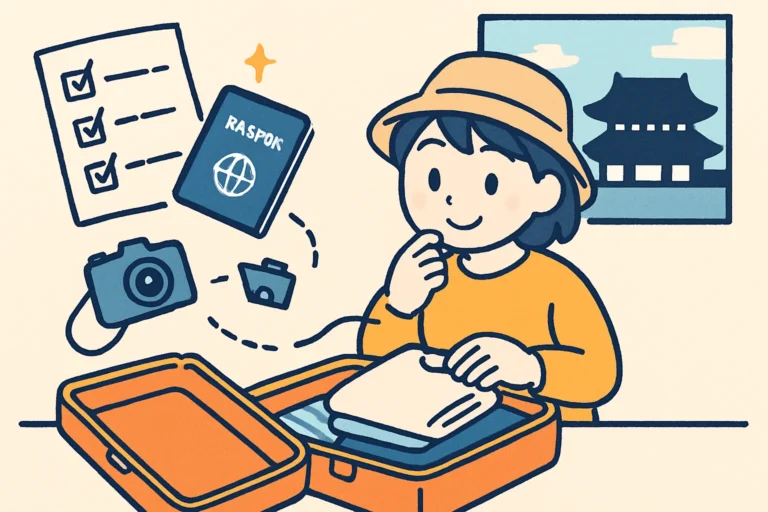
Pack Like a Pro: Your First Korean Travel List!
Hello! Welcome to Maeil Hangeul, the place to upgrade your Korean skills!
Are you dreaming of a trip to Korea? Maybe to Seoul, Busan, or the beautiful Jeju Island? Packing can be exciting, but also a little stressful. Today, we’re going to learn how to write a simple packing list in Korean. This will not only make your travel prep easier but also help you learn essential vocabulary you can use every day!
These days in Korea, “혼행 (honhaeng),” or solo travel, is super popular, especially among young people. Being able to quickly list what you need is a real-life skill. So, let’s get you ready for your adventure!
Core Expressions for Your Packing List
Here are some key words and phrases you absolutely need to know.
1. 짐 (Jim)
- Pronunciation [Romanization]: Jim
- English Meaning: Luggage, baggage, stuff
- Detailed Explanation: 짐 (Jim) is the general word for all the things you pack for a trip. It can mean a single bag or all of your belongings. It’s a simple, essential noun. If you want to say “to pack,” you can say “짐을 싸다 (jimeul ssada).”
-
💡 Pronunciation Tip: The Korean ‘ㅈ (j)’ sound is a bit softer than the English ‘j’ in “jungle.” It’s somewhere between the ‘j’ in “jeep” and the ‘ch’ in “cheese.” Try to make the sound without a strong vibration at the front of your mouth.
2. 챙기다 (Chaenggida)
- Pronunciation [Romanization]: Chaenggida
- English Meaning: To pack, to take care of, to bring along
-
Detailed Explanation: This verb is amazing! 챙기다 (Chaenggida) means more than just “to put something in a bag.” It has the nuance of thoughtfully preparing and making sure you don’t forget something important. When you tell a friend, “여권 챙겨! (Yeogwon chaenggyeo!)”, it means “Don’t forget your passport!” or “Make sure you have your passport!”
-
💡 Pronunciation Tip: The first sound ‘ㅊ (ch)’ is an aspirated consonant. This means you need to release a strong puff of air when you say it, like the ‘ch’ in “chart.” Hold your hand in front of your mouth – you should feel a small burst of air!
3. 목록 (Mongnok)
- Pronunciation [Romanization]: Mongnok
- English Meaning: A list
-
Detailed Explanation: This is the word for any kind of list. A shopping list is “쇼핑 목록 (syoping mongnok),” and a packing list is “짐 싸기 목록 (jim ssagi mongnok).” It’s a very useful word for staying organized.
-
💡 Pronunciation Tip: This word has a fun pronunciation rule called ‘nasalization.’ Even though it’s written as ‘mok-nok,’ the final ‘ㄱ (k)’ sound in ‘목’ changes to an ‘ㅇ (ng)’ sound when it’s followed by ‘ㄴ (n).’ So, you pronounce it as [몽녹, mong-nok]. This makes the pronunciation flow much more smoothly!
4. 잊지 마세요 (Itji maseyo)
- Pronunciation [Romanization]: Itji maseyo
- English Meaning: Don’t forget
-
Detailed Explanation: This is a polite and incredibly useful phrase. You can put it at the end of a sentence to remind someone (or yourself!) not to forget something. The structure is (Noun) + 잊지 마세요. It’s perfect for the bottom of your packing list!
-
💡 Pronunciation Tip: When the syllable ‘잊 (it)’ is followed by ‘지 (ji),’ the sound gets stronger. Instead of a soft ‘it-ji,’ it becomes a tensed, short sound like [읻찌, it-jji]. It sounds almost like a double ‘jj’ sound. This is called ‘tensing’ and happens often in Korean.
Example Dialogue
Let’s see how these words are used in a real conversation! Two friends, A and B, are talking about a trip to Jeju Island.
A: 제주도 여행 짐 싸고 있어요. 목록을 만들었어요.
(Jejudo yeohaeng jim ssago isseoyo. Mongnogeul mandeureosseoyo.)
I’m packing my luggage for the Jeju trip. I made a list.
B: 와, 좋아요! 뭐 챙겨요?
(Wa, joayo! Mwo chaenggyeoyo?)
Wow, that’s great! What are you packing?
A: 옷, 카메라, 그리고 선크림이요.
(Ot, kamera, geurigo seonkeurimiyo.)
Clothes, a camera, and sunscreen.
B: 좋아요! 선글라스도 잊지 마세요!
(Joayo! Seongeullaseudo itji maseyo!)
Sounds good! Don’t forget your sunglasses, too!
Culture Tip & Trend Deep Dive
As we mentioned, solo travel (혼행, honhaeng) and spontaneous trips (즉흥 여행, jeukheung yeohaeng) are huge trends in Korea right now. On social media like Instagram, you’ll see thousands of posts with hashtags like #혼행 and #즉흥여행.
Because of this, Koreans have become experts at packing light and fast. A typical packing list for a weekend trip to the coast might include:
* 보조배터리 (bojobaeteori): A portable battery charger (an absolute must-have!)
* 셀카봉 (selkabong): A selfie stick.
* 여행용 세면도구 (yeohaengyong semyeon dogu): Travel-sized toiletries.
When you use the word “챙기다 (chaenggida),” you sound more like a native speaker. It shows you’re not just packing, but you’re being thoughtful and prepared, which is a key part of Korean travel culture, even for spontaneous trips!
Wrap-up & Practice Time!
Great job today! You’ve learned four essential words and phrases for creating your own Korean packing list:
* 짐 (Jim): Luggage
* 챙기다 (Chaenggida): To pack/prepare
* 목록 (Mongnok): A list
* 잊지 마세요 (Itji maseyo): Don’t forget
Now, let’s test your knowledge!
Quiz: How would you write “Don’t forget your passport” in polite Korean?
(Hint: Passport is 여권, yeogwon)
Fill in the blank:
여권 _______.
Leave your answer in the comments below! You can also try writing a short packing list for your dream trip to Korea using the words we learned today. We’d love to see it
Frequently Asked Questions (FAQ)
Q: What does "짐" mean in Korean and how do you pronounce it?
A: In Korean, "짐" is pronounced [Jim] and means: is the general word for all the things you pack for a trip. It can mean a single bag or all of your belongings. It's a simple, essential noun. If you want to say "to pack," you can say
Q: What does "챙기다" mean in Korean and how do you pronounce it?
A: In Korean, "챙기다" is pronounced [Chaenggida] and means: means more than just "to put something in a bag." It has the nuance of thoughtfully preparing and making sure you don't forget something important. When you tell a friend, "여권 챙겨! (Yeogwon chaenggyeo!)", it means "Don't forget your passport!" or "Make sure you have your passport!"
Q: What does "보조배터리" mean in Korean and how do you pronounce it?
A: In Korean, "보조배터리" is pronounced [bojobaeteori] and means: A portable battery charger (an absolute must-have!)
Q: What does "셀카봉" mean in Korean and how do you pronounce it?
A: In Korean, "셀카봉" is pronounced [selkabong] and means: A selfie stick.







