

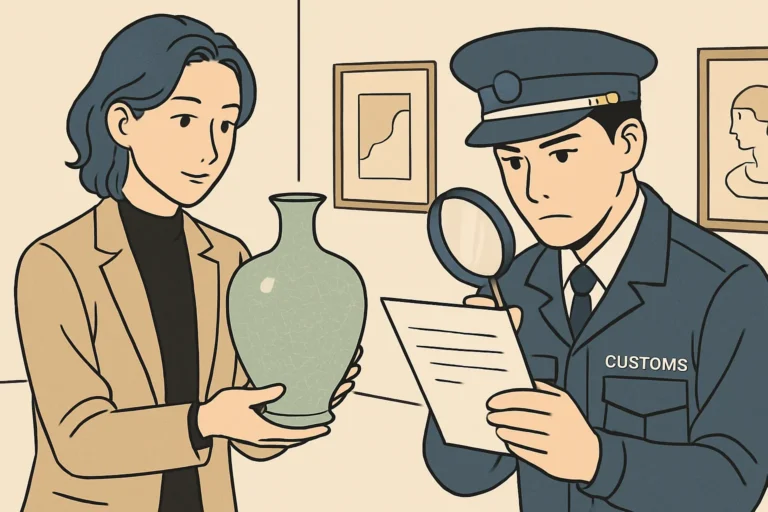
Navigating Korean Art Customs Like a Pro
Hello! It’s [Maeil Hangul], here to upgrade your Korean skills to the next level!
Ever dreamt of bringing a beautiful piece of Korean pottery home, or perhaps you’re a gallery owner preparing for an international art fair? When art crosses borders, so does a lot of complex paperwork and terminology. Today, we’re going to master the professional Korean needed to discuss customs and regulations for importing and exporting art.
Lately, with the Korean art market booming thanks to major events like Frieze Seoul, knowing this vocabulary is more important than ever. Let’s dive in and learn how to talk like a seasoned art world professional!
Core Expressions for Art Professionals
Here are some essential phrases that will make you sound confident and knowledgeable when dealing with art logistics in Korea.
1. 관세가 부과되다 (gwanse-ga bugwa-doeda)
- English Meaning: For a tariff/customs duty to be levied.
- Detailed Explanation: This is a formal and precise passive expression used in official and professional contexts. While you could say
세금을 내다(to pay tax),관세가 부과되다specifically refers to the act of a tariff being officially imposed by customs authorities. It’s the standard term you’ll see on official documents and hear from customs agents. - 💡 Pronunciation Tip:
The되in부과되다is pronounced [dwe]. The vowelㅚis officially pronounced as a monophthong, similar to the ‘ö’ in German. However, most modern speakers pronounce it as a diphthong, like [we]. So, pronouncing부과되다as [bugwa-dweda] will sound perfectly natural.
2. 필요 서류를 구비하다 (piryo seoryu-reul gubi-hada)
- English Meaning: To prepare the necessary documents.
- Detailed Explanation:
구비하다is a more formal and sophisticated verb than the common준비하다(to prepare). It implies preparing and having all the required items or documents ready and complete. Using구비하다in a business or official setting shows a higher level of language proficiency. - 💡 Pronunciation Tip:
When you say the full phrase, a natural liaison (연음) occurs.서류를is not pronouncedseoryu-reulwith a pause, but smoothly as [seoryureul]. Theㄹat the end of서류flows directly into the를particle.
3. 진위 여부를 증명하다 (jinwi yeobu-reul jeungmyeong-hada)
- English Meaning: To prove the authenticity (lit. to prove the truth-or-false status).
- Detailed Explanation: This is a crucial phrase in the art world.
진위(眞僞) means ‘true or false,’ and여부means ‘whether or not.’ Together,진위 여부is a set phrase meaning “authenticity.”증명하다means “to prove.” This expression is used when dealing with certificates of authenticity, appraisal documents, and provenance records. - 💡 Pronunciation Tip:
The word증명has a potential trap. While written asjeung-myeong, the consonantㅇ(ng) beforeㅁ(m) can sometimes be tricky. Focus on making a clear nasal sound for both: [jeung-myeong]. Ensure you don’t accidentally simplify it.
4. 통관 절차를 밟다 (tonggwan jeolcha-reul bapda)
- English Meaning: To go through customs clearance procedures.
- Detailed Explanation: This is a fantastic idiomatic expression.
통관 절차means “customs clearance procedures.” The verb밟다literally means “to step on.” In this context, it idiomatically means to follow a process or go through a series of steps in the correct order. It’s a very common and natural-sounding phrase used by professionals. - 💡 Pronunciation Tip:
This phrase has a key consonant cluster rule. The final consonant in밟isㄼ. In this case, only theㅂis pronounced. So,밟is pronounced [bap]. Furthermore, when밟다is pronounced, theㄷthat follows becomes a tensed sound,ㄸ. So the full pronunciation is [bap-tta]. This is a great rule to master for advanced fluency!
Example Dialogue
Here’s how these expressions might be used in a conversation between a gallery owner (A) and a customs consultant (B).
A: 이번에 프리즈 서울에 출품할 박서보 작가님의 작품을 해외로 보내야 합니다. 어떤 절차를 거쳐야 하나요?
(I need to send a work by artist Park Seo-bo overseas for Frieze Seoul. What procedures do I need to follow?)
B: 먼저, 작품의 진위 여부를 증명할 수 있는 필요 서류를 구비하셔야 합니다. 감정서와 출처 증명서가 필요합니다.
(First, you must prepare the necessary documents that can prove the work’s authenticity. You’ll need an appraisal and a certificate of provenance.)
A: 알겠습니다. 해외로 반출할 때 관세가 부과되나요?
(I see. Will a tariff be levied when exporting it?)
B: 수출 시에는 보통 관세가 없지만, 수입하는 국가의 규정에 따라 달라질 수 있습니다. 서류가 모두 준비되면 정식으로 통관 절차를 밟으시면 됩니다.
(Generally, there’s no tariff for exporting, but it can depend on the regulations of the importing country. Once all the documents are ready, you can formally go through the customs clearance procedures.)
Culture Tip & Trend Deep Dive
The “50-Year Rule” and Cultural Heritage
When you’re dealing with older Korean art, you absolutely must know about Korea’s Cultural Heritage Protection Act (문화재보호법). A key regulation, often called the “50-year rule,” states that movable cultural assets (like paintings, ceramics, and sculptures) created more than 50 years ago cannot be exported without a specific permit from the Cultural Heritage Administration.
So, if you’re handling a piece by a modern master like Park Seo-bo (whose early works are now over 50 years old), you must first verify if it’s designated as a cultural asset. When you use a phrase like “진위 여부를 증명하다,” it’s not just about proving it’s real—it’s also about proving it’s legally exportable. Mentioning this rule in a conversation will instantly show that you have a deep, practical understanding of the Korean art market.
Let’s Practice!
Time to put your new knowledge to the test!
- Fill in the blank:
이 조각품을 한국으로 수입하려면 복잡한 ( ______ ______ )를 밟아야 한다.
(To import this sculpture into Korea, one must go through complex customs clearance procedures.) -
Sentence Building:
Imagine you are a collector buying an antique vase. Using the expression관세가 부과되다, write a question you would ask the seller about potential import duties.
Great job today! You’ve added some seriously impressive, professional-level vocabulary to your Korean toolkit.
Try using one of today’s expressions to write a sentence in the comments below! We’d love to see how you use them.






