

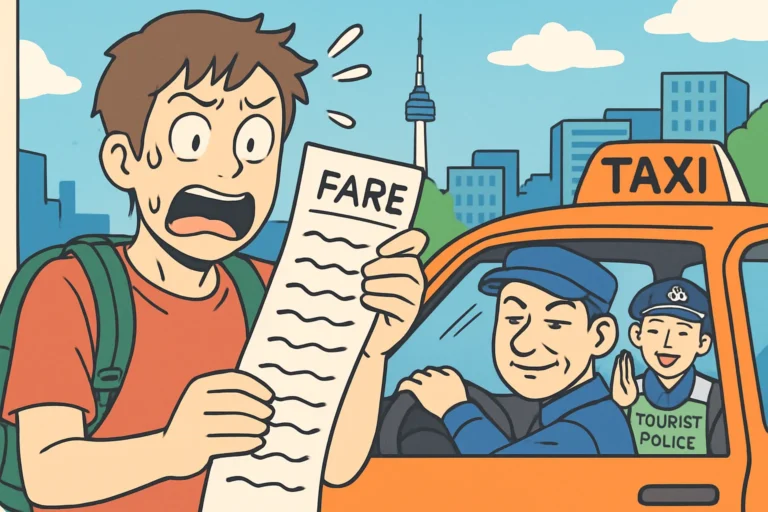
Hello! Welcome back to Daily Hangul, your go-to for upgrading your Korean skills!
Today, we’re tackling a serious but crucial topic: what to do if you find yourself in the unfortunate situation of being scammed while traveling in Korea. While Korea is one of the safest countries in the world, tourist-targeted scams can happen, especially in bustling areas. Recently, there have been discussions online about “foreigner pricing” at certain markets or suspiciously long taxi routes. Knowing how to handle these situations in Korean won’t just save you money; it will empower you to navigate challenges with confidence. Let’s dive in!
Core Expressions for Crisis Mode
Here are some essential phrases you’ll need to articulate your situation and seek help like a pro.
1. 사기를 당하다 (sagireul danghada)
- Pronunciation [Romanization]: [sagireul danghada]
- English Meaning: To be a victim of a scam/fraud.
- Detailed Explanation: This is a powerful and direct phrase used when you believe you’ve been criminally deceived, usually involving a financial loss. ‘사기’ means ‘fraud’ or ‘scam,’ and the grammar pattern ‘-(을/를) 당하다’ creates a passive voice, meaning you are the recipient of the action. This is more serious than simply being overcharged; it implies intentional deception. You would use this for things like fake merchandise sales, phishing scams, or major contractual deceptions.
- 💡 Pronunciation Tip: The particle ‘를’ links smoothly to the verb, so it sounds like one continuous phrase: [sa-gi-reul-dang-ha-da]. The ‘ㄷ’ (d) in ‘당하다’ is a soft, unaspirated sound, similar to the ‘d’ in ‘study’.
2. 바가지를 쓰다 (bagajireul sseuda)
- Pronunciation [Romanization]: [bagajireul sseuda]
- English Meaning: To be ripped off / to be overcharged.
- Detailed Explanation: This is a classic Korean idiom and the most common way to say you’ve been ripped off. Literally, it means “to wear a gourd bowl (바가지).” The origin story suggests that in the past, merchants would make marks inside a gourd bowl to cheat customers on measurements. It’s used specifically for situations where you paid an unfairly high price for a product or service, like a taxi ride or a souvenir. It’s less formal and less severe than ‘사기를 당하다’.
- 💡 Pronunciation Tip: The most important part is the ‘ㅆ’ in ‘쓰다’. It’s a tense consonant, so you should pronounce it with more force than a regular ‘ㅅ’ (s), almost like ‘sseu-da’ with no puff of air.
3. 경찰에 신고하다 (gyeongchare singohada)
- Pronunciation [Romanization]: [gyeongchare singohada]
- English Meaning: To report (something) to the police.
- Detailed Explanation: This is the standard, formal phrase for filing a police report. It’s a direct and necessary expression if you decide to take official action. ‘경찰’ is ‘police,’ ‘-에’ is the location particle ‘to,’ and ‘신고하다’ is the verb ‘to report.’ You can make the sentence more detailed by specifying what you are reporting, for example, “사기 사건을 경찰에 신고했어요” (I reported the fraud incident to the police).
- 💡 Pronunciation Tip: When ‘경찰’ is followed by the particle ‘에’, the ‘ㄹ’ sound at the end of ‘경찰’ links to the vowel, making it sound like [gyeong-cha-re]. It’s a smooth transition, not a hard stop.
4. 증거를 확보하다 (jeunggeoreul hwakbohada)
- Pronunciation [Romanization]: [jeunggeoreul hwakbohada]
- English Meaning: To secure/obtain evidence.
- Detailed Explanation: This is a more advanced, formal (Sino-Korean based) phrase crucial for any official process. ‘증거’ means ‘evidence,’ and ‘확보하다’ is a verb that means ‘to secure’ or ‘to obtain.’ This is what you do before you report an incident. Evidence could be anything from a receipt (영수증), a photograph (사진), or a screenshot of a conversation (대화 캡처). Using this phrase shows a high level of proficiency and seriousness.
- 💡 Pronunciation Tip: In ‘확보’, the first syllable ends with ‘ㄱ’ (k) and the next starts with ‘ㅂ’ (b). Due to a phonetic rule called ‘tensing’ (경음화), the ‘ㅂ’ sound becomes tense, like ‘ㅃ’ (pp). So, the natural pronunciation is closer to [확뽀하다, hwak-ppo-ha-da]. This small change will make you sound much more like a native speaker!
Example Dialogue
Let’s see how these phrases work in a real conversation. Imagine Traveler A just got out of a taxi in Myeongdong.
- A: 와… 방금 택시비가 5만 원이나 나왔어. 이거 아무래도 바가지 쓴 것 같아.
- (Wa… banggeum taeksibiga oman wonina nawasseo. Igeo amuraedo bagaji sseun geot gata.)
- Wow… the taxi fare just came out to 50,000 won. I really think I just got ripped off.
- B: 5만 원? 여기서 명동까지 그 정도 나올 리가 없는데. 이건 명백한 사기야. 어떻게 하지?
- (Oman won? Yeogiseo Myeongdong-kkaji geu jeongdo naol riga eomneunde. Igeon myeongbaekan sagiya. Eotteoke haji?)
- 50,000 won? There’s no way it costs that much from here to Myeongdong. This is a clear scam. What should we do?
- A: 일단 영수증은 받아 뒀고, 급하게 내리면서 택시 번호판 사진도 찍었어. 이 정도면 증거를 확보한 셈이지?
- (Ildan yeongsujeung-eun bada dwotgo, geupage naerimyeonseo taeksi beonhopan sajindo jjigeosseo. I jeongdomyeon jeunggeoreul hwakbohan semiji?)
- Well, I got the receipt, and I also quickly snapped a picture of the license plate as I got out. I guess you could say I’ve secured the evidence, right?
- B: 잘했어! 바로 관광경찰에 신고하자. 그분들이 이런 문제 전문이잖아.
- (Jalhaesseo! Baro gwangwang-gyeongchare singohaja. Geubundeuri ireon munje jeonmunijana.)
- Good job! Let’s report it to the Tourist Police right away. They specialize in these kinds of issues.
Culture Tip & Trend Analysis: Your Secret Weapon, the Tourist Police!
When you face issues like this in Korea, you don’t have to go it alone. The Korean government runs a fantastic service called the Tourist Police (관광경찰).
- Who are they? They are police officers specifically assigned to assist tourists. They wear special uniforms and can offer help in multiple languages (English, Japanese, Chinese, etc.).
- What do they do? They handle tourist complaints, provide information, and mediate minor disputes, including cases of overcharging or fraud.
- How to reach them? You can find them patrolling major tourist areas like Myeongdong, Itaewon, and Hongdae. More importantly, you can call the Korea Travel Hotline at 1330. This 24/7 service can connect you to the Tourist Police and provide interpretation services.
Pro-Tip for the Z-Generation: To avoid taxi scams altogether, most young Koreans exclusively use ride-hailing apps like Kakao T. The app shows the estimated fare upfront and tracks the route, leaving no room for “detours.” Using these apps is the smartest way to travel!
Let’s Wrap It Up & Practice!
Today we learned some vital C1-level expressions for handling scams:
* 사기를 당하다 (to be scammed)
* 바가지를 쓰다 (to be ripped off)
* 경찰에 신고하다 (to report to the police)
* 증거를 확보하다 (to secure evidence)
Now, let’s put your knowledge to the test!
Quick Quiz:
Imagine you bought a “designer” bag at a market, only to realize later it was a fake. You want to report this to the Tourist Police. Fill in the blank with the most appropriate phrase.
“제가 시장에서 가짜 명품 가방을 사는 __________. 증거로 영수증을 가지고 있어요.”
(I __________ by buying a fake designer bag at the market. I have the receipt as evidence.)
A) 바가지를 썼어요 (was ripped off)
B) 사기를 당했어요 (was scammed)
C) 신고를 했어요 (reported)
Think you know the answer? Have you ever had a similar experience while traveling? Share your story or answer in the comments below using the expressions we learned today







