

Unlock Your ‘Miracle Morning’ with This Korean Phrase!
Hello! This is [Maeil Hangeul], here to upgrade your Korean skills!
Have you ever been so tired that all you can think about is your bed? Or maybe you have big plans for the next morning and need to get a good night’s sleep. Today, we’re going to learn the essential Korean phrases for saying, “I’m going to bed early!”
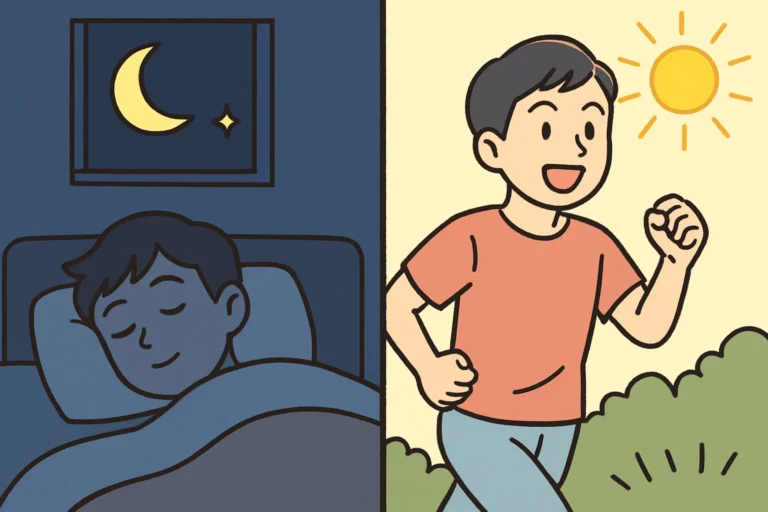
These days in Korea, there’s a huge trend called ‘미라클 모닝’ (Miracle Morning). Young people are waking up at 4 or 5 AM to exercise, study, and start their day productively. And what’s the first step to a successful miracle morning? You guessed it – going to bed early! Let’s learn how to say it like a local.
Core Expressions You Need to Know
Here are three key expressions to help you talk about your plans to sleep early.
1. 일찍 잘 거예요 (I’m going to sleep early)
- Pronunciation [Romanization]: Iljjik jal geoyeyo
- English Meaning: I’m going to sleep early.
- Detailed Explanation: This is the most direct and common way to state your intention to go to bed early. It combines 일찍 (iljjik), meaning “early,” and 잘 거예요 (jal geoyeyo), which is the future tense of the verb 자다 (jada), “to sleep.” The
-(으)ㄹ 거예요ending is a polite and standard way to talk about your future plans. You can use it with friends, family, and in most casual situations. -
💡 Pronunciation Tip:
Notice how 잘 거예요 is pronounced [jal geoyeyo], not [jal geo-ye-yo]. The sounds flow together smoothly. This is called liaison (연음). When a syllable ending in a consonant is followed by a syllable starting with a vowel (ㅇ), the consonant sound moves over to the next syllable. So, the ㄹ (l) sound from 잘 moves to 거예요, making it sound like [jal-geo-ye-yo]. It’s a super common rule that makes your Korean sound much more natural!
2. 피곤해요 (I’m tired)
- Pronunciation [Romanization]: Pigonhaeyo
- English Meaning: I’m tired.
-
Detailed Explanation: This is the perfect reason why you’re going to bed early! 피곤해요 (Pigonhaeyo) is a polite and universal way to say you’re tired. You can use it in almost any situation, from telling your boss you had a long day to telling your friend you can’t watch another movie.
-
💡 Pronunciation Tip:
The first letter, ㅍ (p), is an aspirated sound. This means you should release a strong puff of air when you say it, like the ‘p’ in “park.” It’s stronger than the Korean ㅂ (b/p) sound. Try holding a piece of paper in front of your mouth. When you say 피 (pi), the paper should flutter!
3. 먼저 들어갈게요 (I’ll go in first)
- Pronunciation [Romanization]: Meonjeo deureogalgeyo
- English Meaning: I’ll go in first / I’ll head out first.
-
Detailed Explanation: This is an incredibly useful and polite phrase for when you need to leave a gathering or a room before others. Instead of just saying “goodbye,” this phrase acknowledges that others are staying, and you are excusing yourself first. It’s very considerate and natural. 먼저 (meonjeo) means “first,” and 들어갈게요 (deureogalgeyo) literally means “I will go in.”
-
💡 Pronunciation Tip:
Let’s focus on the vowel 어 (eo) in 먼저 (meonjeo). This sound doesn’t really exist in English! It’s similar to the “o” sound in “song” or “ought,” but with your mouth a little more relaxed and open. It’s not “o” like in “go,” and it’s not “uh” like in “sun.” Practice making this sound – it’s one of the keys to good Korean pronunciation!
Example Dialogue
Let’s see how these phrases work in a real conversation. Imagine Minsu and Sarah are chatting late at night.
A (Minsu): 사라 씨, 우리 영화 한 편 더 볼까요?
(Sarah, should we watch one more movie?)
B (Sarah): 아, 미안해요. 저 너무 피곤해요.
(Oh, I’m sorry. I’m so tired.)
A (Minsu): 정말요? 아직 10시인데요.
(Really? It’s only 10 PM.)
B (Sarah): 네. 내일 ‘미라클 모닝’ 해야 해서 일찍 잘 거예요.
(Yes. I have to do my ‘Miracle Morning’ tomorrow, so I’m going to sleep early.)
A (Minsu): 아하, 그렇군요! 알겠어요. 잘 자요!
(Aha, I see! Okay. Sleep well!)
B (Sarah): 네, 먼저 들어갈게요. 민수 씨도 잘 자요!
(Okay, I’ll go in first. You sleep well too, Minsu!)
Culture Tip: The ‘Miracle Morning’ (미라클 모닝) Craze!
So, what is this 미라클 모닝 trend all about?
It’s a lifestyle focused on self-improvement by waking up very early (think 4 or 5 AM!) before the rest of the world starts its day. During this quiet time, people engage in activities like:
- 운동 (undong): Exercising
- 독서 (dokseo): Reading
- 명상 (myeongsang): Meditating
- 공부 (gongbu): Studying
You’ll see thousands of posts on Korean Instagram and YouTube with the hashtag #미라클모닝, where people share their routines and progress. By saying “일찍 잘 거예요,” you’re not just saying you’re tired; you’re showing that you’re a disciplined person focused on self-growth. It’s a cool way to connect with modern Korean culture!
Let’s Review and Practice!
Great job today! You learned how to say you’re tired and need to go to bed early, all while getting a peek into Korea’s “Miracle Morning” trend.
Now, let’s test your knowledge!
1. Fill in the blank: Your friend asks you to play a game late at night, but you’re sleepy and have plans for tomorrow.
“미안해. 나 너무 _________. 내일 ______ 잘 거예요.”
(Sorry. I’m so tired. I’m going to sleep early tomorrow.)
How would you say this in Korean?
2. Your turn!
What time are you going to sleep today? Use the -(으)ㄹ 거예요 grammar we learned.
Example: 저는 오늘 11시에 잘 거예요! (I’m going to sleep at 11 o’clock today!)
Leave your answers in the comments below! We’d love to see you practice. Until next time, 잘 자요! (Sleep well!)
Frequently Asked Questions (FAQ)
Q: What does "'미라클 모닝'" mean in Korean and how do you pronounce it?
A: In Korean, "'미라클 모닝'" is pronounced [Miracle Morning] and means: . Young people are waking up at 4 or 5 AM to exercise, study, and start their day productively. And what's the first step to a successful miracle morning? You guessed it – going to bed early! Let's learn how to say it like a local.
Q: What does "일찍" mean in Korean and how do you pronounce it?
A: In Korean, "일찍" is pronounced [iljjik] and means: , meaning "early," and
Q: What does "잘 거예요" mean in Korean and how do you pronounce it?
A: In Korean, "잘 거예요" is pronounced [jal geoyeyo] and means: , which is the future tense of the verb
Q: What does "자다" mean in Korean and how do you pronounce it?
A: In Korean, "자다" is pronounced [jada] and means: , "to sleep." The






