

Beyond the Cafe: Mastering Korean for Co-working Spaces
Hello! Welcome back to [Maeil Hangeul], your key to unlocking the next level of Korean fluency!
Are you a digital nomad dreaming of working from Seoul? Or perhaps a remote worker looking for a productive space away from home? Then this post is for you! Today, we’re diving into the essential Korean you’ll need to navigate one of the country’s fastest-growing scenes: co-working spaces.
These days in Korea, the “workation” (워케이션) lifestyle is a huge trend. From the bustling tech hubs of Gangnam to the creative lofts of Seongsu-dong, professionals are swapping traditional offices for flexible, community-oriented workspaces. To get the best deal and find the perfect spot, you’ll need to speak the language of contracts and facilities. Let’s get you ready to sign up for your dream Korean office!
Core Expressions for Your Workspace Hunt
Here are the key phrases that will take you from a curious visitor to a registered member.
1. 이용 약관 (iyong yakgwan)
- Pronunciation [Romanization]: iyong yakgwan
- English Meaning: Terms and Conditions / Terms of Use
- Detailed Explanation: This is a crucial, formal term you’ll encounter when signing up for any service in Korea. It’s a compound of two Sino-Korean words: 이용 (利用), meaning “use,” and 약관 (約款), meaning “clauses” or “provisions.” Before you commit to a membership, you’ll always want to ask to review the
이용 약관to understand rules about cancellations, guest policies, and operating hours. It shows you’re a serious and detail-oriented client. -
💡 Pronunciation Tip:
The final consonant ‘ㄱ’ in ‘약 (yak)’ and the initial ‘ㄱ’ in ‘관 (gwan)’ create a slightly tensed sound, almost like a double ‘k’. Pronounce it as [iyong yak-kwan]. Focus on keeping the syllables distinct and clear, which is characteristic of formal Sino-Korean vocabulary.
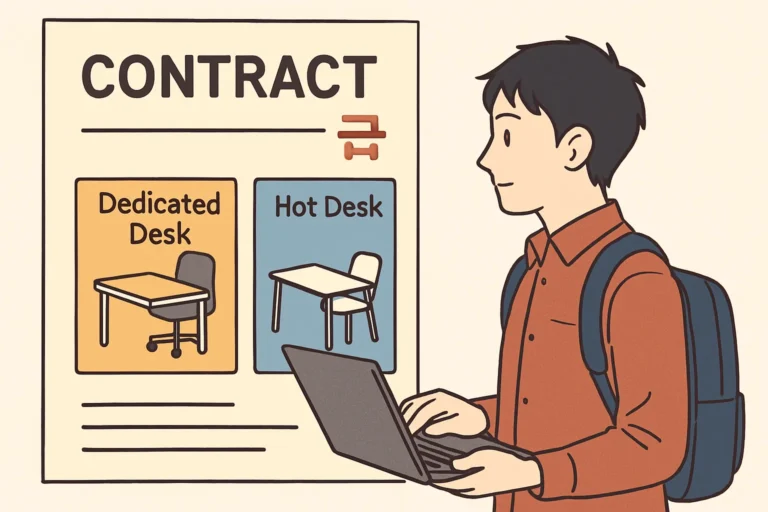
2. 지정석 (jijeongseok) vs. 자유석 (jayuseok)
- Pronunciation [Romanization]: jijeongseok / jayuseok
- English Meaning: Dedicated Desk vs. Hot Desk (Open Seating)
-
Detailed Explanation: This is the most fundamental choice you’ll make.
- 지정석 (指定席):
지정means “designated” and석means “seat.” This is your personal, reserved desk where you can leave your monitor and belongings. It’s ideal for those who need stability and a permanent setup. - 자유석 (自由席):
자유means “freedom.” This is a “hot desk” or “open seating” plan, where you can sit anywhere in a common area. It’s perfect for those seeking flexibility and a lower price point.
- 지정석 (指定席):
- 💡 Pronunciation Tip:
The final consonant ‘ㄱ’ in ‘석 (seok)’ is an unreleased stop. This means you form the ‘k’ sound at the back of your throat but don’t release the puff of air that you would in English. It sounds like you’re cutting the sound off abruptly. Practice saying “jijeong-seok” and “jayu-seok” with that clean, sharp ending.
3. 부대 시설 (budae siseol)
- Pronunciation [Romanization]: budae siseol
- English Meaning: Amenities / Ancillary Facilities
-
Detailed Explanation: This term refers to all the extra facilities that come with your membership. 부대 (附帶) means “accompanying” or “ancillary,” and 시설 (施設) means “facilities.” This is a more professional term than
편의 시설(convenience facilities) and covers everything from meeting rooms (회의실), phone booths (폰부스), printers (프린터), and, of course, the coffee machine (커피 머신). When comparing spaces, the quality of the부대 시설is often the deciding factor. -
💡 Pronunciation Tip:
In the word시설, the initialㅅ(s)is a plain, unaspirated sound. It’s softer than the English ‘s’. Avoid making a strong “sh” sound. It should be a gentle [siseol], not “shisol.”
4. 월 단위로 계약하다 (wol danwiro geyakada)
- Pronunciation [Romanization]: wol danwiro geyakada
- English Meaning: To contract on a monthly basis
-
Detailed Explanation: This is an extremely useful pattern for discussing payment and contract terms.
- 월 (月): Month
- 단위 (單位): Unit
- -로: A particle meaning “by” or “as a”
- 계약하다 (契約하다): To make a contract
This structure(Time) + 단위로is highly versatile. You can swap ‘월’ for ‘일’ (day) for a daily pass (일 단위로) or ‘시간’ (hour) for booking a meeting room (시간 단위로).
- 💡 Pronunciation Tip:
Listen for the sound change (liaison or 연음) in단위로. The final consonant ‘ㄴ’ of단links with the following vowel ‘ㅜ’, making it sound like [다뉘로, danwiro]. This smooth connection between syllables is a key to sounding natural and fluent.
Sample Dialogue: Finding Your Spot
Here’s how a conversation might go at a trendy co-working space in Seongsu-dong.
- A (Digital Nomad): 안녕하세요, 코워킹 스페이스 멤버십에 대해 문의하고 싶은데요. 어떤 옵션이 있나요?
(Annyeonghaseyo, koworking seupeiseu membeosibe daehae munuihago sipeundeyo. Eotteon opsyeoni innayo?)
(Hello, I’d like to inquire about the co-working space membership. What options are there?) -
B (Manager): 네, 환영합니다! 저희는 지정석과 자유석 플랜이 있습니다. 보통 월 단위로 계약하시는데, 장기 계약 시 할인 혜택도 있습니다.
(Ne, hwanyeonghamnida! Jeohuineun jijeongseokgwa jayuseok peullaeni itseumnida. Botong wol danwiro geyakasineunde, janggi geyak si harin hyetaekdo itseumnida.)
(Yes, welcome! We have dedicated desk and hot desk plans. You can contract on a monthly basis, and we also offer discounts for long-term contracts.) -
A (Digital Nomad): 그렇군요. 혹시 계약하기 전에 이용 약관을 먼저 검토해볼 수 있을까요? 그리고 사용 가능한 부대 시설은 어떤 것들이 있는지 궁금합니다.
(Geureokunyo. Hoksi geyakagi jeone iyong yakgwaneul meonjeo geomtohaebol su isseulkkayo? Geurigo sayong ganeunghan budae siseoleun eotteon geotdeuri inneunji gunggeumhamnida.)
(I see. Could I possibly review the terms and conditions before signing? I’m also curious about what amenities are available.) -
B (Manager): 물론입니다. 여기 이용 약관이 있고요, 저희 부대 시설로는 회의실, 폰부스, 그리고 24시간 이용 가능한 라운지가 포함되어 있습니다.
(Mullonimnida. Yeogi iyong yakgwani itgoyo, jeohui budae siseolloneun hoeuisil, ponbuseu, geurigo isipsasigan iyong ganeunghan raunjiga pohamdoeeo itseumnida.)
(Of course. Here are the terms and conditions, and our amenities include meeting rooms, a phone booth, and a 24-hour lounge.)
Culture Tip & Trend Deep Dive
The “Workation” (워케이션) Boom and the Rise of Specialized Spaces
The concept of 워케이션 (a portmanteau of “work” and “vacation”) isn’t just a buzzword in Korea; it’s a government-supported trend. Cities like Jeju and Busan are actively creating programs and infrastructure to attract remote workers, offering stunning views alongside high-speed internet.
When you’re searching, you’ll also notice a distinction between a 코워킹 스페이스 (co-working space) and a 스터디 카페 (study cafe). While they may seem similar, their purposes are different. Co-working spaces are geared towards professionals, startups, and freelancers, often fostering a community with networking events. Study cafes, on the other hand, are primarily for students and individuals seeking absolute silence for intense focus. Knowing the difference will help you find the right environment for your needs!
Wrap-up & Practice Time!
Today, we learned four key expressions to confidently discuss co-working space options in Korean:
- 이용 약관 (Terms and Conditions)
- 지정석 / 자유석 (Dedicated Desk / Hot Desk)
- 부대 시설 (Amenities)
- 월 단위로 계약하다 (To contract monthly)
Now, let’s put your knowledge to the test!
1. Fill in the blanks:
I think a __________ (hot desk) is enough for me, but I need a space with various __________ (amenities) like a private phone booth.
2. Make a sentence:
Using the pattern
~단위로 계약하다, how would you say “I want to sign up for a daily pass”?
Share your answers in the comments below! We’d love to see you put these powerful expressions to use. Happy working
Frequently Asked Questions (FAQ)
Q: What does "이용" mean in Korean and how do you pronounce it?
A: In Korean, "이용" is pronounced [利用] and means: , meaning "use," and
Q: What does "약관" mean in Korean and how do you pronounce it?
A: In Korean, "약관" is pronounced [約款] and means: , meaning "clauses" or "provisions." Before you commit to a membership, you'll always want to ask to review the
Q: What does "부대" mean in Korean and how do you pronounce it?
A: In Korean, "부대" is pronounced [附帶] and means: means "accompanying" or "ancillary," and
Q: What does "시설" mean in Korean and how do you pronounce it?
A: In Korean, "시설" is pronounced [施設] and means: means "facilities." This is a more professional term than







