

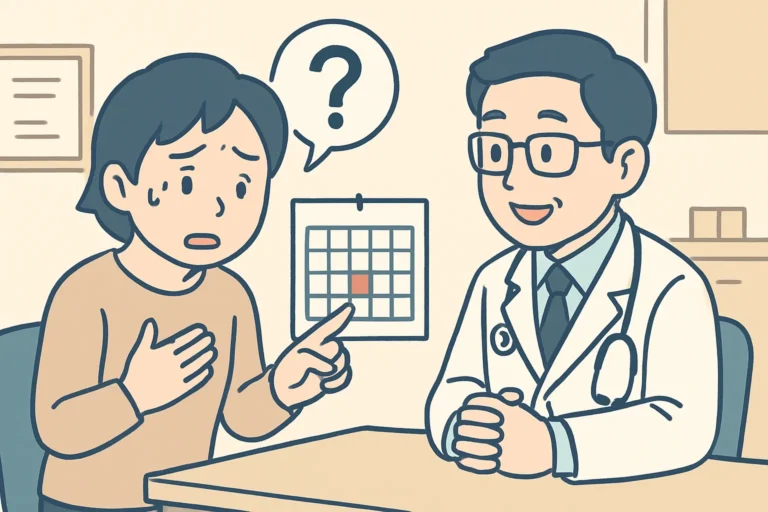
Ouch! How to Explain Your Symptoms at a Korean Hospital
Hello, everyone! Welcome to [Daily Hangul], the place to upgrade your Korean skills! 😊
Have you ever felt sick while in Korea but worried about how to explain it to a doctor? Don’t worry! Today, we’re going to learn some essential phrases to tell a doctor or pharmacist exactly when your symptoms started.
Lately in Korea, with the seasons changing, many people are catching colds. You might hear your Korean friends saying, “요즘 감기 조심해! (Yuseum gamgi josimhae! – Be careful not to catch a cold these days!)”. Knowing how to describe your condition is a real-life superpower here. Let’s get you ready for your next clinic visit!
Key Expressions You Need to Know
Here are three core expressions to help you explain when you started feeling unwell.
1. 언제부터 (Eonjebuteo)
- Korean Expression: 언제부터?
- Pronunciation [Romanization]: Eonjebuteo?
- English Meaning: Since when? / From when?
- Detailed Explanation: This is the most common question a doctor will ask you about your symptoms. It’s a combination of 언제 (eonje), meaning “when,” and the particle -부터 (-buteo), meaning “from” or “since.” It’s a polite and direct way to ask about the starting point of an issue.
2. [Time] + -부터 아팠어요 ([Time] + -buteo apasseoyo)
- Korean Expression: 어제부터 아팠어요.
- Pronunciation [Romanization]: Eojebuteo apasseoyo.
- English Meaning: I’ve been sick/hurting since yesterday.
- Detailed Explanation: This is the perfect answer to “언제부터 아팠어요?”. You simply put a time word before -부터 아팠어요.
- 어제 (eoje): yesterday
- 오늘 아침 (oneul achim): this morning
- 이틀 전 (iteul jeon): two days ago
So, if you started hurting this morning, you would say, “오늘 아침부터 아팠어요 (Oneul achimbuteo apasseoyo).”
- 💡 Pronunciation Tip:
The double consonant ‘ㅆ’ in 아팠어요 (apasseoyo) creates a tense, strong ‘s’ sound. It’s different from the single ‘ㅅ’ (s). Imagine the ‘ss’ sound in “miss” versus the ‘s’ in “sea.” Making this sound stronger will make you sound much more natural!
3. 아프기 시작한 지 [Duration] 됐어요 (Apugi sijakan ji [Duration] dwaesseoyo)
- Korean Expression: 아프기 시작한 지 이틀 됐어요.
- Pronunciation [Romanization]: Apugi sijakan ji iteul dwaesseoyo.
- English Meaning: It has been two days since it started hurting.
- Detailed Explanation: This phrase is a level-up and sounds very fluent! It focuses on the duration of your sickness. The structure is Verb + -ㄴ/은 지 + Duration + 됐어요. It means, “It has been (duration) since I started (verb).”
- 이틀 (iteul): two days
- 일주일 (iljuil): one week
- 삼일 (sam-il): three days
- 💡 Pronunciation Tip:
Listen to how 시작한 지 (sijakan ji) is pronounced. The final consonant ‘ㄴ(n)’ from 한 (han) links smoothly to the ‘ㅈ(j)’ in 지 (ji), so it sounds like [시자칸지 (sijakanji)]. This is called linking, or ‘연음 (yeoneum),’ and it’s a key to sounding like a native speaker!
Example Dialogue at the Clinic
Let’s see these phrases in a real conversation! Imagine B is visiting a doctor (의사).
의사 (Doctor): 안녕하세요. 어디가 불편하세요?
(Annyeonghaseyo. Eodiga bulpyeonhaseyo?)
Hello. What seems to be the problem?B (You): 목이 너무 아파요. 그리고 기침도 해요.
(Mogi neomu apayo. Geurigo gichimdo haeyo.)
My throat hurts a lot. And I’m coughing, too.의사 (Doctor): 언제부터 아팠어요?
(Eonjebuteo apasseoyo?)
Since when has it been hurting?B (You): 이틀 전부터 아팠어요.
(Iteul jeonbuteo apasseoyo.)
It has been hurting since two days ago.의사 (Doctor): 알겠습니다. 제가 한번 볼게요.
(Algesseumnida. Jega hanbeon bolgeyo.)
I understand. Let me take a look.
See? Simple and effective!
Culture Tip & Trend Deep Dive
In Korea, the healthcare system is famous for being incredibly fast and efficient. This is often called the “빨리빨리 (ppalli-ppalli – hurry, hurry)” culture. Because doctors see many patients, being able to explain your symptoms clearly and quickly is very much appreciated.
When you use a phrase like “어제 저녁부터요 (eoje jeonyeokbuteyo – since yesterday evening),” you’re giving the doctor the exact information they need right away. This helps the appointment go smoothly and shows you’ve made an effort to communicate effectively in Korean!
Bonus Tip: After seeing the doctor, you’ll take your prescription to a 약국 (yakguk – pharmacy), which is usually right next to the clinic. The pharmacist will often package your medicine into convenient single-dose packets for morning, noon, and night. It’s a small detail that makes life so much easier when you’re feeling sick!
Let’s Review and Practice!
Great job today! You’ve learned how to tell a doctor when your symptoms started. You now know:
* The question: 언제부터? (Eonjebuteo?)
* The simple answer: [Time] + -부터 아팠어요.
* The advanced answer: 아픈 지 [Duration] 됐어요.
Now, let’s test your knowledge!
1. Fill in the Blank
You started feeling sick this morning. The doctor asks, “언제부터 아팠어요?” How would you answer? (Hint: ‘this morning’ is 오늘 아침)
“오늘 ___________ 아팠어요.”
2. Sentence Building
How would you say, “It has been one week since I started hurting”? (Hint: ‘one week’ is 일주일)
“아프기 시작한 지 ___________.”
You’re doing amazing! Don’t be afraid to use these phrases if you ever need them.
Leave a comment below with your answers or try making your own sentence! We’d love to check it for you. See you next time at [Daily Hangul]! 👍
Frequently Asked Questions (FAQ)
Q: What does "언제" mean in Korean and how do you pronounce it?
A: In Korean, "언제" is pronounced [eonje] and means: , meaning "when," and the particle
Q: What does "-부터" mean in Korean and how do you pronounce it?
A: In Korean, "-부터" is pronounced [-buteo] and means: , meaning "from" or "since." It’s a polite and direct way to ask about the starting point of an issue.
Q: What does "어제" mean in Korean and how do you pronounce it?
A: In Korean, "어제" is pronounced [eoje] and means: yesterday
Q: What does "오늘 아침" mean in Korean and how do you pronounce it?
A: In Korean, "오늘 아침" is pronounced [oneul achim] and means: this morning







