

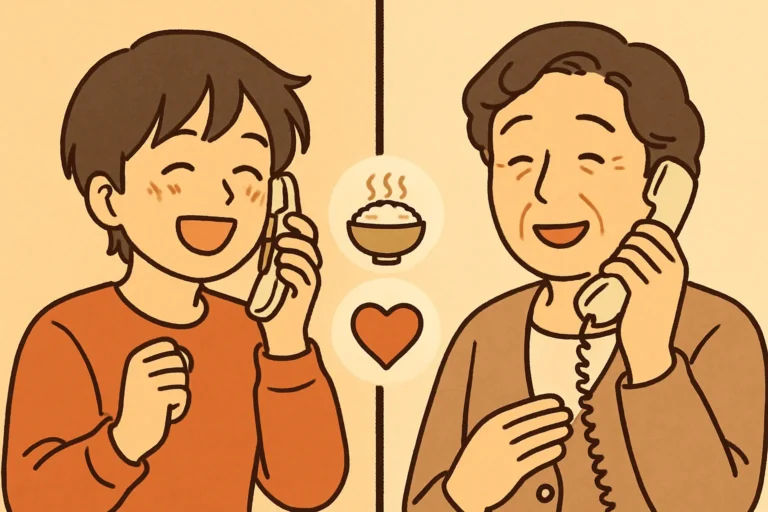
잘 지내세요? How to Call Your Korean Family Like a K-Drama Star!
Hello! This is Daily Korean, here to upgrade your Korean skills!
Have you ever watched a K-drama and wondered how the characters talk to their parents on the phone? They always sound so warm and caring! In Korea, calling your family regularly to check in is a huge part of the culture. You see it all the time in popular dramas—it’s a way to show love and respect.
Today, we’re going to learn some essential phrases for calling your family in Korea. With these expressions, you can show your heart and sound just like a native speaker. Let’s get started!
Core Expressions You Need to Know
Here are four key phrases that will make your next phone call a success!
1. 잘 지내세요? (How are you doing?)
- Pronunciation [Romanization]: Jal jinaeseyo?
- English Meaning: Are you doing well? / How are you?
- Detailed Explanation: This is the standard, polite way to ask someone how they are, especially an elder like a parent or grandparent. The
-세요 (-seyo)ending adds a level of respect. You can use this to start any conversation with someone you respect. - 💡 Pronunciation Tip: The syllable
지 (ji)can be tricky. It’s not a hard “j” like in “jump,” but a softer sound, almost between “j” and “ch.” Try to make the sound at the front of your mouth for a more natural Korean accent!
2. 저는 잘 지내요. (I’m doing well.)
- Pronunciation [Romanization]: Jeo-neun jal jinaeyo.
- English Meaning: I’m doing well.
- Detailed Explanation: This is the perfect polite response to “잘 지내세요?”. It assures the other person that you are okay.
저 (jeo)is the humble way to say “I,” which is why it’s perfect for speaking with elders. - 💡 Pronunciation Tip: Let’s look at 저는 [jeo-neun]. In Korean, when a syllable ends in a consonant (like
저which doesn’t, but let’s take an example like밥은 [ba-beun]), and the next syllable starts with a vowel, the consonant sound often “links” or moves over. This is called liaison (연음, yeon-eum). For example,밥은is not pronouncedbap / eunbut smoothly as [ba-beun]. It makes the language flow beautifully!
3. 밥은 먹었어요? (Have you eaten?)
- Pronunciation [Romanization]: Babeun meogeosseoyo?
- English Meaning: Have you eaten a meal?
- Detailed Explanation: This is one of the most important phrases in Korean culture! It’s more than just a question about food. It’s a way of saying, “I care about you,” “Are you taking care of yourself?” and “How are you?” all in one. If a Korean person asks you this, know that they care for you deeply.
- 💡 Pronunciation Tip: The pronunciation of 먹었어요 is not
meok-eoss-eo-yobut [meo-geo-sseo-yo]. Theㄱ(g)from먹links to the next syllable, and theㅆ(ss)from었also links over, creating a strong, tense ‘ss’ sound. It’s another great example of liaison making the words connect smoothly.
4. 건강 조심하세요. (Take care of your health.)
- Pronunciation [Romanization]: Geongang josimhaseyo.
- English Meaning: Please be careful of your health. / Please take care.
- Detailed Explanation: This is a very warm and respectful way to end a conversation, especially with parents or grandparents. It shows your deep concern for their well-being. It’s like saying “Stay healthy!”
- 💡 Pronunciation Tip: The final consonant
ㅇ (ng)in 건강 [geon-gang] is important. It’s the same sound as the “ng” in the English word “sing.” Make sure you don’t pronounce it like an “n” or “g” alone. It’s a soft sound made in the back of your throat.
Example Dialogue
Let’s see how these phrases work in a real conversation! Here’s a chat between Min-jun, who is studying in Seoul, and his mom.
- Min-jun (A): 여보세요? 엄마, 저예요.
(Yeoboseyo? Eomma, jeoyeyo.)
Hello? Mom, it’s me. - Mom (B): 어, 우리 아들! 잘 지내니? 밥은 먹었고?
(Eo, uri adeul! Jal jinaeni? Babeun meogeotgo?)
Oh, my son! How are you doing? Have you eaten? - Min-jun (A): 네, 저는 잘 지내요. 방금 저녁 먹었어요. 엄마는요?
(Ne, jeoneun jal jinaeyo. Banggeum jeonyeok meogeosseoyo. Eommaneunyo?)
Yes, I’m doing well. I just ate dinner. What about you? - Mom (B): 그럼, 엄마도 잘 있지. 요즘 드라마는 재미있는 거 하니?
(Geureom, eommado jal itji. Yojeum deuramaneun jaemiinneun geo hani?)
Of course, I’m doing well too. Are there any fun dramas on these days? - Min-jun (A): 네! 이제 곧 가야 해요. 또 전화할게요. 건강 조심하세요!
(Ne! Ije got gaya haeyo. Tto jeonhwahalkkeyo. Geongang josimhaseyo!)
Yes! I have to go soon. I’ll call you again. Please take care of your health! - Mom (B): 그래, 너도 조심해!
(Geurae, neodo josimhae!)
Okay, you too!
Culture Tip: The Real Meaning of “밥은 먹었어요?”
As we mentioned, asking “Have you eaten?” is a cornerstone of Korean culture. In the past, when Korea faced difficult times and food was scarce, asking if someone had eaten was a genuine question of survival and well-being.
Today, that spirit of care remains. While Korea is now a modern and prosperous country, this phrase has evolved into the ultimate expression of affection. You’ll hear it constantly between family members, friends, and even coworkers. So, the next time you hear this in a K-drama, you’ll know it’s not just about food—it’s about love!
Time to Practice!
You did an amazing job today! Let’s review with a quick quiz.
- Fill in the blank: You want to end a phone call with your Korean friend’s father. To be polite and caring, you should say: “____________________.”
(Answer: 건강 조심하세요.) -
Your turn! Imagine you are calling a Korean family member. How would you answer if they asked you, “잘 지내세요?”
(Answer: 저는 잘 지내요.)
Awesome work! Keep practicing, and you’ll be having heartwarming conversations in no time.
Why not try out what you learned? Leave a comment below using one of today’s phrases!
Frequently Asked Questions (FAQ)
Q: What does "저는" mean in Korean and how do you pronounce it?
A: In Korean, "저는" is pronounced [jeo-neun] and means: . In Korean, when a syllable ends in a consonant (like
Q: What does "건강" mean in Korean and how do you pronounce it?
A: In Korean, "건강" is pronounced [geon-gang] and means: is important. It's the same sound as the "ng" in the English word "si







