

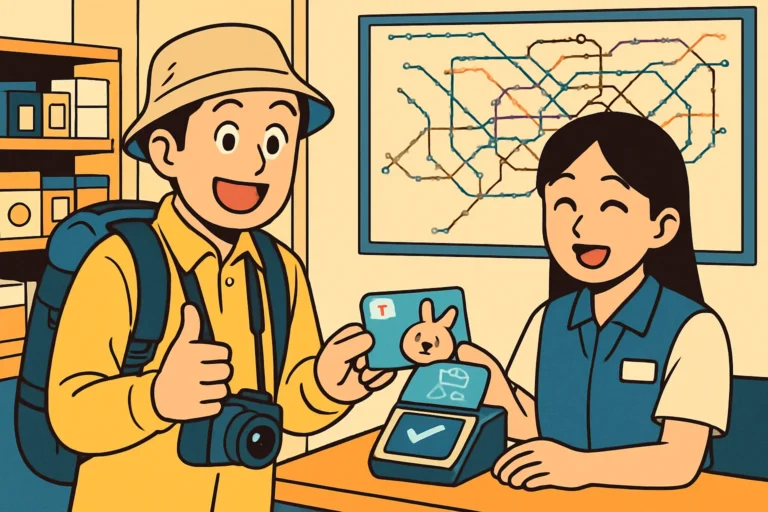
T-money No More Tears! Recharge Your Card Like a Local
Hello! Welcome to [Maeil Hangul], here to upgrade your Korean skills!
Have you ever watched a K-drama or a K-pop idol’s vlog and wondered how they effortlessly zip through the subway gates with a simple tap of a card? Getting around in Korea is super convenient, but first, you need to master one essential skill: charging your transportation card! Today, we’re going to learn how to do just that, so you can explore Korea with confidence. 요즘 한국에서는 (yoz-eum hanguk-eseoneun), having a charged T-money or Cashbee card is the key to everything from bus rides to buying snacks at the convenience store. Let’s get you ready for your adventure!
Core Expressions You Need to Know
Here are the key phrases that will turn you into a transportation card pro!
1. 충전 (Chungjeon)
- Pronunciation [Romanization]: Chungjeon
- English Meaning: Recharge / Charge
- Detailed Explanation: This is the magic word! 충전 (chungjeon) means “to charge” or “recharge.” You can use it for your phone battery, and most importantly, for your transportation card. It’s a noun, so you’ll usually pair it with the verb 하다 (hada), which means “to do.” So, 충전하다 (chungjeon-hada) means “to charge.”
- 💡 Pronunciation Tip: The first syllable ‘충’ (chung) is similar to the ‘choong’ sound in “choo-choo train,” but with a shorter vowel. The second syllable ‘전’ (jeon) sounds like the name ‘John’ but with a softer ‘j’ sound.
2. 얼마 충전해 드릴까요? (Eolma chungjeon-hae deurilkkayo?)
- Pronunciation [Romanization]: Eolma chungjeon-hae deurilkkayo?
- English Meaning: How much would you like to charge?
- Detailed Explanation: This is the question you will hear from a convenience store clerk or see on the screen of a ticket machine. Let’s break it down:
- 얼마 (eolma): How much
- 충전해 드릴까요? (chungjeon-hae deurilkkayo?): Shall I charge for you? (This is a very polite way to ask.)
- 💡 Pronunciation Tip: Notice how 충전해 (chungjeon-hae) flows together. The final ‘ㄴ’ (n) sound of ‘충전’ links smoothly to the ‘해’ (hae). Also, the ‘ㄹ’ (r/l) sound in 드릴까요 (deurilkkayo) is a soft ‘l’ sound, almost like a flap of the tongue.
3. 만 원 충전해 주세요. (Man won chungjeon-hae juseyo.)
- Pronunciation [Romanization]: Man won chungjeon-hae juseyo.
- English Meaning: Please charge 10,000 won.
- Detailed Explanation: This is your perfect answer! You simply state the amount of money followed by 충전해 주세요 (chungjeon-hae juseyo), which means “Please charge… for me.”
- 만 원 (man won): 10,000 won (만 = 10,000, 원 = won, the Korean currency)
- 주세요 (juseyo): Please give / Please do for me
- You can easily change the amount! For example:
- 오천 원 (ocheon won): 5,000 won
- 이만 원 (iman won): 20,000 won
- 💡 Pronunciation Tip: The word 같이 (gat-i) is pronounced [gachi]. This is because the final consonant ‘ㅌ’ (t) meets the vowel ‘ㅣ’ (i) and changes to a ‘ㅊ’ (ch) sound. This rule is called palatalization (구개음화). It makes the pronunciation softer and more natural! It’s the same reason why 굳이 (gud-i) is pronounced as [guji]. So, when you say ‘같이’, think ‘ga-chi,’ not ‘gat-i’!
Example Dialogue
Let’s see how these phrases work in a real conversation at a convenience store!
- A (You): (Handing your card to the clerk) 이 카드 충전해 주세요.
- (I kadeu chungjeon-hae juseyo.)
- Please charge this card.
- B (Clerk): 네, 얼마 충전해 드릴까요?
- (Ne, eolma chungjeon-hae deurilkkayo?)
- Yes, how much would you like to charge?
- A (You): 만 원 충전해 주세요.
- (Man won chungjeon-hae juseyo.)
- Please charge 10,000 won.
- B (Clerk): 네, 만 원입니다. 카드 여기에 올려주세요.
- (Ne, man won-imnida. Kadeu yeogi-e ollyeojuseyo.)
- Okay, that’s 10,000 won. Please place your card here.
See? You’re already having a conversation!
Culture Tip & Trend Deep Dive
In Korea, your transportation card is more than just a travel pass; it’s a lifestyle tool. This is deeply connected to Korea’s famous ‘빨리 빨리’ (ppalli-ppalli), or “hurry, hurry” culture. Efficiency is key!
- One Card to Rule Them All: You’ll see characters in the latest K-dramas like “Queen of Tears” pay for a taxi, buy a banana milk at a convenience store, and even use a vending machine all with a single tap of their card or phone. This is everyday life in Korea!
- Make it Fashion: Forget boring plain cards! Nowadays, you can get T-money cards featuring your favorite K-pop idols like BTS or BLACKPINK, or cute characters like Kakao Friends. These are popular souvenirs and a fun way to show your personality. When you use a cool card, you’ll definitely feel like a local!
Wrap-up & Practice Time!
Great job today! You’ve learned the essential phrases for recharging your transportation card in Korea. You now know how to say 충전 (chungjeon), understand 얼마 충전해 드릴까요? (eolma chungjeon-hae deurilkkayo?), and confidently ask “만 원 충전해 주세요” (man won chungjeon-hae juseyo).
Now, let’s test your knowledge!
- Fill in the blank: You want to charge 5,000 won. What do you say?
______ 원 충전해 주세요.
(Hint: 5,000 = 오천) - Challenge: How would you say “I charged my card” in a simple past tense?
(Hint: Use the past tense of 하다, which is 했어요 (haesseoyo).)
You’re all set to navigate Korea like a pro!
Why not try leaving a comment below using the phrases we learned? For example: “저는 오천 원 충전했어요!” (I charged 5,000 won!). Keep up the great work
Frequently Asked Questions (FAQ)
Q: What does "충전" mean in Korean and how do you pronounce it?
A: In Korean, "충전" is pronounced [chungjeon] and means: means "to charge" or "recharge." You can use it for your phone battery, and most importantly, for your transportation card. It's a noun, so you'll usually pair it with the verb
Q: What does "하다" mean in Korean and how do you pronounce it?
A: In Korean, "하다" is pronounced [hada] and means: , which means "to do." So,
Q: What does "충전하다" mean in Korean and how do you pronounce it?
A: In Korean, "충전하다" is pronounced [chungjeon-hada] and means: means "to charge."
Q: What does "얼마" mean in Korean and how do you pronounce it?
A: In Korean, "얼마" is pronounced [eolma] and means: How much







