

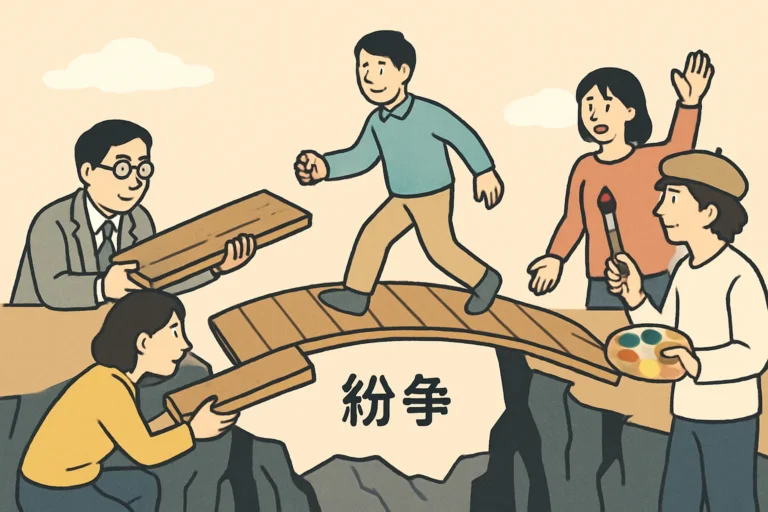
The Unseen Architects of Peace: Korean for Multi-track Diplomacy
Hello! Welcome back to [Maeil Hangeul], the place to upgrade your Korean proficiency to the highest level!
Are you ready to move beyond everyday conversation and dive into the sophisticated language of international relations and peace studies? Today, we’re exploring a fascinating and highly relevant topic: Multi-track Diplomacy (다중 트랙 외교). This is the language you’ll hear in university lectures, news debates, and academic papers in Korea. Recently in Korean policy circles, as global conflicts become more complex, there’s a growing emphasis on the role of non-governmental actors in building sustainable peace. Mastering these terms will allow you to understand and participate in these critical discussions.
Let’s get started!
Core Expressions for Peacemakers
Here are the essential terms you need to know to discuss conflict transformation like an expert.
1. 다중 트랙 외교 (Dajung teuraek oegyo)
- Pronunciation [Romanized]: [Dajung teuraek oegyo]
- English Meaning: Multi-track Diplomacy
- Detailed Explanation: This is a core concept in modern peace studies. While ‘1트랙 외교’ (Track 1 Diplomacy) refers to official negotiations between governments, ‘다중 트랙 외교’ is a holistic approach involving various sectors of society. ‘다중(多重)’ means ‘multiple’ or ‘manifold,’ and ‘트랙’ is the Korean transliteration of the English word ‘track.’ This framework recognizes that sustainable peace requires more than just political agreements; it needs engagement from citizens, academics, NGOs, and more.
- 💡 Pronunciation Tip: The syllable ‘외’ [oe] in ‘외교’ can be tricky. It’s a diphthong, a quick glide from an ‘o’ sound to an ‘e’ sound. Think of the “we” in “wet.” Practice saying it smoothly: [oe-gyo].
2. 비국가 행위자 (Bigukga haengwija)
- Pronunciation [Romanized]: [Bigukga haengwija]
- English Meaning: Non-state Actors
- Detailed Explanation: These are the key players in multi-track diplomacy. The term is a combination of Sino-Korean characters: ‘비(非)’ meaning ‘non-‘, ‘국가(國家)’ meaning ‘state’ or ‘nation,’ and ‘행위자(行爲者)’ meaning ‘actor’ or ‘agent.’ It refers to any influential individual or group operating outside of government control, such as NGOs (비정부기구), multinational corporations (다국적 기업), academic institutions, and citizen movements.
- 💡 Pronunciation Tip: In compound words like this, it’s crucial to enunciate each syllable clearly to maintain formality and precision. Avoid slurring the sounds together. Pronounce it as three distinct parts: [Bi-guk-ga] [Haeng-wi-ja]. This clarity is a hallmark of advanced, formal speech.
3. 갈등 전환 (Galdeung jeonhwan)
- Pronunciation [Romanized]: [Galdeung jeonhwan]
- English Meaning: Conflict Transformation
- Detailed Explanation: This is a nuanced term that advanced learners should appreciate. It’s different from ‘갈등 해결’ (conflict resolution) or ‘갈등 관리’ (conflict management). The word ‘전환(轉換)’ implies a fundamental change or transformation. This concept focuses not just on ending violence, but on transforming the underlying structures, relationships, and root causes of the conflict to build long-term, sustainable peace.
- 💡 Pronunciation Tip: Notice the aspiration in ‘환’ [hwan]. The ‘ㅎ’ (h) sound should be a distinct puff of air. A common mistake is to under-pronounce it, making it sound like ‘완’ [wan]. Emphasizing this aspiration will make your pronunciation sound much more precise and native-like.
4. 상호 신뢰 구축 (Sangho silloe guchuk)
- Pronunciation [Romanized]: [Sangho shilloe guchuk]
- English Meaning: Building Mutual Trust
- Detailed Explanation: This phrase is the cornerstone of any peace process. It’s a formal, academic expression composed of ‘상호(相互)’ (mutual), ‘신뢰(信賴)’ (trust/faith), and ‘구축(構築)’ (construction/building). In the context of multi-track diplomacy, non-state actors often play a vital role in fostering dialogue and creating human connections that slowly build trust between conflicting parties, paving the way for official negotiations.
- 💡 Pronunciation Tip: This phrase contains a critical pronunciation rule called liquidization (유음화). The word ‘신뢰’ is written as ‘sin-roe’, but the final consonant ‘ㄴ(n)’ of ‘신’ meets the initial ‘ㄹ(r/l)’ of ‘뢰’. When this happens, the ‘ㄴ(n)’ assimilates and also becomes an ‘ㄹ(l)’ sound. Therefore, the correct pronunciation is [실뢰/shilloe], not [sin-roe]. Mastering this will significantly elevate your fluency!
Example Dialogue
Here’s how these terms might be used in a conversation between two university students discussing an international affairs seminar.
- A: 오늘 세미나에서 다룬 다중 트랙 외교 개념이 정말 흥미로웠어. 정부 간의 공식 채널만으로는 복잡한 분쟁을 다룰 수 없다는 점이 명확해졌어.
(The concept of multi-track diplomacy we covered in the seminar today was fascinating. It became clear that official government channels alone can’t handle complex disputes.) - B: 맞아. 특히 비국가 행위자의 역할이 인상 깊었지. 그들이야말로 장기적인 갈등 전환을 위해 풀뿌리 수준에서 상호 신뢰 구축을 이끌어내는 핵심 주체인 것 같아.
(I agree. The role of non-state actors was particularly impressive. They seem to be the key agents leading the building of mutual trust at the grassroots level for long-term conflict transformation.) - A: 동감이야. 결국 평화는 정치적 합의를 넘어, 인간적인 연결과 이해에서 시작되는 거니까.
(I feel the same way. Ultimately, peace begins not just with political agreements, but with human connection and understanding.)
Cultural Tip & Trend Deep Dive
In the context of the Korean Peninsula, these concepts are not just academic theories; they are lived realities. For decades, South Korean non-state actors (비국가 행위자), including religious groups and NGOs like ‘우리민족서로돕기운동’ (The Movement for Sharing One Korea), have been at the forefront of providing humanitarian aid to North Korea and facilitating cultural and academic exchanges.
When you read high-level Korean newspapers like 한겨레 (The Hankyoreh) or listen to policy debates on channels like JTBC, you’ll hear analysts use the term ‘갈등 전환’ very deliberately. They use it to argue for a more profound approach to inter-Korean relations—one that moves beyond temporary political deals and aims to transform the fundamental structure of the conflict. Using this term correctly in a discussion shows you have a deep, nuanced understanding of the peace discourse in Korea.
Let’s Review and Practice!
Great job today! We’ve delved into some highly sophisticated Korean vocabulary related to peace and diplomacy. You learned about 다중 트랙 외교 (multi-track diplomacy), the importance of 비국가 행위자 (non-state actors), the profound goal of 갈등 전환 (conflict transformation), and the foundational process of 상호 신뢰 구축 (building mutual trust).
Now, let’s put your knowledge to the test!
- Fill in the Blank:
정부의 공식적인 외교 외에도, 학자나 시민 단체가 평화 프로세스에 참여하는 것을 _________ _________ _________라고 부릅니다.
(Besides official government diplomacy, the participation of scholars or civic groups in the peace process is called _________ _________ _________.) -
Short Answer Challenge:
In your opinion, why is ‘상호 신뢰 구축’ essential for ‘갈등 전환’? Try to answer in one or two Korean sentences.
Share your answers and thoughts in the comments below using the powerful new terms you’ve learned today! We’d love to hear your perspective.
Frequently Asked Questions (FAQ)
Q: What does "'외'" mean in Korean and how do you pronounce it?
A: In Korean, "'외'" is pronounced [oe] and means: in '외교' can be tricky. It’s a diphthong, a quick glide from an 'o' sound to an 'e' sound. Think of the "we" in "wet." Practice saying it smoothly: [oe-gyo].
Q: What does "'환'" mean in Korean and how do you pronounce it?
A: In Korean, "'환'" is pronounced [hwan] and means: . The 'ㅎ' (h) sound should be a distinct puff of air. A common mistake is to under-pronounce it, making it sound like '완' [wan]. Emphasizing this aspiration will make your pronunciation sound much more precise and native-like.
Q: What does "다중 트랙 외교" mean in Korean and how do you pronounce it?
A: In Korean, "다중 트랙 외교" is pronounced [multi-track diplomacy] and means: , the importance of
Q: What does "비국가 행위자" mean in Korean and how do you pronounce it?
A: In Korean, "비국가 행위자" is pronounced [non-state actors] and means: , the profound goal of







