

Is Your Smartphone a New Family Member? Talking Tech in Korea
Hello! Welcome to Daily Hangul, the place to upgrade your Korean skills!
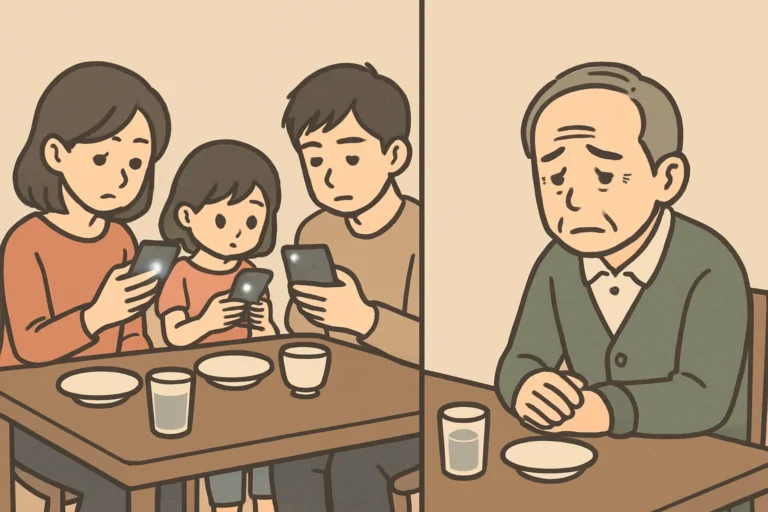
Have you ever been at a family dinner where everyone is physically together, but mentally miles away, scrolling through their phones? You’re not alone! Lately in Korea, as technology becomes more integrated into our lives, the way families connect—or disconnect—is a hot topic. Today, we’ll learn essential Korean phrases to talk about how technology is changing family relationships. You’ll be able to share your thoughts on this modern phenomenon just like a native speaker!
Core Expressions You Need to Know
Here are some key phrases to help you discuss this topic.
1. 각자 알아서 하다 (Gakja araseo hada)
- English Meaning: To do one’s own thing; to handle things individually.
- Detailed Explanation: This phrase literally means “each person figures it out and does it.” While it can mean being independent and responsible, in a family context, it often implies a lack of shared activity or togetherness. It perfectly describes a scene where family members are in the same room but are all engaged in separate activities on their own devices.
- 💡 Pronunciation Tip:
- In 알아서 [araseo], the ‘ㅅ’ (s) sound from the bottom of ‘알’ doesn’t get pronounced. Instead, the ‘ㄹ’ (r/l) sound from ‘알’ links to the next syllable, ‘아’, making it sound like [아라서]. It’s a key liaison (연음) rule that makes your Korean sound much smoother!
2. 소통이 단절되다 (Sotong-i danjeol-doeda)
- English Meaning: For communication to be cut off or severed.
- Detailed Explanation: This is a slightly more formal and serious expression. 소통 (sotong) means ‘communication’, and 단절되다 (danjeol-doeda) means ‘to be severed’ or ‘cut off’. It’s often used in news articles or serious conversations about the negative social impacts of technology, like the growing communication gap within families.
- 💡 Pronunciation Tip:
- The word 되다 is often romanized as ‘doeda’, but its pronunciation is closer to a single syllable: [dwe-da]. Try to blend the ‘ㅗ’ (o) and ‘ㅣ’ (i) vowels into a ‘we’ sound. It’s the same sound you hear in 돼지 (dwaeji – pig).
3. 스마트폰에 빠져 살다 (Seumateupon-e ppajyeo salda)
- English Meaning: To live absorbed in one’s smartphone.
- Detailed Explanation: This is a very common and vivid expression. 빠지다 (ppajida) means “to fall into” or “to be submerged in,” so the phrase literally means “to live fallen into a smartphone.” It’s the perfect way to describe someone who is constantly on their phone, seemingly addicted to it.
- 💡 Pronunciation Tip:
- Notice the pronunciation of 빠져 is [ppajyeo]. The ‘ㅈ’ (j) sound followed by the ‘ㅕ’ (yeo) vowel creates a natural “jyeo” sound. Don’t try to pronounce it as “pa-jeu-eo”; blend it into one smooth syllable!
4. 디지털 격차 (Dijiteol gyeokcha)
- English Meaning: The digital divide/gap.
- Detailed Explanation: 격차 (gyeokcha) means ‘gap’ or ‘disparity’. This term is frequently used to talk about the technology gap between different generations. For example, grandchildren might communicate through the latest social media apps, while their grandparents may not even use a smartphone. This 디지털 격차 can be a major source of misunderstanding and disconnection in families.
- 💡 Pronunciation Tip:
- The last syllable 차 is pronounced with a strong puff of air. It’s an aspirated sound, written as ‘cha’. Make sure to distinguish it from ‘자’ (ja) and ‘짜’ (jja). Think of the ‘ch’ in “charge!”
Example Dialogue
Let’s see how these phrases work in a real conversation!
A: 설 연휴에 가족들하고 잘 보냈어? (Seol yeonhyu-e gajokdeul-hago jal bonaesseo?)
Did you have a good time with your family during the Lunar New Year holiday?
B: 응, 오랜만에 다 모여서 좋았는데… 다들 스마트폰에 빠져 사니까 좀 서운하더라. (Eung, oraenman-e da moyeoso joanneunde… dadeul seumateupon-e ppajyeo sanikka jom seoun-hadeonra.)
Yeah, it was nice to all get together for the first time in a while… but I was a bit sad because everyone was so absorbed in their smartphones.
A: 맞아. 우리 집도 그래. 거실에 같이 있어도 각자 알아서 하니까 대화가 없어. (Maja. Uri jipdo geurae. Geosil-e gachi isseodo gakja araseo hanikka daehwa-ga eopseo.)
I know. My family is the same. Even when we’re in the living room together, there’s no conversation because everyone just does their own thing.
B: 이러다가 정말 소통이 단절될 것 같아. 특히 할머니랑은 디지털 격차 때문에 더 대화하기 어려운 것 같아. (Ireodaga jeongmal sotong-i danjeol-doel geot gata. Teuki halmeoni-rang-eun dijiteol gyeokcha ttaemun-e deo daehwa-hagi eoryeoun geot gata.)
I’m worried communication will be completely cut off at this rate. It feels especially hard to talk with my grandma because of the digital divide.
Culture Tip & Trend Analysis
In Korea, the concept of 밥상머리 교육 (bapsang-meori gyoyuk), or “table manners education,” is very important. Traditionally, the family dinner table was not just for eating, but for conversation, sharing, and teaching values.
This is why a scene of a family silently staring at their phones during a meal is so powerful and often used in K-dramas. It symbolizes a break from this cherished tradition. When you use a phrase like 소통이 단절되다, you’re tapping into this deeper cultural concern. You’re not just saying “we don’t talk”; you’re hinting at the loss of a valuable family connection. So, when you use this phrase, you’ll sound not just fluent, but culturally aware, too!
Let’s Practice!
Ready to test your knowledge?
- Fill in the blank:
My parents don’t know how to use the new smart TV, so I feel a big ______________ ______________ with them.
(부모님은 새 스마트 TV 사용법을 모르셔서 부모님과 큰 ______________ ______________를 느껴요.) -
Make a sentence:
Try making your own sentence using ~에 빠져 살다. For example, what is something your friend or family member is “absorbed” in? (e.g., 게임에 빠져 살다 – to be absorbed in games).
Great job today! Technology is a part of our lives, but so is family. Now you have the tools to talk about it in Korean!
Leave a comment below with your answers to the practice questions or share your own experiences!
Frequently Asked Questions (FAQ)
Q: What does "알아서" mean in Korean and how do you pronounce it?
A: In Korean, "알아서" is pronounced [araseo] and means: , the 'ㅅ' (s) sound from the bottom of '알' doesn't get pronounced. Instead, the 'ㄹ' (r/l) sound from '알' links to the next syllable, '아', making it sound like
Q: What does "소통" mean in Korean and how do you pronounce it?
A: In Korean, "소통" is pronounced [sotong] and means: means 'communication', and
Q: What does "단절되다" mean in Korean and how do you pronounce it?
A: In Korean, "단절되다" is pronounced [danjeol-doeda] and means: means 'to be severed' or 'cut off'. It’s often used in news articles or serious conversations about the negative social impacts of technology, like the growing communication gap within families.
Q: What does "빠지다" mean in Korean and how do you pronounce it?
A: In Korean, "빠지다" is pronounced [ppajida] and means: means "to fall into" or "to be submerged in," so the phrase literally means "to live fallen into a smartphone." It’s the perfect way to describe someone who is constantly on their phone, seemingly addicted to it.







