

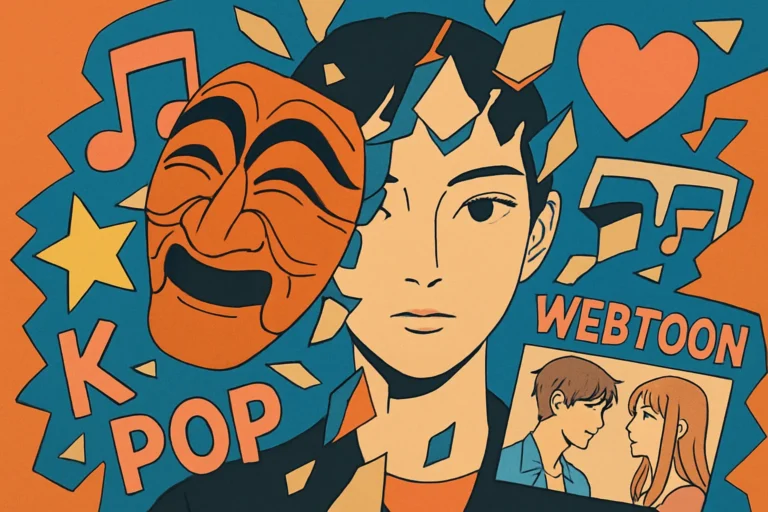
Beyond the Binary: Deconstructing Third-Wave Feminism in Korea
Hello! Welcome back to [Maeil Hangeul], where we upgrade your Korean skills for complex, real-world conversations!
Today, we’re diving deep into a fascinating and highly relevant academic topic: the Third Wave of Feminism in Korea and its intricate relationship with postmodernism and queer theory. This isn’t just for university seminars! Understanding these concepts will give you a powerful lens to analyze modern K-dramas, film, K-pop, and the dynamic social movements shaping contemporary Korea.
Lately in Korea, there’s been a huge surge in media that challenges old norms. From webtoons featuring powerful, independent female leads to K-pop idols playing with gender fluidity, the ideas we’ll discuss today are unfolding in pop culture right now. Ready to explore the vocabulary that describes this cultural shift? Let’s begin!
Core Expressions for Critical Discourse
Here are four key terms that are essential for discussing modern feminist and cultural theory in Korean.
1. 탈구축 (Talguchuk)
- Pronunciation [Romanization]: Talguchuk
- English Meaning: Deconstruction
- Detailed Explanation: Borrowed from the postmodern philosophy of Jacques Derrida, 탈구축 is the process of taking apart or dismantling established ideas and structures to reveal their hidden assumptions and internal contradictions. In feminist theory, it’s used to critique the binary opposition of “man” versus “woman,” showing that these categories are not natural but are social constructs. It’s a powerful tool for questioning what we take for granted about gender.
- 💡 Pronunciation Tip: The first syllable ‘탈’ (tal) is strongly aspirated, meaning you should feel a puff of air when you say the ‘ㅌ’ (t) sound. The second part, ‘구축’ (guchuk), is pronounced without aspiration. Think of it as [Tal-goo-chook].
2. 교차성 (Gyochaseong)
- Pronunciation [Romanization]: Gyochaseong
- English Meaning: Intersectionality
- Detailed Explanation: This is a crucial concept in third-wave feminism. 교차성 refers to the interconnected nature of social categorizations such as race, class, gender, and sexual orientation as they apply to a given individual or group. It argues that these overlapping identities create unique and specific experiences of discrimination and privilege. For example, the experience of a working-class woman in Korea is different from that of an upper-class woman, and intersectionality provides the framework to analyze this.
- 💡 Pronunciation Tip: The ‘교’ (gyo) sound is a single, quick syllable. The most important part is the ‘ㅆ’ (ss) in ‘성’ (seong). It’s a tensed consonant, so you should pronounce it with more force than a single ‘ㅅ’ (s), almost like a sharp hiss: [Gyo-cha-sseong].
3. 퀴어 이론 (Kwieo Iron)
- Pronunciation [Romanization]: Kwieo iron
- English Meaning: Queer Theory
- Detailed Explanation: 퀴어 이론 is an academic field that challenges ‘normativity’—the idea that there are ‘normal’ and ‘abnormal’ ways to be, particularly concerning gender and sexuality. It goes beyond simply advocating for LGBTQ+ rights; it critiques the very idea of stable, fixed identities (like ‘heterosexual’ or ‘homosexual’) and celebrates fluidity, difference, and the subversion of norms. It asks fundamental questions about how desire and identity are constructed by society.
- 💡 Pronunciation Tip: ‘퀴어’ (Kwieo) is the Korean transliteration of “queer.” The ‘ㅟ’ (wi) vowel is pronounced like the “we” in the English word “we.” So, it sounds like [Kwi-eo ee-ron].
4. 상호텍스트성 (Sangho-tekseuteu-seong)
- Pronunciation [Romanization]: Sanghotekseuteuseong
- English Meaning: Intertextuality
- Detailed Explanation: A core concept of postmodernism, 상호텍스트성 is the idea that the meaning of any text (a film, a book, a song) is not self-contained but is shaped by its relationship to other texts. K-pop music videos are a perfect example! They often reference classic paintings, films, or myths. Analyzing this intertextuality allows us to see how they create new, complex meanings about gender, identity, and society by putting old and new ideas in conversation.
- 💡 Pronunciation Tip: This is a long one! Let’s break it down: [Sang-ho-tek-seu-teu-seong]. Notice how the English word “text” is adapted into Korean as ‘텍스트’ (tekseuteu). The final ‘ㅡ’ (eu) vowel is very subtle.
Example Dialogue
Here’s how two university students might use these terms while discussing a popular webtoon.
- A: 소민아, 요즘 화제인 웹툰 <그림자 여왕> 봤어? 주인공이 전형적인 여성상을 완전히 **탈구축해서 정말 흥미로워.**
- (Somin, have you seen the popular webtoon Shadow Queen? It’s fascinating how it completely deconstructs the typical female archetype.)
- B: 응, 나도 보고 있어. 작가가 단순히 젠더 문제만 다루는 게 아니라, 계급이나 학벌 같은 요소까지 다루면서 **교차성 페미니즘의 관점을 잘 보여주는 것 같아.**
- (Yeah, I’m reading it too. I think the author does a great job of showing an intersectional feminist perspective by not just dealing with gender, but also with factors like class and educational background.)
- A: 맞아. 그리고 등장인물들의 관계가 이성애 규범에 얽매이지 않는다는 점에서 **퀴어 이론의 영향도 느껴져. 정체성이 유동적이잖아.**
- (Exactly. And I feel the influence of Queer Theory in how the characters’ relationships aren’t bound by heteronormative standards. Their identities are so fluid.)
- B: 그리고 옛날 동화를 비꼬는 설정에서는 **상호텍스트성이 돋보이지. 원작을 알면 더 깊이 있는 해석이 가능해져.**
- (And the intertextuality really stands out in the way it subverts old fairy tales. Knowing the original stories allows for a much deeper interpretation.)
Culture Tip & Trend Deep Dive
- Intersectionality in Action: The concept of 교차성 is no longer just academic in Korea. It’s central to modern social movements. For instance, the “4B movement” (비혼, 비출산, 비연애, 비섹스 – no marriage, no childbirth, no dating, no sex) is often analyzed through an intersectional lens, as it connects feminist ideals with economic realities and critiques of patriarchal family structures.
- Deconstruction in K-Pop: You can see 탈구축 everywhere in 4th generation K-pop. Groups like aespa deconstruct the boundary between ‘real’ and ‘virtual’ identities with their avatar concept, while groups like LE SSERAFIM’s song “UNFORGIVEN” uses 상호텍스트성 by sampling the theme from the classic Western film The Good, the Bad and the Ugly to deconstruct the image of a “forgivable” or “docile” woman.
Wrap-up & Practice
Today, we learned four powerful concepts—탈구축 (deconstruction), 교차성 (intersectionality), 퀴어 이론 (queer theory), and 상호텍스트성 (intertextuality)—that will allow you to engage in high-level discussions about contemporary Korean culture.
Now, let’s put your knowledge to the test!
- Fill-in-the-blank: A film director who references classic paintings and literature in their movie to create new meaning is using the principle of ________.
- Challenge: Think of a K-drama, film, or K-pop group. In the comments, try to write one sentence explaining how they challenge traditional gender roles using the concept of 탈구축.
Share your thoughts and practice sentences in the comments below! We’d love to hear your analysis.
Frequently Asked Questions (FAQ)
Q: What does "퀴어 이론" mean in Korean and how do you pronounce it?
A: In Korean, "퀴어 이론" is pronounced [queer theory] and means: , and
Q: What does "상호텍스트성" mean in Korean and how do you pronounce it?
A: In Korean, "상호텍스트성" is pronounced [intertextuality] and means: —that will allow you to engage in high-level discussions about contemporary Korean culture.







