

Slow Down! Let’s Talk Slow Food in Korean
Hello! Welcome to Daily Hangul, here to upgrade your Korean skills!
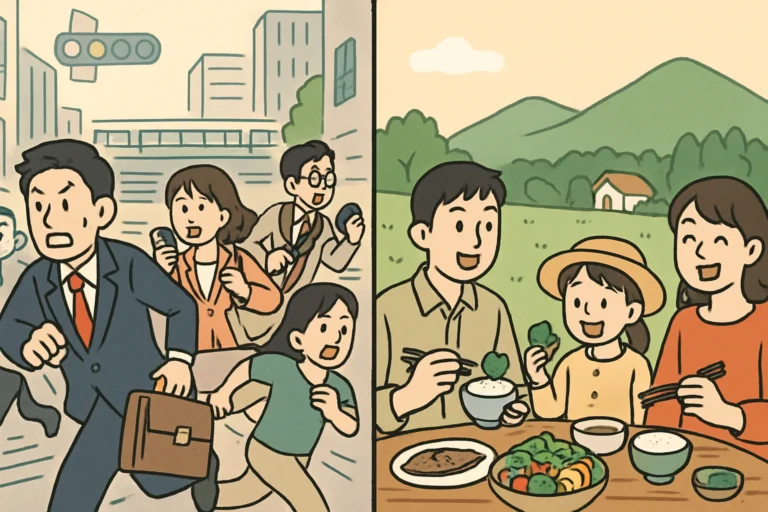
Ever feel like life is moving too fast? In Korea, famous for its “빨리빨리 (ppalli-ppalli)” or “hurry, hurry” culture, many people are starting to embrace a slower, more mindful way of life. This trend is especially visible in food culture! Today, we’re going to learn how to discuss the Slow Food movement in Korean. You’ll be able to talk about healthy eating, sustainability, and local culture, sounding like a true connoisseur.
Let’s dive in!
Core Expressions You Need to Know
Here are some essential phrases to help you join the conversation about Slow Food.
1. 느리게 살기 (Neurige salgi)
- Pronunciation [Romanization]: Neurige salgi
- English Meaning: To live slowly / The slow life
- Detailed Explanation: This phrase captures the entire philosophy behind the Slow Food movement. It’s not just about eating slowly, but about living intentionally and mindfully. It’s the direct opposite of Korea’s famous ‘빨리빨리 문화 (ppalli-ppalli munhwa)’. You can use this to talk about a lifestyle choice that values quality over speed.
- 💡 Pronunciation Tip: The particle ‘-게 (-ge)’ is attached to an adjective stem to turn it into an adverb. So, ‘느리다 (neurida – to be slow)’ becomes ‘느리게 (neurige – slowly)’. The ‘ㄱ(g)’ sound is soft, almost between a ‘g’ and a ‘k’.
2. 로컬 푸드 (Lokeol pudeu)
- Pronunciation [Romanization]: Lokeol pudeu
- English Meaning: Local food
- Detailed Explanation: This is a Konglish (Korean-style English) term you’ll hear all the time. It refers to food sourced from local farms and producers. Discussing ‘로컬 푸드’ is central to the Slow Food conversation, as it emphasizes freshness, seasonality, and supporting the local community.
- 💡 Pronunciation Tip: Korean doesn’t have an ‘f’ sound, so it’s replaced with ‘ㅍ (p)’. That’s why ‘food’ becomes ‘푸드 (pudeu)’. Also, notice how the ‘l’ in ‘local’ becomes a clear ‘ㄹ (l)’ sound at the end of the syllable.
3. -(으)ㄹ 뿐만 아니라 (-(eu)l ppunman anira)
- Pronunciation [Romanization]: -(eu)l ppunman anira
- English Meaning: Not only… but also…
- Detailed Explanation: This is a fantastic grammar point for making more sophisticated arguments. You attach it to a verb or adjective stem to connect two positive qualities. For example, you can say, “Local food is not only fresh, but also healthy.”
- Use -ㄹ 뿐만 아니라 after a stem ending in a vowel (e.g., 신선하다 → 신선할 뿐만 아니라).
- Use -을 뿐만 아니라 after a stem ending in a consonant (e.g., 좋다 → 좋을 뿐만 아니라).
- 💡 Pronunciation Tip: When you say ‘뿐만 아니라 (ppunman anira)’ quickly, the ‘ㄴ(n)’ sound in ‘만(man)’ links to the ‘아(a)’, making it sound smooth like [ppunmananira]. This is a linking rule called ‘연음 (yeoneum)’.
4. 지속 가능한 (Jisok ganeunghan)
- Pronunciation [Romanization]: Jisok ganeunghan
- English Meaning: Sustainable
- Detailed Explanation: This is a key term for any modern discussion about food, the environment, or lifestyle. It’s composed of ‘지속 (jisok – continuation)’ and ‘가능한 (ganeunghan – possible)’. You can use it to describe agriculture, development, or a way of living that can be maintained for a long time without harming the environment.
- 💡 Pronunciation Tip: The ‘ㄱ(g)’ at the end of ‘지속 (jisok)’ is an unreleased stop. This means you form the ‘k’ sound but don’t release a puff of air. It’s a subtle but important part of sounding natural.
Example Dialogue
Let’s see how these expressions work in a real conversation between two friends, Minjun and Sora.
A (민준): 요즘 느리게 살기를 실천해 보려고 노력 중이야.
[Yojeum neurige salgireul silcheonhae boryeogo noryeok jung-iya.]
A (Minjun): I’m trying to practice living slowly these days.
B (소라): 아, 정말? 슬로우 푸드 운동 같은 거?
[A, jeongmal? Seullou pudeu undong gateun geo?]
B (Sora): Oh, really? Like the Slow Food movement?
A (민준): 응, 맞아. 그래서 로컬 푸드를 더 많이 먹으려고 해. 신선할 뿐만 아니라 건강에도 더 좋잖아.
[Eung, maja. Geuraeseo rokeol pudeureul deo mani meogeuryeogo hae. Sinseonhal ppunman anira geongang-edo deo jochanha.]
A (Minjun): Yeah, exactly. So I’m trying to eat more local food. It’s not only fresh but also better for your health.
B (소라): 좋은 생각이다! 그게 더 지속 가능한 삶의 방식인 것 같아.
[Joeun saenggagida! Geuge deo jisok ganeunghan salmui bangsik-in geot gata.]
B (Sora): That’s a great idea! It seems like a more sustainable way of life.
Culture Tip & Trend Deep Dive
In Korea, the Slow Food movement connects deeply with a traditional philosophy called ‘약식동원 (藥食同源, yaksik dongwon)’. This means “food and medicine come from the same source.” The idea is that eating good, wholesome food is the best way to stay healthy and prevent illness.
Today, many young Koreans on Instagram are showcasing this trend by visiting ‘한옥 (hanok)’ cafes in the countryside that serve traditional teas and desserts made from local ingredients. They are moving away from processed, fast food and rediscovering the joy of food that is both delicious and nourishing. So, when you use a phrase like “로컬 푸드는 건강에 좋아요 (Lokeol pudeuneun geongang-e joayo – Local food is good for your health),” you’re tapping into a cultural value that has existed for centuries!
Let’s Practice!
Ready to test your knowledge?
1. Fill in the blank:
로컬 푸드를 먹는 것은 환경에 좋을 ___________ 지역 경제도 살릴 수 있어요.
(Eating local food is good for the environment, ___________ it can also save the local economy.)
2. Quick Question:
What is the opposite philosophy of ‘느리게 살기 (neurige salgi)’ that is famous in Korea?
Great job today! You’ve learned how to have a meaningful conversation about an important global and local trend.
Now it’s your turn! Try making a sentence using ‘지속 가능한 (jisok ganeunghan)’ in the comments below!







