

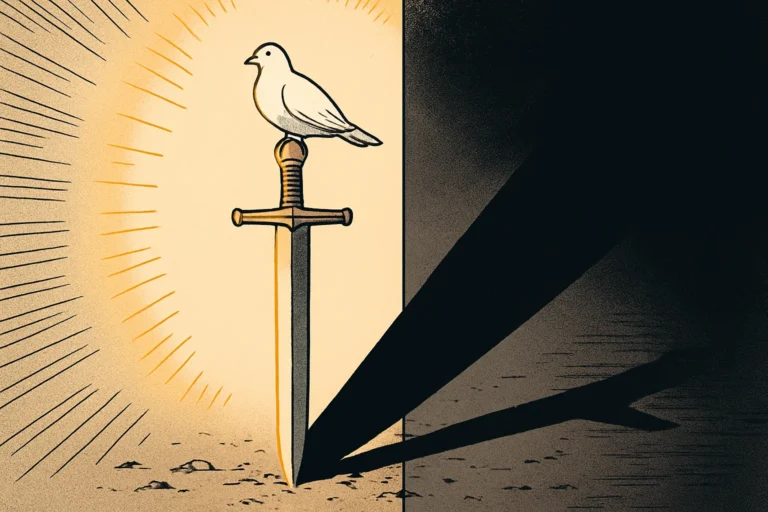
Beyond Blind Faith: Debating Religion & Violence in Korean
Hello! Welcome to [매일한글], where we upgrade your Korean skills to the next level!
Today, we’re diving into a profound and challenging topic: the complex relationship between religion and violence. This might seem heavy, but it’s a conversation that requires linguistic and cultural nuance. Recently in Korea, a new documentary called “그림자와 빛” (Shadow and Light) has become a huge topic of discussion. It critically examines how faith, throughout history, has been used to both inspire peace and justify conflict. This has sparked intense debates online and in the media. Learning the right vocabulary will not only allow you to understand these conversations but also to express your own sophisticated thoughts on the matter. Let’s get started!
Core Expressions for a Deeper Discussion
Here are some key expressions you’ll need to navigate this complex topic like a native speaker.
1. 맹목적인 믿음 (Maengmokjeogin Mideum)
- Romanization: [Maengmokjjeogin mideum]
- English Meaning: Blind faith
- Detailed Explanation: This term is composed of
맹목적(blind, aimless) and믿음(faith, belief). It carries a critical nuance, referring to a belief that is accepted without question or critical thought. It’s often used in philosophical or sociological discussions to point out the potential dangers of unquestioning adherence to a doctrine. It’s a powerful term to use when analyzing the root causes of conflict. -
💡 Pronunciation Tip:
The standard pronunciation is [maengmokjeogin], but in natural, fast speech, theㄱ(g/k) in적often becomes tense, sounding likeㅉ(jj). This is a phenomenon called ‘tensing’ (경음화). So,[maengmokjeogin]sounds more like [maengmokjjeogin]. This small change will make your pronunciation sound incredibly fluent.
2. 양날의 검 (Yangnarui Geom)
- Romanization: [Yangnarui geom]
- English Meaning: A double-edged sword
-
Detailed Explanation: This is a fantastic idiomatic expression.
양날means “both edges” and검means “sword.” Just like in English, it refers to something that has both positive and negative effects. It’s the perfect metaphor for discussing religion, acknowledging its capacity to foster love and community while also recognizing its potential to create division and conflict. -
💡 Pronunciation Tip:
The pronunciation of날의is a great example of liaison (연음). The final consonantㄹ(l) of날moves into the empty consonant space of the following syllable의. Therefore, instead of sayingnal / ui, it flows together as [narui]. Mastering this will make your spoken Korean much smoother.
3. 폭력을 정당화하다 (Pongnyeogeul Jeongdanghwahada)
- Romanization: [Pongnyeogeul jeongdanghwahada]
- English Meaning: To justify violence
-
Detailed Explanation: This is a crucial phrase for this topic.
폭력means “violence,” and정당화하다is a verb meaning “to justify.” It’s used to describe the process by which an ideology or belief system provides moral or divine reasoning for committing acts of violence. This is a formal, academic-sounding phrase often found in news articles, documentaries, and debates. -
💡 Pronunciation Tip:
Let’s look at폭력[pongnyeok]. This is a classic example of nasal assimilation. Theㄱ(k) at the end of폭comes beforeㄹ(r/l) in력. This interaction causes theㄱto change toㅇ(ng) and theㄹto change toㄴ(n). So,폭력(pok-ryeok)is pronounced [퐁녁, pongnyeok]. It’s a complex rule, but getting it right is a sign of a truly advanced speaker!
4. 배타적인 교리 (Baetajeogin Gyori)
- Romanization: [Baetajeogin gyori]
- English Meaning: Exclusive doctrine
-
Detailed Explanation:
배타적means “exclusive” or “exclusionary,” and교리means “doctrine” or “dogma.” This term refers to religious teachings that claim to be the only true path, often leading to the rejection or condemnation of other faiths. It’s a key concept when discussing the ideological roots of religious intolerance and conflict. -
💡 Pronunciation Tip:
Similar to맹목적인, the pronunciation of배타적인[baetajeogin] benefits from understanding the natural flow. Pay attention to the smooth transition between syllables, without pausing. The key is to pronounce it as a single, flowing unit rather than three separate words.
Example Dialogue
Here’s how these expressions might appear in a real conversation about the documentary “그림자와 빛.”
- A: 요즘 화제가 된 다큐멘터리 ‘그림자와 빛’ 봤어요? 종교가 어떻게 폭력을 정당화하는지 보여줘서 생각이 많아지더라고요.
- (Have you seen the hit documentary ‘Shadow and Light’? It really makes you think, showing how religion is used to justify violence.)
- B: 네, 저도 봤어요. 종교가 양날의 검이라는 걸 다시금 느꼈죠. 평화를 가르치기도 하지만, 특정 배타적인 교리와 맹목적인 믿음이 결합하면 정말 위험해질 수 있으니까요.
- (Yes, I saw it too. It made me feel once again that religion is a double-edged sword. It can teach peace, but when a certain exclusive doctrine combines with blind faith, it can become truly dangerous.)
- A: 맞아요. 그래서 서로 다른 신념을 가진 사람들이 어떻게 평화롭게 공존을 모색할 수 있을지가 우리 시대의 중요한 과제인 것 같아요.
- (Exactly. That’s why finding ways for people with different beliefs to seek peaceful coexistence seems to be a crucial challenge of our time.)
Culture Tip & Trend Deep Dive
In Korea, which has a diverse religious landscape including large Christian and Buddhist populations alongside growing secularism, public discussions about religion can be sensitive. However, in academic circles, online forums, and through media like the fictional documentary “그림자와 빛,” these critical conversations are thriving.
The Korean MZ generation (Millennials + Gen Z), while often less religious than previous generations, shows a high level of interest in philosophical and ethical issues. They are not afraid to critically analyze traditions and institutions. Using a term like 양날의 검 shows that you can appreciate complexity and avoid simplistic conclusions, which is highly valued in intellectual discussions in Korea. When you use these expressions, you’re not just showing off your vocabulary; you’re signaling that you can engage with complex social issues with the depth and nuance expected of a thoughtful, educated person.
Wrap-up & Practice
Today, we learned some powerful, advanced expressions to discuss the profound topic of religion and violence. You can now analyze complex issues using terms like 맹목적인 믿음 (blind faith), describe multifaceted situations with 양날의 검 (a double-edged sword), and pinpoint critical problems with phrases like 폭력을 정당화하다 (to justify violence) and 배타적인 교리 (exclusive doctrine).
Now, let’s test your understanding!
- Fill in the Blank: 어떤 이념이든 비판 없이 받아들이는 것은 ___________으로 이어질 위험이 있다. (Accepting any ideology without criticism carries the risk of leading to ___________.)
- Sentence Building: Using the expressions we learned, write one sentence in Korean expressing your opinion on the theme of “religion and peace.”
Great job today on tackling such a difficult but important topic! Try using one of today’s expressions to leave a comment below. We’d love to hear your thoughts
Frequently Asked Questions (FAQ)
Q: What does ""그림자와 빛"" mean in Korean and how do you pronounce it?
A: In Korean, ""그림자와 빛"" is pronounced [Shadow and Light] and means: has become a huge topic of discussion. It critically examines how faith, throughout history, has been used to both inspire peace and justify conflict. This has sparked intense debates online and in the media. Learning the right vocabulary will not only allow you to understand these conversations but also to express your own sophisticated thoughts on the matter. Let's get started!
Q: What does "맹목적인 믿음" mean in Korean and how do you pronounce it?
A: In Korean, "맹목적인 믿음" is pronounced [blind faith] and means: , describe multifaceted situations with
Q: What does "양날의 검" mean in Korean and how do you pronounce it?
A: In Korean, "양날의 검" is pronounced [a double-edged sword] and means: , and pinpoint critical problems with phrases like







