

Korea’s Sizzling Summer vs. Chilly Winter: Which Do You Prefer?
Hello! This is [Daily Hangul], here to upgrade your Korean skills! 😊
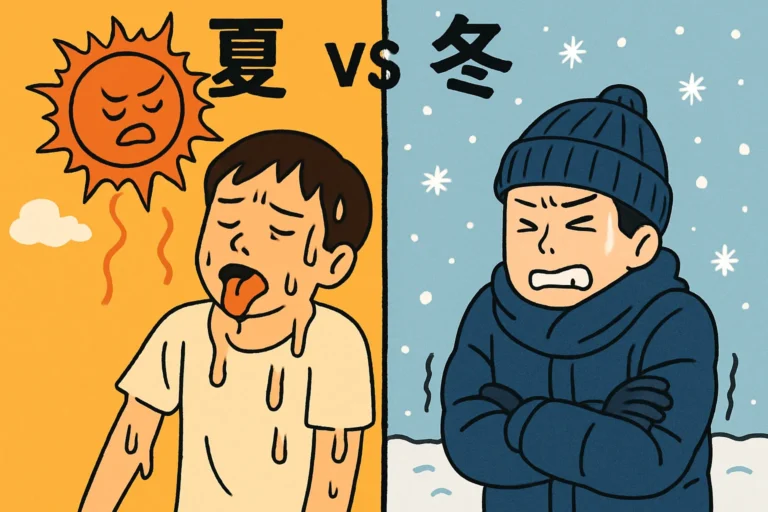
Do you love the feeling of the warm sun on your skin, or do you prefer bundling up in a cozy sweater with a hot drink? Today, we’re going to learn how to talk about your weather preferences in Korean—specifically, whether you’re a summer person or a winter person!
Lately in Korea, with the sweltering summer heat and the freezing cold winters, everyone is debating their favorite season online. It’s a super common topic for small talk, so after this lesson, you’ll be able to join the conversation right away! Let’s get started!
Core Expressions You Need to Know
Here are some essential phrases to express your feelings about the heat and the cold.
1. 더위를 타다 (Deowireul tada)
- Pronunciation [Romanization]: Deowireul tada
- English Meaning: To be sensitive to heat / To not handle heat well.
- Detailed Explanation: This is a fantastic idiomatic expression that Koreans use all the time! Literally, it means “to ride the heat,” but it’s used to say that you get hot very easily and don’t like hot weather. If you’re always the first person to turn on the air conditioner, this phrase is for you!
- 💡 Pronunciation Tip:
The word ‘더위를’ is pronounced [deowireul]. The final consonant ‘ㄹ’ (l) in ‘를’ (reul) is a light ‘l’ or ‘r’ sound. For ‘타다’ (tada), the first letter ‘ㅌ’ (t) is an aspirated sound. It should be pronounced with a strong puff of air, like the ‘t’ in “top.”
2. 추위를 타다 (Chuwireul tada)
- Pronunciation [Romanization]: Chuwireul tada
- English Meaning: To be sensitive to cold / To not handle cold well.
- Detailed Explanation: This is the exact opposite of the expression above! It literally means “to ride the cold” and is used for people who get cold easily. If you’re always wearing a jacket, even indoors, you can say, “저는 추위를 타요” (Jeoneun chuwireul tayo).
- 💡 Pronunciation Tip:
The first letter ‘ㅊ’ (ch) in ‘추위’ is also an aspirated sound, like the ‘ch’ in “chart.” Make sure to release a puff of air when you say it to sound natural!
3. 차라리 (Charari)
- Pronunciation [Romanization]: Charari
- English Meaning: Rather / Preferably
- Detailed Explanation: This is a super useful adverb for when you’re choosing between two options, especially if neither is perfect. You use it to say you’d prefer one thing over the other. For example, “I don’t love winter, but I’d rather have the cold than the extreme heat.”
- 💡 Pronunciation Tip:
The Korean ‘ㄹ’ (r/l) sound can be tricky. When it’s between two vowels like in ‘차라리’ [charari], it sounds like a soft ‘r’, similar to the Spanish ‘r’ or the ‘tt’ sound in the American English pronunciation of “water.”
4. A-는 것보다 B-는 게 더 좋아요 (A-neun geotboda B-neun ge deo joayo)
- Pronunciation [Romanization]: A-neun geot-bo-da B-neun ge deo jo-a-yo
- English Meaning: I like B more than A.
- Detailed Explanation: This is the ultimate grammar pattern for expressing preferences! You can use it for anything, not just weather.
- 더운 것보다 (deoun geotboda) = than it being hot
- 추운 게 더 좋아요 (chuun ge deo joayo) = it being cold is better.
Put them together, and you get: “더운 것보다 추운 게 더 좋아요.” (I like it being cold more than it being hot.)
- 💡 Pronunciation Tip:
In ‘좋아요’ (joayo), the consonant ‘ㅎ’ (h) is silent when it’s followed by a vowel like ‘ㅏ’ (a). So, instead of pronouncing it “joh-a-yo,” it sounds like [조아요 / joayo]. This is a very important rule that makes your Korean sound much more natural!
Example Dialogue
Let’s see how these expressions are used in a real conversation.
A: 와, 오늘 진짜 덥다! 땀 나.
(Wa, oneul jinjja deopda! Ttam na.)
Wow, it’s so hot today! I’m sweating.
B: 맞아. 나 어제 아이돌 OO 인스타 봤는데 여름이 제일 좋대. 나는 더위를 많이 타서 이해가 안 돼.
(Maja. Na eoje aidol OO insuta bwanneunde yeoreumi jeil jodae. Naneun deowireul mani taseo ihaega an dwae.)
I know. Yesterday I saw idol OO’s Instagram post saying they love summer the most. I don’t handle heat well, so I don’t get it.
A: 나도! 나는 더운 것보다 차라리 추운 게 더 좋아.
(Nado! Naneun deoun geotboda charari chuun ge deo joa.)
*Me too! I’d rather it be cold than hot. *
B: 진짜! 겨울에는 옷을 더 입으면 되잖아.
(Jinjja! Gyeoureneun oseul deo ibeumyeon doejanha.)
Exactly! In the winter, you can just wear more clothes.
Culture Tip & Trend Deep Dive 🇰🇷
In Korea, the “Summer vs. Winter” debate is a classic small talk topic. You’ll often hear it in offices, cafes, and even on TV shows where K-pop idols are asked to choose their favorite!
Here’s a fun cultural concept: 이열치열 (iyeolchiyeol). It means “fighting heat with heat.” On the hottest days of summer, many Koreans eat boiling hot, nutritious soups like 삼계탕 (samgyetang – ginseng chicken soup) to replenish their energy and “fight” the heat from the inside.
This concept is so popular that you can use it to sound like a local! If your friend complains about the heat, you can suggest, “우리 이열치열하러 삼계탕 먹으러 갈까?” (Wuri iyeolchiyeolhareo samgyetang meogeureo galkka? – Shall we go eat samgyetang to fight heat with heat?).
Let’s Review and Practice!
Great job today! We learned how to talk about our preferences for hot and cold weather using these key phrases:
* 더위를 타다 (to be sensitive to heat)
* 추위를 타다 (to be sensitive to cold)
* 차라리 (rather)
* ~는 것보다 ~는 게 더 좋아요 (I like ~ more than ~)
Now, let’s test your knowledge!
1. Fill in the blank:
If you get cold easily and don’t like winter, you can say:
“저는 _________ 많이 타서 겨울을 안 좋아해요.”
(Jeoneun _________ mani taseo gyeoureul an joahaeyo.)
2. Make a sentence:
How would you say “I’d rather have summer than winter” using 차라리?
What about you? Are you a summer person or a winter person? Leave a comment below using the Korean phrases you learned today! We can’t wait to read your answers! 👇
Frequently Asked Questions (FAQ)
Q: What does "더운 것보다" mean in Korean and how do you pronounce it?
A: In Korean, "더운 것보다" is pronounced [deoun geotboda] and means: = than it being hot
Q: What does "추운 게 더 좋아요" mean in Korean and how do you pronounce it?
A: In Korean, "추운 게 더 좋아요" is pronounced [chuun ge deo joayo] and means: = it being cold is better.
Q: What does "이열치열" mean in Korean and how do you pronounce it?
A: In Korean, "이열치열" is pronounced [iyeolchiyeol] and means: . It means "fighting heat with heat." On the hottest days of summer, many Koreans eat boiling hot, nutritious soups like 삼계탕 (samgyetang - ginseng chicken soup) to replenish their energy and "fight" the heat from the inside.







