

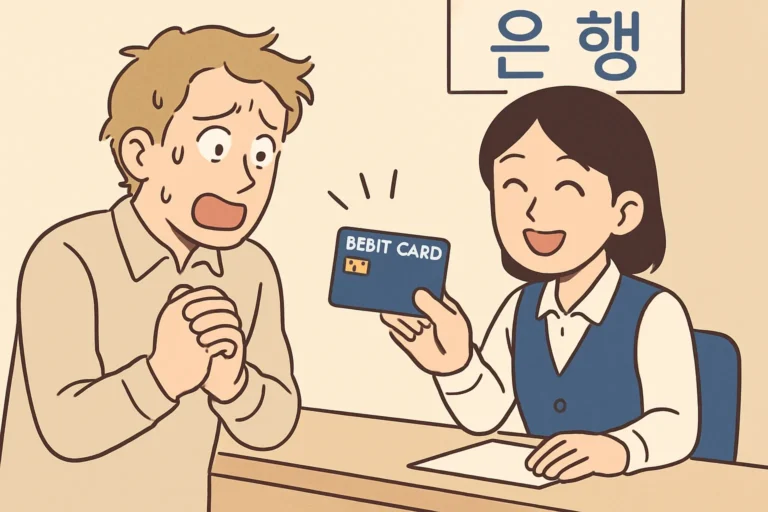
Lost Your Korean Card? Your Ultimate Rescue Guide!
Hello! Welcome to Everyday Korean, the place to upgrade your Korean skills!
Ever had that mini heart attack when you can’t find your wallet? It’s a scary thought, especially when you’re in another country. These days in Korea, with tap-to-pay being the norm for everything from subway rides to grabbing a coffee at a trendy café, your bank card is basically your lifeline. So, what happens if you lose it?
Don’t panic! Today, we’re going to learn the essential Korean phrases you need to walk into any bank and get your card reissued like a pro. Let’s get you prepared for a real-life situation!
Core Expressions You MUST Know
Here are three key phrases that will make your trip to the bank smooth and successful.
1. I’d like to get my debit card reissued.
- Korean: 체크카드를 재발급받고 싶어요.
- Pronunciation [Romanized]: Chekeukadeureul jaebalgeupbatgo sipeoyo.
- English Meaning: I would like to get my debit card reissued.
- Detailed Explanation: This is the magic sentence that starts the whole process. Let’s break it down:
- 체크카드 (chekeukadeu): Debit card
- 재발급 (jaebalgeup): Reissue
- -받고 싶어요 (-batgo sipeoyo): A polite way to say “I want to get/receive…”
This phrase clearly and politely tells the bank teller exactly what you need.
- 💡 Pronunciation Tip:
The word 재발급 (jaebalgeup) ends with a ‘ㅂ’ (b) sound. When a consonant like this is at the end of a syllable block (called a batchim), its sound is often “unreleased,” meaning you close your lips for the ‘b’ but don’t release a puff of air. It sounds more like a soft ‘p’. So, it’s not “jae-bal-geu-BUH” but a cleaner [jaebalgüp].
2. I lost my card.
- Korean: 카드를 잃어버렸어요.
- Pronunciation [Romanized]: Kadeureul ireobeoryeosseoyo.
- English Meaning: I lost my card.
-
Detailed Explanation: This phrase explains why you need a new card. 잃어버리다 (ireobeorida) is the verb “to lose,” and the -었어요 (-eosseoyo) ending puts it in the past tense. It’s a super useful expression for any item you might lose, not just a card! (e.g., “핸드폰을 잃어버렸어요” – I lost my phone.)
-
💡 Pronunciation Tip:
This phrase is a great example of a Korean pronunciation rule called linking (연음, yeoneum). The first syllable, 잃 (ilh), has two consonants, ‘ㄹ’ (l) and ‘ㅎ’ (h). When followed by a vowel like ‘어’ (eo), the ‘ㅎ’ becomes silent and the ‘ㄹ’ (l) sound “links” or moves over to the next syllable. So, instead of saying “ilh-eo,” it flows smoothly into [ireo]. The whole phrase sounds like [ireobeoryeosseoyo]. It makes your Korean sound much more natural!
3. Here is my ID card.
- Korean: 신분증 여기 있어요.
- Pronunciation [Romanized]: Sinbunjeung yeogi isseoyo.
- English Meaning: Here is my ID card.
-
Detailed Explanation: The bank teller will 100% ask for your identification. 신분증 (sinbunjeung) is the general word for an ID card. For foreigners in Korea, this will be your Alien Registration Card (ARC), which is called 외국인등록증 (oegugin deungnokjeung). Using the word 신분증 is perfectly fine and universally understood. 여기 있어요 (yeogi isseoyo) is the polite and standard way to say “Here it is” as you hand something over.
-
💡 Pronunciation Tip:
Let’s focus on 신분증 (sinbunjeung). The vowel ‘으’ (eu) in ‘증’ (jeung) can be tricky for English speakers. It doesn’t have a perfect English equivalent. To make the sound, keep your lips in a flat, wide line (like a slight, closed-lip smile) and make a sound from the back of your throat. It’s different from ‘우’ (u), where you round your lips. Practice saying [jeung] with a flat mouth!
Example Dialogue at the Bank
Let’s see how these phrases work in a real conversation.
- You (A): 안녕하세요. 체크카드를 재발급받고 싶어요.
(Annyeonghaseyo. Chekeukadeureul jaebalgeupbatgo sipeoyo.)
(Hello. I’d like to get my debit card reissued.) - Bank Teller (B): 네, 알겠습니다. 혹시 카드 분실하셨나요?
(Ne, algesseumnida. Hoksi kadeu bunsilhasyeonnayo?)
(Yes, I understand. Did you happen to lose the card?) - You (A): 네, 카드를 잃어버렸어요.
(Ne, kadeureul ireobeoryeosseoyo.)
(Yes, I lost my card.) - Bank Teller (B): 알겠습니다. 신분증 좀 보여주시겠어요?
(Algesseumnida. Sinbunjeung jom boyeojusigesseoyo?)
(I see. Could you please show me your ID card?) - You (A): 네, 신분증 여기 있어요.
(Ne, sinbunjeung yeogi isseoyo.)
(Yes, here is my ID card.)
Culture Tip & Trend Deep Dive
- The “Ppalli-Ppalli” (빨리빨리) Advantage: Welcome to Korea’s “fast, fast” culture! One of the best things about banking here is the speed. In many cases, you won’t have to wait a week for your new card to arrive in the mail. The bank will often print a brand new, fully functional card for you right there on the spot! You can walk out with your new card in just 10-15 minutes.
- Your ARC is Your Key: For any official business in Korea, especially banking, your Alien Registration Card (ARC) is your most important document. Always carry it with you when you go to the bank. A passport might work in some cases, but the ARC is the standard and makes everything much easier.
- Go Digital First!: Most Koreans use highly advanced banking apps. As soon as they realize their card is missing, the very first thing they do is open their banking app and report the card as lost or stolen (
분실 신고, bunsil singo). This immediately freezes the card and prevents anyone else from using it. It’s a great first step to take even before you head to the bank!
Let’s Review & Practice!
Great job today! You’ve learned the most crucial phrases for handling a lost card in Korea. You now know how to state your problem, explain what happened, and provide your ID.
Now, let’s test your knowledge!
1. Fill in the blank: You walk up to the bank teller. What do you say to ask for a new debit card?
체크카드를 ___________ 싶어요.
2. O/X Quiz: In Korea, you almost always have to wait 5-7 business days to receive a new bank card in the mail. (True or False?)
You’ve got this! Try to answer the questions in the comments below, and feel free to create your own sentence using one of today’s phrases. We can’t wait to see what you come up with
Frequently Asked Questions (FAQ)
Q: What does "체크카드" mean in Korean and how do you pronounce it?
A: In Korean, "체크카드" is pronounced [chekeukadeu] and means: Debit card
Q: What does "재발급" mean in Korean and how do you pronounce it?
A: In Korean, "재발급" is pronounced [jaebalgeup] and means: Reissue
Q: What does "-받고 싶어요" mean in Korean and how do you pronounce it?
A: In Korean, "-받고 싶어요" is pronounced [-batgo sipeoyo] and means: A polite way to say "I want to get/receive..."
Q: What does "재발급" mean in Korean and how do you pronounce it?
A: In Korean, "재발급" is pronounced [jaebalgeup] and means: ends with a 'ㅂ' (b) sound. When a consonant like this is at the end of a syllable block (called a







