

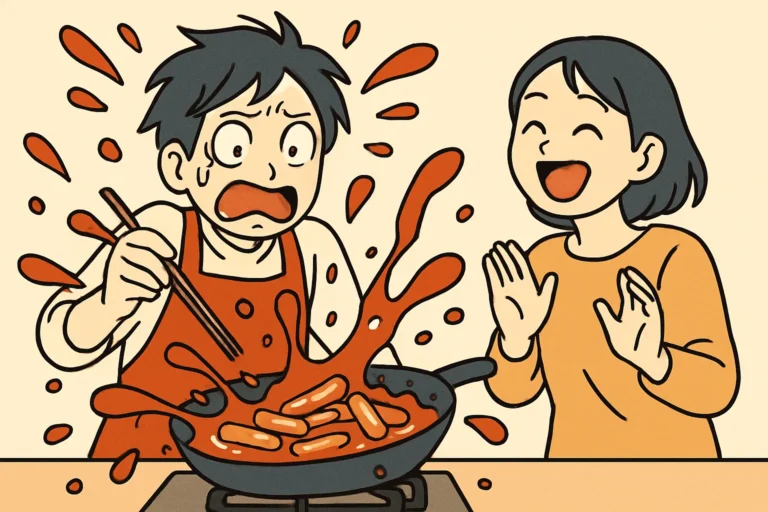
Oops! How to Laugh Off Mistakes in Korean
Hello! Welcome to [Daily Hangul], here to upgrade your Korean skills!
Ever made a silly mistake while speaking Korean and felt your face turn red? We’ve all been there! But what if you could turn that awkward moment into a funny one? Today, we’re going to learn some fun and natural Korean expressions to use when you mess up.
Lately in Korea, you’ll see celebrities on variety shows or in K-dramas constantly making small blunders. Instead of being embarrassed, they use humor to handle it, which makes them seem super charming and relatable. Now, you can too! Let’s learn how to laugh it all off like a pro.
Core Expressions for Your “Oops!” Moments
Here are three essential phrases to turn your mistakes into masterpieces of comedy.
1. 아, 망했다! (A, manghaetda!)
- Pronunciation [Romanization]: A, mang-haet-da!
- English Meaning: Oh no, I’m screwed! / It’s a disaster!
- Detailed Explanation: This is a very common and dramatic expression used among friends when something goes wrong. Did you burn the ramyeon? Forget your homework? Get on the wrong subway? This is your go-to phrase! It’s an exaggeration, so it instantly makes the situation feel less serious and more humorous. It’s very informal, so save it for your close friends!
- 💡 Pronunciation Tip:
The key here is the ‘했다’ (haetda) part. The final consonant ‘ㅆ’ (ss) is a tensed sound. You make it by tightening the back of your tongue without letting out a puff of air. It’s stronger and shorter than a regular ‘ㅅ’ (s). So, it sounds more like [haet-tta] than ‘haet-da’.
2. 실수, 실수! (Silsu, silsu!)
- Pronunciation [Romanization]: Sil-su, sil-su!
- English Meaning: My mistake, my mistake! / My bad, my bad!
- Detailed Explanation: This is a lighthearted and cute way to admit a small error. Spilling a little coffee or mispronouncing a word are perfect moments for this phrase. Repeating it twice—”실수, 실수!”—makes it sound playful and shows you’re not taking your mistake too seriously.
- 💡 Pronunciation Tip:
For English speakers, the ‘ㅅ’ (s) sound followed by the vowel ‘ㅣ’ (i) can sometimes sound like ‘sh’. So, ‘실’ (sil) is pronounced closer to [shil]. Saying [shil-su, shil-su] will make you sound very natural.
3. 현타 온다 (Hyeonta onda)
- Pronunciation [Romanization]: Hyeon-ta on-da
- English Meaning: Reality is hitting me. / The cringe is real.
- Detailed Explanation: This is a super trendy slang term you need to know! ‘현타’ (hyeonta) is short for ‘현실 자각 타임’ (hyeonsil jagak ta-im), which literally means “reality awareness time.” It’s that feeling you get a moment after you do something embarrassing and suddenly realize how awkward it was. It’s a funny way to express self-awareness and cringe.
- 💡 Pronunciation Tip:
The vowel ‘ㅕ’ (yeo) can be tricky. It’s a ‘y’ sound combined with an ‘uh’ sound (like in ‘sofa’). Try saying “yuh” quickly. So, ‘현’ is [hyeon]. Practice it a few times: hyeon-ta, hyeon-ta!
Example Dialogue
Let’s see these phrases in action! Imagine two friends trying to cook the trendy Rosé Tteokbokki they saw their favorite idol make.
A: Okay, the last step is to add the cream… oops! (A pours in way too much cream)
A: 아, 망했다! It looks like soup now!
(A, manghaetda!)
B: Hahaha! It’s okay, don’t worry!
A: 실수, 실수! I was too excited.
(Silsu, silsu!)
B: Let’s just call it “Rosé Tteokbokki Stew.”
A: Good idea. Wow, I can’t believe I did that. 현타 온다…
(Hyeonta onda…)
Culture Tip & Trend Deep Dive
- Variety Show Gold: If you watch popular Korean variety shows like Running Man or any content featuring K-pop idols, you’ll hear “아, 망했다!” constantly. When an idol fails a mission or a game, they shout this phrase with a dramatic expression. It’s a guaranteed way to make the audience laugh and is a huge part of Korean entertainment humor.
-
Gen Z Slang Alert: “현타 온다” is a must-know phrase if you want to sound like a local. Korean Gen Z uses it all the time on social media and in texts. They use it to describe the feeling after pulling an all-nighter to study and then failing the test, or after confidently trying a new dance challenge and watching the video back. Using it correctly will definitely impress your Korean friends!
Wrap-up & Practice Time!
Today we learned how to turn our mistakes into funny, relatable moments with three key phrases:
* 아, 망했다! (For dramatic failures)
* 실수, 실수! (For small, cute mistakes)
* 현타 온다 (For that post-embarrassment cringe)
Now it’s your turn to practice!
Quiz: You are trying to follow a recipe from a Korean YouTuber, but you accidentally add salt instead of sugar. Which phrase would be the most natural and funny to shout in that moment?
1. 안녕하세요! (Annyeonghaseyo!)
2. 아, 망했다! (A, manghaetda!)
3. 잘 먹겠습니다! (Jal meokgetseumnida!)
Let us know your answer in the comments! And don’t be afraid to share a funny mistake you’ve made while learning Korean. We can all laugh together







