The Aesthetics of Emptiness: The Pros and Cons of Minimalist Interiors
Hello! This is [Daily Korean], here to upgrade your Korean skills to the next level!
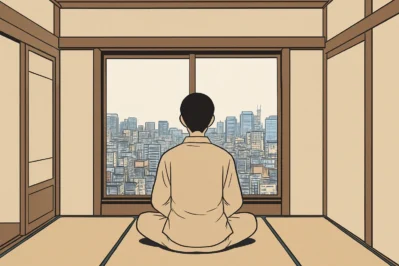
Ever scrolled through Instagram and found yourself mesmerized by those stunningly simple, clean, and peaceful Korean cafes or apartments? That, my friends, is the power of minimalism. Today, we’re going beyond just “pretty” and “clean.” We’re diving deep into the philosophy of minimalist interior design, a huge trend in Korea, and learning how to discuss its pros and cons like a true intellectual.
Lately in Korea, the concept of ‘비움’ (bium – emptying) is more than just a design choice; it’s a lifestyle. From popular home-decorating apps like ‘오늘의 집’ (Ohouse) to TV shows, everyone is talking about creating spaces that are not just visually appealing but also mentally calming. Mastering today’s expressions will allow you to participate in these sophisticated conversations about design, philosophy, and personal taste. Let’s get started!
Core Expressions for Design Philosophers
Here are some key phrases that will help you articulate your thoughts on minimalism with nuance and depth.
1. 비움의 미학 (bium-ui mihak)
- Pronunciation [Romanization]: [biume mihak]
- English Meaning: The aesthetics of emptiness.
- Detailed Explanation: This is the philosophical heart of Korean minimalism. It’s not just about having less stuff (미니멀리즘); it’s about finding beauty, peace, and focus in the empty space that remains. It suggests that by removing the non-essential, you can truly appreciate the value of what’s left. It’s a profound concept that you can apply not just to interiors, but to life itself.
- 💡 Pronunciation Tip:
The possessive particle ‘의’ has multiple pronunciations. While its standard pronunciation is [ui], when used as a particle after a noun, it’s often pronounced as [e]. So, whilebium-uiis technically correct, you will almost always hear it pronounced naturally as [biume]. Saying 비우메 미학 [biume mihak] will make you sound much more like a native speaker.
2. 장단점은 명확하다 (jangdanjeom-eun myeonghwakada)
- Pronunciation [Romanization]: [jangdanjeomeun myeonghwakada]
- English Meaning: The pros and cons are clear/distinct.
- Detailed Explanation: This is a fantastic phrase for starting a balanced analysis. 장단점 (jangdanjeom) literally means “long points and short points,” a common word for pros and cons. 명확하다 (myeonghwakada) means ‘to be clear’ or ‘to be distinct.’ Use this phrase when you want to state that the advantages and disadvantages of a certain choice are very obvious and easy to lay out.
- 💡 Pronunciation Tip:
This phrase showcases a common consonant assimilation rule involving ‘ㅎ’. When a consonant like ‘ㄱ’ (from 명확) is followed by ‘ㅎ’ (from 하다), they merge to create an aspirated sound. In this case, ㄱ + ㅎ = ㅋ [k]. So, instead of sayingmyeong-hak-ha-da, the sounds blend into [myeonghwakada]. It’s a subtle but crucial difference for advanced fluency.
3. 일장일단이 있다 (iljang-ildan-i itda)
- Pronunciation [Romanization]: [iljangildani itda]
- English Meaning: It has its pros and cons; It’s a double-edged sword.
- Detailed Explanation: This is a Saja-sungeo (사자성어), a four-character idiom derived from Chinese characters. It literally means “one pro, one con” (一長一短). It’s a more concise and sophisticated way of saying that something has both good and bad aspects in equal measure. It implies a trade-off.
- 💡 Pronunciation Tip:
Listen for the magic of liaison (연음) here. The final consonant of a syllable block moves over to the next syllable if it begins with a vowel. So, 일단 + 이 is not pronouncedil-dan / i, but rather as [일다니 / ildani]. Mastering this rule is key to smooth, flowing Korean.
4. 호불호가 갈리다 (hobulho-ga gallida)
- Pronunciation [Romanization]: [hobulho-ga gallida]
- English Meaning: Likes and dislikes are divided; It’s polarizing or a matter of personal taste.
- Detailed Explanation: This is the perfect expression for subjective topics like design. 호불호 (hobulho) is a noun made from the characters for ‘like’ (好) and ‘dislike’ (不好). 갈리다 (gallida) means ‘to be split’ or ‘to be divided.’ Together, it means that public opinion on something is sharply divided. It’s a very common phrase used to talk about movies, food, fashion, and of course, interior design!
- 💡 Pronunciation Tip:
The key here is the initial ‘ㅎ’ [h] sound in 호불호. In English, the ‘h’ sound can sometimes be weak, but in Korean, you should produce a clear puff of air. Also, the ‘ㄹ’ in 갈리다 is a light flap sound, similar to the ‘r’ in the Spanish word “pero” or the ‘tt’ in the American English pronunciation of “water.” It should dance off your tongue lightly.
Example Dialogue
Let’s see how these expressions work in a real conversation. Two friends, A and B, are discussing redecorating.
A: 요즘 ‘오늘의 집’ 앱을 보는데, 미니멀리즘 인테리어가 정말 마음에 들어. 우리 집도 그렇게 바꿔볼까 봐. 그 비움의 미학이라는 게 주는 안정감이 있더라고.
(A: I’ve been looking at the ‘Ohouse’ app lately, and I really love minimalist interiors. I’m thinking of redoing my place like that. There’s a sense of stability that comes from that “aesthetics of emptiness.”)
B: 아, 나도 알아. 확실히 깔끔하고 세련돼 보이지. 근데 일장일단이 있어. 청소는 편하겠지만, 물건이 조금만 널려 있어도 엄청 지저분해 보일 수 있잖아.
(B: Ah, I know what you mean. It definitely looks neat and stylish. But it has its pros and cons. Cleaning might be easy, but if even a few things are out of place, it can look incredibly messy.)
A: 맞아. 그런 장단점은 명확한 것 같아. 그래도 난 복잡한 것보다 단순한 게 좋아.
(A: True. I think the pros and cons are quite clear. Still, I prefer simplicity over complexity.)
B: 결국 개인의 취향 문제지. 미니멀리즘은 정말 호불호가 갈리는 스타일인 것 같아. 어떤 사람들은 너무 차갑고 휑하다고 느끼기도 하니까.
(B: Ultimately, it’s a matter of personal taste. I think minimalism is a style that really divides people. Some people feel it’s too cold and empty.)
Culture Tip & Trend Deep Dive
Why is Minimalism so big in Korea?
It’s not just a fleeting trend; it’s deeply connected to modern Korean society.
- Urban Density: Many young Koreans, especially in Seoul, live in compact spaces like one-rooms (원룸) or officetels (오피스텔). Minimalism isn’t just a choice; it’s a practical necessity to make small spaces feel larger, brighter, and more functional.
- The “Healing” Culture: In a fast-paced and competitive society, the home has become a sanctuary. The minimalist philosophy of decluttering your space to declutter your mind resonates deeply. It’s part of a broader “healing” (힐링) and wellness trend, which also includes concepts like 소확행 (so-hwak-haeng)—finding small but certain happiness in everyday life.
- Social Media Influence: Platforms like Instagram and “오늘의 집” (Ohouse) have created a visual standard. Users share their beautifully curated minimalist homes, turning it into an aspirational lifestyle that many want to emulate. It’s a way of signaling taste, control, and a modern sensibility.
So, when you use a phrase like 비움의 미학, you’re not just talking about white walls and few pieces of furniture; you’re tapping into a significant cultural current about how to live a meaningful life in modern Korea.
Let’s Wrap It Up & Practice!
Today, we learned four sophisticated expressions to discuss the pros and cons of minimalist design: 비움의 미학, 장단점은 명확하다, 일장일단이 있다, and 호불호가 갈리다. These phrases will elevate your Korean, allowing you to discuss subjective and philosophical topics with confidence.
Practice Time!
Answer the following question in the comments below using at least one of the expressions we learned today.
Question: 여러분은 미니멀리즘 인테리어에 대해 어떻게 생각하세요? 여러분의 집에 적용하고 싶나요? 그 이유는 무엇인가요?
(What do you think about minimalist interiors? Would you want to apply it to your own home? Why or why not?)
We can’t wait to read your thoughtful opinions. Keep up the fantastic work