
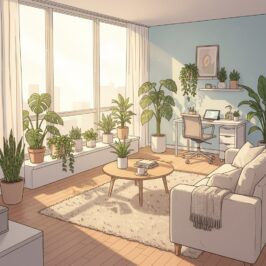
Find Your Zen: Sunlight & Quiet Room
Introduction
Hello! This is [Daily Hangul], here to upgrade your Korean skills! 👋
Are you planning to live in Korea? Finding a place to live is one of the most exciting yet challenging parts of settling down. Today, we are going to learn how to check for Sunlight (Chaegwang) and Noise levels (Soeum) when looking for a room.
Why is this important now?
Recently in Korea, spending time at home has become a huge trend. From “Home Cafes” to “Working from Home,” the quality of the living space is more important than ever! Especially for the MZ generation, having a room with “Gamseong” (emotional vibe) created by warm sunlight is a must for their Instagram photos. Also, as people stay home more, checking for noise has become crucial to avoid stress.
Let’s learn the expressions you need to find a bright and peaceful home! 🏠✨
Key Expressions
Here are 4 essential expressions to ensure your new home is sunny and quiet.
1. 햇빛이 잘 들어와요?
- Pronunciation: [Haet-bi-chi jal deureowayo?]
- English Meaning: Does the sunlight come in well?
- Detailed Explanation: This is the best way to ask about natural lighting. Koreans love bright houses. You can use this when you enter a room and want to confirm if it stays bright throughout the day.
- 💡 Pronunciation Tip:
- Let’s look at 햇빛이 (Sunlight + particle).
- The second syllable 빛 (bit) ends with a ‘ㅊ’ (ch) sound in its base form. When followed by the vowel ‘이 (i)’, the ‘ㅊ’ sound carries over to the next spot.
- So, instead of [haet-bit-i], it is pronounced [haet-bi-chi]. This linking makes your Korean sound much smoother!
2. 남향이에요?
- Pronunciation: [Nam-hyang-ieyo?]
- English Meaning: Is it south-facing?
- Detailed Explanation: In Korea, a South-facing (Nam-hyang) house is considered the best because it gets the most sunlight in winter and is cooler in summer. Asking this question shows the real estate agent that you know your stuff!
- 💡 Pronunciation Tip:
- When ‘ㅁ’ (m) meets ‘ㅎ’ (h), the sound flows very softly.
- Sometimes, in fast speech, the ‘h’ sound can become weak. So 남향 can sound like [Na-myang]. Try to say it softly without stopping your breath!
3. 방음은 잘 돼요?
- Pronunciation: [Bang-eumeun jal dwaeyo?]
- English Meaning: Is the soundproofing good?
- Detailed Explanation: “방음” (Bang-eum) means soundproofing. If you are sensitive to noise, you must ask this. It is a polite but direct way to ask if you will hear your neighbors.
- 💡 Pronunciation Tip:
- This is a great example of Resyllabification (Linking).
- The final consonant ‘ㅇ’ (ng) in 방 (Bang) moves to the empty consonant spot in 음 (eum).
- So, it sounds like [Ba-ngeum]. Connect the two sounds smoothly!
4. 층간 소음은 없나요?
- Pronunciation: [Cheung-gan so-eumeun eomnayo?]
- English Meaning: Is there any noise between floors?
- Detailed Explanation: “층간 소음” (Inter-floor noise) is a specific term for noise coming from the apartment above or below you (like footsteps). It is a very hot topic in Korea these days. Asking this specifically helps you avoid stressful situations.
- 💡 Pronunciation Tip:
- 없나요 (Is there not?): The bottom consonant ‘ㅄ’ (bs) is tricky. In this position, only the ‘ㅂ’ (p/b) sound is pronounced initially -> [Eop].
- However, because it is followed by ‘나’ (na), the ‘ㅂ’ changes to an ‘ㅁ’ (m) sound due to Nasalization.
- So, 없나요 is pronounced [Eom-na-yo]. It’s not [Eop-na-yo]!
Example Dialogue
Let’s see how these expressions work in real life. Lisa is looking for a studio apartment (Officetel) and is talking to a Realtor (Real Estate Agent).
Realtor: 이 방은 어떠세요? 요즘 인기가 많은 스타일이에요.
(How about this room? It’s a very popular style these days.)Lisa: 와, 방이 예쁘네요! 그런데 햇빛이 잘 들어와요? 저는 식물을 키워서 중요해요.
(Wow, the room is pretty! But does the sunlight come in well? I grow plants, so it’s important.)Realtor: 네, 그럼요! 여기 큰 창문 보이시죠? 남향이에요. 낮에는 불을 안 켜도 밝아요.
(Yes, of course! Do you see this big window? It is south-facing. It’s bright during the day even without lights.)Lisa: 다행이네요. 아, 그리고 제가 집에서 일을 자주 해요. 혹시 방음은 잘 돼요?
(That’s a relief. Ah, and I often work from home. By any chance, is the soundproofing good?)Realtor: 네, 이 건물은 벽이 두꺼워서 층간 소음 걱정은 안 하셔도 돼요.
(Yes, this building has thick walls, so you don’t have to worry about inter-floor noise.)
Culture Tip & Trend Deep Dive 🕵️♀️
“Why is everyone obsessed with ‘Nam-hyang’ (South-facing)?”
In Western countries, the view might be the most important factor, but in Korea, the direction of the house is king!
* Nam-hyang (South): The Gold Standard. Warm in winter, cool in summer, lots of light.
* Dong-hyang (East): Good for early risers (morning sun).
* Seo-hyang (West): Gets hot afternoon sun (good for drying laundry, but hot in summer).
The “Gamseong” (Vibe) Trend:
Recently, young Koreans look for “Chaegwang Mat-jib” (Sunlight Restaurant/Expert). This is slang meaning a place with amazing sunlight. They love to take photos of the sun hitting their white bedding or wooden furniture. If you ask, “Is this place a Chaegwang Mat-jib?” your Korean friends will be surprised by your trendy vocabulary!
Conclusion & Practice
Today, we learned how to secure a peaceful and bright home in Korea. Remember, asking about Sunlight (Haet-bit) and Soundproofing (Bang-eum) is your right as a tenant!
📝 Mini Quiz:
Fill in the blank to complete the sentence!
“I need a quiet room. Is the ____________ good here?”
( Korean: 저는 조용한 방이 필요해요. 여기 _____은/는 잘 돼요? )
- 남향 (Nam-hyang)
- 방음 (Bang-eum)
Answer: __________ (Check the bottom!)
Did you get it right? If you have any questions about renting in Korea, please leave a comment below! See you next time! 👋
(Answer: 2. 방음)