Landing in Korea Like a Pro: Phrases for the Plane!
Hello! Welcome to [Maeil Hangul], here to upgrade your Korean skills!
You’ve made it! After a long flight, your plane has finally landed at Incheon International Airport. The seatbelt sign is off, and you can hear the exciting buzz of people getting ready to start their Korean adventure. But wait… how do you politely get your bag from the overhead bin? What do you say to the flight attendants on your way out?
Don’t worry! Today, we’re going to learn some simple but super useful Korean phrases for getting off the plane. Lately in Korea, travel vlogs showing the very first moments of arrival are a huge trend on YouTube. With these phrases, you’ll be able to navigate your landing smoothly and maybe even film your own cool arrival video, just like a local!
Let’s get started!
Core Expressions for a Smooth Landing
Here are three essential phrases you need to know.
1. 잠시만요 (Jamsimanyo)
- Pronunciation [Romanization]: Jamsimanyo
- English Meaning: Excuse me / Just a moment.
- Detailed Explanation: This is your magic word on a crowded plane! It’s a polite way to get someone’s attention or ask them to move aside for a moment. Use it when you need to squeeze past someone to get to the aisle or reach for your bag. It’s much softer and more polite than just pushing through.
- 💡 Pronunciation Tip:
While the spelling is ‘Jam-si-man-yo’, pay attention to the smooth flow. Koreans say it all as one fluid phrase. The ‘yo’ (요) at the end makes the expression polite and friendly.
2. 내릴게요 (Naerilgeyo)
- Pronunciation [Romanization]: Naerilgeyo
- English Meaning: I’m getting off. / I will get off now.
- Detailed Explanation: This phrase comes from the verb ‘내리다’ (naerida), which means ‘to get off’ or ‘to descend’. The ending
-(으)ㄹ게요(-eulgeyo) is used to express your intention to do something. It’s a nice way to inform the person next to you that you’re about to stand up and leave, especially if you need them to move. - 💡 Pronunciation Tip:
This one has a fun sound change! When the consonant ‘ㄱ’ (g) comes after ‘ㄹ’ (l), it becomes a tense, strong sound like ‘ㄲ’ (kk). So, instead of ‘Nae-ril-ge-yo’, the natural pronunciation is closer to [Naerilkkeyo]. This is called ‘tensification’ (경음화). It makes your Korean sound much more authentic!
3. 감사합니다 (Gamsahamnida)
- Pronunciation [Romanization]: Gamsahamnida
- English Meaning: Thank you. (Formal)
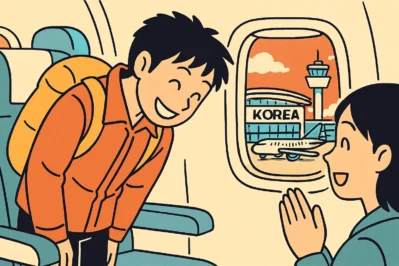
- Detailed Explanation: You probably already know this one, but it’s crucial! This is the formal and most common way to say “thank you.” As you exit the plane, it’s customary to say this to the flight attendants who are greeting you at the door. It’s a simple act of courtesy that is very much appreciated.
- 💡 Pronunciation Tip:
Here’s another important sound change rule! Notice the last syllable of ‘감사합…’ is ‘합’ (hap), which ends in a ‘ㅂ’ (b/p) sound. When ‘ㅂ’ is followed by ‘ㄴ’ (n), the ‘ㅂ’ sound changes to an ‘ㅁ’ (m) sound. So, you don’t pronounce it ‘Gam-sa-hap-ni-da’. The correct, natural pronunciation is [Gamsahamnida]. This is called ‘nasalization’ (비음화).
Example Dialogue: Arriving at Incheon!
Let’s see how these phrases work in a real conversation. Imagine you (A) and another passenger (B) have just landed.
A: (Wants to get bag from the overhead bin)
저기, 잠시만요.
(Jeogi, jamsimanyo.)
Uh, excuse me for just a moment.B: (Moves out of the way)
아, 네.
(A, ne.)
Oh, sure.A: (After getting the bag and ready to leave)
먼저 내릴게요.
(Meonjeo naerilgeyo.)
I’ll get off first.B:
네, 조심히 가세요.
(Ne, josimhi gaseyo.)
Okay, travel safely.(A walks to the exit and sees a flight attendant)
A:
감사합니다.
(Gamsahamnida.)
Thank you.
Culture Tip & Trend Deep Dive
In Korea, showing politeness and consideration for others in public spaces is very important. This is called having good “매너” (maeneo – from the English word ‘manner’).
- Vlog Like a Pro: In those popular Korean travel vlogs, you’ll notice that people almost always use gentle phrases like “잠시만요” instead of just saying “Excuse me.” It shows respect for the other person’s space. Using these phrases will make you look like a considerate traveler