Korean Café Pro-Tip: Where Does My Cup Go?
Hello! This is Maeil Hangeul, here to upgrade your Korean skills!
Have you ever finished a delicious coffee in a beautiful Korean café and thought… “Now what?” You look around and see no one is coming to clear your table. What do you do?
Lately in Korea, visiting unique and aesthetic “concept cafes” is a huge trend, especially in trendy neighborhoods like Seongsu-dong or Yeonnam-dong. After you’ve taken the perfect Instagram shot of your latte, knowing what to do with your empty cup is a key part of fitting in. Today, you’ll learn the essential phrases to clean up like a local and navigate Korean café culture with confidence!
Core Expressions You Need to Know
Here are three simple but powerful expressions for your next café adventure.
1. 반납하는 곳 (Bannapaneun got)
- Romanization: [Ban-na-pa-neun got]
- English Meaning: The place to return (things)
- Detailed Explanation: This is the magic phrase for the self-service return station you see in almost every Korean café. Let’s break it down: 반납하다 (bannapada) means “to return,” and -는 곳 (-neun got) means “the place that…” So, it literally means “the place where you return things.” You’ll often see this written on a sign pointing to the return counter.
- 💡 Pronunciation Tip: The final consonant ‘ㅅ’ (s) in 곳 (got) isn’t pronounced like an ‘s’. When a consonant is at the end of a syllable (we call this 받침 [batchim]), its sound often changes. Here, ‘ㅅ’ makes a ‘t’ sound. So, you say [got], not [gos]. It’s a clean, sharp stop!
2. 어디에 있어요? (Eodie isseoyo?)
- Romanization: [Eo-di-e i-sseo-yo?]
- English Meaning: Where is it?
- Detailed Explanation: This is one of the most useful questions you can learn in Korean! You can use it to ask for the location of anything. Just put the noun you’re looking for in front of it. For example, “화장실 어디에 있어요?” (Hwajangsil eodie isseoyo?) means “Where is the restroom?” It’s a polite and standard way to ask for directions.
- 💡 Pronunciation Tip: Notice the double consonant ‘ㅆ’ in 있어요 (isseoyo). This is a “tensed sound.” It’s stronger and shorter than the regular ‘ㅅ’ (s) sound. To make this sound, tense the back of your tongue and push the air out forcefully, like the “ss” in “hiss.” It’s [i-sseo-yo], not [i-se-o-yo].
3. 여기요 (Yeogiyo)
- Romanization: [Yeo-gi-yo]
- English Meaning: Excuse me! / Over here! / Here you are.
- Detailed Explanation: This is an incredibly versatile word. You can use it to get a staff member’s attention (like raising your hand and saying “여기요!”). You can also say it when you are handing something to someone, like giving your card to the cashier. In our café situation, you can use it to politely get the barista’s attention before asking your question.
- 💡 Pronunciation Tip: The first syllable ‘여’ (yeo) starts with an ‘ㅇ’ (ieung). When ‘ㅇ’ is the first letter of a syllable block, it’s a silent placeholder! It has no sound. So, you don’t pronounce it like ‘ngeo’ or ‘ngee-o’. You simply start with the vowel sound [yeo].
Example Dialogue
Imagine two friends, A (a learner) and B (a barista), at a busy café in Seoul.
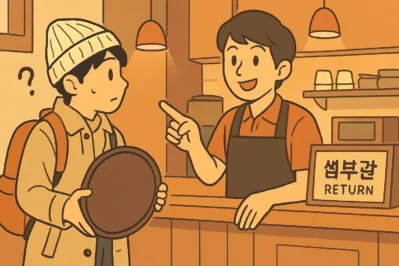
A: (Walks up to the counter holding an empty tray)
“여기요. 저… 반납하는 곳 어디에 있어요?”
(Yeogiyo. Jeo… Bannapaneun got eodie isseoyo?)
(Excuse me. Um… Where is the place to return this?)
B: (Smiles and points to a corner)
“아, 저쪽 코너에 있어요.”
(A, jeojjok koneo-e isseoyo.)
(Ah, it’s in that corner over there.)
A: “네, 감사합니다!”
(Ne, gamsahamnida!)
(Okay, thank you!)
Culture Tip: The ‘Self-Service’ Soul of Korean Cafes
In many Western countries, a waiter might clear your table after you leave. However, in Korea, the “self-service” (셀프) culture is dominant, especially in chain coffee shops and casual cafes.
- It’s the Norm: Returning your own tray, cups, and trash is standard etiquette. Leaving it on the table can be seen as slightly inconsiderate, especially when the café is busy.
- Recycling is Key: At the 반납하는 곳 (bannapaneun got), you’ll almost always find separate bins for liquids (ice/leftover drinks), plastic lids, straws, paper cups, and other trash. Taking a moment to separate your trash correctly is a small act that shows great cultural awareness!
- Why? This system helps keep cafes clean and efficient, allowing for faster turnover and lower prices. Embracing it will make you feel less like a tourist and more like a local enjoying your daily coffee routine.
Let’s Review and Practice!
Great job today! You’ve learned how to handle one of the most common situations in a Korean café. You now know how to find the 반납하는 곳 by asking “어디에 있어요?”
Now, let’s test your skills!
- Fill in the blank: You need to find the subway station. How do you ask someone, “Where is the subway station?” (The word for subway station is 지하철역 [jihacheollyeok]).
지하철역 ___________?
- Sentence Building: You’re at the counter, and you want to get the barista’s attention and ask where the return station is. What two phrases from today could you combine to do this?
Leave your answers in the comments below! We’d love to see you practice.
다음에 또 봐요! (See you next time!)