Beyond K-Beauty: Debating the ‘Right to Be Beautiful’ in Korea
Hello! Welcome back to [Maeil Hangeul], the place to upgrade your Korean skills!
Today, we’re moving beyond skincare routines and diving into a much deeper, more philosophical conversation happening in Korea. We’ll explore the complex ideas of ‘아름다울 권리’ (the right to be beautiful) and its powerful counterpart, ‘아름답지 않을 권리’ (the right not to be beautiful).
Lately in Korea, the conversation around beauty is evolving. While the K-beauty industry is a global phenomenon, there’s a growing internal dialogue questioning the very standards and social pressures it creates. This is a fascinating, advanced topic, perfect for C1 learners who want to engage in meaningful discussions about modern Korean society. Ready to explore?
Core Expressions for the Debate
Here are some essential terms you’ll need to understand and participate in this nuanced conversation.
1. 권리 (Gwonri)
- Pronunciation [Romanization]: Gwonri
- English Meaning: Right, entitlement
- Detailed Explanation: This isn’t just about having a right to the last piece of pizza. 권리 is a formal, almost legalistic term used for fundamental, philosophical, or human rights. It’s the word at the heart of our discussion today.
- 아름다울 권리 (areumdaul gwonri): This often refers to the right to pursue one’s own definition of beauty—be it through makeup, fashion, or cosmetic procedures—without social judgment.
- 아름답지 않을 권리 (areumdapji aneul gwonri): This is a powerful counter-statement. It asserts the right to exist freely and be valued without the constant pressure to conform to societal beauty standards.
- 💡 Pronunciation Tip:
The ‘권 (gwon)’ sound can be tricky. It’s not ‘gwon’ with two distinct sounds, but a quick, smooth glide from ‘g’ to ‘w’ – almost like the ‘quo’ in ‘quote’. Practice saying it as one fluid syllable: [gwon].
2. 미적 기준 (Mijeok Gijun)
- Pronunciation [Romanization]: Mijeok gijun
- English Meaning: Aesthetic standards, beauty standards
- Detailed Explanation: This is a more academic and sophisticated way to say ‘beauty standards’ than something simple like ‘예쁜 기준 (yeppeun gijun)’. Let’s break it down: 미적 (mijeok) comes from the Hanja character 美 (mi), meaning ‘beauty’, with the adjectival suffix -적 (-jeok). 기준 (gijun) means ‘standard’ or ‘criteria’. Use this phrase when you’re analyzing or critiquing societal expectations.
- 💡 Pronunciation Tip:
The 받침 (final consonant) ‘ㄱ(k)’ in ‘미적’ links to the following vowel in particles, but when followed by another consonant like in ‘기준’, you pronounce it clearly but without a strong puff of air. It’s a crisp stop: [mi.jeok gi.jun].
3. -을/를 강요하다 (Eul/reul Gangyohada)
- Pronunciation [Romanization]: -eul/reul gangyohada
- English Meaning: To force, to impose, to compel
- Detailed Explanation: This is a strong verb that implies coercion or unwanted pressure. It’s perfect for discussing how society can make individuals feel they must adhere to certain norms. For example: “사회는 여성에게 획일화된 미적 기준을 강요하는 경향이 있다.” (Society has a tendency to impose standardized aesthetic standards on women.)
- 💡 Pronunciation Tip:
The ‘ㅇ’ 받침 in ‘강 (gang)’ is a nasal ‘ng’ sound, like the end of the word ‘sing’. Don’t pronounce it like an ‘n’ or ‘g’. The ‘요 (yo)’ is a bright, clear vowel sound.
4. 주체적인 삶 (Juchejeogin Salm)
- Pronunciation [Romanization]: Juchejeogin salm
- English Meaning: A self-directed, autonomous life
- Detailed Explanation: This is a hugely important concept in modern Korean discourse, especially among younger generations. 주체 (juche) means ‘subject’ or ‘agent’—the one who acts, not the one who is acted upon. A 주체적인 삶 is a life where you are the main character, making conscious choices based on your own values, not external pressures. This idea is the philosophical backbone of the ‘right not to be beautiful’.
- 💡 Pronunciation Tip:
When the adjective-forming suffix ‘-적’ is followed by ‘-인’, the final ‘ㄱ’ sound often links to the next syllable. So, ‘주체적인’ is pronounced smoothly as [주체저긴, juchejeogin], not [juchejeok-in]. This is a very common sound change called 연음 (yeon-eum).
Example Dialogue
Let’s see how these expressions might appear in a real conversation between two friends.
A: 요즘 SNS에서 ‘탈코르셋’ 운동에 대한 다큐멘터리 이야기 많던데, 봤어?
(Yojeum SNS-eseo ‘tal-koruset’ undong-e daehan dakyumenteori iyagi manteonde, bwasseo?)
Have you seen the documentary about the ‘Escape the Corset’ movement that’s all over social media lately?
B: 응, 봤어. 우리 사회의 미적 기준이 얼마나 획일적인지에 대해 다시 생각하게 되더라.
(Eung, bwasseo. Uri sahoe-ui mijeok gijun-i eolmana hoegiljeoginji-e daehae dasi saenggak-hage doedeora.)
Yeah, I saw it. It really made me rethink how uniform our society’s aesthetic standards are.
A: 맞아. 꼭 그렇게 꾸며야 한다는 압박을 강요하는 분위기가 있잖아. 각자의 권리를 존중해야 하는데 말이야.
(Maja. Kkok geureoke kkumyeoya handaneun apbag-eul gangyohaneun bunwigi-ga itjana. Gakja-ui gwonri-reul jonjunghaeya haneunde mariya.)
Exactly. There’s this atmosphere that imposes pressure to look a certain way. We should be respecting each individual’s rights.
B: 완전 공감해. 결국 가장 중요한 건 남의 시선이 아니라 주체적인 삶을 사는 거니까.
(Wanjeon gonggamhae. Gyeolguk gajang jung-yohan geon nam-ui siseon-i anira juchejeogin salm-eul saneun geonikka.)
I totally agree. In the end, what’s most important isn’t what others think, but living a self-directed life.
Culture Tip & Trend Deep Dive
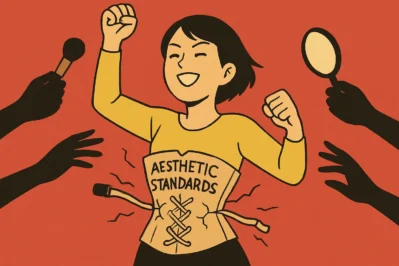
The expressions we learned today are directly linked to the ‘탈코르셋 (Tal-corset)’ movement in South Korea. This is a feminist movement where women actively reject rigid beauty norms. It’s called ‘Escape the Corset’ to symbolize breaking free from restrictive and often painful societal expectations, much like a physical corset.
Actions within this movement can include cutting hair short, forgoing makeup and cosmetic surgery, and choosing comfortable, functional clothing over stylish but restrictive options.
When you discuss this topic, using a phrase like “주체적인 삶을 위한 선택” (a choice for a self-directed life) to describe these actions shows a deep, C1-level understanding of the cultural context. You’re not just describing what they do; you’re explaining why they do it, using the very language central to the movement itself. You’ll sound less like a textbook and more like someone who truly gets the nuances of modern Korean society.
Let’s Review & Practice!
We learned some powerful vocabulary today to discuss a complex topic: 권리 (right), 미적 기준 (aesthetic standards), 강요하다 (to impose), and 주체적인 삶 (a self-directed life).
Now, it’s your turn to use them!
- Fill in the blanks:
- 모든 사람은 타인의 ___________에 얽매이지 않고 ___________ 삶을 살 ___________가 있다.
(Everyone has the ___________ to live a(n) ___________ life, untethered by others’ ___________.)
- 모든 사람은 타인의 ___________에 얽매이지 않고 ___________ 삶을 살 ___________가 있다.
- Your Opinion:
- ‘아름다울 권리’와 ‘아름답지 않을 권리’ 중, 현대 사회에 더 필요한 가치는 무엇이라고 생각하세요? 오늘 배운 표현을 사용해 댓글로 여러분의 의견을 남겨주세요!
(Between the ‘right to be beautiful’ and the ‘right not to be beautiful’, which value do you think is more necessary in modern society? Please leave a comment with your opinion using the expressions we learned today!)
- ‘아름다울 권리’와 ‘아름답지 않을 권리’ 중, 현대 사회에 더 필요한 가치는 무엇이라고 생각하세요? 오늘 배운 표현을 사용해 댓글로 여러분의 의견을 남겨주세요!
We look forward to reading your insightful thoughts