

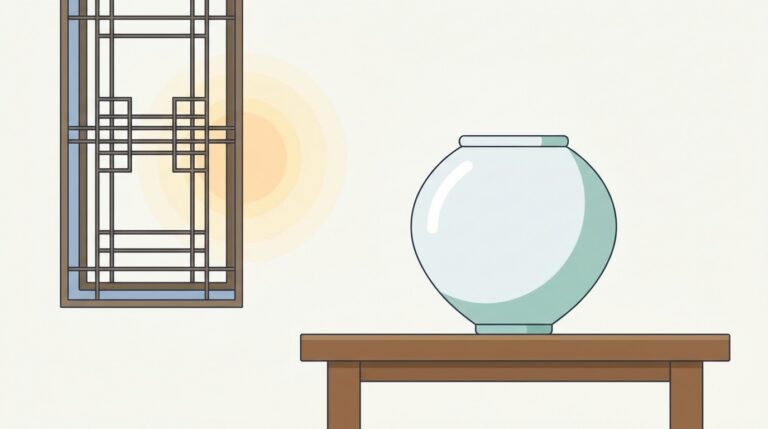
Phase 1: Empathy — Lost for Words Before a Lopsided Jar
안녕하세요! 매일한글 에디터입니다. (Hello! I’m your Daily Hangul Editor.) Picture yourself standing inside the National Museum of Korea, gazing at a slightly lopsided Joseon Moon Jar. Unlike rigid monumental symmetry or dazzling ornamentation, its quiet curve radiates living warmth. Yet when your Korean friend asks what you think, your Level 6 brain freezes at 예쁘다 (yeppeuda, pretty). Frustrating, isn’t it? Real advanced learners constantly tell us this exact gap keeps them from deeper cultural chats. Built from real tutoring insights, today’s guide unlocks art historian Ko Yu-seop’s philosophy—giving you effortless native nuance to discuss Korean beauty with depth!
Phase 2: Deep Dive into 3 Core Expressions
1. 무기교의 기교 (Mugigyo-ui gigyo)
- Pronunciation: [mugigyo-ui gigyo] — Note that the possessive particle 의 (ui) softens to ‘eh’ in natural speech, sounding like moo-gee-gyo-eh gee-gyo (soft ‘g’ as in ‘go’, not ‘gee’ as in ‘jeep’).
- Meaning: Literal: Technique of no-technique. Actual nuance: Mastery so supreme that every trace of deliberate effort vanishes, leaving effortless, organic naturalness.
- K-Culture Moment: Imagine watching a Korean documentary on master ceramicists—or seeing BTS’s RM reflect on painter Yun Hyong-keun’s dark, bleeding brushstrokes—where critics praise beauty that refuses to show off.
- Editor’s Insight: Coined by Korea’s pioneering art historian Ko Yu-seop (고유섭) to articulate Joseon aesthetics. Rather than competing with the grand, symmetrical monumentality of Chinese art or the razor-sharp, intricate ornamentation of Japanese craft, Joseon artisans stopped just short of over-polishing, letting nature finish the work.
- Situation Spectrum: Casual ⚠️ (sounds slightly academic unless joking with artsy friends) / Semi-formal ✅ (gold standard at exhibitions or book clubs) / Formal ✅ (essential in essays, lectures, and cultural interviews)
- 🤔 Think About It: In English, ‘artless’ often implies clumsy or naive. Why do you think Korean philosophy elevates the absence of visible technique to the highest pinnacle of artistic mastery?
2. 구수한 큰 맛 (Gusuhan keun mat)
- Pronunciation: [gusuhan keun mat] — Think goo-soo-han (like ‘goo’ + ‘sue’), followed by keun (a deep ‘uh’ sound with your tongue pulled back), and maht where you stop your tongue on the ‘t’ without releasing a puff of air.
- Meaning: Literal: Savory big taste. Actual nuance: Warm, earthy, generous depth—a soulful comfort that embraces human imperfection rather than chasing sterile perfection.
- K-Culture Moment: Think of those quiet, healing scenes in My Mister or Reply 1988 where characters gather over a chipped earthenware pot of doenjang-jjigae—or an architect admiring a crooked wooden pillar in an old hanok temple.
- Editor’s Insight: Gusu-hada normally describes roasted barley tea or fermented soybean stew! Ko Yu-seop brilliantly borrowed a culinary sensation to describe visual art. (Confession: I once tried explaining this to a foreign friend over dinner and ended up making everyone crave soup instead of discussing Joseon philosophy!) It means art that feels approachable, unpretentious, and deeply human.
- Situation Spectrum: Casual ✅ (warm and vivid) / Semi-formal ✅ (great for cultural chats) / Formal ✅ (widely cited in humanities and art criticism)
- 🤔 Think About It: Western aesthetics traditionally separates intellectual beauty from bodily senses like taste. What does it reveal about Korean culture that one of its highest aesthetic compliments comes straight from the kitchen?
3. 인위를 걷어낸 소박한 생명력 (Inwireul geodeonaen sobakhan saengmyeongnyeok)
- Pronunciation: [inwireul geodeonaen sobakhan saengmyeongnyeok] — Watch two cool sound shifts: 소박한 becomes so-ba-kan (aspirated ‘k’), and 생명력 undergoes nasalization to saeng-myeong-nyeok (sounds like ‘sang-myung-nyuck’).
- Meaning: Literal: Humble vitality with artificiality peeled away. Actual nuance: Raw, breathing life-force that shines precisely because the artist resisted over-decorating.
- K-Culture Moment: Picture a K-Travel vlog touring a quiet mountain hanok stay in Andong, where crooked pine beams and unbleached hanji paper let dappled sunlight dance across the floor.
- Editor’s Insight: The verb 걷어내다 (geodeonaeda, to lift or strip away) frames beauty as subtraction rather than addition. While grand palaces dazzle through scale and lacquerware amazes through micro-precision, Joseon beauty breathes through restraint.
- Situation Spectrum: Casual 🚫 (too poetic/heavy for everyday banter) / Semi-formal ✅ (impressive in design discussions) / Formal ✅ (sophisticated Level 6 critique)
- 🤔 Think About It: When you see an asymmetrical bowl or an empty stretch of canvas, does your brain instinctively want to ‘fix’ or fill it? How does pausing to admire restraint challenge modern perfectionism?
Phase 3: Textbook Korean vs. Real Korean
Situation 1: Admiring an asymmetrical ceramic bowl at an exhibition
- 📖 Textbook Korean: 이 도자기는 대칭이 완벽하지 않지만 소박하고 자연스러워서 아름답습니다. (I dojagineun daeching-i wanbyeokhaji anchiman sobakhago jayeonseureowoseo areumdapseumnida. / This ceramic piece isn’t perfectly symmetrical, yet it is beautiful because it is humble and natural.)
- 🗣️ Real Korean: 각 잡힌 완벽함보다 요런 투박한 멋이 진짜 사람 냄새 나고 좋지 않아요? (Gak japhin wanbyeokhamboda yoreon tubakhan meosi jinjja saram naemsae nago jochi anayo? / Don’t you love how this rustic charm feels way warmer and more human than rigid perfection?)
- 💡 Why Is It Different? Native speakers rarely string together stiff dictionary adjectives in casual conversation. Expressions like 각 잡힌 (gak japhin, rigidly squared-off) and 사람 냄새 나다 (saram naemsae nada, to carry human warmth) capture Ko Yu-seop’s philosophy effortlessly.
Situation 2: Contrasting flashy luxury with quiet Korean elegance
- 📖 Textbook Korean: 화려한 장식은 없지만 기교를 부리지 않은 깊은 아름다움이 느껴집니다. (Hwaryeohan jangsigeun eopjiman gigyoreul buriji aneun gipeun areumdaumi neukkyeojimnida. / There is no flashy ornamentation, yet one feels a deep, unpretentious beauty.)
- 🗣️ Real Korean: 억지로 힘 준 티가 전혀 없어서 오히려 볼수록 진국이에요. (Eokjiro him jun tiga jeonhyeo eopseoseo ohiryeo bolsurok jingugieyo. / Because there’s zero sign of trying too hard, the more you look at it, the deeper and richer it gets.)
- 💡 Why Is It Different? 힘 주다 (him juda, literally ‘to tense/force’) is the ultimate modern Korean slang for overdoing aesthetics, while 진국 (jinguk, rich slow-simmered broth) is the playful everyday cousin of 구수한 큰 맛 (gusuhan keun mat)!
Phase 4: K-Culture Deep Dive & Non-Verbal Manners
4-1. Nunchi (눈치) & Gestures in Korean Aesthetic Spaces
When visiting a traditional ceramic workshop in Icheon or a quiet gallery in Seoul’s Bukchon neighborhood, your body language speaks before your vocabulary does. Avoid pointing directly at an artifact with your index finger; instead, gesture softly with an open, upward-facing palm—a subtle sign of respect. Keep your voice low and allow three-second pauses (yeobaek, empty space) in your conversation rather than rushing to fill every silence. Leaning slightly closer with soft, unhurried eyes mirrors the quiet contemplation valued in Joseon aesthetics.
4-2. Cultural Code Analysis: K-Art, Architecture & Modern Design
To truly grasp Ko Yu-seop’s insight, picture three neighboring East Asian artistic traditions side by side, each extraordinary in its own right: monumental Chinese works famous for awe-inspiring scale and cosmic symmetry (균제미, gyunjemi), Japanese masterworks celebrated for razor-sharp, intricate ornamentation (정교한 장식미, jeonggyohan jangsingmi), and Korean Joseon art, which chose a third path—humble, unforced vitality. Look at traditional Korean hanok architecture using chagyeong (차경, borrowing scenery): rather than conquering the mountain behind it, the roofline gently curves to echo the ridge. Even in contemporary K-Culture—from BTS’s RM championing asymmetrical Dalhangari (달항아리, Moon Jars) to minimalist K-Beauty packaging inspired by white porcelain—that love for effortless, breathing imperfection remains Korea’s cultural heartbeat.
Phase 5: Real-Life Roleplay Scenario
Setting: A sunlit private gallery in Samcheong-dong, Seoul. Outside the window, dark grey giwa roof tiles meet autumn maple leaves. Min-jun (민준), a sharp yet endlessly enthusiastic curator in a linen blazer, stands beside a softly glowing Joseon white Moon Jar.
- Min-jun: 어서 오세요! 방금 들어오실 때부터 이 달항아리 앞에서 발걸음을 못 떼시네요. (Eoseo oseyo! Banggeum deureoosil ttaebuteo i dalhangari apeseo balgeoreumeul mot ttesineyo. / Welcome! You haven’t been able to take your eyes off this Moon Jar since you walked in.) 🎭 Smiles warmly, stepping beside you with hands clasped politely behind his back.
- You: 네, 처음엔 그저 단순해 보였는데, 볼수록 묘한 생명력이 느껴져서요. (Ne, cheoeumen geujeo dansunhae boyeonneunde, bolsurok myohan saengmyeongnyeogi neukkyeojyeoseoyo. / Yes, at first it looked plain, yet the longer I look, the more a mysterious vitality comes through.) 🎭 Gently tilt your head, gesturing softly with an open palm.
- Min-jun: 아, 정확하게 보셨어요! 자세히 보시면 좌우 대칭이 미묘하게 어긋나 있죠? (A, jeonghwakhage bosyeosseoyo! Jasehi bosimyeon jwau daeching-i mimyohage eogeunna itjyo? / Ah, you spotted it! Look closely—notice how the left and right symmetry is subtly off?)
- You: 맞아요. 완벽한 균형 대신 오히려 그 비뚤어진 선이 마음을 편하게 해 주는 것 같아요. (Majayo. Wanbyeokhan gyunhyeong daesin ohiryeo geu bittureojin seoni maeumeul pyeonhage hae juneun geot gatayo. / Right. Instead of rigid balance, that slightly tilted curve actually puts my mind at ease.)
- Min-jun: 바로 그게 고유섭 선생이 말한 ‘무기교의 기교’예요. 장인의 욕심을 덜어낸 자리죠. (Baro geuge Goyu-seop seonsaengi malhan ‘mugigyo-ui gigyo’yeyo. Jangin-ui yoksimeul deoreonaen jarijyo. / That is precisely what Ko Yu-seop called ‘artless art’—the space left when the artisan lets go of ego.) 🎭 Nods enthusiastically, eyes sparkling.
- You: 화려한 문양으로 꽉 채우지 않아서 더 깊은 여운이 남는군요. (Hwaryeohan munyangeuro kkwak chaeuji anaseo deo gipeun yeouni namneungunyo. / Because it isn’t packed with flashy patterns, it leaves an even deeper lingering resonance.)
- Min-jun: 한국 미학의 진수를 아시네요! 혹시 이 작품에서 어떤 분위기가 가장 먼저 와닿으셨어요? (Hanguk mihag-ui jinsureul asineyo! Hoksi i jakpumeseo eotteon bunwigiga gajang meonjeo wadayeosseoyo? / You really understand Korean aesthetics! Out of curiosity, what kind of mood struck you first in this piece?) 🎭 Looks at you attentively, genuinely eager for your answer.
- You: [🔀 Choose your response below!]
🔀 Interactive Branching Point
- Option A: “장엄한 위압감이나 섬세한 장식과는 다른, 구수한 큰 맛과 자연스러운 생명력이 느껴져요.” (Jangeomhan wiapgamina seomsehan jangsikgwaneun dareun, gusuhan keun matgwa jayeonseureoun saengmyeongnyeogi neukkyeojyeoyo. / Unlike grand monumentality or delicate ornamentation, I feel an earthy grandeur and unforced vitality.) -> ✅ Best! Min-jun practically beams with pride. Using gusuhan keun mat accurately in context instantly places you at an educated native speaker’s level!
- Option B: “만들다 만 것처럼 대충 빚어서 좀 덜 완성된 느낌이 들어요.” (Mandeulda man geotcheoreom daechung bijeoseo jom deol wanseongdoen neukkimi deureoyo. / It feels slightly unfinished, like someone shaped it carelessly and stopped halfway.) -> 🚫 Bad! Calling Joseon craft daechung (careless/sloppy) completely misses the intentional restraint behind mugigyo and can sound dismissive to a curator.
- Option C: “이거 완전 멍때리기 좋은 그릇이네요!” (Igeo wanjeon meongttaerigi joheun geureusineyo! / This is a totally great pot for spacing out to!) -> ⚠️ Risk! Funny and relatable in casual peer conversation—Min-jun might chuckle—but using heavy slang (meongttaerigi) in a formal gallery setting can feel a bit jarring.
Phase 6: 10-Second Emotion Shadowing Drill
Read aloud while matching the pauses (/) and emotional cues!
- [😌 Deeply moved and contemplative]
완벽한 대칭보다 / 살짝 어긋난 곡선에서 / 진정한 생명력이 느껴져요.
(Wanbyeokhan daechingboda / saljjak eogeunnan gokseoneseo / jinjeonghan saengmyeongnyeogi neukkyeojyeoyo. / More than rigid symmetry / in a slightly uneven curve / true vitality comes alive.) -
[🤔 Thoughtful and analytical]
기교를 숨긴 자리마다 / 넉넉하고 구수한 큰 맛이 / 조용히 스며들어 있죠.
(Gigyoreul sumgin jarimada / neongneokhago gusuhan keun masi / joyonghi seumyeodeureo itjyo. / Wherever technique hides itself / a generous, earthy warmth / quietly seeps in.) -
[✨ Warmly admiring]
억지로 꾸미지 않았기에 / 볼수록 질리지 않는 / 여백의 미가 살아 있습니다.
(Eokjiro kkumiji anatgie / bolsurok jilliji anneun / yeobaeg-ui miga sara itseumnida. / Because it isn’t forced or ornate / the longer you gaze, it never tires / the beauty of empty space lives on.)
Phase 7: K-Culture Mini Dictionary
- 무심함 (Musimham) | Effortless unconcern / Unintentionality | Used both in art criticism (brushstrokes made without calculation) and daily life when praising someone who is effortlessly stylish without trying too hard.
- 여백의 미 (Yeobaeg-ui mi) | The beauty of negative/empty space | Essential in traditional ink painting, minimalist Korean interior design, and even corporate UX/PPT feedback (‘Let’s leave more yeobaek on this slide’).
- 투박하다 (Tubakhada) | Rustic, unpolished, chunky | While negative for clumsy manners, it is genuine praise for handmade pottery, hearty rural food, or sincere, unadorned speech.
- 균제미 (Gyunjemi) | Beauty of symmetry and proportion | A formal art-history term used to contrast strict architectural balance with Korea’s asymmetrical, organic charm.
Phase 8: Survival Kit for Travelers
Top 3 Gallery & Heritage Survival Phrases
- 이 작품의 가장 큰 미학적 특징은 무엇인가요? (I jakpumui gajang keun mihakjeok teukjingeun mueosingayo? / What is the defining aesthetic feature of this piece?) — Pro Tip: Gallery docents at the National Museum of Korea light up when visitors ask using the Level 6 word 미학적 (mihakjeok, aesthetic)!
- 사진 촬영 시 플래시 사용은 안 되죠? (Sajin chwaryeong si peullaesi sayongeun an doejyo? / Flash photography isn’t allowed, right?) — Pro Tip: Almost all Korean museums allow non-flash photos for permanent collections, while special exhibitions may forbid cameras completely.
- 한국 전통 공예품을 직접 체험할 수 있나요? (Hanguk jeontong gongyepumeul jikjeop cheheomhal su innayo? / Can I try making traditional Korean crafts hands-on?) — Pro Tip: Use this at pottery studios in Icheon or traditional hanji workshops in Jeonju!
Editor’s Travel Note
Before heading to Seoul’s museum district, grab the Naver Map app download since Google Maps walking routes rarely update accurately in Korea. Most permanent exhibitions at the National Museum of Korea are completely free, and you can browse schedules via the National Museum of Korea official reservation guide. Load up a T-money card (or Seoul’s Climate Card for unlimited rides) and hop off at Ichon Station (Line 4) for direct museum access—remember, mobile tap-to-pay works everywhere at museum cafes, though small pottery stalls in rural markets still appreciate spare cash.
Phase 9: One Step Deeper
Why does a hyper-modern society famous for breakneck speed and spotless K-Pop choreography still hold Joseon’s unpolished Moon Jar closest to its heart? Perhaps because Ko Yu-seop’s ‘artless art’ speaks directly to jeong (정)—the messy, imperfect, deeply human warmth that binds Korean communities together. When perfection feels exhausting, Korean aesthetics whispers a timeless reassurance: beauty doesn’t require symmetry, gold leaf, or constant performance; sometimes, leaving room to breathe is the highest art of all.
💬 Your Turn: Think of a Korean song, ceramic piece, film scene, or everyday object whose quiet imperfection moved you more than flashy perfection. Drop a comment below and tell us why!
Phase 10: FAQ & Myth-Busting
Q: Does ‘artless art’ (무기교의 기교) mean Joseon artisans lacked technical skill?
A: Not at all! In fact, throwing a symmetrical porcelain jar is often easier than creating a Moon Jar whose subtle asymmetry still balances harmoniously without collapsing in the kiln. It takes supreme mastery to hide mastery.
Q: Is it rude to use the food word ‘구수하다’ (gusuhada) when talking about fine art?
A: On the contrary! Since Ko Yu-seop popularized 구수한 큰 맛 (gusuhan keun mat) in early 20th-century art criticism, calling an artwork or traditional building ‘gusuhada’ shows deep cultural literacy.
Q: How does Korea’s aesthetic compare with Japanese ‘Wabi-sabi’?
A: Both celebrate imperfection and impermanence, yet while Japanese aesthetics often pairs restraint with razor-sharp refinement and melancholic solitude, Joseon beauty leans toward warm, humorous, earthy vitality—like a friendly neighbor sharing warm soup.
🚨 Common Mistakes TOP 3
- Mistake: Saying 무심하다 (musimhada) to compliment a friend’s warmth. -> Correct Action: In daily relationships, 무심하다 means ‘indifferent/cold’! Reserve 무심함 for artistic detachment, and use 소박하다 (sobak-hada, unpretentious) or 정겹다 (jeonggyeopda, affectionate) for people.
- Mistake: Translating ‘unpretentious’ as 대충 만들다 (daechung mandeulda, slapped together carelessly). -> Correct Action: Say 인위를 덜어냈다 (inwireul deoreonaetda, stripped away artifice) or 꾸밈이 없다 (kkumimi eopda, unadorned) to preserve positive nuance.
- Mistake: Pronouncing 의 in 무기교의 기교 strictly as ‘oo-ee’. -> Correct Action: Pronounce the possessive particle as ‘eh’ (mugigyo-eh gigyo) so your speech flows naturally like a native scholar.
Phase 11: Action Mission & Participation
- 🥉 Bronze Mission (Solo Practice): Look at one ordinary object on your desk (a chipped mug, a notebook) and describe its charm out loud three times using 꾸밈없는 자연스러움 (kkumimeomneun jayeonseureoum, unadorned naturalness).
- 🥈 Silver Mission (SNS Share): Snap a photo of an asymmetrical cloud, cafe latte, or ceramic cup and caption it with
#여백의미and#구수한큰맛on Instagram or Threads. - 🥇 Gold Mission (Real-World Use): Next time you visit a museum or chat with a Korean friend about design, casually drop ‘억지로 힘 준 티가 없어서 더 좋네요’ (Eokjiro him jun tiga eopseoseo deo jonneyo / It’s even better because it doesn’t try too hard).
- 🎮 K-Culture Mission: Rewatch a calm scene from a historical K-Drama (Mr. Sunshine or The Red Sleeve) or a cozy healing show (My Liberation Notes), spot one example of yeobaek (empty space), and write a one-sentence Korean reflection in your study journal!
Phase 12: Interactive Quiz Challenge
Quiz 1: Situational Judgment
Your Korean mentor shows you a handmade celadon bowl with an uneven rim. Which response reflects Ko Yu-seop’s aesthetic appreciation best?
* A) 균형이 좀 안 맞아서 아쉽지만 색은 예쁘네요. (Gyunhyeong-i jom an majaseo aswipjiman saegeun yeppeuneyo.)
* B) 인위적인 완벽함보다 자연스러운 여백과 소박한 생명력이 돋보이네요. (Inwijeogin wanbyeokhamboda jayeonseureoun yeobaekgwa sobakhan saengmyeongnyeogi dotboineyo.)
* C) 대충 만든 것 같아서 오히려 웃기네요. (Daechung mandeun geot gataseo ohiryeo utgineyo.)
Click to reveal answer & explanation
Answer: B! Option B accurately honors unforced organic vitality over artificial symmetry. (Wrong-answer feedback: Option A treats asymmetry as a flaw to apologize for, while Option C uses 대충—implying carelessness—which can offend the artisan!)
Quiz 2: Fill in the Blank
Complete Ko Yu-seop’s famous expression describing warm, earthy, unpretentious greatness:
기교를 부리지 않은 ( ____ ) 큰 맛
Click to reveal answer & explanation
Answer: 구수한 (gusuhan) — 구수한 큰 맛 (gusuhan keun mat) captures the comforting, soulful depth of Joseon aesthetics.
Quiz 3: True or False Cultural Quiz
Statement: Ko Yu-seop coined ‘무기교의 기교 (artless art)’ because Korean artisans historically lacked the tools to make symmetrical pottery or ornate carvings.
Click to reveal answer & explanation
Answer: False! Korean artisans possessed extraordinary technical prowess (such as Goryeo inlaid celadon); Joseon aesthetics consciously moved beyond technical showmanship to embrace natural restraint and unforced vitality.
🎬 Watch Our Daily Videos! (Daily Hangul Official Instagram)
Review the expressions you learned in this article with our fun daily short videos! Check out native pronunciation and real-life nuances in action.
- Instagram @dailyhangul_en







