

Phase 1: Why Does Everyone Suddenly Feel Like Strangers?
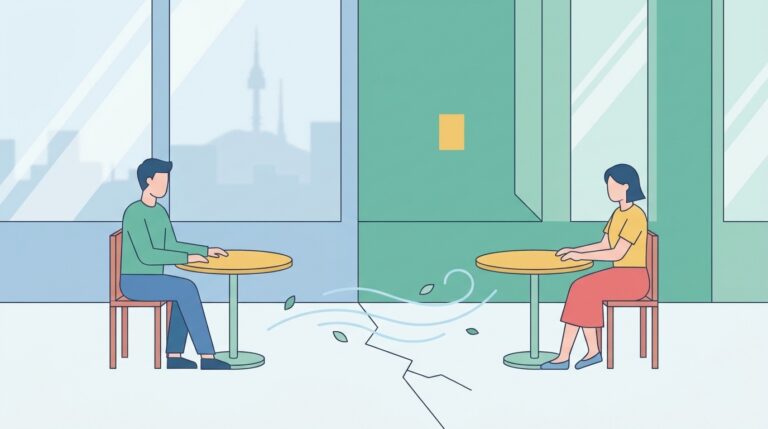
안녕하세요! 매일한글 에디터입니다. (Annyeonghaseyo! Hello from your Daily Hangul editor!) Picture this classic K-Drama moment: two inseparable friends sit across from each other in a cozy Seoul cafe, swirling their iced Americanos in icy silence. No yelling, no dramatic slams—just a sudden chill that makes everyone nearby hold their breath. If you are at a B2 level, you probably know how to say “사이가 안 좋아요” (saiga an joayo – we don’t get along). Yet when real Koreans whisper that a crack formed between them or a cold wind is blowing, textbook phrases suddenly fall short. Based on feedback from dozens of intermediate learners struggling to read office tension, this guide unlocks the vivid idioms Koreans use to navigate social rifts and shifting loyalties.
Phase 2: Top 3 Core Expressions Deep Dive
1. (두 사람) 사이에 금이 가다 ((du saram) saie geumi gada)
- Pronunciation: saie geumi gada (Sounds like “sah-ee-eh guh-mee gah-dah”—imagine tapping fine porcelain and hearing a sharp g-m crack!)
- Meaning: Literally “a crack goes between (two people).” In real life, it means a deep rift has formed in a once-close relationship due to betrayal, clashing values, or hurt feelings.
- K-Culture Moment: Think of the tense boardroom or family dinner scenes in hit K-Dramas like Queen of Tears or Reborn Rich. When two allies stop sharing secrets after a scandal, characters inevitably murmur that trust is broken and a crack has formed between them.
- Editor’s Insight: Unlike a quick fight where you shout and make up over chimaek (chicken and beer), “금이 가다” implies structural damage—like a hairline fracture in a mug. Even if both sides stay polite on the surface, the warmth doesn’t easily return.
- Situation Spectrum: Casual ✅ / Semi-formal ✅ / Formal ⚠️ (Use cautiously in formal reports; fine in private work chats)
- 🤔 Think About It: In English, people talk about “a rift” or “falling out,” whereas Korean pictures a physical crack (금, geum) in a shared vessel. Does your native language treat relationships like a fragile object, a bridge, or a temperature?
2. 찬바람이 불다 (chanbarami bulda)
- Pronunciation: chanbarami bulda (Sounds like “chahn-bah-rah-mee bool-dah”—let that crisp ch sound feel like an autumn breeze hitting your cheek!)
- Meaning: Literally “a cold wind blows.” Used metaphorically when the atmosphere between people—or in a room—turns icy, distant, and hostile.
- K-Culture Moment: Imagine an episode of the classic office drama Misaeng (Incomplete Life). When a team misses a huge deadline or two coworkers clash over credit, the whole office feels like winter arrived indoors: “오늘 우리 팀 분위기에 찬바람이 부네.” (Oneul uri tim bunwigie chanbarami bune. – An icy wind is blowing through our team’s vibe today.)
- Editor’s Insight: You can use this both for a tense room right now and for a long-term cooling off between two people—for instance, “요즘 둘 사이에 찬바람이 쌩쌩 불어요” (Yojeum dul saie chanbarami ssaengssaeng bureoyo – A freezing wind is practically howling between those two lately). Adding the mimetic word 쌩쌩 (ssaengssaeng, whistling wind) makes you sound effortlessly native!
- Situation Spectrum: Casual ✅ / Semi-formal ✅ / Formal ⚠️
- 🤔 Think About It: Korean relies heavily on weather and temperature words to describe social harmony. Why do you think indirect atmospheric metaphors feel safer than bluntly saying “They hate each other”?
3. 눈 밖에 나다 (nun bakke nada)
- Pronunciation: nun bakke nada (Sounds like “noon bahk-keh nah-dah”—stress that tight double k in bakke like locking a door!)
- Meaning: Literally “to go outside someone’s eyes.” In Korean social navigation, it means falling out of someone’s favor or losing the trust of a boss, professor, or influential senior.
- K-Culture Moment: In K-Pop survival shows or drama subplots set in strict companies, trainees and junior employees walk on eggshells because getting on a producer’s or director’s bad side—”감독님 눈 밖에 나다” (gamdongnim nun bakke nada)—can mean losing screen time or key projects.
- Editor’s Insight: Notice the direction! You don’t casually say a friend fell out of your eyes unless you’re joking dramatically. This idiom carries vertical hierarchy (위계질서, wigyejilseo). When someone says “팀장님 눈 밖에 나면 끝이야” (Timjangnim nun bakke namyeon kkeuchiya – If you fall out of the team leader’s favor, you’re done for), they’re warning you about office survival.
- Situation Spectrum: Casual ✅ / Semi-formal ✅ / Formal ⚠️
- 🤔 Think About It: Notice how being favored means staying inside someone’s line of sight (눈 안에 들다), while losing favor means being cast outside it. How does your culture describe losing a mentor’s or boss’s goodwill?
Phase 3: Textbook Korean vs. Real Korean
Situation 1: Explaining why two friends suddenly act distant
- 📖 Textbook Korean (교과서 한국어): 요즘 그 친구하고 사이가 조금 나빠졌어요. (Yojeum geu chinguhago saiga jogeum nappajeosseoyo. – Lately, my relationship with that friend has gotten a bit bad.)
- 🗣️ Real Korean (진짜 한국어): 요즘 둘 사이가 좀 서먹서먹해졌어 / 냉랭해졌어. (Yojeum dul saiga jom seomeokseomeokhaejyeosseo / naengnaenghaejyeosseo. – Lately, things have gotten awkward / chilly between those two.)
- 💡 Why Is It Different? (왜 다를까?): Saying “사이가 나쁘다” (relationship is bad) can sound blunt or childish at a B2 level. Real Korean speakers soften judgment using sensory words like 서먹서먹하다 (awkwardly stiff) or 냉랭하다 (frostily cold), which accurately capture that uncomfortable silence without naming a villain.
Situation 2: Deciding to completely stop seeing someone
- 📖 Textbook Korean (교과서 한국어): 그 사람과 더 이상 연락하거나 만나지 않기로 했어요. (Geu saramgwa deo isang yeollakhageona mannaji ankiro haesseoyo. – I decided not to contact or meet that person anymore.)
- 🗣️ Real Korean (진짜 한국어): 그쪽이랑은 아예 발을 끊었어 / 손절했어. (Geujjogirangeun aye bareul kkeuneosseo / sonjeolhaesseo. – I completely cut ties with them / cut them off.)
- 💡 Why Is It Different? (왜 다를까?): Native speakers love vivid action idioms! 발을 끊다 (bareul kkeunta – lit. sever one’s footsteps) comes from no longer visiting someone’s home or circle, while younger Seoulites also use the trendy B2 slang 손절하다 (sonjeolhada, borrowed from stock-market “cut-loss”) when protecting their peace.
Phase 4: K-Culture Deep Dive & Non-verbal Manners
4-1. Nunchi (눈치) & Gestures When Things Turn Icy
When 찬바람이 불다 happens in Korea, people rarely make a scene in public—instead, you spot it through 눈치 (nunchi, social awareness). Watch for three telltale non-verbal clues:
1. The Sudden Speech-Level Shift: If two friends who normally spoke 반말 (banmal, casual speech) suddenly switch back to stiff 존댓말 (jondaetmal, polite speech) like “그러세요” (Geureoseyo – Is that so), a massive crack (금이 가다) has formed.
2. Micro-avoidance at the Table: Normally, Koreans pour water or drinks for each other and share side dishes closely. When things turn cold, everyone pours their own glass, stares straight at their phone, and avoids passing spoons.
3. Short, Dry Acknowledgements: Instead of warm filler reactions like “아 진짜요?” (A jinjja-yo? – Oh really?), you hear flat one-word replies—”네.” (Ne.) or “알겠습니다.” (Algesseumnida.)—delivered without a nod or eye contact.
4-2. Cultural Code Analysis: K-Drama & Korean Workplace Dynamics
In K-Dramas—from corporate survival stories like Misaeng to emotional melodramas—silences speak louder than shouting matches. Because Korean workplace culture traditionally prizes 분위기 (bunwigi, group atmosphere) and 화합 (hwahap, harmony), openly confronting a senior is risky. That’s why two colleagues who have an issue often end up doing something called 입을 맞추다 (ibeul matchuda – literally “matching mouths,” meaning coordinating stories) before a big meeting so they don’t fall out of the boss’s favor (눈 밖에 나다)—even if there’s an icy wind blowing between them behind closed doors!
Phase 5: Real-life Roleplay Scenario
Setting: A sunlit, indie coffee shop in Euljiro (을지로), Seoul, humming with espresso machines during lunch break.
Characters: Ji-hoon (your perceptive Korean teammate who notices every office whisper) and You (a UX designer who just survived a tense morning meeting with Team Leader Park).
- Ji-hoon: 🎭 (Leaning over the small wooden table, lowering his voice)
오늘 회의 때 분위기가 왜 이렇게 살벌했어요? 박 팀장님 표정이 완전 굳었던데요.
(Oneul hoeui ttae bunwigiga wae ireoke salbeolhaesseoyo? Bak timjangnim pyojeongi wanjeon gudeotteondeyo.)
Why was the vibe so intense during today’s meeting? Team Leader Park’s face was completely frozen. -
You: 🎭 (Sighing softly while stirring your iced latte)
저도 눈치 보느라 혼났어요. 어제 디자인 시안 때문에 둘 사이에 찬바람이 부는 것 같아요.
(Jeodo nunchi boneura honnasseoyo. Eojae dijain sian ttaemune dul saie chanbarami buneun geot gatayo.)
I had a hard time reading the room too. Because of yesterday’s design draft, it feels like a cold wind is blowing between us. -
Ji-hoon: 🎭 (Eyes widening in surprise, tapping his cup)
설마 어제 의견 충돌 때문에 팀장님이랑 사이에 금이 간 거예요? 원래 엄청 믿으셨잖아요.
(Seolma eoje uigyeon chungdol ttaemune timjangnimirang saie geumi gan geoyeyo? Wollae eomcheong mideusyeotjanayo.)
Wait, did a crack really form between you and the team leader over yesterday’s disagreement? They used to trust you so much. -
You: 🎭 (Looking slightly worried and rubbing your neck)
제가 회의에서 너무 직설적으로 반박했나 봐요. 이러다가 팀장님 눈 밖에 날까 봐 걱정이에요.
(Jega hoeuieseo neomu jikseoljeogeuro banbakhaenna bwayo. Ireodaga timjangnim nun bakke nalkka bwa geokjeongieyo.)
I think I pushed back too bluntly in the meeting. I’m worried I might fall out of the team leader’s favor at this rate. -
Ji-hoon: 🎭 (Giving a reassuring, empathetic nod)
에이, 그 정도 가지고 발을 끊을 사이까지는 아니잖아요. 팀장님도 화가 풀리면 괜찮아지실 거예요.
(Ei, geu jeongdo gajigo bareul kkeuneul saikkajineun anijanayo. Timjangnimdo hwaga pullimyeon gwaenchanajisil geoyeyo.)
Hey, it’s not like things are bad enough to cut ties over that. Once the team leader cools down, it’ll be fine. -
You: 🎭 (Straightening up a bit, trying to stay practical)
그랬으면 좋겠네요. 오후 발표 전에는 우리라도 먼저 입을 맞춰 두는 게 낫겠죠?
(Geuraesseumyeon jokenneyo. Ohu balpyo jeoneneun urirado meonjeo ibeul matchwo duneun ge natgetjyo?)
I hope so. Before the afternoon presentation, wouldn’t it be better if at least we got our stories straight first? -
Ji-hoon: 🎭 (Smiling warmly and pulling out his tablet)
당연하죠! 제가 옆에서 잘 거들 테니까 너무 서먹서먹하게 굴지 말고 평소처럼 해요.
(Dangyeonhajyo! Jega yeopeseo jal geodeul tenikka neomu seomeokseomeokhage gulji malgo pyeongsocheoreom haeyo.)
Of course! I’ll back you up, so don’t act too awkward and just be your usual self. -
You: 🎭 (Laughing with relief and raising your coffee cup)
고마워요, 지훈 씨! 덕분에 살았어요.
(Gomawoyo, Jihun ssi! Deokbune sarasseoyo.)
Thanks, Ji-hoon! You’re a lifesaver.
🔀 Interactive Branching Point: What do you say to Team Leader Park after lunch?
- Choice A: “팀장님, 오전에는 제가 경솔했습니다. 다시 이야기 나눌 수 있을까요?” (Timjangnim, ojeoneneun jega gyeongsolhaesseumnida. Dasi iyagi nanul su isseulkkayo? – Team Leader, I was rash this morning. Could we talk again?)
- Feedback (Best ✅): Humble, mature, and packed with high nunchi! By acknowledging the tension first without over-explaining, you melt the 찬바람 (chanbaram) before the crack deepens.
- Choice B: “팀장님, 왜 저한테 그렇게 찬바람이 부세요? 저한테 화나셨어요?” (Timjangnim, wae jeohante geureoke chanbarami buseyo? Jeohante hwanasyeosseoyo? – Team Leader, why is such a cold wind blowing toward me? Are you mad at me?)
- Feedback (Risk ⚠️): Even though 찬바람이 불다 is a great idiom, throwing it directly at a superior puts them on the spot! Use 찬바람이 불다 when describing a situation to a third party, not when confronting your boss.
- Choice C: “어차피 의견 안 맞으니까 그냥 저쪽 팀이랑 발을 끊고 우리끼리 해요.” (Eochapi uigyeon an majeunikka geunyang jeojjok timirang bareul kkeunko urikkiri haeyo. – Since we disagree anyway, let’s just cut ties with that team and do it ourselves.)
- Feedback (Bad 🚫): Way too extreme for a workplace disagreement! In Korean office culture, suggesting you 발을 끊다 over one design clash makes you look impulsive and hard to work with.
Phase 6: 10-Second Emotion Shadowing Drill
Read these out loud! Pause briefly at each / and really lean into the emotion.
- [😟 Worried and whispering]
어제 그 일 때문에 / 둘 사이에 / 금이 간 것 같아.
(Eoje geu il ttaemune / dul saie / geumi gan geot gata.)
Because of what happened yesterday / between the two of them / I think a crack has formed. -
[🥶 Shivering at the awkwardness]
방에 들어가자마자 / 분위기에 / 찬바람이 쌩쌩 불더라고.
(Bange deureogajamaja / bunwigie / chanbarami ssaengssaeng buldeorago.)
As soon as I walked into the room / in the atmosphere / a freezing wind was howling. -
[🧐 Serious and giving advice]
아무리 화가 나도 / 윗사람 눈 밖에 나면 / 진짜 피곤해져.
(Amuri hwaga nado / wissaram nun bakke namyeon / jinjja pigonhaejyeo.)
No matter how angry you get / if you fall out of a senior’s favor / life gets really exhausting.
Phase 7: K-Culture Mini Dictionary
- 서먹서먹하다 (seomeokseomeokhada) | Awkward and distant | Used when two people who used to be warm—or who haven’t met in ages—feel stiff and unnatural together. Example: “오랜만에 만나니 좀 서먹서먹하네.” (Oraenmane mannani jom seomeokseomeokhane. – Seeing each other after so long feels a bit awkward.)
- 발을 끊다 (bareul kkeunta) | To cut ties / stop visiting | Used both literally (never visiting a restaurant again after bad service: “그 식당은 발을 끊었어”) and socially (completely stopping contact with someone or a group).
- 입을 맞추다 (ibeul matchuda) | To get one’s stories straight / coordinate | Literally “match mouths.” In business or drama plots, it means agreeing on what to say beforehand so no one contradicts each other. (Careful: in romantic contexts, it can also mean kissing, so context matters!)
- 소원해지다 (sowonhaejida) | To grow apart / become estranged | A refined B2 verb (소원하다, not to be confused with 소원, “wish”!) for relationships that naturally cool down over time without a big fight.
Phase 8: Survival Kit for Travelers
Top 3 Survival Phrases for Smoothing Over Awkward Moments
- 오해가 좀 있었던 것 같아요. (Ohaega jom isseotteon geot gatayo.) — “I think there was a slight misunderstanding.”
Pro Tip: Softens tension immediately without blaming anyone. - 제가 눈치가 좀 없었네요, 죄송해요. (Jega nunchiga jom eopseonneyo, joesonghaeyo.) — “I wasn’t very observant, I’m sorry.”
Pro Tip: Koreans love hearing foreigners use 눈치 self-deprecatingly—it instantly melts an icy vibe! - 서운하셨다면 정말 죄송합니다. (Seounhasyeotdamyeon jeongmal joesonghamnida.) — “I’m truly sorry if you felt hurt/left out.”
Pro Tip: 서운하다 (seounhada) expresses hurt disappointment gently; acknowledging it shows high emotional intelligence.
Editor’s Travel Note
Navigating Seoul smoothly also means avoiding unnecessary friction on the road! Before landing, download the Naver Map app or set up the KakaoMap route planner, since global map apps often miss Korean walking paths and bus exits. Grab a T-money card at any GS25 or CU convenience store for seamless subway and bus transfers, and remember: on crowded Seoul subways, keeping your backpack on your chest prevents accidental bumps that could start an awkward stare-down!
Phase 9: One Step Deeper
In Korean culture, relationships are traditionally woven around 정 (jeong)—an invisible, sticky emotional bond built through shared meals, favors, and unspoken loyalty. Because 정 connects individuals into a tight 우리 (uri, “we”) circle, a personal disagreement rarely stays purely private; it ripples through the whole group’s atmosphere. That is why idioms like “사이에 금이 가다” or “찬바람이 불다” feel so vivid in Korean: when trust breaks, it feels as undeniable as a cracked porcelain bowl or a sudden drop in room temperature. Understanding these metaphors doesn’t just upgrade your B2 vocabulary—it helps you sense the emotional currents beneath polite Korean smiles.
💬 Your Turn: How do people in your native language describe an awkward rift or icy silence between friends? Drop your favorite idiom in the comments below—I’d love to compare!
Phase 10: FAQ & Common Mistakes
Q: Can I tell someone directly, “우리 사이에 금이 간 것 같아요” (I think a crack formed between us)?
A: Yes, you can! While 찬바람이 불다 sounds odd when hurled as an accusation at a boss, 사이에 금이 가다 works well in serious, heart-to-heart talks with a close friend or partner when you want to address trust honestly.
Q: Does “입을 맞추다” always mean conspiring or lying?
A: Not always! In business or school group projects, saying “발표 전에 입을 맞추자” (Balpyo jeone ibeul matchuja – Let’s align our talking points before the presentation) is completely positive and practical. Just check the tone—if detectives or shady K-Drama villains say it, it means covering up a secret!
Q: What is the difference between “발을 끊다” and “연락을 끊다”?
A: 연락을 끊다 (yeollageul kkeunta) specifically means cutting off phone calls, texts, and messages. 발을 끊다 (bareul kkeunta) means you stop physically showing up—whether at someone’s house, a club, or a regular cafe you’re boycotting.
🚨 Common Mistakes Alert
- Mistake: Saying “사이가 금이 갔어요” (wrong particle!).
- Correct Action: Always attach ~에 (-e) to 사이: “두 사람 사이에 금이 갔어요” (saie = in the space between).
- Mistake: Using “눈 밖에 나다” for romantic breakups between equals.
- Correct Action: Use 눈 밖에 나다 when someone with authority (a boss, professor, parent-in-law) loses trust in you. For equals growing apart, use 사이가 멀어지다 or 소원해지다.
- Mistake: Confusing 소원해지다 (grow distant) with 소원 (a wish).
- Correct Action: Remember context! “소원을 빌다” is making a wish; “둘 사이가 소원해지다” means two people drifted apart.
Phase 11: Action Mission & Engagement
- 🥉 Bronze Mission (Solo Practice): Look in the mirror and say all three Phase 6 shadowing lines aloud twice, matching the worried, shivering, and serious tones.
- 🥈 Silver Mission (Community Share): Share one Korean idiom you learned today on your study Instagram or language-exchange chat using a mini K-Drama scene caption!
- 🥇 Gold Mission (Real-Life Use): Next time you chat with a Korean friend about a tense movie scene or celebrity rumor, casually drop “둘 사이에 찬바람이 부는 것 같아요” and watch their amazed reaction!
- 🎮 K-Culture Mission: Watch one episode of an office or family K-Drama (like Misaeng or Queen of Tears) with Korean subtitles on, and spot at least one moment where characters silently 눈치 each other or mention 금이 가다 / 눈 밖에 나다!
Phase 12: Interactive Quiz Challenge
Test your B2 social-navigation instincts before checking the answers!
- Situational Judgment: Your Korean friend tells you they got terrible service at their favorite neighborhood bakery and will never step foot inside again. Which expression fits best?
A) 그 빵집 눈 밖에 났어.
B) 그 빵집은 이제 발을 끊었어.
C) 그 빵집이랑 입을 맞췄어. -
Fill in the Blank: Complete the sentence naturally:
“팀장님과 의견이 안 맞아서 요즘 사무실 분위기에 ( _________ ) 불어요.”
(Hint: It feels chilly in the office!) -
True or False (Culture Quiz): In Korean, saying “우리 입을 맞추자” to a coworker before a client meeting always means you are inviting them for a romantic kiss.
Click to reveal answers and detailed explanations
- Question 1 Answer: B) 그 빵집은 이제 발을 끊었어.
Feedback: If you picked A, remember 눈 밖에 나다 means falling out of a person’s favor (hierarchical), not boycotting a bakery! Choice C (입을 맞추다) means coordinating stories. 발을 끊다 is the exact idiom for cutting off visits to a place or person. - Question 2 Answer: 찬바람이 (chanbarami)
Explanation: “찬바람이 불다” describes a frosty, tense atmosphere—perfect for an office after a disagreement. - Question 3 Answer: False!
Explanation: While 입을 맞추다 can mean kissing in romantic fiction, in workplaces and everyday conversation it overwhelmingly means aligning your stories or talking points beforehand so everyone stays on the same page!
🎬 Watch Our Daily Videos! (Daily Hangul Official Instagram)
Review the expressions you learned in this article with our fun daily short videos! Check out native pronunciation and real-life nuances in action.
- Instagram @dailyhangul_en







