

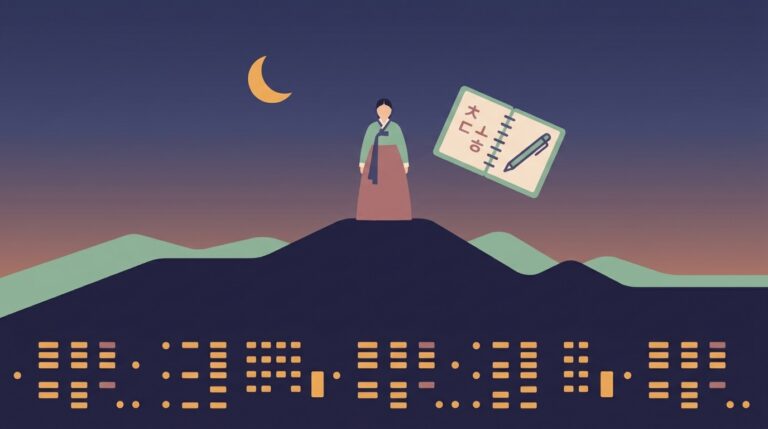
Phase 1: The Midnight Philosophy Dilemma
안녕하세요! 매일한글 에디터입니다. (Annyeonghaseyo! Maeil Hangeul editeo-imnida.) Hello, this is your Daily Hangul editor.
Have you ever sat in a misty Seoul pojangmacha after binging My Liberation Notes or Death’s Game, aching to discuss Heidegger’s Being-toward-death with your Korean friends—only to freeze up? Many C2 learners I’ve coached ace formal exams yet sound like dusty textbooks when talking about mortality and existential angst. In this guide, built on real learner feedback, you’ll gain the razor-sharp idioms and cultural nuance to articulate how confronting finitude awakens authentic selfhood—just like a native Korean thinker.
Phase 2: Deep Dive into 3 Core Expressions
1. 유한성을 직시하다 (yuhanseong-eul jikshihada)
- Pronunciation: yuhanseong-eul jikshihada (sounds like yoo-hahn-sung-ul jik-shee-ha-da, with jik landing as crisp as “geek” starting with a J)
- Meaning: Literally “to look straight at boundedness,” this means to confront one’s finite mortality head-on without flinching or making excuses.
- K-Culture Moment: Think of the protagonist in the hit K-Drama Death’s Game (이재, 곧 죽습니다), who only begins to truly perceive the value of every fleeting breath once death stops being an abstract concept and stares him right in the face.
- Editor’s Insight: While 마주하다 (majuhada, to face) works for general difficulties, 직시하다 carries an unflinching, almost surgical moral courage. Native intellectuals favor it when stripping away comfortable illusions.
- Situation Spectrum: Casual ⚠️ / Semi-formal ✅ / Formal ✅
- 🤔 Think About It: English uses physical metaphors like “grapple with” or “confront” mortality, whereas Korean uses 직시 (a direct, unblinking gaze). Why do you think visual clarity equates to existential honesty in Korean?
2. 실존적 불안에 휩싸이다 (siljonjeok buran-e hwipssaida)
- Pronunciation: siljonjeok buran-e hwipssaida (sounds like shil-john-juck boo-rahn-eh hweep-ssah-ee-da, where the double ss hisses tightly like a sudden gust of wind)
- Meaning: Literally “to be wrapped up in existential anxiety,” capturing Heideggerian Angst—that uncanny moment when everyday distractions collapse and existence feels naked.
- K-Culture Moment: Remember Yeom Mi-jeong’s quiet, suffocating dread on the Seoul subway in My Liberation Notes (나의 해방일지)? She isn’t afraid of a specific crisis; she is engulfed by the hollow weight of an unlived, conformist routine.
- Editor’s Insight: Choosing 휩싸이다 (to be engulfed/swept up) over the plain 느끼다 (neukkida, to feel) paints angst as an all-encompassing atmosphere rather than a passing mood.
- Situation Spectrum: Casual ⚠️ / Semi-formal ✅ / Formal ✅
- 🤔 Think About It: English borrows the German Angst to separate existential dread from everyday worry, while Korean modifiers attach 실존적 (existential) to 불안 (unease). How does having one root word for both affect how Koreans talk about mental weight?
3. 본래적 자아로 깨어나다 (bollaejeok jaa-ro kkaeeonada)
- Pronunciation: bollaejeok jaa-ro kkaeeonada (sounds like bohl-leh-juck jah-ah-roh kkeh-uh-nah-da; notice how n+r melts smoothly into a liquid l sound like “bowl-lay”)
- Meaning: Literally “to wake up as one’s original self,” meaning to shatter social conformity and awaken into Heidegger’s authentic selfhood (Eigentlichkeit) through Being-toward-death.
- K-Culture Moment: Like Park Dong-hoon in My Mister (나의 아저씨), who spends decades swallowing unfairness to keep the peace, until a brush with total collapse wakes up his true moral backbone.
- Editor’s Insight: Pairing 본래적 (primordial/authentic) with 깨어나다 (to wake up) treats authenticity not as inventing yourself from scratch (like Sartre’s radical creation), but as snapping out of society’s sleepwalk.
- Situation Spectrum: Casual ⚠️ / Semi-formal ✅ / Formal ✅
- 🤔 Think About It: In a hyper-connected society where blending in often feels safer than standing apart, how radical does it feel to claim a 본래적 자아 (authentic self) out loud?
Phase 3: Textbook Korean vs. Real Korean
Even at the C2 level, speaking like a translated Heidegger treatise over late-night drinks will make your Korean friends smile politely and change the subject. Here is how sharp native speakers actually voice these heavy truths.
Situation 1: Explaining how confronting mortality transforms how you live
* 📖 교과서 한국어: 우리는 죽음을 인식함으로써 본래적 실존을 회복할 수 있습니다. (Urineun jukeum-eul inshikhameurosseo bollaejeok siljon-eul hoebokhal su itseumnida.) — By recognizing death, we can recover authentic existence.
* 🗣️ 진짜 한국어: 죽음이 코앞에 닥쳐봐야 비로소 내 인생을 제대로 살게 되더라고요. (Jugeum-i koap-e dakchyeobwaya biroso nae insaeng-eul jedaero salge doedeoragoyo.) — You honestly only start living your own life properly once death lands right in front of your nose.
* 💡 왜 다를까?: Outside lecture halls, Koreans swap stiff nominalized clauses (-ㅁ으로써) for visceral idioms like 코앞에 닥치다 (right before one’s nose) and the reflective -더라고요 ending, grounding philosophy in lived experience.
Situation 2: Critiquing how society hides from existential angst in the crowd
* 📖 교과서 한국어: 현대인은 세인에 매몰되어 실존적 불안을 회피합니다. (Hyeondaein-eun sein-e maemoldoe-eo siljonjeok buran-eul hoepihamnida.) — Modern people are buried in the “They” and evade existential anxiety.
* 🗣️ 진짜 한국어: 다들 남 눈치 보며 휩쓸려 사느라 정작 ‘내가 누구인지’는 애써 외면하는 거죠. (Dadeul nam nunchi bomyeo hwipssullyeo saneura jeongjak ‘naega nuguinji’-neun aesseo oemyeonhaneun geojyo.) — Everyone’s so busy reading the room and getting swept along that they deliberately look away from who they actually are.
* 💡 왜 다를까?: Rather than dropping the academic word 세인 (Das Man), real Koreans express that exact conformity through 남 눈치 보다 (watching others’ cues) and 휩쓸려 살다 (living swept away by the current).
Phase 4: K-Culture Deep Dive & Non-Verbal Manners
4-1. 눈치 (Nunchi) & Gestures
When unpacking 죽음에로의 선구 (Being-toward-death) in Korea, your delivery matters as much as your vocabulary. Avoid rapid-fire debating or aggressive hand gestures—which can feel dismissive when discussing mortality. Instead, practice 여유 (yeoyu, unhurried composure): lower your vocal pitch slightly, allow a two-second thoughtful silence (침묵, chimmuk) before responding to show you’ve genuinely weighed your friend’s words, and hold eye contact softly rather than intensely. If you’re over drinks, quietly refilling their glass with both hands signals 배려 (baeryeo, empathetic care) even as you dissect bleak existential truths.
4-2. Cultural Code Analysis: K-Drama & Modern Korean Literature
Why are existential dramas like My Liberation Notes (나의 해방일지) and Death’s Game (이재, 곧 죽습니다), alongside authors like Han Kang (한강) and Kim Young-ha (김영하), resonating so fiercely in Korea right now? For decades, Korea’s compressed modernization demanded living as Heidegger’s 세인 (the anonymous “They”)—chasing identical milestones of universities, corporations, and apartments. Today’s K-Culture waves push back against that autopilot. By staring directly at finitude, burnout, and mortality, modern Korean storytellers argue that Sartre’s burden of free choice and Heidegger’s Angst aren’t morbid luxuries—they are the only exit door from suffocating social expectations.
Phase 5: Live Roleplay Scenario
Setting & Characters: It’s 11:30 PM on a rainy Friday at a tucked-away vinyl LP bar in Euljiro, Seoul. Rain taps against the fogged window while quiet jazz hums in the background. You’re sitting across from Ji-hoon (지훈), a 32-year-old Korean film critic who recently walked away from a prestigious corporate career after a sudden health scare forced him to rethink his life.
- Ji-hoon: 🎭 (Swirling ice in his whisky glass, staring thoughtfully at the wet window) 옛날엔 남들 뒤처질까 봐 앞만 보고 달렸는데, 막상 병실에 누워 보니 다 부질없더라고요. (Yetnal-en namdeul dwicheojilkka bwa apman bogo dallyeotneunde, maksang byeongshil-e nuwo boni da bujireopdeoragoyo.) — Back then I ran forward terrified of falling behind others, yet lying in that hospital bed made it all feel futile.
- You: 🎭 (Leaning in attentively, nodding slowly) 결국 유한성을 직시하게 되면서 비로소 삶의 우선순위가 뒤바뀐 거네요. (Gyeolguk yuhanseong-eul jikshihage doemyeonseo biroso salm-ui useonsunwiga dwibakkwingeoneyo.) — So by confronting your finitude head-on, your life’s priorities finally flipped.
- Ji-hoon: 🎭 (Giving a wry, quiet smile) 맞아요. 하이데거가 말한 ‘죽음에로의 선구’가 책 속 글자가 아니라 뼈저리게 와닿았죠. (Majayo. Haidegeo-ga malhan ‘jugeum-ero-ui seongu’-ga chaek sok geulja-ga anira ppyeojeorige wadaatjyo.) — Exactly. Heidegger’s ‘Being-toward-death’ stopped being ink on a page and hit me right to the bone.
- You: 🎭 (Lowering your voice to match the quiet bar) 그렇지만 일상의 안전한 틀을 깨고 나오면, 말로 설명하기 힘든 실존적 불안에 휩싸이기도 하지 않아요? (Geureochiman ilsang-ui anjeonhan teur-eul kkaego naomyeon, mallo seolmyeonghagi himdeun siljonjeok buran-e hwipssai-gido haji anayo?) — Still, once you break out of everyday safety nets, don’t you get engulfed by an existential angst that’s hard to put into words?
- Ji-hoon: 🎭 (Sighing softly, looking straight at you) 당연하죠. 사르트르 말대로 자유라는 게 결국 온전한 책임을 떠안는 형벌 같을 때도 있어요. (Dangyeonhajyo. Sareuteureu maldaero jayuraneun ge gyeolguk onjeonhan chaegim-eul tteoanneun hyeongbeol gateul ttaedo isseoyo.) — Of course. Just like Sartre said, freedom sometimes feels like a sentence where you shoulder total responsibility.
- You: 🎭 (Raising your glass gently) 그래도 남의 기준에 매몰되지 않고 본래적 자아로 깨어났다는 게 정말 멋지네요. (Geuraedo nam-ui gijun-e maemoldoeji anko bollaejeok jaa-ro kkaeeonatdaneun ge jeongmal meotjineyo.) — Even so, awakening to your authentic self instead of being buried in other people’s standards is truly admirable.
- Ji-hoon: 🎭 (Clinking his glass lightly against yours) 덕분에 오늘은 불안을 피하지 않고, 그냥 이 밤을 온전히 살아 보려고요. (Deokbun-e oneur-eun buran-eul pihaji anko, geunyang i bam-eul onjeonhi sara boryeogoyo.) — Thanks to you, tonight I won’t dodge the angst—I’ll just try living this night completely.
- You: 🎭 (Smiling warmly) 그럼 오늘 밤 우리의 선택과 실존을 위해서 건배할까요? (Geureom oneul bam uri-ui seontaek-gwa siljon-eul wihaeseo geonbaehalkkayo?) — Then shall we toast to our choices and existence tonight?
🔀 Interactive Branching Point
Right after Ji-hoon admits his fear of total freedom and responsibility, how would you naturally keep this C2 philosophical conversation flowing? Choose your reply:
* Option A: “맞아요, 사르트르가 말했듯 실존이 본질에 앞서니까 이제 지훈 씨만의 본질을 매일 만들어 가는 거죠!” (Majayo, Sareuteureu-ga malhaetdeut siljon-i bonjir-e apseonikka ije Ji-hoon ssi-man-ui bonjir-eul maeil mandeureo ganeun geojyo! — Right, as Sartre said, existence precedes essence, so now you’re crafting your own essence daily!)
* Option B: “에이, 너무 깊게 생각하지 마세요! 그냥 좋은 회사 다시 들어가면 불안도 금방 사라질 거예요.” (Ei, neomu gipge saenggakhaji maseyo! Geunyang joeun hoesa dasi deureogamyeon burando geumbang sarajil geoyeyo. — Aw, don’t overthink it! Just rejoin a good company and the anxiety will vanish quickly.)
* Option C: “사실 죽음이란 건 누구에게나 공평한 거니까, 지금 느끼는 불안도 일종의 사치 아닐까요?” (Sashil jugeum-iran geon nugu-egena gongpyeonghan geonikka, jigeum neukkineun burando iljong-ui sachi anilkkayo? — Actually, death is fair to everyone, so isn’t the angst you feel now a kind of luxury?)
Feedback:
* Option A (Best!): Brilliant C2 pivot! You seamlessly bridge Heidegger’s anxiety with Sartre’s core thesis (실존이 본질에 앞선다), validating Ji-hoon’s courage while honoring his agency.
* Option B (Bad!): Ouch—this dismisses his profound existential awakening and drags him straight back into the conformist trap (세인) he fought hard to escape.
* Option C (Risk!): Calling someone’s raw Angst a “luxury” (사치) sounds cynical and could shut down emotional vulnerability, though a very close philosophical sparring partner might debate it playfully.
Phase 6: 10-Second Emotion Shadowing Drill
Practice these C2 sentences aloud. Pause slightly at every / and lock into the emotional cues so your rhythm flows like a native thinker:
- [😔 Calm and reflective] 우리는 / 죽음이라는 유한성을 직시할 때만 / 비로소 삶의 무게를 깨닫는다. (Urineun / jugeum-iraneun yuhanseong-eul jikshihal ttaeman / biroso salm-ui mugereul kkaedatneunda. — Only when we stare straight at the finitude called death / do we finally grasp the weight of life.)
- [😮 Quietly struck by realization] 남들의 시선 속에 숨어 있다가 / 갑작스러운 불안에 휩싸였을 때 / 진짜 내가 보이기 시작했다. (Namdeur-ui shiseon sok-e sumeo itdaga / gapjakseureoun buran-e hwipssayeosseul ttae / jinjja naega boigi shijakhaetda. — After hiding in others’ gazes / when I was suddenly engulfed by angst / the real me began to appear.)
- [🔥 Resolute and grounded] 불안을 회피하지 않기로 한 순간 / 나는 세인에서 벗어나 / 본래적 자아로 깨어났다. (Buran-eul hoepihaji ankiro han sungan / naneun sein-eseo beoseona / bollaejeok jaa-ro kkaeeonatda. — The moment I chose not to evade angst / I broke free from the crowd / and awakened to my authentic self.)
Phase 7: K-Culture Mini Dictionary
- 죽음에로의 선구 (jugeum-ero-ui seongu) | Being-toward-death / Anticipation of death | Used in university philosophy circles, literary podcasts, and deep essays analyzing how facing mortality strips away trivial fears.
- 세인 (sein) | The “They” (Das Man) | Appears in cultural criticism and book club debates to describe the anonymous social herd dictating how we ought to dress, work, and think.
- 비본래성 (bibollaeseong) | Inauthenticity | Common in indie film reviews and existential aesthetics when critiquing characters living entirely on autopilot.
- 현존재 (hyeonjonjae) | Dasein (Being-there) | The foundational term in Korean phenomenology papers for human existence that constantly questions its own being.
Phase 8: Survival Kit for Travelers
Planning a trip to Seoul’s independent bookstores in Seochon or literary cafes in Yeonnam-dong? Keep these C2 survival lines handy:
- 철학이나 인문학 서적 코너는 어디에 있나요? (Cheolhak-ina inmunhak seojeok koneoneun eodi-e itnayo? — Where is the philosophy or humanities book section?) | Pro Tip: Larger bookstores like Kyobo use touch-screen kiosks, but indie shops love personal questions about curated shelves.
- 혹시 실존주의 관련 독서 모임도 운영하시나요? (Hokshi siljonjuui gwallyeon dokseo moim-do unyeonghashinayo? — By any chance, do you also host any reading groups related to existentialism?) | Pro Tip: Many neighborhood bookshops in Mapo-gu run evening 북토크 (book talks) open to fluent foreigners!
- 조용히 사색하며 읽을 수 있는 자리를 추천해 주시겠어요? (Joyonghi sasaekhamyeo ilgeul su itneun jarireul chucheonhae jushigesseoyo? — Could you recommend a seat where I can read quietly in contemplation?) | Pro Tip: Using the elevated word 사색하다 (to contemplate deeply) immediately signals refined Korean fluency.
Editor’s Travel Note: Before heading out to hunt down rare Korean translations of Heidegger or Sartre, Download Naver Map App for Seoul Indie Bookstores since Google Maps lacks accurate walking routes in Korea, and Check Kyobo Book Centre Gwanghwamun Stock ahead of time. Grab a T-money transit card at any convenience store for seamless subway transfers between Gwanghwamun and Hongdae, and bring a physical credit card or KakaoPay since tiny literary cafes rarely keep change for large cash bills.
Phase 9: One Step Deeper
Korean grammar constantly reminds speakers of their relational web—through honorifics, context-dependent pronouns, and the possessive 우리 (uri, “our”) even for personal things like 우리 엄마 (my/our mom). At first glance, that collective gravity seems to clash head-on with Heidegger’s solitary confrontation with death and Sartre’s fierce insistence that each individual alone bears total responsibility for their essence. Yet in Korea, confronting mortality doesn’t necessarily turn you into a cold, isolated island. Instead, passing through existential Angst often births a deeper 정 (jeong, heartfelt solidarity)—a quiet understanding that because every single one of us is finite, our shared moments carry irreplaceable weight.
💬 Your Turn: In your native language or culture, is talking openly about mortality and existential dread seen as inspiring wisdom or an uncomfortable taboo? Drop your thoughts in the comments below!
Phase 10: FAQ & Common Mistakes
Q: Can I literally call someone “세인” (sein) in a casual Korean conversation?
A: Not unless you’re in a philosophy seminar or joking with literature majors! In everyday speech, calling someone 세인 will draw blank stares because it sounds like a typo for 성인 (adult) or a person’s name. Use 남들 눈치 보는 사람 (someone overly worried about what others think) instead.
Q: What is the difference between “실존적 불안” (existential angst) and regular “불안감” (anxiety)?
A: Everyday 불안감 (burangam) or 걱정 (geokjeong) has a concrete trigger—like an upcoming exam or a late bill. Adding 실존적 (siljonjeok) elevates it to the philosophical dread of existence, freedom, and mortality itself.
Q: How do Koreans differentiate Heidegger’s essence vs. Sartre’s “existence precedes essence”?
A: Korean scholars phrase Sartre’s famous maxim cleanly as 실존이 본질에 앞선다 (siljon-i bonjir-e apseonda), emphasizing free self-creation, whereas Heidegger’s 본래적 자아 focuses on waking up to our finite 현존재 (Dasein) amid mortality.
🚨 Common Mistakes Warning Board
- Mistake: Saying 나는 죽음을 선구한다 directly in daily chat. → Correct Action: Keep 죽음에로의 선구 as a noun phrase inside academic quotes; in real speech, say 죽음을 직시하다 (to look death straight in the eye).
- Mistake: Confusing 본질적 (essential/fundamental) with 본래적 (authentic/original) when translating Heidegger. → Correct Action: Use 본래적 자아 for authentic selfhood, reserving 본질적 for core traits or Sartre’s 본질 (essence).
- Mistake: Using blunt, low-form speech (반말) when asking a Korean elder or stranger deep questions about death. → Correct Action: Always cushion sensitive philosophical questions with soft, polite endings like -더라고요 or -지 않을까요?.
Phase 11: Action Mission & Engagement
- 🥉 Bronze Mission (Solo Practice): Record a 30-second voice memo in Korean using all three Phase 2 expressions to describe what living authentically means to you.
- 🥈 Silver Mission (Social Share): Post your favorite quote from Phase 3 on Threads or Instagram with both Hangul and English, tagging a friend who loves deep midnight talks.
- 🥇 Gold Mission (Real-World Use): The next time you chat with a Korean language partner or friend over coffee, steer the topic toward a meaningful K-Drama and naturally weave in 직시하다 or 휩싸이다.
- 🎮 K-Culture Mission: Rewatch an episode of My Liberation Notes (나의 해방일지), My Mister (나의 아저씨), or listen to RM’s solo tracks, and spot one scene where a character sheds 세인 conformity to awaken their 본래적 자아!
Phase 12: Interactive Quiz Challenge
Test your C2 philosophical Korean before wrapping up!
1. Situational Judgment: Your Korean friend says they finally quit chasing society’s checklist after realizing life is short. Which expression best affirms their courage?
A) 이제야 세인에 완전히 매몰되었네요.
B) 유한성을 직시하고 본래적 자아로 깨어났군요.
C) 그냥 일상적인 불안감을 피하고 있는 거네요.
Check Answer & Feedback (Quiz 1)
Answer: B) 유한성을 직시하고 본래적 자아로 깨어났군요. (Yuhanseong-eul jikshihago bollaejeok jaa-ro kkaeeonatgunyo.)
Why A is wrong: 세인에 매몰되다 means being buried in herd conformity—the exact opposite! Why C is wrong: Accusing them of dodging ordinary anxiety undermines their brave choice.
2. Fill in the Blank: In a natural conversation, complete the idiom for when mortality hits close to home: “죽음이 ____에 닥쳐봐야 비로소 깨닫게 돼요.” (Jugeum-i ____-e dakchyeobwaya biroso kkaedatge dwaeyo.)
Check Answer & Feedback (Quiz 2)
Answer: 코앞 (koap — right in front of one’s nose)
Full sentence: 죽음이 코앞에 닥쳐봐야 비로소 깨닫게 돼요. This vivid native idiom instantly replaces dry textbook phrasing.
3. True/False Cultural Quiz: In Korea, using academic German-translated terms like 세인 (Das Man) and 현존재 (Dasein) while chatting at a casual pojangmacha makes you sound like the most natural native speaker.
Check Answer & Feedback (Quiz 3)
Answer: False!
While C2 learners should master 세인 and 현존재 for essays, lectures, and book reviews, native speakers over drinks prefer idiomatic equivalents like 남 눈치 보다 and 휩쓸려 살다 to keep the warmth and rhythm natural.
🎬 Watch Our Daily Videos! (Daily Hangul Official Instagram)
Review the expressions you learned in this article with our fun daily short videos! Check out native pronunciation and real-life nuances in action.
- Instagram @dailyhangul_en







