

Phase 1: Empathy & Storytelling Opening
안녕하세요! 매일한글 에디터입니다! (Hello! It’s your Daily Hangul editor!)
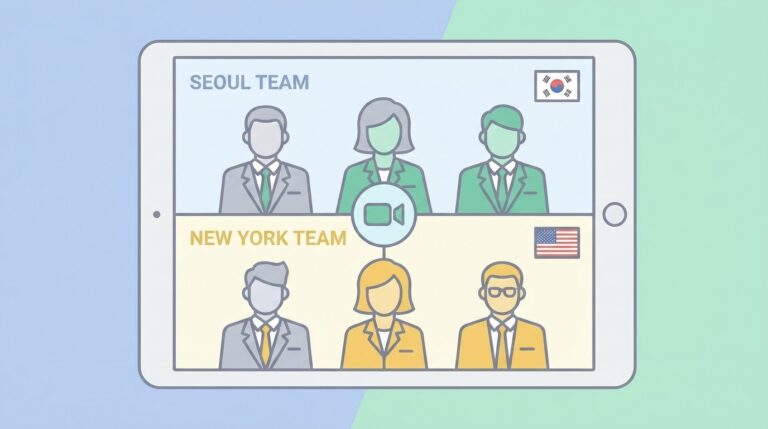
Picture this: You are on a crucial Zoom call bridging the executive team at headquarters in California and the engineering leads in Seoul. The US VP asks eagerly, “Can we launch the new fintech feature by next Friday?” On the Seoul screen, Manager Park smiles warmly, pauses, scratches his temple, and says:
“아, 그 부분은 일정이 조금 빠듯해서 내부 검토가 필요할 것 같습니다.”
(A, geu bubuneun iljeongi jogeum ppadeut-haeseo naebu geomtoga piryohal geot gatseumnida.)
“Ah, that part… the schedule is a bit tight, so internal review seems necessary.”
The American VP beams: “Awesome! So it’s tight, but they’re on it. Let’s aim for Friday!” Meanwhile, your stomach drops into your shoes. As someone who understands Korean corporate DNA, you know Manager Park didn’t say “We’ll try.” In high-context Korean business culture, that delicate sentence translates to: “There is a 0% chance this happens by Friday without the entire team collapsing.”
If you translate the words literally, HQ hears “Yes, with a challenge.” If you translate bluntly by saying “He said no,” the Korean team feels disrespected and exposed. Over my ten years mentoring global liaisons and bilingual coordinators, this exact breakdown is the single biggest cause of friction between foreign headquarters and Korean branches. The secret isn’t just knowing the vocabulary—it’s decoding Korean high-context indirectness (완곡어법, wan-gok-eo-beop) and tactfully converting it into crisp, quantitative metrics and actionable trade-offs that Western executives respect. Let’s master the art of being the ultimate cross-cultural diplomat!
Phase 2: Core Expressions Deep Dive
Here are the top three euphemisms you will hear in almost every Korea-HQ video conference, along with the blueprint for transforming them into solid business data.
1. 일정이 조금 빠듯할 것 같습니다 (Iljeongi jogeum ppadeuthal geot gatseumnida)
- Pronunciation: [Il-jeong-i jo-geum ppa-deut-hal geot gat-seum-ni-da] (Pro-tip: Pronounce “ppa” with a popping, tense double-p sound like popping bubble wrap, and glide softly through “deut-hal”).
- Meaning:
- Literal translation: “The schedule seems a bit tight.”
- Actual business nuance: “This timeline is mathematically impossible with our current staff. We are heading for a delivery failure unless the scope is reduced or the deadline shifts by at least two weeks.”
- K-Culture Moment: Think of the classic office drama Misaeng (Incomplete Life). Whenever Manager Oh rubs the back of his neck, looks at his monitor sideways, and murmurs this phrase, you know the team is about to pull three consecutive all-nighters unless someone intervenes.
- Editor’s Insight: Koreans avoid direct negatives (안 됩니다, An doemnida – “It cannot be done”) because preserving relational harmony (기분, gibun) is paramount. Modifiers like “조금” (jogeum – a bit) and “~것 같다” (-geot gatda – it seems like) act as protective shock absorbers. When interpreting for HQ, drop the emotional cushion and substitute a metric: “The Seoul engineering sprint is at 120% capacity; to deliver quality code, we require a 10-day buffer.”
- Situation Spectrum: Casual 🚫 | Semi-formal ⚠️ | Formal ✅
- 🤔 Think About It: In low-context cultures, ambiguity can feel evasive or incompetent. In high-context Korean culture, brutal directness can feel hostile. How can numbers serve as a neutral language that protects both sides?
2. 내부 검토 후 다시 말씀드리겠습니다 (Naebu geomtto hu dasi malsseumdeurigessseumnida)
- Pronunciation: [Nae-bu geom-to hu da-si mal-sseum-deu-ri-get-seum-ni-da] (Pronounce “geom-to” like “gum-toe”, keeping the vowels short and crisp).
- Meaning:
- Literal translation: “We will speak again after internal review.”
- Actual business nuance: “We cannot approve this on the spot because cross-departmental consensus (품의, pum-ui) is required. Pushing us for an answer right now will only trigger institutional resistance.”
- K-Culture Moment: Seen in hit startup series like Start-Up when venture capitalists or senior partners politely smile, bow their heads 15 degrees, and close their notebooks with this exact remark.
- Editor’s Insight: HQ often expects team leads to make executive decisions on live video calls. Korean leadership, however, relies on collective sign-offs (결재, gyeolje). Don’t leave HQ hanging with “They’ll look into it.” Convert it into an SLA: “The Korea office needs a 48-hour internal alignment window to assess QA risks and will submit an official impact summary by Thursday 10 AM KST.”
- Situation Spectrum: Casual 🚫 | Semi-formal ✅ | Formal ✅
- 🤔 Think About It: How does your native workplace culture view collective decision-making versus individual empowerment during live meetings?
3. 현실적으로 다소 어려움이 있습니다 (Hyeonsiljeogeuro daso eoryeoumi itseumnida)
- Pronunciation: [Hyeon-sil-jeog-eu-ro da-so eo-ryeo-um-i it-seum-ni-da] (Pronounce “Hyeon” like “Hyun” in Hyun Bin, and make the “eo” an open, relaxed ‘uh’ sound).
- Meaning:
- Literal translation: “Realistically, there are somewhat difficulties.”
- Actual business nuance: “Hard stop. This is a non-starter under current regulatory, budgetary, or technical constraints.”
- K-Culture Moment: In corporate legal dramas like Extraordinary Attorney Woo, when senior partners push back against an aggressive client demand without raising their voice.
- Editor’s Insight: Whenever “현실적으로” (hyeonsiljeogeuro – realistically) enters the conversation, the proposal has hit a concrete wall. Pair this observation with hard choices for HQ: “Due to local regulatory compliance, adopting this process will increase project costs by 35%. Would HQ prefer to allocate budget or deselect this module?”
- Situation Spectrum: Casual 🚫 | Semi-formal ⚠️ | Formal ✅
- 🤔 Think About It: Why is asking clarifying trade-off questions more diplomatic than simply translating “They say it’s impossible”?
Phase 3: Textbook Korean vs. Real Korean
Let’s compare the robotic phrases taught in standard curricula with the high-impact, professional language used by seasoned Korean business leaders.
Situation 1: Pushing back on an unrealistic sprint timeline
- 📖 교과서 한국어 (Textbook):
“그 마감 기한은 불가능합니다. 못 맞춥니다.”
(Geu magam gihaneun bulganeunghamnida. Mot matchumnida.)
“That deadline is impossible. We cannot meet it.” - 🗣️ 진짜 한국어 (Real-World B2 Business):
“현재 가동 가능한 리소스상 그 일정은 다소 무리가 있어서, 3일 정도 버퍼가 필요할 것 같습니다.”
(Hyeonjae gadong ganeunghan risoseusang geu iljeongeun daso muriga isseoseo, sail jeongdo beopeoga piryohal geot gatseumnida.)
“Given our currently deployable resources, that timeline is somewhat overburdened, so we will likely need approximately a 3-day buffer.” - 💡 왜 다를까? (Why is it different?):
Blunt statements sound confrontational and uncollaborative. Experienced Korean professionals incorporate loanwords like “리소스” (resources) and “버퍼” (buffer), coupling polite diplomatic cushions (다소 무리가 있어서) with a concrete time estimate (3일 정도).
Situation 2: Requesting missing project requirements from HQ
- 📖 교과서 한국어 (Textbook):
“정보가 없어서 일을 시작할 수 없습니다. 데이터를 보내주십시오.”
(Jeongboga eopseoseo ireul sijakhal su eopseumnida. Deiteoreul bonaejusipsio.)
“Because there is no information, we cannot start work. Send the data.” - 🗣️ 진짜 한국어 (Real-World B2 Business):
“기획안의 세부 스펙이 아직 확정되지 않아 킥오프가 지연되고 있는데요, 금일 중으로 수치를 공유해 주시면 즉시 착수하겠습니다.”
(Gihwegan-ui sebu seupegi ajik hwakjeongdoeji ana kik-opeuga jiyeondoego inneundeyo, geum-il jung-euro suchireul gong-yuhae jusimyeon jeuksi chaksuhagessseumnida.)
“Because the detailed specifications in the proposal haven’t been finalized yet, kickoff is experiencing delays; if you could share the confirmed metrics by end of day today, we will begin execution immediately.” - 💡 왜 다를까? (Why is it different?):
Instead of sounding like an accusation, this framing highlights a constructive workflow relationship: you clearly demonstrate why the delay exists and promise instant execution once data arrives.
Phase 4: K-Culture Deep Dive & Non-Verbal Manners
4-1. 눈치 (Nunchi) & Screen Gestures
On a video conference, non-verbal cues (비언어적 신호) are your earliest warning system:
* The Chin-Stroke and Head-Tilt: If your Korean counterpart tilts their head slightly (고개 갸웃거리기), pauses for more than three seconds, or touches their chin/collarbone while sighing softly, their brain is screaming No.
* The Inhaled “Haaa”: Sucking air through teeth with a muted “씁…” (sseup…) is the universal Korean corporate indicator of imminent risk.
* Eye Direction: If they look away from the webcam down toward their desk or exchange brief glance shifts with colleagues in the meeting room, consensus has not been reached. Step in before HQ misinterprets this polite silence as passive agreement.
4-2. Culture Code: The “Gyeolje” (결재) Hierarchy
In many Western companies, an agile manager has wide autonomy to say “Sure, we’ll swap that sprint goal right now!” In Korea, even in fast-paced IT unicorns, structural accountability is tied to Gyeolje (formal management sign-off). When Korean partners offer indirect answers, it is rarely due to indecisiveness; they are protecting their team from committing to unvetted deliverables that violate company protocols. Reframe this caution to HQ not as a bottleneck, but as rigorous risk management.
Phase 5: Real-World Roleplay Scenario
Context: A high-stakes Zoom sync between Steve (US VP of E-Commerce), Team Lead Kim (Korean Backend Lead), and You (Bilingual Project Bridge).
- Steve: “Team, our Tokyo pop-up opens in three weeks. We must integrate the new localized checkout API by next Wednesday. Can we lock that in?”
- Team Lead Kim (김 팀장): 🎭 (Looks uncomfortable, glances down at his sprint chart, rubs the back of his neck) “어… 스티브 이사님, 그 모듈은 보안성 검토도 남아 있고… 지금 단계에서는 일정이 조금 빠듯할 것 같습니다.”
(Eo… Seuteibu isanim, geu modyureun boanseong geomttodo nama itgo… jigeum dangye-eseoneun iljeongi jogeum ppadeut-hal geot gatseumnida.)
“Uh… Director Steve, that module still has security audits remaining, and… at this stage, the schedule seems a bit tight.” - Steve: “Okay, sounds like a challenge, but you didn’t say impossible! Let’s schedule testing for Thursday!”
- Team Lead Kim (김 팀장): 🎭 (Eyes widen slightly, smiles apologetically) “아, 네… 현실적으로 개발팀 리소스에 다소 무리가 따르는 상황입니다…”
(A, ne… hyeonsiljeogeuro gaebaltim risoseue daso muriga ttareuneun sanghwang-imnida…)
“Ah, yes… realistically, it’s a situation where somewhat unreasonable strain is placed on the dev team’s resources…” - You (Bridge Coordinator): 🎭 (Intervening calmly to quantify the boundary) [Your turn to translate and mediate!]
🔀 Interactive Decision Point
How do you deliver Team Lead Kim’s message to Steve?
- Option A: “Steve, Kim says yes, but it’s very tight. He will try his best to make next Wednesday work if we push.”
- Option B: “Steve, Kim’s team is at full capacity with existing sprints. The security audit alone takes 4 business days. Mathematically, next Wednesday has an 80% failure risk. If Tokyo launch is priority #1, we can hit it only if HQ agrees to postpone the user profile redesign sprint. Otherwise, the safe delivery date is the following Monday.”
- Option C: “Steve, Kim is telling you no. In Korea, ‘a bit tight’ means totally impossible, so stop pushing him.”
Feedback:
* Option A (Bad): You fell for the surface politeness! The team will miss the deadline, the API will fail QA, and trust between HQ and Seoul will be shattered.
* Option B (Best!): Perfect! You protected Team Lead Kim’s boundaries, eliminated vague ambiguity, translated “일정이 빠듯하다” into hard risk percentages and days, and presented Steve with an executive trade-off decision.
* Option C (Risk): While factual, the tone is aggressive and shames both parties. It violates corporate etiquette and makes the Korean team feel uncomfortable for causing conflict.
Phase 6: 10-Second Emotion Shadowing Drill
Read these lines aloud, honoring the pause markers (/) and emotional tone cues!
[💼 신중하고 정중하게 - Measured and Courteous]
“현재 리소스상 / 일정이 다소 빠듯하여, / 정확한 일정은 / 내부 검토 후 / 금일 5시까지 / 공유해 드리겠습니다.”
(Hyeonjae risoseusang / iljeongi daso ppadeuthayeo, / jeonghwakhan iljeongeun / naebu geomtto hu / geum-il daseotsikkaji / gong-yuhae deurigessseumnida.)
“Due to current resources / the schedule is somewhat tight, / so as for the exact timeline / following internal review / by 5 PM today / we will share it with you.”-
[📊 단호하지만 객관적인 데이터로 - Firm, Objective, and Data-Driven]
“품질 검수 기간을 / 최소 3일 확보해야 하므로, / 현재 마감일보다 / 48시간의 추가 버퍼가 / 반드시 필요합니다.”
(Pumjil geomsu giganeul / choeso sam-il hwakbohaeya hameuro, / hyeonjae magam-ilboda / sasip-pal sigan-ui chuga beopeoga / baneusi piryohamnida.)
“Because we must secure / at least a 3-day QA testing period, / compared to the current deadline / an additional 48-hour buffer / is strictly required.”
Phase 7: K-Culture Mini Dictionary
-
완곡어법 (Wan-gok-eo-beop) | Euphemistic/Indirect Phrasing
The art of softening harsh realities or rejections to preserve mutual face and group harmony. Essential in Korean professional correspondence. -
무리수 (Mu-ri-su) | An Unreasonable / Overreaching Move
Originally a baduk (Go) term referring to an irrational play. In business, taking on an impossible deadline without extra budget is called a “무리수를 두다” (to make an reckless overextension). -
병목 현상 (Byeong-mok hyeon-sang) | Bottleneck
Literally “bottle-neck phenomenon.” Use this term to explain operational roadblocks to both local engineers and international management without assigning personal blame. -
우선순위 조율 (U-seon-sun-wi jo-yul) | Reprioritization / Priority Calibration
The most diplomatic counter-offer in Korean-Western operations. Instead of refusing an HQ directive, use this term to initiate a pragmatic scope trade-off.
Phase 8: Survival Kit for Global Professionals
Top 3 On-the-Spot Survival Expressions
- “수치로 말씀드리면…” (Suchiro malsseumdeurimyeon…)
- English: “If we look at the exact metrics…”
- Pro-Tip: The instant you feel conversation drifting into ambiguous polite back-and-forth, drop this phrase to ground the Zoom room in verifiable data.
- “우선순위를 조정해야 합니다.” (Useonsunwireul jojeonghaeya hamnida.)
- English: “We need to recalibrate our priorities.”
- Pro-Tip: The most elegant way to handle an impossible new request from HQ without saying “No.”
- “현재 가동률이 100%를 초과했습니다.” (Hyeonjae gadongnyuri baekpeosenteureul chogwahaetseumnida.)
- English: “Our operating capacity currently exceeds 100%.”
- Pro-Tip: The definitive professional phrase to justify why an urgent project cannot simply be squeezed in.
Editor’s Travel & Workflow Note
When collaborating on projects in South Korea, digital infrastructure moves at lightning speed. For fast file exchange and meeting coordination with local vendors, do not rely on email alone. Download and configure the KakaoTalk messenger app for team collaboration to coordinate impromptu offline prep sessions. For accurate navigation between client headquarters in Gangnam or Pangyo Techno Valley, install the Naver Map transit navigation app rather than generic global maps, ensuring you never arrive late to a pre-conference consensus briefing.
Phase 9: A Step Deeper (Reflective Insight)
Anthropologist Edward T. Hall famously differentiated between low-context cultures (where communication is explicit, direct, and literal) and high-context cultures (where background relationships, status, and unspoken social atmosphere carry the true message). South Korea remains one of the world’s highest-context societies. In this communicative ecosystem, demanding blunt, on-camera commitments can feel like social violence, while ambiguous phrases are designed as polite lifelines. True cross-cultural fluency is not about forcing one culture to abandon its habits, but about acting as a skilled transformer—stepping between the high-context nuance of Seoul and the low-context metric-driven drive of HQ with grace and clarity.
💬 Your Turn: Have you ever experienced a workplace misunderstanding where “Yes” actually meant “Maybe” or “No”? Share your story in the comments below! We read and reply to every single experience! 👇
Phase 10: FAQ & Common Mistakes
Q: If a Korean team member says “검토해 보겠습니다” (We will review it), how long should I wait before following up?
A: In Korean corporate etiquette, an initial status update or clarification request should typically be sent within 24 to 48 business hours. Frame your follow-up politely around their workload: “We understand the team is reviewing the QA scope; please let us know if additional data from HQ is required to support your internal evaluation.”
Q: Can I ever just say “안 됩니다” (That cannot be done) in a formal Korean meeting?
A: Almost never to clients, senior management, or cross-border project stakeholders. Saying “안 됩니다” abruptly can shut down dialogue and make you look rigid. Always frame boundaries as conditional: “현재 조건으로는 어려우며, 일정이나 리소스가 조정된다면 가능합니다” (Under current conditions it is difficult, but if schedule or resources are adjusted, it becomes feasible).
Q: Why do Korean colleagues often say “Yes” (네, 네) repeatedly while the foreign lead is explaining something?
A: In Korean, “네” (ne) frequently functions as an active listening marker (맞장구, matjanggu), meaning “I am listening attentively and tracking your words,” not necessarily “I agree with your proposal.” Always ask confirming comprehension questions before concluding the call.
🚨 Common Mistakes Alert!
- Mistake 1: Translating “조금 빠듯합니다” (a bit tight) literally as “We can make it if we work hard.”
- Correct Action: Re-frame it immediately into quantifiable scope requirements: “We are looking at a 3-day deficit under the current workload.”
- Mistake 2: Putting Korean team members on the spot for an immediate verbal commitment in front of senior HQ executives.
- Correct Action: Provide an official offline window: “Let’s give the Korea dev squad until tomorrow morning KST to run the numbers and confirm.”
- Mistake 3: Treating indirect language as deceit or passive aggression.
- Correct Action: Recognize it as traditional social consideration (배려, baeryeo) meant to prevent embarrassing either party publicly.
Phase 11: Action Mission & Community Challenge
- 🥉 Bronze Mission (Solo Practice): Stand in front of your mirror or open your voice memo app. Practice the Phase 6 Emotion Shadowing Drill twice, focusing on a calm, confident, and professional cadence.
- 🥈 Silver Mission (Social Share): Post your favorite business Korean euphemism from this lesson on LinkedIn, Threads, or Instagram Stories with your own metric-conversion example. Tag
@DailyHangul! - 🥇 Gold Mission (Real-World Execution): In your next international Zoom sync or email thread, catch an indirect soft phrase and successfully negotiate the requirement using the phrase “수치로 말씀드리면…” (Looking at the exact metrics…).
- 🎮 K-Culture Mission: Watch an episode of a workplace K-Drama (like Misaeng or Agency). Count how many times team members say “검토하겠습니다” or “빠듯합니다” instead of a direct “No” when their boss makes an unreasonable demand!
Phase 12: Interactive Quiz Challenge
Test your real-world workplace fluency below! Can you score a perfect 3 out of 3?
1. Situational Judgment
During a sprint planning call, the Korean branch team lead says:
“그 스펙을 반영하려면 다른 기능의 배포 일정이 현실적으로 조금 밀릴 것 같습니다.”
What is the most accurate translation and proactive response to HQ?
A) “He says the timeline will be slightly delayed, so let’s check back on launch day.”
B) “He says it’s completely impossible and refuses to build this feature.”
C) “He indicates that adding this specification will create a bottleneck for other features; we need to decide which feature to deprioritize to keep the launch date intact.”
2. Fill in the Blank
Complete the professional boundary-setting sentence:
“현재 개발팀 가동률이 100%를 초과하여, 이번 스프린트에 추가 작업을 진행하는 것은 다소 _________가 따릅니다.”
(Hint: A word meaning an unreasonable, overreaching operational burden)
* Choice: [ 무리수 / 매너 / 뉘앙스 ]
3. True or False
When a Korean colleague says “내부 검토 후 말씀드리겠습니다”, it is safe to assume they have already approved your proposal and are just checking administrative paperwork.
* True / False
👉 Click here to reveal the answers and detailed explanations!
Answers & Explanations:
1. Answer: C. Option A ignores the underlying risk, while Option B is overly combative. Option C translates the high-context warning (밀릴 것 같습니다) into an actionable operational trade-off for executives.
2. Answer: 무리 (Muri / Murisu). The full phrase 무리가 따릅니다 means it entails an unreasonable strain/burden.
3. Answer: False! “내부 검토” (internal review) is a diplomatic buffer indicating that key internal stakeholders have not consented, technical dependencies exist, or consensus must be built behind closed doors.
🎬 Watch Our Daily Videos! (Daily Hangul Official Instagram)
Review the expressions you learned in this article with our fun daily short videos! Check out native pronunciation and real-life nuances in action.
- Instagram @dailyhangul_en







