

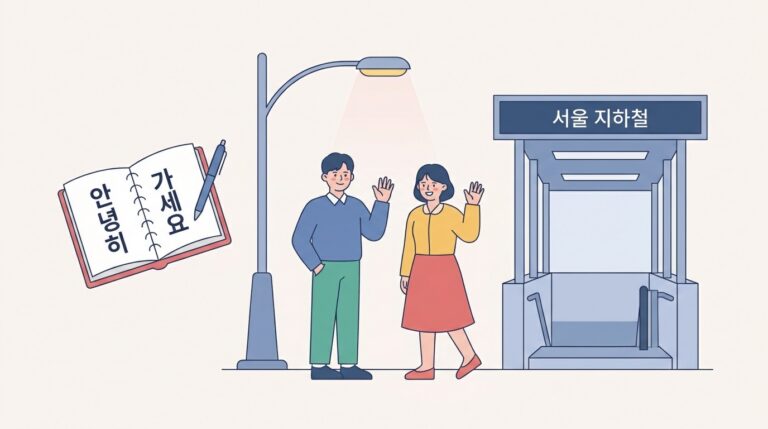
Phase 1: Empathy (Storytelling Opening)
안녕하세요! 매일한글 에디터입니다. (Hello! I’m your Daily Hangul editor.)
Picture this: You just spent an incredible evening in a bustling Hongdae cafe, sharing sweet bingsu and practicing Korean with a new local friend. The cafe is playing your favorite acoustic K-Drama soundtrack, the vibe is electric, and you feel on top of the world. But suddenly, you both stand up to leave at the subway turnstiles. Your heart beats faster. Your brain races through chapter 1 of your dusty textbook.
“Wait… do I say 안녕히 가세요 (Annyeonghi gaseyo)? Or is it 안녕히 계세요 (Annyeonghi gyeseyo)? Wait, are they staying or am I leaving?!”
Panic sets in. You end up freezing, giving an awkward 90-degree robotic bow, and blurting out “Bye!” while scurrying away into the subway carriage. On the train ride back, you cringe thinking, “Did I sound cold? Did I sound like an automated subway announcement?”
Take a deep breath—we have all been there! Over the past 10 years of coaching global learners, this exact moment has been voted the #1 most awkward social hurdle for beginners. In real Korean daily life, native speakers rarely use stiff, textbook farewells when parting with friends, friendly baristas, or colleagues. Instead, they use warm, future-focused expressions that leave the door wide open for the next encounter.
By the end of this guide, you will master the art of saying “See you again next time” like a real Seoulite, turning awkward departures into smooth, heart-warming connections.
Phase 2: Core 3 Expressions Breakdown
Here are the top three parting phrases you will hear constantly on Korean streets, variety shows, and dramas.
1. 다음에 또 만나요 (Daeume tto mannayo)
- Pronunciation: Dae-um-eh tto man-na-yo (Think: “Die-um-eh” + snappy “tto” like the start of “tortilla” + “mahn-nah-yo”)
- Meaning: Literal: Next time again meet | Natural Nuance: “See you again next time!” / “Let’s meet up again soon!”
- K-Culture Moment: The heartwarming parting line used by YouTube vloggers or podcast hosts when signing off, and friends splitting up after an awesome weekend meetup.
- Editor’s Insight: The magic word here is 또 (tto), which means “again.” It injects an enthusiastic hope that this is definitely not the final goodbye.
- Situation Spectrum: Casual ⚠️ (Drop the “-yo” to make it 반말 between close peers) | Semi-formal ✅ | Formal ✅
- 🤔 Think About It: Notice how Korean goodbyes often talk about the next meeting rather than the current parting? How does focusing on the future change how parting feels compared to your native language?
2. 조심히 들어가세요 (Josimhi deureogaseyo)
- Pronunciation: Jo-sim-hi deu-reo-ga-se-yo (Sounds like: “Joe-seem-he” + “dew-ruh-gah-say-yo”)
- Meaning: Literal: Carefully enter [your home] | Natural Nuance: “Get home safe!” / “Take care on your way back!”
- K-Culture Moment: Every K-Drama evening dinner scene! When characters finish late-night grilled pork belly (삼겹살) or pojangmacha drinks, they bow slightly and say this as they hail a taxi.
- Editor’s Insight: Koreans rarely say “Goodbye” at night; they say “Enter safely.” In Korean culture, you haven’t completed your day until you are safe inside your home.
- Situation Spectrum: Casual 🚫 (Use 조심히 가 / Josimhi ga for close pals) | Semi-formal ✅ | Formal ✅
- 🤔 Think About It: Why do you think Korean culture emphasizes the act of “entering” (들어가다) one’s private dwelling safely rather than just “traveling” (가다)?
3. 다음에 밥 한번 먹어요 (Daeume bap hanbeon meogeoyo)
- Pronunciation: Dae-um-eh bap han-beon meog-eo-yo (Sounds like: “Die-um-eh bahp hahn-bun mug-uh-yo”)
- Meaning: Literal: Next time eat rice/meal once | Natural Nuance: “Let’s grab a meal sometime!” / “Keep in touch!”
- K-Culture Moment: The classic social exit code seen between coworkers, classmates, or acquaintances walking out of a studio or office building.
- Editor’s Insight: Cultural Alert! 90% of the time, this is not an official invitation to open your Google Calendar. It is the ultimate Korean social lubricant signifying: “I like you, you’re cool, let’s stay friendly.”
- Situation Spectrum: Casual ✅ | Semi-formal ✅ | Formal ⚠️ (Too informal for strict board meetings)
- 🤔 Think About It: In many Western cultures, asking someone to eat implies setting a date. How does viewing “sharing food” as a casual parting wish reflect Korean community bonds?
Phase 3: Textbook Korean vs. Real Korean
Let’s bust the myth of stiff classroom phrasing!
Situation 1: Parting outdoors at a street corner
- 📖 Textbook Korean: 안녕히 계세요. (Annyeonghi gyeseyo. – “Stay peacefully.”)
- 🗣️ Real Korean: 다음에 또 봐요! 들어가세요~ (Daeume tto bwayo! Deureogaseyo~ – “See you again next time! Get home safe~”)
- 💡 Why is it different? 안녕히 계세요 is strictly used when you are leaving and the other person is staying behind in a room/building. If you both part on a sidewalk, saying it sounds clumsy. In real life, locals use lively forward-looking phrases!
Situation 2: Texting right after parting ways
- 📖 Textbook Korean: 다음 기회에 다시 뵙겠습니다. (Daeum gihoee dasi boepgetseumnida. – “I shall meet you again at the next opportunity.”)
- 🗣️ Real Korean: 오늘 즐거웠어요! 조심히 들어가세요 🙂 (Oneul jeulgeowosseoyo! Josimhi deureogaseyo! – “Had so much fun today! Get home safe :)”)
- 💡 Why is it different? The textbook sentence sounds like a contract negotiation between corporate CEOs. Using simple, warm everyday adjectives builds real friendship.
Phase 4: K-Culture Deep Dive & Non-verbal Etiquette
4-1. Nunchi (눈치) & Farewell Body Language
In Korea, body language speaks just as loudly as your words when parting:
* The Gentle Two-Handed Mini Wave: Rather than an aggressive high-five or a stiff wave from your shoulder, keep your elbows close to your ribs and wave with one or both hands gently around chest height.
* The Step-Back Bow (15 Degrees): You do not need a deep 90-degree historical drama bow with friends or friendly acquaintances. A soft, 15-degree nod while subtly taking half a step backward shows respect and modesty.
* The “Lingering Look” (배웅): In Korea, turning your back and sprinting away the second you finish speaking feels cold. Good Nunchi means pausing for 2-3 seconds, making warm eye contact, and nodding once more before turning toward your path.
4-2. Cultural Code: The Sacred “Bap” (Rice) Parting
Food is love in Korea. Historically, asking about food was a way to check if someone survived harsh winters or famines. Today, saying 다음에 밥 먹어요 (Daeume bap meogeoyo) is the Korean equivalent of “Take care.” If someone says this to you, don’t rush to say, “What time tomorrow?” Instead, smile and reply: 좋아요, 꼭 먹어요! (Joh-ayo, kkok meogeoyo! – “Sounds great, let’s definitely eat!”).
Phase 5: Real Role-play Scenario
Setting: Outside Hongik University Station Exit 3, 10:15 PM. A cool breeze is blowing under the street lights.
Characters:
* You: An enthusiastic traveler/student practicing Korean.
* Minji (민지): Your friendly Korean language exchange partner.
[1] Minji: 오늘 진짜 재미있었어요!
    (Oneul jinjja jaemiisseosseoyo!)
    "I had so much fun today!"
    🎭 [Smiling brightly while adjusting her canvas tote bag]

[2] You: 저도요! 시간 진짜 빨라요.
    (Jeodoyo! Sigan jinjja ppallayo.)
    "Me too! Time flies so fast."
    🎭 [Looking at your watch with a happy, lingering smile]

[3] Minji: 벌써 10시 넘었네요. 이제 지하철 타러 갈까요?
    (Beolsseo yeolsi neomeonneyo. Ije jihacheol tareo galkkayo?)
    "It's already past 10! Shall we head down to catch the subway?"
    🎭 [Gesturing gently toward the subway staircase]

[4] You: 네, 오늘 맛있는 것도 사주시고 정말 감사해요.
    (Ne, oneul masinneun geotdo sajusigo jeongmal gamsahaeyo.)
    "Yes, thank you so much for treating me to delicious food today."
    🎭 [Giving a modest 15-degree bow with hands clasped]

[5] Minji: 아니에요~ 우리 다음 주에도 시간 맞으면 만나요!
    (Anieyo~ Uri daeum juedo sigan majeumyeon mannayo!)
    "Not at all~ If our schedules align next week, let's hang out!"
    🎭 [Tucking hair behind ear, looking expectant]

[6] You: 좋아요! 다음에 또 만나요!
    (Joh-ayo! Daeume tto mannayo!)
    "Sounds wonderful! See you again next time!"
    🎭 [Waving hand gently at chest level]

[7] Minji: 네! 오늘 늦었으니까 조심히 들어가세요!
    (Ne! Oneul neojeosseumnikka josimhi deureogaseyo!)
    "Yes! It's late, so get home safe!"
    🎭 [Stepping back slightly toward the turnstiles]

[8] You: 민지 씨도 조심히 들어가세요! 잘 가요!
    (Minji ssido josimhi deureogaseyo! Jal gayo!)
    "You get home safe too, Minji! Safe travels!"
    🎭 [Waving warm goodbye until she turns the corner]
🔀 Interactive Decision Point
Imagine Minji turns back one last time at the turnstile and waves: “조심히 들어가세요!” What do you shout back?
- Option A: “안녕히 계세요!” (Annyeonghi gyeseyo!)
- Option B: “민지 씨도 조심히 들어가세요!” (Minji ssido josimhi deureogaseyo!)
- Option C: “내일 아침 8시에 우리 집 앞에서 만나요!” (Naeil achim yeodeolsie uri jip ap-eseo mannayo!)
Feedback:
* Option A [Risk / Awkward]: Minji isn’t staying at the station—she is going home too! Saying 계세요 makes you sound like a textbook audio CD.
* Option B [Best / Perfect!]: Mirroring 조심히 들어가세요 with their name shows empathy, politeness, and high emotional intelligence.
* Option C [Bad / Overkill]: Whoa, hold on! Don’t book an 8:00 AM breakfast immediately unless you want to startle your new friend!
Phase 6: 10-Second Emotional Shadowing Drill
Speak out loud! Follow the rhythm breaks marked by / and absorb the emotional cue:
[😊 Cheerful & Upbeat]
다음에 / 또 / 만나요!
(Daeume / tto / mannayo!)
“See you / again / next time!”-
[🥺 Caring & Heartfelt]
오늘 / 즐거웠어요, / 조심히 / 들어가세요!
(Oneul / jeulgeowosseoyo, / josimhi / deureogaseyo!)
“Today / was so fun, / carefully / get home safe!” -
[🤝 Casual & Friendly Promise]
우리 / 다음에 / 밥 한번 / 꼭 먹어요!
(Uri / daeume / bap hanbeon / kkok meogeoyo!)
“We / next time / a meal / must eat together!”
Phase 7: K-Culture Mini Dictionary
-
막차 (Makcha)
Meaning: The last train or bus of the night.
Usage: In Korea, you will often hear friends say: “막차 시간 다 됐어요! (It’s almost last train time!)” at around 11:30 PM. It is the ultimate socially acceptable cue to say 다음에 또 만나요. -
약속 (Yaksok)
Meaning: An appointment, promise, or social plan.
Usage: Parting phrases usually reference future plans: “다음 약속 때 봐요! (See you at our next appointment!)”. -
배웅 (Bae-ung)
Meaning: The act of walking someone out to the elevator, subway station, or bus stop.
Usage: If a Korean host walks you all the way out to your taxi, that is 배웅—a supreme sign of hospitality. -
정 (Jeong)
Meaning: The unique Korean emotional bond of warmth, attachment, and mutual caring.
Usage: Saying 조심히 들어가세요 (Get home safe) is a direct verbal expression of Jeong.
Phase 8: Survival Kit for Travelers
TOP 3 Parting Survival Phrases
-
다음에 또 올게요! (Daeume tto olgeyo!)
Meaning: “I will come back again next time!”
Pro Tip: Say this to a kind restaurant owner or cafe barista when paying at the counter. Their faces will light up with the biggest smiles. -
먼저 가볼게요! (Meonjeo gabolgeyo!)
Meaning: “I’ll get going first!”
Pro Tip: Perfect when you have to leave a party or group gathering a bit earlier than everyone else. -
도착하면 연락해요! (Dochakhamyeon yeollakhaeyo!)
Meaning: “Text me when you get home!”
Pro Tip: Common among young friends taking late-night transport.
Editor’s Travel Note
When you are hanging out in Seoul or Busan, never rely on Google Maps for transit schedules. Be sure to check the Naver Map app download guide or download KakaoMap before your trip. Knowing the exact time of the 막차 (last train) allows you to say your heartfelt 다음에 또 만나요 gracefully, without sprinting through the terminal in sheer panic!
Phase 9: “One Step Deeper” (Reflective Cultural Essay)
In many Western cultures, a farewell marks a closure—a punctuation mark ending the interaction until further notice. But in Korean society, relationships are viewed as an ongoing, continuous river connected by 인연 (Inyeon – fate/relational ties). When a Korean tells you 다음에 또 만나요 or 다음에 밥 먹어요, they are reassuring you that the relational thread remains unbroken. You are not saying goodbye to an isolated individual; you are reinforcing that both of you remain part of each other’s community circle.
💬 Your Turn: How does your culture handle goodbyes? Do you use formal closings, or do you always reference the future like Koreans do? Let’s chat in the comments below!
Phase 10: FAQ & Avoiding Misunderstandings
Q: What is the real difference between “안녕히 가세요” and “다음에 또 만나요”?
A: 안녕히 가세요 (Go peacefully) is formal, polite, and neutral—perfect for shop staff or strangers. 다음에 또 만나요 (See you again next time) is warm, personal, and conversational. It indicates that you have an established rapport and look forward to meeting again.
Q: If someone says “다음에 밥 한번 먹어요,” should I immediately pull out my calendar?
A: No! Treat it as a warm sentiment meaning “I enjoyed our time, let’s keep in touch.” If they genuinely want to make plans, they will follow up on KakaoTalk within 24–48 hours with specific days and locations.
Q: Can I use “다음에 또 봐요” with my boss or university professor?
A: Be careful! 다음에 또 봐요 is semi-formal. For professors, elders, or high-ranking bosses, use the ultra-respectful honorific form: 다음에 또 뵙겠습니다 (Daeume tto boepgetseumnida).
🚨 Common Mistakes Alert!
- ❌ Mistake 1: Shouting “안녕히 계세요!” when both people are walking away on the street.
👉 Fix: Use 조심히 들어가세요! or 다음에 또 만나요! - ❌ Mistake 2: Confusing “들어가세요” (Enter safe) with “나가세요” (Get out!).
👉 Fix: Never say 나가세요 at a farewell unless you are kicking someone out of your home! - ❌ Mistake 3: Dropping “-요” (-yo) too quickly with peers.
👉 Fix: Keep the polite ending -요 until you both explicitly agree to use informal language (말 놓기).
Phase 11: Action Missions
- 🥉 Bronze Mission (Solo Practice): Stand in front of your mirror. Practice the 15-degree nod, the gentle chest-level hand wave, and say: “다음에 또 만나요! 조심히 들어가세요!” 3 times smoothly.
- 🥈 Silver Mission (Social Engagement): Hop onto your Instagram story or language exchange app (like HelloTalk) and post a photo of your study notes with the caption: “오늘 공부 끝! 여러분 다음에 또 만나요~”
- 🥇 Gold Mission (Real-world Challenge): Next time you finish an online Korean lesson with your tutor or buy a treat at a local Korean bakery, skip “Bye!” and confidently say: “감사합니다, 다음에 또 올게요!”
- 🎮 K-Culture Mission: Watch the ending 5 minutes of any K-Drama episode or variety show (like Running Man). Spot how many times the members say 가자 (let’s go), 들어가 (get home safe), or 다음에 봐 (see you next time)!
Phase 12: Interactive Quiz Challenge
Test your instincts below! Click the toggles to check your answers.
Quiz 1: Situational Check
You and your Korean classmate just stepped out of a library at 9:00 PM. You are both walking to different bus stops. Which phrase is the most natural and warm?
* A) 안녕히 계세요.
* B) 조심히 들어가세요! 다음에 또 봐요!
* C) 저리 가세요.
🔍 Click to reveal Answer & Explanation
Correct Answer: B
Explanation: Since you are both departing outdoors in the evening, wishing them a safe trip home (조심히 들어가세요) and promising to meet next time (다음에 또 봐요) is 100% natural. Option A is incorrect because no one is staying in the building, and Option C means “Go away!”
Quiz 2: Fill in the Blank
Complete the warm goodbye phrase:
다음에 _____ 만나요! (Hint: The word for “again”)
* A) 너무 (Neomu)
* B) 또 (Tto)
* C) 안 (An)
🔍 Click to reveal Answer & Explanation
Correct Answer: B
Explanation: 또 (tto) means “again.” So 다음에 또 만나요 translates directly to “See you again next time!”
Quiz 3: Cultural True or False
True or False: When an acquaintance says “다음에 밥 한번 먹어요!” at a train station, you must immediately specify a restaurant and reserve a table.
🔍 Click to reveal Answer & Explanation
Correct Answer: False
Explanation: In Korean social culture, this is usually a warm parting gesture showing goodwill and friendship, rather than an immediate, set-in-stone booking!
🎬 Watch Our Daily Videos! (Daily Hangul Official Instagram)
Review the expressions you learned in this article with our fun daily short videos! Check out native pronunciation and real-life nuances in action.
- Instagram @dailyhangul_en







