

Phase 1: Empathy (Real-Life Story Opening)
안녕하세요! (Annyeonghaseyo!) I’m your Daily Hangul editor.
Picture this: You are watching your ultimate K-pop bias host a live birthday broadcast. The comments are flying at light speed with heart emojis and Korean letters. Or perhaps you’ve been invited to your very first Korean birthday dinner in Seoul with local friends. The cake comes out, sparkling candles glowing, and everyone turns to the birthday person. You open your mouth to say something sweet, but your mind goes completely blank. Do you say “생일 축하해” (Saeng-il chuk-ha-hae) or “생신 축하드려요” (Saeng-sin chuk-ha-deu-ryeo-yo)? And when someone asks your age right after, do you count by the calendar year, the international age, or that mysterious “Korean age” you saw on TikTok?
If your heart skipped a beat just imagining this, take a deep breath! You are definitely not alone. Over the past decade tutoring hundreds of beginner Korean learners, asking about birthdays and ages has consistently been the #1 moment where students freeze up out of fear of sounding rude. In Korean culture, age isn’t just a number—it defines how people talk to each other. But learning to celebrate a friend’s special day and share your own age doesn’t have to feel like walking a social tightrope. Today, we will break down the exact friendly phrases you need, clear up the awkward honorific traps, and get you celebrating like a true local!
Phase 2: Top 3 Core Expressions Deep Dive
1. 생일 축하해요! (Saeng-il chuk-ha-hae-yo!)
- Pronunciation: [Saeng-il chuk-ha-hae-yo] (Sound metaphor: Think of “Sang-ill” + “chook-ha” with a gentle puff of air on “ha” + a smiling “hay-yo”)
- Meaning: Literal: “Birthday celebration do!” | Real Nuance: “Happy Birthday!” (Warm, polite, and universally friendly).
- K-Culture Moment: This is the exact phrase K-pop idols read aloud with big smiles while reading fan comments on Weverse or YouTube live streams.
- Editor’s Insight: The ending “-해요 (-hae-yo)” strikes the golden balance in Korean. It is polite enough for acquaintances and coworkers, yet warm enough for close friends.
- Situation Spectrum: Casual ⚠️ | Semi-formal ✅ | Formal ✅
- 🤔 Think About It: In English, we simply wish someone a “Happy Birthday.” In Korean, the root word “축하 (chuk-ha)” means to congratulate or celebrate. Why do you think Korean emphasizes “congratulating” the day rather than just wishing happiness?
2. 몇 살이에요? (Myeot sal-i-e-yo?)
- Pronunciation: [Myeot sal-i-e-yo] (Sound metaphor: Sounds like “Myut” + smooth link “sah-lee-eh-yo”)
- Meaning: Literal: “How many years/ages are you?” | Real Nuance: “How old are you?”
- K-Culture Moment: In K-dramas, new college roommates or friendly peers ask this right after exchanging names so they know whether they can call each other “언니 (Unnie)”, “오빠 (Oppa)”, or “친구 (Chingu)”.
- Editor’s Insight: While asking age in Western cultures can sometimes feel invasive, in Korea it is an act of consideration. People ask so they can calibrate their speech level and show you proper respect.
- Situation Spectrum: Casual ✅ | Semi-formal ✅ | Formal 🚫 (Use “연세가 어떻게 되세요? [Yeon-se-ga eo-tteo-ke doe-se-yo?]” for elders)
- 🤔 Think About It: In your home culture, is asking someone’s age on the first day considered rude? How does knowing that Koreans ask to be polite change your perspective?
3. 생일이 언제예요? (Saeng-il-i eon-je-ye-yo?)
- Pronunciation: [Saeng-il-i eon-je-ye-yo] (Sound metaphor: Flow the “L” sound into the next syllable: “Sang-ee-lee un-jeh-yeh-yo”)
- Meaning: Literal: “Birthday when is it?” | Real Nuance: “When is your birthday?”
- K-Culture Moment: Seen in romantic variety shows like Single’s Inferno when two people look for shared astrological signs or surprise anniversary connections.
- Editor’s Insight: Notice the marker “-이 (-i)” attached to “생일 (saeng-il)”. Because “생일” ends with a final consonant (받침), it naturally catches the “-이” for a smooth, lyrical sound.
- Situation Spectrum: Casual ✅ | Semi-formal ✅ | Formal ✅
- 🤔 Think About It: Notice how Korean places the question word “언제 (when)” right in the middle rather than at the very start of the sentence like English does.
Phase 3: Textbook Korean vs. Real Korean
Situation 1: Wishing Someone a Happy Birthday
- 📖 교과서 한국어 (Textbook): 귀하의 생일을 축하드립니다. (Gwi-ha-ui saeng-il-eul chuk-ha-deu-rim-ni-da. – “I offer congratulations on your esteemed birthday.”)
- 🗣️ 진짜 한국어 (Real-Life): 생일 축하해요! (Saeng-il chuk-ha-hae-yo!) / Text message: 생축! (Saeng-chuk!)
- 💡 왜 다를까? (Why the difference?): The textbook version sounds like a formal greeting card from a bank or insurance company! In everyday life, even in professional team settings, “생일 축하해요!” is the gold standard of warmth and politeness.
Situation 2: Asking an Adult’s Age
- 📖 교과서 한국어 (Textbook): 당신은 몇 살입니까? (Dang-sin-eun myeot sal-im-ni-kka? – “How many years old are you, Thou?”)
- 🗣️ 진짜 한국어 (Real-Life): 몇 살이에요? (Myeot sal-i-e-yo?) or 혹시 몇 년생이세요? (Hok-si myeot nyeon-saeng-i-se-yo? – “Which birth year are you, by any chance?”)
- 💡 왜 다를까? (Why the difference?): Using the pronoun “당신 (dang-sin)” can sound confrontational in spoken Korean. Asking for the “birth year (몇 년생)” is the most polite, natural shortcut adults use to avoid awkward age math!
Phase 4: K-Culture Deep Dive & Non-Verbal Manners
4-1. 눈치 (Nunchi) & Essential Gestures
When handing over a birthday gift in Korea, never toss it casually with one hand! Always use two hands (or place your left hand supporting your right wrist or forearm). When receiving a gift, do the same with a gentle bow of your head. If someone puts a birthday cake in front of you and sings, hold off on eating until you blow out the candles together. And don’t be shocked if everyone starts enthusiastically clapping to a bouncy, fast rhythm—Koreans sing the birthday song with maximum energy!
4-2. The Soul Food Code: 미역국 (Seaweed Soup)
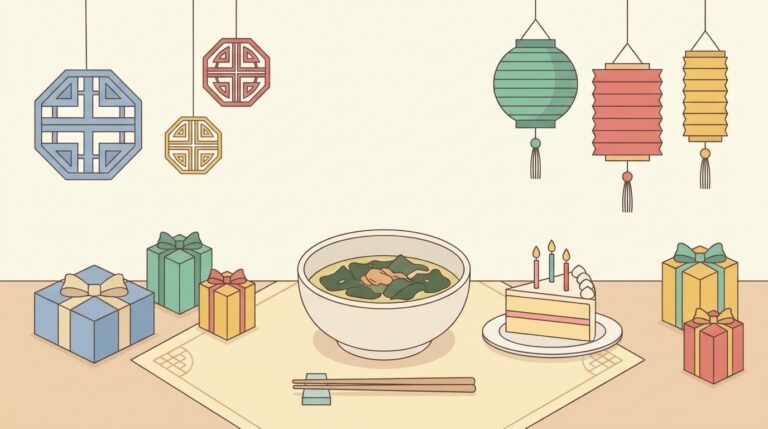
Why do Koreans eat steaming bowls of dark green seaweed soup (미역국, Miyeok-guk) on their birthday? It stems from profound gratitude. Traditionally, Korean mothers consume nutrient-rich seaweed soup for weeks after giving birth to recover their health. Eating it on your birthday is an act of honoring your mother’s sacrifice and remembering where you came from. Furthermore, in modern digital Korea, sending a birthday gift is as easy as tapping a screen via KakaoTalk Gift. If you get a Korean friend’s birthday notification on KakaoTalk, sending an iced Americano and cake coupon is the ultimate friendship flex!
Phase 5: Real-World Roleplay Scenario
Setting: A cozy boutique cafe in Yeonnam-dong, Seoul. You are meeting your Korean language exchange partner, Minho (민호), who mentioned today is a special day.
- Turn 1 (Minho): 오늘 사실 제 생일이에요! (O-neul sa-sil je saeng-il-i-e-yo! | “Actually, today is my birthday!”)
🎭 (민호는 쑥스러운 듯 머리를 긁적이며 웃는다. / Minho scratches his head shyly with a grin.) - Turn 2 (You): 정말요? 생일 축하해요, 민호 씨! (Jeong-mal-yo? Saeng-il chuk-ha-hae-yo, Min-ho ssi! | “Really? Happy birthday, Minho!”)
🎭 (두 손을 모아 손뼉을 치며 환하게 축하한다. / Clapping your hands together with a bright smile.) - Turn 3 (Minho): 고마워요! 축하해 줘서 기뻐요. (Go-ma-wo-yo! Chuk-ha-hae jwo-seo gi-ppeo-yo. | “Thank you! I’m so happy you wished me.”)
🎭 (가방에서 작은 음료수를 건네며 / Handing you a drink from his bag.) - Turn 4 (You): 오늘 미역국 먹었어요? (O-neul mi-yeok-guk meog-eoss-eo-yo? | “Did you eat seaweed soup today?”)
🎭 (눈을 반짝이며 호기심 가득한 표정으로 묻는다. / Asking with curious, sparkling eyes.) - Turn 5 (Minho): 네! 아침에 어머니가 끓여 주셨어요. (Ne! A-chim-e eo-meo-ni-ga kkeul-yeo ju-syeoss-eo-yo. | “Yes! My mom cooked it for me this morning.”)
🎭 (행복한 표정으로 끄덕인다. / Nodding with a happy expression.) - Turn 6 (You): 다행이네요! 그런데 혹시 몇 살이에요? (Da-haeng-i-ne-yo! Geu-reon-de hok-si myeot sal-i-e-yo? | “That’s great! By the way, how old are you?”)
🎭 (자연스럽게 차를 한 모금 마시며 / Taking a casual sip of tea.) - Turn 7 (Minho): 저 올해 스물네 살이에요. 2001년생이에요! (Jeo ol-hae seu-mul-ne sal-i-e-yo. I-cheon-il-nyeon-saeng-i-e-yo! | “I’m 24 this year. Born in 2001!”)
🎭 (손가락으로 24를 살짝 만들어 보이며 / Playfully showing 24 with his fingers.) - Turn 8 (You): 아, 그렇군요! 우리 좋은 친구가 될 것 같아요. (A, geu-reoh-gun-yo! U-ri jo-eun chin-gu-ga doel geot gat-a-yo. | “Ah, I see! I think we will be great friends.”)
🎭 (따뜻하게 미소 지으며 고개를 끄덕인다. / Smiling warmly with a nod.)
🔀 Interactive Decision Point
Minho just told you it’s his birthday. What do you reply?
* Option A: “생신 축하드려요, 할아버지!” (Saeng-sin chuk-ha-deu-ryeo-yo, hal-a-beo-ji!)
* Option B: “생일 축하해요! 오늘 맛있는 거 먹어요!” (Saeng-il chuk-ha-hae-yo! O-neul mat-iss-neun geo meog-eo-yo!)
* Option C: “야, 너 몇 살이야? 생축.” (Ya, neo myeot sal-i-ya? Saeng-chuk.)
Feedback:
* Option A [Bad]: Oh no! “생신 (saeng-sin)” and “할아버지 (grandfather)” are reserved for elderly seniors. Saying this to a 24-year-old friend will make them choke on their coffee!
* Option B [Best]: Perfect! Polite, caring, and natural. Suggesting good food matches Korean celebration culture flawlessly.
* Option C [Risk]: High social risk! “야 (ya)” and dropping honorifics without permission sounds abrasive unless you are already childhood buddies.
Phase 6: 10-Second Emotion Shadowing Drill
Repeat these aloud, paying attention to the emotion tags and slash marks (/) for breathing pauses!
[🎉 Bright & Cheerful]
생일 / 축하해요! / 오늘 하루 / 행복하게 보내세요!
(Saeng-il / chuk-ha-hae-yo! / O-neul ha-ru / haeng-bok-ha-ge bo-nae-se-yo!)
“Happy / birthday! / Have a / wonderfully happy day today!”-
[🤔 Friendly Curiosity]
저기요, / 혹시 / 몇 년생이세요?
(Jeo-gi-yo, / hok-si / myeot nyeon-saeng-i-se-yo?)
“Excuse me, / by any chance, / which year were you born?” -
[🎂 Warm & Grateful]
축하해 줘서 / 정말 / 고마워요!
(Chuk-ha-hae jwo-seo / jeong-mal / go-ma-wo-yo!)
“Thank you / so very much / for wishing me!”
Phase 7: K-Culture Mini Dictionary
- 미역국 (Mi-yeok-guk) | Seaweed soup eaten on birthdays to symbolize gratitude toward mothers and health for the coming year.
- 케이크 (Ke-i-keu) | Birthday cake; in Korea, bakeries like Paris Baguette or Tous Les Jours give you long candles for tens and short candles for single digits.
- 만 나이 (Man-na-i) | International age; South Korea officially adopted this standard in June 2023, unifying legal age calculations with the rest of the world.
- 생카 (Saeng-ka) | Short for “생일 카페 (Birthday Cafe)”; fan-organized cafe events celebrating a K-pop idol or actor’s birthday, complete with custom cups, photo cards, and themed drinks.
Phase 8: Traveler’s Survival Kit
Top 3 Survival Phrases for Birthday Celebrations
- 촛불 꺼요! (Chot-bul kkeo-yo!) | [Chot-bul kkeo-yo] | Pro Tip: Say this right after singing the birthday song so the celebrant knows it’s time to blow out the candles!
- 소원 빌었어요? (So-won bir-eoss-eo-yo?) | [So-won bee-ross-eo-yo] | Pro Tip: Use this sweet question right after they blow out the candles: “Did you make a wish?”
- 초 몇 개 필요하세요? (Cho myeot gae pil-yo-ha-se-yo?) | [Cho myut gae peel-yo-ha-seh-yo] | Pro Tip: When buying a cake at a Korean bakery, the clerk will always ask this. Tell them your friend’s age so they pack the exact candles!
Editor’s Travel Note
If you plan to meet friends in Korea, make sure you complete your Naver Map app download before landing, as foreign mapping apps don’t support accurate walking navigation in Seoul. When heading to a party, you can pick up a trendy mini “lunchbox cake (도시락 케이크)” in Hongdae or Seongsu without ordering weeks in advance. And if you have a local phone number, explore the KakaoTalk Gift feature guide to surprise friends remotely!
Phase 9: “One Step Deeper” (Cultural Reflection)
In Western traditions, birthdays often focus solely on the individual becoming one year older, unwrapping personal presents. In Korea, however, a birthday is a communal reflection of roots. Sitting down for a warm bowl of seaweed soup bridges generations—it silently acknowledges that our existence is tied to the physical pain and immense love of our mothers. Furthermore, sharing food and drinks on your own birthday is customary in Korea; the birthday person often treats friends rather than expecting a free meal. It is an occasion to say: “Thank you for being in my life this past year.”
💬 Your Turn: Does your culture have a special dish or unique tradition on birthdays similar to Korean seaweed soup? Share your story in the comments below!
Phase 10: FAQ & Common Mistakes
Q: Can I use “생일 축하해 (Saeng-il chuk-ha-hae)” with my K-pop idol?
A: Yes! When typing comments on idol live streams or fan community apps like Weverse and Bubble, using casual “반말 (banmal)” like “생일 축하해!” or “태어나 줘서 고마워 (Thank you for being born)” is accepted and creates a friendly, close bond.
Q: Should I use Korean age or International age when asked “몇 살이에요?”?
A: Since the official legal change in June 2023, you can comfortably state your international age (만 나이)! To be completely clear and avoid math, simply state your birth year: “2000년생이에요 (I was born in 2000).”
Q: What should I say to an elder or professor on their birthday?
A: Never say “생일 (saeng-il)” to a grandparent or professor! Use the honorific term 생신 (saeng-sin) and say: “생신 축하드립니다 (Saeng-sin chuk-ha-deu-rim-ni-da).”
🚨 Common Mistakes Alert
- Mistake 1: Calling an elder’s birthday “생일 (Saeng-il)”.
- Correct Action: Upgrade to “생신 (Saeng-sin)” for anyone senior or elderly.
- Mistake 2: Forgetting the honorific particles when giving gifts.
- Correct Action: Hand items over with two hands, not just one.
- Mistake 3: Saying “당신은 몇 살이에요?” to strangers.
- Correct Action: Drop “당신 (you)” completely; just ask “실례지만, 몇 살이세요? (Excuse me, how old are you?)”.
Phase 11: Action Mission & Community Challenge
- 🥉 Bronze Mission (Solo): Stand in front of your mirror and practice saying “생일 축하해요! (Saeng-il chuk-ha-hae-yo!)” 5 times with a bright, welcoming smile.
- 🥈 Silver Mission (Social): Find a post or live stream of your favorite Korean celebrity or artist on their birthday and leave a comment: “생일 축하해요! 맛있는 거 많이 드세요! (Happy birthday! Eat lots of delicious food!)”.
- 🥇 Gold Mission (Real-Life): Ask a Korean friend or classmate their birth year using “몇 년생이세요?” and congratulate them when their month comes up!
- 🎮 K-Culture Mission: Next time you watch a K-drama, listen carefully for the words “미역국 (seaweed soup)” or “케이크 (cake)” during family or romance scenes!
Phase 12: Interactive Quiz Challenge
Test your skills before heading out into the real Korean world!
- Situational Judgment: You are meeting your Korean partner’s 70-year-old grandmother on her birthday. What is the most respectful phrase to say?
- A) 생일 축하해, 할머니!
- B) 생신 축하드려요, 할머니!
- C) 몇 살이에요, 할머니?
- Fill-in-the-Blank: Complete the question to ask when someone’s birthday is:
- “생일이 ________? (When is your birthday?)”
- True or False: In Korea, eating seaweed soup (미역국) on your birthday is traditionally meant to remember and honor your mother’s devotion.
- (True / False)
👉 Click here for Answers & Explanations!
- Answer: B | For grandparents and respected elders, always use the honorific word “생신 (saeng-sin)” and formal ending “축하드려요 (chuk-ha-deu-ryeo-yo)”.
- Answer: 언제예요? (eon-je-ye-yo?) | Full sentence: “생일이 언제예요?” (Saeng-il-i eon-je-ye-yo?).
- Answer: True | Mothers traditionally eat seaweed soup for postpartum recovery, making it a sacred birthday dish symbolizing filial gratitude and new life.
🎬 Watch Our Daily Videos! (Daily Hangul Official Instagram)
Review the expressions you learned in this article with our fun daily short videos! Check out native pronunciation and real-life nuances in action.
- Instagram @dailyhangul_en







