

Phase 1: Empathy (Story-Driven Opening)
안녕하세요! 매일한글 에디터입니다. (Annyeonghaseyo! I am your Daily Hangul Editor.)
Picture this: It is 2:30 AM in a bustling dokseosil (독서실, private study library) in Gangnam or a dim research lab in Daejeon. The neon glow outside has faded, your fourth shot of iced Americano is down to melted cubes, and your eyes burn as you pore over reams of research data or prepare for an intense Korean proficiency or fellowship defense. You look around, and you see others typing quietly, hunched over stacks of papers with razor-sharp focus. In Korea, this degree of intellectual grit isn’t just routine—it’s romanticized, deeply respected, and woven into the very fabric of history.
Have you ever achieved an academic breakthrough or pulled off a massive personal victory after months of relentless sacrifice, only to feel paralyzed when trying to describe that hard-won triumph in Korean? Saying “열심히 공부해서 좋은 결과를 냈어요” (I studied hard and got good results) feels painfully flat. It fails to convey the blood, sweat, and sleepless nights you poured into your craft. When you want to express profound respect for an achievement born from genuine adversity, native Koreans reach into ancient wisdom: 사자성어 (four-character idioms).
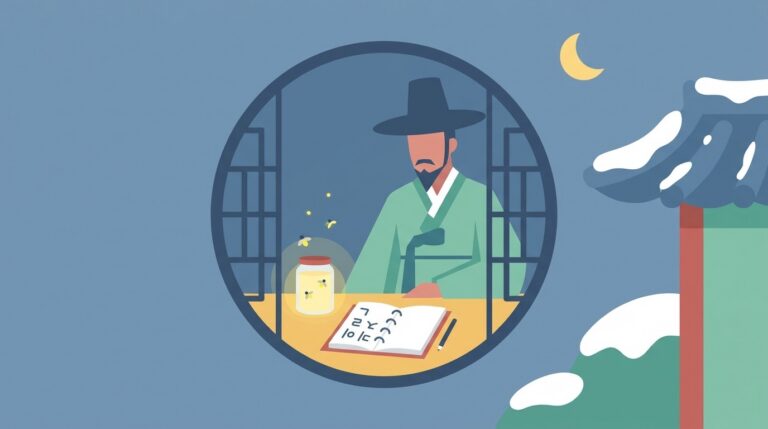
Among them, none captures the poetic dignity of scholarly resilience quite like 형설지공 (螢雪之功)—the fruit of reading by the light of fireflies and the reflection of snow. In this guide, backed by years of mentoring advanced international researchers and C1 learners navigating Korean academia and executive boardrooms, you will master not just the linguistic mechanics of this idiom, but the exact emotional frequency, non-verbal cues, and cultural ethos that will make your Korean sound effortlessly refined.
Phase 2: Deep Dive into 3 Core Idioms
1. 형설지공 (螢雪之功)
- Pronunciation: [Hyeong-seol-ji-gong] (Pronounce like: ‘Hyung’ + ‘Soul’ + ‘G’ + ‘Gong’)
- Meaning:
- Literal: The merit achieved through fireflies and snow.
- Nuanced Reality: The monumental, hard-won fruits of research or scholarship achieved through bitter poverty, severe adversity, and unwavering dedication.
- K-Culture Moment: Seen frequently in academic graduation speeches, documentaries tracking self-made scientists, or historical period dramas (Sageuk) when an underprivileged scholar finally tops the civil service exam (Gwageo).
- Editor’s Insight: The origin comes from two ancient scholars: Che In, who was too poor to buy lamp oil so he collected dozens of fireflies in a gauze bag to read at night, and Son Gang, who sat beside his open window in sub-zero winters to read by the glare of the white snow. Calling someone’s success 형설지공 is the ultimate compliment—it honors their process far more than their final trophy.
- Situation Spectrum: Casual 🚫 | Semi-formal ⚠️ | Formal ✅ (Used in essays, graduation remarks, speeches, formal press releases).
- 🤔 Think About It: In many Western individualist cultures, success is celebrated through individual genius or raw talent. Why do you think Korean culture places such supreme moral virtue on the physical endurance and suffering endured before the breakthrough?
2. 주경야독 (晝耕夜讀)
- Pronunciation: [Ju-gyeong-ya-dok] (Pronounce like: ‘Jew’ + ‘Gyoung’ + ‘Yah’ + ‘Doke’)
- Meaning:
- Literal: Plowing the fields by day, reading books by night.
- Nuanced Reality: Working tirelessly to make a living during daylight hours while relentlessly studying or building a dream after dark.
- K-Culture Moment: Frequently used in modern K-Dramas featuring ambitious protagonists working multiple part-time delivery jobs while preparing for the bar exam or building an AI tech startup.
- Editor’s Insight: While 형설지공 focuses on the final, glorious fruition of long adversity, 주경야독 emphasizes the ongoing, grinding double-shift lifestyle. If you work a 9-to-5 job and take intensive Korean classes at night, you are living the definition of 주경야독.
- Situation Spectrum: Casual ⚠️ | Semi-formal ✅ | Formal ✅
- 🤔 Think About It: Do you have an equivalent idiom in your native tongue for burning the candle at both ends purely for scholarly or professional betterment?
3. 고진감래 (苦盡甘來)
- Pronunciation: [Go-jin-gam-rae] (Pronounce like: ‘Go’ + ‘Jean’ + ‘Gahm’ + ‘Reh’)
- Meaning:
- Literal: Bitterness ends, sweetness arrives.
- Nuanced Reality: After enduring grueling hardships and sacrifice, joy and triumph inevitably follow.
- K-Culture Moment: Sung in celebratory company dinners (Hoesik) after a team lands a difficult patent, or exchanged between students when they receive university acceptance letters.
- Editor’s Insight: This is often paired with 형설지공. While 형설지공 is elevated and strictly related to scholarly/intellectual achievement, 고진감래 is widely used across daily life, business deals, and romantic journeys.
- Situation Spectrum: Casual ✅ | Semi-formal ✅ | Formal ✅
- 🤔 Think About It: Notice the culinary root: ‘bitter’ (苦) and ‘sweet’ (甘). Reflect on how Korean cultural endurance (Han and Heung) often relies on contrasting emotional opposites.
Phase 3: Textbook Korean vs. Real Korean
Situation 1: Congratulating a Colleague on a Major Thesis or Research Publication
- 📖 교과서 한국어:
오랫동안 열심히 연구하셔서 좋은 결과를 얻으셨군요. 축하드립니다.
(Oraedong-an yeolsimhi yeonguhasyeoseo joeun gyeolgwareul eodeusyeotgunyo. Chukhadeurimnida.)
“You researched hard for a long time and got good results. Congratulations.” - 🗣️ 진짜 한국어:
온갖 역경 속에서도 포기하지 않으시더니, 드디어 형설지공의 결실을 맺으셨네요! 진심으로 존경스럽습니다.
(On-gat yeokgyeong sogeseodo pogihaji aneosideoni, deudieo hyeongseoljigong-ui gyeolsireul maejeusyeotneyo! Jinsimeuro jongyeongseureopseumnida.)
“You refused to back down amidst all those adversities, and you’ve finally borne the fruits of scholarly perseverance! I hold immense respect for you.” - 💡 왜 다를까? Textbook Korean sounds like a machine translation from an automated card. At the C1 level, using 형설지공의 결실을 맺다 highlights the emotional journey and signals to native speakers that you understand the depth of their struggle.
Situation 2: Describing Your Own Late-Night Hustle to a Mentor
- 📖 교과서 한국어:
저는 낮에는 일하고 밤에는 한국어를 열심히 공부했습니다.
(Jeoneun najeneun ilhago bameun hangugoreul yeolsimhi gongbuhaetseumnida.)
“I worked in the daytime and studied Korean hard at night.” - 🗣️ 진짜 한국어:
지난 몇 년간 주경야독하며 제 한계를 시험해 왔는데, 오늘 이 연구 성과를 보고하니 감회가 새롭습니다.
(Jinan myeot nyeongan jugyeong-yadokhamyeo je hangyereul siheomhae wanneunde, oneul i yeongu seonggwareul bogohani gamhoega saeropseumnida.)
“Plowing by day and reading by night, I’ve pushed my limits for years; presenting these research findings today feels surreal and deeply moving.” - 💡 왜 다를까? C1 speakers avoid simple coordinating conjunctions like “~하고”. Instead, adopting 주경야독하다 and idiomatic reflections like 감회가 새롭다 illustrates profound maturity and humility.
Phase 4: K-Culture Deep Dive & Non-Verbal Manners
4-1. 눈치 (Nunchi) & Non-Verbal Modesty
When you invoke elevated idioms like 형설지공 or receive praise for your scholarly triumphs in Korea, your physical posture carries equal weight to your grammar. If a professor or director remarks on your accomplishments:
* The Humble Gaze: Avoid staring directly into their eyes with a triumphant smirk. Lower your gaze slightly by 10 to 15 degrees, keeping your neck relaxed.
* The Two-Handed Hand Wave (겸양의 손사래): Bring both hands lightly up near your chest, palms facing inward or subtly waving side-to-side, saying: “과찬이십니다. 교수님의 지도 덕분입니다” (You flatter me; it is all thanks to your guidance).
* Attribution of Credit: Never claim 형설지공 exclusively for your own brilliance when speaking of yourself. Use it to acknowledge the shared labor of mentors, lab peers, or family sacrifice.
4-2. Cultural Code: The Sacred Value of Scholarly Grinding
To understand why 형설지공 holds such weight, look at the historical roots of Korea’s civil examinations (Gwageo during the Joseon Dynasty). For centuries, scholarly mastery was the sole legal vehicle to change one’s family destiny. That ancient momentum directly fuels today’s extreme test-taking dedication (Goshiwon life, the frenzy of Suneung examination day where airplanes are grounded during the English listening section, and grueling post-doctoral labs in KAIST or Seoul National University). When you use this idiom, you tap straight into this 1,000-year-old cultural reverence for academic triumph.
Phase 5: Real-World Roleplay Scenario
Setting: The office of Professor Min (민 교수), an exacting senior research director at a top-tier Korean university laboratory. You are presenting your newly accepted international journal paper.
- Professor Min: 드디어 논문이 승인되었군요. 지난 2년간 실험실 불이 꺼진 적이 없더니 결국 해냈습니다.
(Deudieo nonmuni seung-indwoeeotgunyo. Jinan i-nyeongan sileomsil buri kkeojin jeogi eopdeoni gyeolguk haenaetseumnida.)
“The paper has finally been accepted. The laboratory lights never went out these past two years, and you made it happen.”
🎭 [안경을 벗으며 진심 어린 표정으로 바라본다 / Takes off glasses and looks on with genuine pride] - Learner (You): 교수님께서 밤낮없이 지도해 주신 덕분입니다. 제가 부족하여 시행착오가 많았습니다.
(Gyosunimkkeseo bamnat-eopsi jidohae jusin deokbunimnida. Jega bujokhayeo sihaengchagoga manhatseumnida.)
“It was only possible because of your tireless guidance, Professor. My lack of skill caused many trial-and-error setbacks.”
🎭 [두 손을 공손히 모으고 가볍게 목례를 한다 / Clasps hands politely in front and gives a subtle bow] - Professor Min: 아닙니다. 온갖 데이터 오류와 장비 고장 속에서도 묵묵히 버텨내지 않았습니까?
(Animnida. On-gat deiteo oryuwa jangbi gojang sogeseodo mungmukhi beotyeonaeji anatseumnikka?)
“Not at all. Didn’t you quietly persevere through every data failure and equipment breakdown?”
🎭 [고개를 끄덕이며 찻잔을 건넨다 / Nods slowly and hands over a teacup] - Learner (You): 그 힘든 시간 속에서 옛 선현들의 형설지공이라는 말을 늘 가슴에 새기며 버텼습니다.
(Geu himdeun sigan sogeseo yet seonhyeondeurui hyeongseoljigong-iraneun mareul neul gaseume saegimyeo beotyeotseumnida.)
“During those exhausting moments, I held on by keeping the ancestors’ wisdom of ‘hyeongseoljigong’ deeply engraved in my heart.”
🎭 [찻잔을 두 손으로 조심스레 받으며 담담하게 미소 짓는다 / Receives teacup with both hands, smiling serenely] - Professor Min: 형설지공이라… 외국인 연구원의 입에서 그 사자성어를 들으니 참 감회가 깊군요.
(Hyeongseoljigong-ira… Oegugin yeonguwon-ui ibeseo geu sajaseong-eoreul deureuni cham gamhoega gipgunyo.)
“Hyeongseoljigong… Hearing that idiom from an international researcher stirs deep emotions in me.”
🎭 [감탄하며 등을 툭툭 두드려 준다 / Pats your back in heartfelt admiration] - Learner (You): 밤마다 눈빛 대신 모니터 빛을 벗 삼아 달렸지만, 결실을 맺어 보람을 느낍니다.
(Bammada nunbit daesin moniteo bicheul beot sama dallyeotjiman, gyeolsireul maejeo borameul neukkimnida.)
“Instead of snow-glare, I spent my nights befriending the glow of the computer monitor, but seeing it bear fruit is profoundly rewarding.”
🎭 [약간의 위트를 담아 부드럽게 눈을 맞춘다 / Makes warm eye contact with subtle wit] - Professor Min: 이 경험이 앞으로 연구자 인생에 가장 든든한 밑거름이 될 겁니다. 정말 수고 많았어요.
(I gyeongheomi apeuro yeonguja insaeng-e gajang deundeunhan mitgeoreumi doel geomnida. Jeongmal sugo manhasseoyo.)
“This experience will serve as the most dependable cornerstone for your future research career. Splendid work.”
🎭 [서류철을 덮고 흐뭇하게 웃는다 / Closes the dossier and smiles with deep satisfaction] - Learner (You): 더 정진하여 학계에 기여할 수 있는 연구자가 되겠습니다. 감사합니다!
(Deo jeongjinhayeo hakgye-e giyeohal su inneun yeongujaga doegetseumnida. Gamsahamnida!)
“I will devote myself further to become a scholar who makes genuine contributions to our field. Thank you!”
🎭 [정중하게 90도로 허리를 숙여 인사한다 / Bows respectfully from the waist]
🔀 Interactive Decision Point
When Professor Min praises your resilience in Turn 3, how should you respond if you want to leave an unforgettable impression of intellectual humility?
- Option A: “제가 워낙 머리가 좋아서 끝까지 해낼 수 있었습니다.” (My innate intelligence allowed me to finish.)
- Feedback [BAD ❌]: Complete cultural taboo. This destroys the virtue of modest labor and sounds narcissistic.
- Option B: “교수님 연구실이 너무 빡세서 도망치려다 참았어요!” (Your lab was so brutal I almost ran away, but endured!)
- Feedback [RISK ⚠️]: Too flippant for a senior academic setting. While usable with very close peers over soju, it violates formal etiquette with an advisor.
- Option C: “그 힘든 시간 속에서 옛 선현들의 형설지공이라는 말을 늘 가슴에 새기며 버텼습니다.” (I held on by keeping the ancient wisdom of ‘hyeongseoljigong’ in my heart.)
- Feedback [BEST ✅]: Flawless C1 cultural resonance. Shows profound literary depth, gratitude, and an elevated command of Korean values.
Phase 6: 10-Second Emotional Shadowing Drill
Master the rhythmic pauses and pitch drops that characterize authoritative, cultured Korean.
- [🔥 Resolute and Gritty]
“온갖 역경 속에서도 / 묵묵히 버텨내며 / 마침내 연구를 완성했습니다.”
(On-gat yeokgyeong sogeseodo / mungmukhi beotyeonaemyeo / machimnae yeongureul wanseonghaetseumnida.)
Intonation Tip: Keep your voice low and drop the pitch slightly at each slash/to project emotional endurance. -
[😊 Deeply Grateful & Humble]
“형설지공의 결실을 맺은 것은 / 모두 팀원들의 헌신 덕분입니다.”
(Hyeongseoljigong-ui gyeolsireul maejeun geoseun / modu tim-wondeurui heonsin deokbunimnida.)
Intonation Tip: Elevate the inflection gently on ‘맺은 것은’ before softly settling on ‘덕분입니다’. -
[🌟 Visionary and Scholarly]
“오늘의 작은 성공에 안주하지 않고 / 더욱 학문에 정진하겠습니다.”
(Oneurui jageun seonggong-e anjuhaji anko / deouk hangmune jeongjinhagetseumnida.)
Intonation Tip: Deliver ‘정진하겠습니다’ with crisp, resolute terminal consonants.
Phase 7: K-Culture Mini Dictionary
- 학구열 (Hak-gu-yeol) | Academic Zeal / Thirst for Knowledge
Usage: Refers to the passionate, unstoppable desire to learn. Essential when describing intense students, researchers, or Korea’s legendary educational devotion. - 뼈를 묻다 (Ppyeo-reul mut-da) | To Bury One’s Bones (Commit Life & Soul)
Usage: Figurative expression meaning to devote one’s entire existence or career to an institution, lab, or cause without looking back. - 결실 (Gyeol-sil) | Fruition / Fruits of Labor
Usage: Used almost exclusively with the verb 맺다 (to bear/form). Represents the concrete rewards of prolonged struggle. - 독기 (Dok-gi) | Tenacious Grit / Fierce Venomous Drive
Usage: A fascinating modern term. While dok literally means poison, having dokgi means you possess an unstoppable, fierce willpower that refuses to quit regardless of exhaustion.
Phase 8: Traveler & Scholar Survival Kit
Top 3 Academic Survival Expressions
- 논문 심사 통과를 기원합니다.
(Nonmun simsa tonggwareul giwonhamnida.)
“I wish you the very best for your upcoming thesis defense.”
Pro Tip: Send this via Kakaotalk to senior lab colleagues 3 days before their defense with a gift voucher for coffee. - 시행착오 끝에 의미 있는 결과를 얻었습니다.
(Sihaengchago kkeute uimi inneun gyeolgwareul eodeotseumnida.)
“After much trial and error, we have derived meaningful findings.”
Pro Tip: The most professional sentence to start the conclusion section of any formal presentation. - 학회 발표 준비에 매진하고 있습니다.
(Hakhoe balpyo junbie maejinhago itseumnida.)
“I am currently pouring all my energy into preparing for the academic symposium presentation.”
Pro Tip: The verb 매진하다 (maejinhada) conveys elite scholarly diligence far better than simply 열심히 하다.
Editor’s Practical Travel Note
If you need deep focus while conducting research in Seoul, skip chaotic commercial cafes and search for premium “스터디카페” (Study Cafes) or visit the National Library of Korea in Seocho-dong. Use the 네이버 지도 앱 다운로드 to locate 24-hour quiet study spaces featuring silent mechanical keyboards, high-speed Wi-Fi, and individual study booths. When paying at Korean automated kiosks, keep your T-money transit card or foreign travel card ready; virtually all study cafes in Seoul operate completely cashless.
Phase 9: “One Step Deeper” (Critical Thinking)
In contemporary Korean society, the boundary between collective duty and personal grit is razor-thin. When a scholar or creator endures hardship to reach 형설지공, their victory is seen as proof that human will can transcend socio-economic limits. Yet, this historic glorification of suffering also sparks fierce debates among younger generations regarding burnout and systemic educational pressure. Grasping this idiom means understanding both Korea’s magnificent historic engine of progress and the heavy psychological weight carried by those who keep that engine running.
💬 Your Turn: Have you ever experienced a phase in your life where you felt you were reading by the glow of fireflies? Share your journey in the comments below using today’s expressions!
Phase 10: FAQ & Avoiding Misunderstandings
Q: Can I use 형설지공 to describe passing a driver’s license test or winning a casual video game match?
A: Absolutely not. 형설지공 carries immense literary weight and is strictly reserved for monumental intellectual, artistic, or scientific breakthroughs that demanded months or years of severe personal sacrifice. Using it for casual achievements sounds comical or sarcastic.
Q: What is the main contextual difference between 형설지공 and 고진감래?
A: While both celebrate overcoming adversity, 고진감래 (sweetness follows bitterness) is a universal life philosophy applicable to diet journeys, relationships, financial struggles, and athletic careers. 형설지공 is uniquely bound to scholarly pursuit, research, writing, and intellectual mastery.
Q: Can I use 형설지공 to praise myself directly when meeting someone for the first time?
A: In Korean honorific culture, assigning 형설지공 directly to yourself can come off as self-aggrandizing unless phrased with deep modesty (e.g., stating you aspire to achieve it, or that your small result was inspired by it). It shines brightest when offered as deep praise to honor someone else’s grueling work.
🚨 Common Mistakes (흔한 실수) Warning Board
- Mistake: Pronouncing 공 (功, merit) as 꽁 (ggong).
- Correct Action: Keep the initial consonant soft: [Gong], not [Kkong].
- Mistake: Confusing 주경야독 (work by day, study by night) with 형설지공 (merit from adversity).
- Correct Action: Use 주경야독 to describe your ongoing busy process, and 형설지공 to honor the ultimate finished triumph.
- Mistake: Pairing 형설지공 with overly casual endings like “~했어!” in formal settings.
- Correct Action: Anchor it with formal grammatical patterns such as “~형설지공의 결실을 맺었습니다” or “~형설지공의 표상입니다”.
Phase 11: Action Missions
- 🥉 Bronze Mission (Solo Shadowing Drill): Record a 15-second voice memo reading Turn 4 and Turn 6 of Phase 5. Focus on clean pronunciation of [Hyeong-seol-ji-gong] without rushing.
- 🥈 Silver Mission (Social Reflection): Write a 2-sentence post on your social media or language study journal describing your hardest study milestone: “지난 수험 생활은 주경야독의 연속이었지만, 결국 형설지공의 결실을 맺었습니다.”
- 🥇 Gold Mission (Live Execution): The next time your Korean instructor, colleague, or research peer publishes an article or passes a challenging credential, send them a message using: “그동안의 형설지공이 이렇게 빛나는 결실을 맺었네요. 진심으로 축하드립니다!”
- 🎮 K-Culture Mission: Watch an episode of a legal or medical K-Drama (like Hospital Playlist or Extraordinary Attorney Woo) or a historical drama (Sageuk). Watch for scenes where characters study through the night surrounded by dim candlelight, and identify the dialogue expressing academic sacrifice.
Phase 12: Interactive Quiz Challenge
Test your mastery of Korean idioms on scholarship and perseverance!
- [Situation Judgment] Which of the following situations is the MOST appropriate context to use the idiom ‘형설지공 (螢雪之功)’?
- A) Buying a discounted designer bag after waiting in line for 30 minutes.
- B) An underprivileged scientist developing an affordable water filter after 10 years of laboratory setbacks.
- C) Completing a single episode of a K-Drama without subtitles.
- D) Winning a friendly board game against your roommate.
- [Fill-in-the-Blank] Complete the sentence with the natural C1 collocation:
“수많은 역경을 극복하고 드디어 형설지공의 ______을/를 맺었습니다.”- A) 뿌리 (Ppuri)
- B) 결실 (Gyeolsil)
- C) 씨앗 (Ssiat)
- D) 나뭇잎 (Namusinip)
- [True / False]
- Statement: The idiom ‘주경야독’ can only be used if you literally work as an agricultural farmer plowing fields during the day. (True / False)
👉 Click here to reveal answers and explanations
- Answer: B
Explanation: 형설지공 is reserved for monumental, hard-won scholarly, scientific, or research achievements achieved through sustained adversity. -
Answer: B (결실)
Explanation: The idiomatic expression is 결실을 맺다 (to bear fruit / reach fruition). Together with the idiom, 형설지공의 결실을 맺다 is the golden standard C1 phrase. -
Answer: False
Explanation: While 경 (耕) literally refers to plowing fields, in modern Korean it metaphorically represents any day job, office work, or labor done to earn a living while pursuing studies at night.
🎬 Watch Our Daily Videos! (Daily Hangul Official Instagram)
Review the expressions you learned in this article with our fun daily short videos! Check out native pronunciation and real-life nuances in action.
- Instagram @dailyhangul_en






