

Don’t Park That Scooter Here! How to Navigate Korean Sidewalks Like a True Local
Phase 1: Empathy (Story-Driven Opening)
안녕하세요! Welcome back to Daily Hangul! I’m your Korean culture bestie and editor.
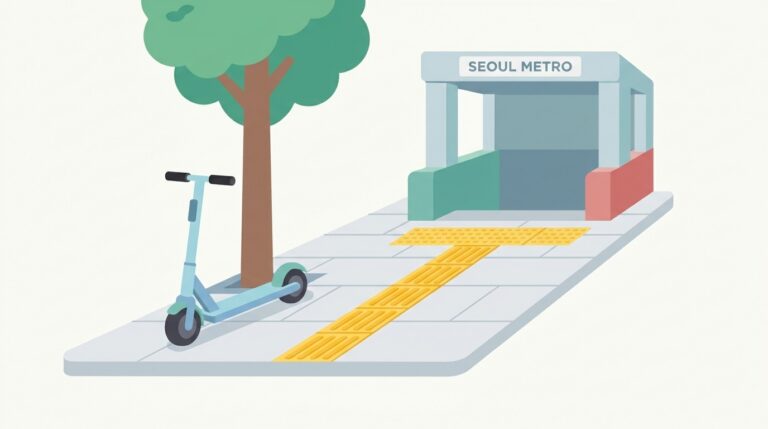
Imagine this: You are exploring the vibrant streets of Hongdae on a shared electric scooter (전동 킥보드 – jeondong kikbodeu). The night breeze is refreshing, K-pop is buzzing from street shops, and you are having the time of your life. When you reach your favorite convenience store, you hop off, tap ‘End Ride’ on your mobile app, and leave the scooter right on the sidewalk near the subway entrance. It seems convenient, right?
Suddenly, you hear the distinctive tap-tap-tap of a white cane. A visually impaired pedestrian has to stop abruptly because your parked scooter is directly blocking the bright yellow textured paving tiles. You freeze in embarrassment. You had no bad intentions, but in South Korea, parking personal mobility devices improperly is not just a minor nuisance—it is a critical safety issue and an immediate community hazard.
Over the past two years, Korean cities like Seoul have strictly cracked down on electric scooter parking. If you park your scooter in the middle of a sidewalk, right on tactile paving (점자블록), or directly blocking building entrances, it can be towed within minutes, racking up a towing fee of 40,000 KRW plus storage costs! More importantly, understanding pedestrian safety etiquette will instantly earn you deep respect from locals. This guide combines real feedback from international residents and on-the-ground traffic insights so you can cruise Korea safely, politely, and fluently.
Phase 2: Top 3 Core Expressions Deep Dive
Let’s break down three indispensable B1-level expressions that will save you from awkward misunderstandings and parking fines.
1. 점자블록 위에 주차하면 안 돼요 (Jeomjabeullok wie juchahamyeon an dwaeyo)
- Pronunciation: [Jeom-ja-beul-lok wi-e ju-cha-ha-myeon an dwae-yo] (Think: “Jum-jah-block wee-eh joo-cha-hah-myeon ahn dway-yo”)
- Meaning: Literal: “If you park on top of the tactile blocks, it is not okay.” / Actual Nuance: “You cannot park on the tactile paving (it blocks visually impaired walkers).”
- K-Culture Moment: You will often hear this from civic volunteers, subway staff, or mindful passersby when someone carelessly drops their scooter near a station exit in a realistic slice-of-life K-drama.
- Editor’s Insight: The grammar pattern
-(으)면 안 돼요is the gold standard for polite yet firm prohibition. Use it when stating objective rules or safety principles without sounding aggressive.- Situation Spectrum: Casual: ✅ | Semi-formal: ✅ | Formal: ⚠️ (In official municipal announcements, you will see ‘주차를 금지합니다’)
- 🤔 Think About It: In many Western cities, street clutter is treated as individual inconvenience. In Korea, tactile paving is legally protected shared infrastructure. Why does communal consideration (배려 – baeryeo) carry such high moral weight in Korean public spaces?
2. 보행자 통행에 방해되지 않게 세워 주세요 (Bohaengja tonghaeng-e banghaedoeji anke seowo juseyo)
- Pronunciation: [Bo-haeng-ja tong-haeng-e bang-hae-doe-ji an-ke se-wo ju-se-yo] (Think: “Boh-hang-jah tong-hang-eh bang-hay-dweh-jee ahn-keh seh-woh joo-seh-yoh”)
- Meaning: Literal: “Please park it so that it does not become a hindrance to pedestrian traffic.” / Actual Nuance: “Please park it aside so it doesn’t get in people’s way.”
- K-Culture Moment: Store owners in bustling alleys like Ikseon-dong or Seongsu-dong using a gentle hand wave to ask scooter riders to tuck their devices neatly against the wall.
- Editor’s Insight: The connective
-게expresses purpose (“so that”), while방해되다means “to be obstructed/hindered”. It is polite, objective, and focuses on the outcome rather than blaming the rider.- Situation Spectrum: Casual: ⚠️ | Semi-formal: ✅ | Formal: ✅
- 🤔 Think About It: Notice how the sentence focuses on “pedestrian flow” (보행자 통행) rather than saying “You are blocking me.” How does this reflect the Korean tendency to frame issues around group harmony?
3. 킥보드를 아무렇게나 두면 견인될 수 있어요 (Kikbodeureul amureokena dumyeon gyeon-indoel su isseoyo)
- Pronunciation: [Kik-bo-deu-reul a-mu-reo-ke-na du-myeon gyeon-in-doel su is-seo-yo] (Think: “Keek-boh-deu-reul ah-moo-ruh-keh-nah doo-myeon gyun-een-dwehl soo ees-suh-yoh”)
- Meaning: Literal: “If you leave the scooter just any which way, it can get towed.” / Actual Nuance: “If you dump your scooter carelessly, it might get towed away!”
- K-Culture Moment: Two university friends stepping out of a cafe, noticing an instant towing truck (견인차) lifting a scooter that was blocking a crosswalk ramp.
- Editor’s Insight:
아무렇게나(carelessly / haphazardly) combined with the passive potential견인될 수 있어요creates a friendly warning among peers.- Situation Spectrum: Casual: ✅ | Semi-formal: ✅ | Formal: 🚫
- 🤔 Think About It: Why is it helpful to warn a friend using “It could get towed” instead of “You are doing something illegal”? Softening consequences makes advice easier to swallow in Korean culture.
Phase 3: Textbook Korean vs. Real Korean
Let’s bridge the gap between stiff grammar books and what Koreans actually say on the sidewalk.
Situation 1: Warning someone about parking in the wrong spot
- 📖 Textbook Korean: 여기에 전동 킥보드를 주차하는 것은 금지되어 있습니다. (Yeogie jeondong kikbodeureul juchahaneun geoseun geumjidoeeo itseumnida. – Parking an electric kickboard here is strictly prohibited.)
- 🗣️ 진짜 한국어 (Real Korean): 여기 두시면 사람들 지나다니기 불편해요. 옆으로 좀 치워 주세요. (Yeogi dusimyeon saramdeul jinadanigi bulpyeonhaeyo. Yeop-euro jom chiwo juseyo. – If you leave it here, it’s hard for people to walk past. Could you move it over to the side, please?)
- 💡 왜 다를까? (Why is it different?): Native speakers rarely quote legal codes like
금지되어 있습니다in casual street encounters. Instead, they appeal to public convenience (지나다니기 불편해요) and make a gentle request with좀(a little).
Situation 2: Asking a friend where it is safe to leave the scooter
- 📖 Textbook Korean: 킥보드 주차 구역이 어디인지 가르쳐 주십시오. (Kikbodeu jucha guyeog-i eodi-inji gareuchyeo jusipsio. – Please inform me where the kickboard parking area is located.)
- 🗣️ 진짜 한국어 (Real Korean): 이거 어디에 세워 둬야 안 끌려가요? (Igeo eodie seowo dwoya an kkeullyeogayo? – Where should I park this so it doesn’t get towed away?)
- 💡 왜 다를까? (Why is it different?): In everyday spoken Korean, locals casually use
끌려가다(literally “dragged away”) to describe towing, rather than the formal term견인되다.
Phase 4: K-Culture Deep Dive & Non-Verbal Manners
4-1. 눈치 (Nunchi) & Sidewalk Gestures
When parking any personal mobility device in Korea, your Nunchi (cultural situational awareness) must be fully activated:
1. The 360-Degree Scan: After stopping, turn your head and check the ground. Look specifically for bright yellow tactile paving (점자블록). If any part of your kickboard’s wheels or kickstand touches the yellow tiles, shift it immediately.
2. The Two-Hand Adjustment: If an elder or pedestrian is approaching while you are adjusting your scooter, use both hands on the handlebars and bow your head slightly (목례 – mongnye). This non-verbally signals: “I am actively clearing the way for you, not blocking you.”
3. Hugging the Boundary: The golden rule of Seoul parking is “against the outer building line or bike rack.” Keep the pedestrian walkway completely open.
4-2. Cultural Code: The ‘Kick-rani’ (킥라니) Phenomenon
In South Korea, electric scooters have sparked intense nationwide debate. Locals coined the satirical compound word 킥라니 (Kik-rani), which combines 킥보드 (Kickboard) and 고라니 (Gorani – Korean water deer). Water deer are notorious for suddenly darting onto country highways out of nowhere; hence, “Kick-rani” refers to reckless scooter riders who zip through red lights, weave between pedestrians, and dump their scooters across sidewalks.
Because the public is weary of “Kick-rani” behavior, local district offices now enforce 즉시 견인 구역 (Immediate Towing Zones):
* Within 10 meters of subway station exits
* Right on yellow tactile blocks (점자블록)
* Directly in front of bus stops and crosswalk curb cuts
* Blocking entrances to emergency stairs or commercial buildings
Being mindful of where you park shows that you respect Korea’s shared urban space and sets you apart as a conscientious traveler.
Phase 5: Real-World Roleplay Scenario
Setting: Outside Exit 3 of Sinchon Station at 5:30 PM. Pedestrians and college students are pouring out of the subway. Alex (an international exchange student) has just parked an electric scooter right next to the escalator entrance, directly resting on the tactile tiles. Min-jun, a university student passing by, gently stops to intervene.
- Min-jun: 저기요, 실례지만 킥보드 여기 세우시면 안 돼요! (Jeogiyo, sillyejiman kikbodeu yeogi seousimyeon an dwaeyo! – Excuse me, but you shouldn’t park your kickboard here!)
- 🎭 Action: Points gently toward the yellow textured tiles beneath the wheels with an open palm.
- Alex: 네? 왜요? 길가 구석에 세웠는데요? (Ne? Waeyo? Gilga guseog-e seowonneundeyo? – Huh? Why? I parked it in the corner of the sidewalk?)
- 🎭 Action: Looks confused and checks his phone parking confirmation screen.
- Min-jun: 바닥에 노란 점자블록 보이시죠? 시각장애인분들이 밟고 다니는 길이라서 막히면 정말 위험해요. (Badag-e noran jeomjabeullok boisijyo? Sigakjang-aeinbundeuri balpgo danineun giriraseo makhimyeon jeongmal wiheomhaeyo. – Do you see the yellow tactile paving on the ground? Visually impaired people walk along this, so if it’s blocked, it’s very dangerous.)
- 🎭 Action: Taps his foot gently beside the yellow block to demonstrate.
- Alex: 아, 정말 몰랐어요! 시각장애인용 길인 줄은 생각도 못 했네요. (A, jeongmal mollasseoyo! Sigakjang-aeinyong girin jureun saenggakdo mot haenneyo. – Oh, I really didn’t know! I didn’t realize it was a designated path for visually impaired people.)
- 🎭 Action: Eyes widen in realization, holding handlebars to move the scooter.
- Min-jun: 네, 게다가 여기 지하철 입구는 즉시 견인 구역이라서 몇 분 만에 끌려가요. 과태료도 나와요. (Ne, gedaga yeogi jihacheol ipguneun jeuksi gyeon-in guyeog-iraseo myeot bun mane kkeullyeogayo. Gwataeryodo nawon-yo. – Yeah, and what’s more, subway entrances are immediate towing zones, so it could get towed within minutes. You’ll get fined too.)
- 🎭 Action: Glances around for traffic enforcement officers.
- Alex: 헉, 큰일 날 뻔했네요! 어디에 세워 두는 게 좋을까요? (Heok, keunil nal ppeonhaenneyo! Eodie seowo duneun ge joeulkkayo? – Gasp, that was a close call! Where would be the best place to leave it?)
- 🎭 Action: Looks around for a safe parking spot.
- Min-jun: 저기 가로수 옆이나 자전거 거치대 옆에 보행자 통행에 방해 안 되게 두시면 돼요. (Jeogi garosu yeop-ina jajeon-geo geochidae yeop-e bohaengja tonghaeng-e banghae an doege dusimyeon dwaeyo. – You can leave it over there next to the street tree or bike rack, where it won’t block pedestrians.)
- 🎭 Action: Points toward a row of neatly parked bicycles 10 meters away.
- Alex: 친절하게 알려주셔서 정말 감사합니다! 얼른 옮길게요. (Chinjeolhage allyeojusyeoseo jeongmal gamsahamnida! Eolleun omgikkeyo. – Thank you so much for explaining kindly! I’ll move it right away.)
- 🎭 Action: Bows respectfully and rolls the scooter toward the designated bike rack.
🔀 Interactive Decision Point
Suppose you just finished your scooter trip and need to park. What do you do?
- Option A: Leave it right in front of the convenience store sliding doors because you are just buying a drink. (Feedback: ❌ BAD. Blocking commercial doorways triggers complaints, app penalty fees, and potential immediate towing!)
- Option B: Park right on top of the yellow dotted tiles because the rest of the sidewalk is crowded. (Feedback: ⚠️ HIGH RISK. This directly endangers visually impaired citizens and violates Seoul PM safety regulations with a 40,000 KRW fine!)
- Option C: Wheel the scooter next to a street tree or public bicycle rack, keeping at least 2 meters of clear sidewalk for pedestrians. (Feedback: 🌟 BEST! You protect disabled pedestrians, avoid towing, and master local civic etiquette like a true pro!)
Phase 6: 10-Second Emotion Shadowing Drill
Practice these lines out loud! Pay attention to the pauses (/) and emotional cues to master native rhythm.
[🚨 Urgently and cautionary]
점자블록 위에 / 세우시면 / 안 돼요! / 시각장애인분들이 다쳐요.
(Jeomjabeullok wie / seousimyeon / an dwaeyo! / Sigakjang-aeinbundeuri dachyeoyo.)
“You shouldn’t park on top of tactile paving! / Visually impaired people could get hurt.”-
[🙏 Apologetic and polite]
죄송합니다, / 몰랐어요! / 보행자 통행에 방해 안 되게 / 바로 치울게요.
(Joesonghamnida, / mollasseoyo! / Bohaengja tonghaeng-e banghae an doege / baro chiulgeyo.)
“I am so sorry, / I didn’t know! / I’ll move it right away / so it won’t block pedestrians.” -
[💡 Realizing and thankful]
알려주셔서 감사해요! / 여기 두면 / 바로 견인될 뻔했네요.
(Allyeojusyeoseo gamsahaeyo! / Yeogi dumyeon / baro gyeon-indoel ppeonhaenneyo.)
“Thank you for letting me know! / If I left it here, / it could have been towed immediately.”
Phase 7: K-Culture Mini Dictionary
| Term (Hangul + Romanization) | Meaning | Real-Life Usage Insight |
|---|---|---|
| 1. 점자블록 (Jeomjabeullok) | Tactile Paving / Braille Blocks | The yellow textured raised paving tiles installed on Korean sidewalks and subway platforms designed to guide cane users. Never park or stand on them. |
| 2. 킥라니 (Kik-rani) | Reckless Scooter Rider | Slang blend of Kickboard + Gorani (water deer). Used when criticizing riders who ignore traffic signals, ride without helmets, or park haphazardly. |
| 3. 견인 구역 (Gyeon-in gu-yeok) | Tow-Away Zone | High-priority street zones (crosswalks, bus stops, subway exits) where improperly parked PMs are towed immediately within 1 to 2 hours. |
| 4. 보행권 (Bohaenggwon) | Pedestrian Right of Way | A widespread civil advocacy concept in Korea highlighting that the safety and comfort of pedestrians should always take priority over vehicles and PMs. |
Phase 8: Traveler’s Survival Kit
Top 3 Survival Phrases
- 여기 세워도 돼요? (Yeogi seowodo dwaeyo?) – “Is it okay to park here?”
- Pro Tip: Ask this to shop owners or parking attendants before locking your scooter.
- 조금만 비켜 주세요! (Jogeumman bikyeo juseyo!) – “Could you step aside slightly, please?”
- Pro Tip: Use when walking a scooter through tight pedestrian zones rather than ringing an aggressive bell.
- 견인료 얼마예요? (Gyeon-innyo eolmayeyo?) – “How much is the towing fee?”
- Pro Tip: Useful if your rented scooter was towed before your rental ended.
Editor’s Travel Note
- Required Mobility Apps: To rent shared scooters (like Beam, Swing, or Kickgoing), you must possess a valid driver’s license (or International Driving Permit) and wear a helmet (헬멧). Check available parking zones directly on the Seoul Smart Mobility map on Naver Map app.
- Official Public Bicycles Alternative: If scooter regulations seem too complex, try using the public bike system instead by downloading the Seoul Bike Ddareungi official application. Ddareungi has clearly marked docking stations that eliminate parking anxiety altogether!
Phase 9: “One Step Deeper” (Reflective Cultural Essay)
In Korean culture, the street is not merely concrete beneath our shoes; it is an extension of collective civic life (공공질서 – gonggong jilseo). Because South Korean cities boast incredible population density, everyday life functions smoothly only when citizens practice unspoken mutual consideration (배려 – baeryeo).
Tactile paving (점자블록) represents an essential lifeline for visually impaired citizens navigating fast-paced metropolitan areas like Seoul and Busan. When someone abandons a 25-kilogram metal scooter directly across that path, it instantly transforms a trusted guide into a dangerous trip hazard. Speaking up about scooter parking isn’t about being bossy or nitpicky; it is an expression of communal solidarity—ensuring that every neighbor, regardless of physical ability, has an unobstructed path forward.
💬 Your Turn: Have you ever noticed tactile paving in your home country? How are electric scooters regulated where you live? Share your thoughts with us in the comments below!
Phase 10: FAQ & Common Mistakes
Q: Can I ride an electric scooter on the sidewalk if I go slowly?
A: No! Under Korean Road Traffic Law, electric kickboards are classified as “Personal Mobility (PM)” devices and are strictly prohibited from riding on pedestrian sidewalks. You must ride on designated bicycle paths or along the rightmost edge of the roadway. Riding on sidewalks can result in a 30,000 KRW fine.
Q: What happens if my rented electric scooter gets towed?
A: The towing agency charges the scooter rental company a towing fee (typically 40,000 KRW in Seoul) plus storage fees. The rental company will automatically charge this penalty directly to the credit card linked to your account.
Q: Can two people ride one electric scooter together in Korea?
A: Absolutely not! Tandem riding (동승 탑승) is strictly illegal and subject to a 40,000 KRW police fine. Scooters are certified for single-rider use only.
🚨 Common Mistakes Warning Board
- Mistake 1: Leaving the scooter directly at the subway exit stairs.
- Correct Action: Walk the scooter at least 10 meters away from the exit before parking against a wall or bicycle rack.
- Mistake 2: Thinking yellow lines on the pavement are decorative.
- Correct Action: Remember that all textured yellow tiles are tactile paving for the visually impaired. Keep them 100% clear at all times.
- Mistake 3: Riding without a helmet because it’s a short trip.
- Correct Action: Always strap on a helmet. Police regularly conduct random checkpoints near university areas and subway stations, issuing 20,000 KRW fines for helmetless riders.
Phase 11: Action Mission Challenge
- 🥉 Bronze Mission (Solo Practice): Stand in front of your mirror and repeat:
"점자블록 위에 주차하면 안 돼요!"three times with a confident, polite hand gesture. - 🥈 Silver Mission (Social Eye): Next time you walk down a street, spot a tactile block. Take a mental photo and verify whether any bicycles or scooters are blocking it.
- 🥇 Gold Mission (Real Life Action): If you see a carelessly abandoned scooter fallen across a sidewalk or on tactile paving during your Korea trip, safely nudge it upright against a wall. Take pride in protecting pedestrian safety!
- 🎮 K-Culture Mission: Watch an episode of a modern Seoul-based drama (like Extraordinary Attorney Woo or Itaewon Class) and see if you can spot tactile paving tiles along the subway walkways!
Phase 12: Interactive Quiz Challenge
Test your knowledge before hitting the streets!
1. Situation Judgment: You are riding a kickboard near Gangnam Station. Which of the following is an illegal and dangerous place to park?
* A) Next to an existing outdoor bicycle rack
* B) Directly over the yellow dot-patterned tactile tiles near a crosswalk
* C) Along an exterior wall with no building entrances
2. Fill in the Blank: Complete the safety warning:
* “보행자 통행에 ________ 않게 세워 주세요.” (Please park it so it doesn’t hinder pedestrian traffic.)
* (1) 편리하지 (pyeonrihaji)
* (2) 방해되지 (banghaedoeji)
* (3) 조용하지 (joyonghaji)
3. True or False: In Seoul, you can park an electric scooter right in front of a subway exit as long as you take a parking photo on the app.
* True / False
👉 Click here for answers and explanations!
- Answer: B. Parking on tactile paving endangers visually impaired pedestrians and leads to immediate towing.
- Answer: (2) 방해되지. The phrase
방해되지 않게means “so that it does not cause a hindrance/obstruction.” - Answer: False. Subway exits are designated immediate towing zones within 10 meters, regardless of what photo you submit to the rental app!
🎬 Watch Our Daily Videos! (Daily Hangul Official Instagram)
Review the expressions you learned in this article with our fun daily short videos! Check out native pronunciation and real-life nuances in action.
- Instagram @dailyhangul_en







