

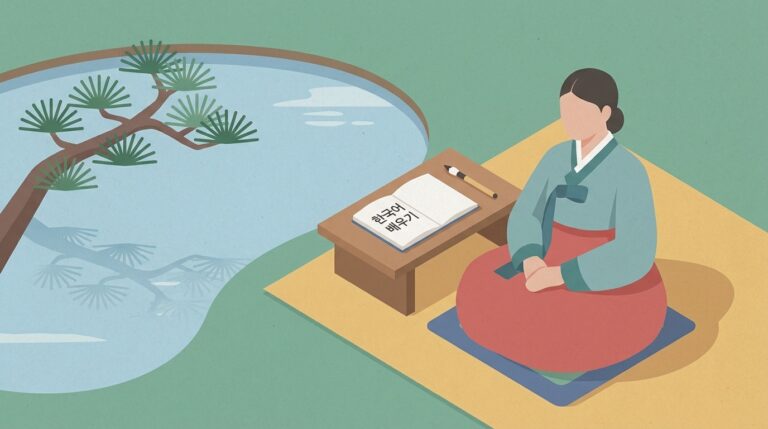
Beyond Calm: Master ‘Myeonggyeongjisu’ and the Art of Korean Scholarly Zen
Phase 1: Empathy (Story-Immersive Opening)
안녕하세요! 매일한글 에디터입니다. (Annyeonghaseyo! It’s your Daily Hangul editor here.)
Picture this: You are watching a gripping K-drama like Stranger (비밀의 숲) or a high-stakes sageuk like Under the Queen’s Umbrella (슈룹). The courtroom or royal court is erupting into chaos—allegations flying, voices cracking with fury, political survival hanging by a thread. Amidst this storm, the protagonist sits completely motionless. Their gaze is not angry; it is tranquil, crystalline, and terrifyingly clear. In modern colloquial Korean, you might be tempted to utter something basic like, “저 사람 진짜 침착해요” (That person is really calm). But in your gut, as an advanced C2 learner, you know that falls flat. It misses the moral fortitude, the ancestral philosophy, and the incorruptible dignity radiating from the screen.
That exact friction is where many C2 learners hit a wall. You have conquered standard grammar and casual slang, yet classical four-character idioms (고사성어, gosaseong-eo) still feel like impenetrable museum artifacts. You worry about sounding overly pedantic or using an archaic phrase in an awkward, robotic way.
Today, we are diving deep into 명경지수 (明鏡止水, Myeonggyeongjisu)—an idiom expressing a mind as unclouded as a polished mirror and as serene as still water. Backed by field-tested insights from our Master-level bilingual coaching sessions, this guide is designed to transform these profound classical metaphors into an organic, commanding extension of your advanced Korean fluency.
Phase 2: Core Expressions Deep Dive
1. 명경지수 (明鏡止水)
- Pronunciation: [Myeong-gyeong-ji-su] (Sounds like “myung-gyung-jee-soo”—glide through the velar nasal ‘ng’ cleanly without harsh friction)
- Meaning: Literal: A bright mirror and still water. | Nuance: A state of unclouded moral clarity, absolute impartiality, and emotional serenity free from personal greed.
- K-Culture Moment: Used in political analysis, legal dramas, or historical sagas when a judge or statesman refuses bribes and issues an unbiased verdict: “그의 판결 뒤에는 명경지수의 마음가짐이 있었다” (Behind his verdict was a mind of serene, unclouded impartiality).
- Editor’s Insight: Derived from ancient philosophical texts (Zhuangzi), this phrase transcends mere “calmness” (평정심). It denotes that because your mind has no turbulent ripples of selfish desire (욕심), it reflects the objective truth of reality exactly as it is.
- Situation Spectrum: Casual 🚫 | Semi-formal ⚠️ | Formal ✅
- 🤔 Think About It: In Western stoicism, composure is often framed as emotional suppression or detachment. How does the Korean metaphor of reflective water differ from the concept of a “stone cold” poker face?
2. 안빈낙도 (安貧樂道)
- Pronunciation: [An-bin-nak-do] (Notice the consonant assimilation: ‘bin’ + ‘nak’ sounds like “ahn-been-nahk-doh”)
- Meaning: Literal: Being at peace in poverty while delighting in the righteous path. | Nuance: Finding profound contentment in a simple, honest life rather than compromising one’s values for material luxury.
- K-Culture Moment: Frequently cited in essays, documentaries, or historical dramas describing the classical seonbi (Joseon scholar) retreating to a thatched cottage to write poetry rather than serving a corrupt court.
- Editor’s Insight: Don’t confuse this with forced destitution. It represents an intentional, proud minimalism where intellectual and ethical integrity outweighs consumerist rat races.
- Situation Spectrum: Casual 🚫 | Semi-formal ⚠️ | Formal ✅
- 🤔 Think About It: Modern Korea is synonymous with hyper-fast consumerism and trendy materialism. Why do you think modern Koreans still deeply revere the concept of anbinnakdo in literature and art?
3. 지조와 절개 (志操와 節介)
- Pronunciation: [Ji-jo-wa Jeol-gae] (Crisp ‘j’ sounds, like “jee-joh-wah jeol-geh”)
- Meaning: Literal: Will/principle and integrity/fidelity. | Nuance: Unwavering moral backbone; staying true to one’s principles despite immense adversity, threats, or temptation.
- K-Culture Moment: In historical epics, when a loyal subject faces exile or death before signing an unethical decree, shouting that their spirit cannot be bought.
- Editor’s Insight: Often symbolized in Korean traditional art by the evergreen pine (소나무) or bamboo (대나무), which never lose their green needles even in the harshest winter snow.
- Situation Spectrum: Casual ⚠️ | Semi-formal ✅ | Formal ✅
- 🤔 Think About It: How does the linguistic pairing of abstract virtues (지조 + 절개) shape the high-context, holistic way moral character is evaluated in Korean leadership?
Phase 3: Textbook Korean vs. Real Korean
Situation 1: Giving high-level advice to remain calm and objective before a crucial tribunal
- 📖 교과서 한국어 (Textbook Korean): 마음을 편안하게 먹고 공정하게 결정하세요. (Maeumeul pyeonanhage meokgo gongjeonghage gyeoljeonghaseyo. / Make your mind comfortable and decide fairly.)
- 🗣️ 진짜 한국어 (Real Korean): 사사로운 감정에 휘둘리지 말고, 명경지수의 자세로 임하십시오. (Sasaroun gamjeonge hwidulliji malgo, myeonggyeongjisu-ui jaserob imhasipsio. / Do not be swayed by personal sentiments; approach the matter with a posture of unclouded serenity.)
- 💡 왜 다를까? (Why the difference?): At the C2 level, replacing generic adjectives with classical imagery elevated through Sino-Korean idioms commands authority, establishing intellectual gravitas in formal discussions.
Situation 2: Commending a colleague who turned down an ethically questionable corporate incentive
- 📖 교과서 한국어 (Textbook Korean): 돈의 유혹에 넘어가지 않은 착한 사람이에요. (Don-ui yuhoge neomeogaji aneun chakhan saram-ieyo. / They are a good person who did not fall for the temptation of money.)
- 🗣️ 진짜 한국어 (Real Korean): 온갖 외압 속에서도 선비 같은 지조와 절개를 지켜내더군요. (Ongat oeap sogeseodo seonbi gateun jijowa jeolgaereul jikyeonaedeogunyo. / Amid all kinds of external pressure, they steadfastly upheld their scholarly integrity.)
- 💡 왜 다를까? (Why the difference?): Labeling someone simply as “착하다” (nice/good) diminishes professional resilience. Framing it through “지조와 절개” highlights deep philosophical agency and moral courage.
Phase 4: K-Culture Deep Dive & Non-Verbal Manners
4-1. 눈치 (Nunchi) & Gestures
When invoking idioms of scholarly integrity (myeonggyeongjisu), physical demeanor is everything:
* The Steady Gaze (정좌, Jeongjwa): Do not shift your eyes rapidly or nod excessively. Sit with an upright spine, hands gathered calmly in your lap (공수, gongsu), and maintain an unblinking, level eye contact that conveys calm resolve.
* Voice Modulation: Speak from the lower abdomen (단전, danjeon). Lower your vocal pitch slightly and moderate your pace. Rushing your syllables destroys the gravity of the idiom.
4-2. Cultural Code: The Joseon Seonbi (선비) Heritage
The Joseon Dynasty (1392–1910) was an ideological civilization constructed upon Neo-Confucian metaphysics. The ideal human archetype was not a wealthy merchant or an invincible warrior, but the 선비 (Seonbi)—the virtuous scholar-official who prioritized righteousness (의, Ui) over personal profit (리, Ri).
When modern Koreans describe a leader as having myeonggyeongjisu, they are not complimenting their mental wellness app streak. They are connecting that individual to a centuries-old lineage of scholars who risked beheading to deliver blunt remonstrances (상소문) to absolute monarchs. This moral stoicism remains a core aspirational benchmark in contemporary Korean jurisprudence, high journalism, and presidential rhetoric.
Phase 5: Real-World Roleplay Scenario
Setting: A quiet, traditional tea house near Insadong, Seoul. Rain trickles outside. You are a senior policy analyst discussing an intense corporate audit with Mentor Director Min (민 국장).
- 턴 1 (Director Min): 이번 감사 건, 윗선의 압박이 만만치 않을 텐데 자네 괜찮겠나? (Ibeon gamsa geon, witseon-ui apbagi manmanchi aneul tende jane gwaenchankenna? / 🎭 Leaning back with a furrowed, concerned brow.)
- 턴 2 (You): 솔직히 부담은 됩니다만, 원칙대로 처리할 생각입니다. (Soljiki budameun doemnida-man, wonchik-daero cheorihal saenggak-imnida. / 🎭 Sitting upright, holding the ceramic teacup steadily.)
- 턴 3 (Director Min): 타협하지 않으면 자네 커리어에 오점이 남을 수도 있어. (Tahyeophaji aneumyeon jane keorieo-e ojeomi nameul sudo isseo. / 🎭 Speaking in a lowered, cautionary whisper.)
- 턴 4 (You): 자리에 연연하여 명경지수의 마음을 저버릴 수는 없습니다. (Jarie yeon-yeonhayeo myeonggyeongjisu-ui maeumeul jeobeoril suneun eopseumnida. / 🎭 Looking into his eyes calmly without hesitation.)
- 턴 5 (Director Min): 허허, 역시 자네다운 결기군. 옛 선비들의 서슬 퍼런 기개가 느껴져. (Heoheo, yeoksi janedaun gyeolgigun. Yet seonbideurui seoseul peoreon gigaega neukkyeojyeo. / 🎭 Letting out a faint, admiring chuckle.)
- 턴 6 (You): 과찬이십니다. 그저 부끄럽지 않은 결정을 내리고 싶을 뿐입니다. (Gwachan-isimnida. Geujeo bukkeureopji aneun gyeoljeongeul naerigo sipeul ppun-imnida. / 🎭 Lowering head slightly with humble dignity.)
- 턴 7 (Director Min): 그래, 흔들리는 물에는 세상이 일그러져 비치는 법이지. (Geurae, heundeullineun mureneun sesang-i ilgeureojyeo bichineun beobiji. / 🎭 Pouring warm green tea into your cup.)
- 턴 8 (You): 네, 국장님 말씀대로 끝까지 지조를 지키겠습니다. (Ne, gukjangnim malsseumdaero kkeutkkaji jijoreul jikigesseumnida. / 🎭 Accepting the cup with both hands respectfully.)
🔀 Interactive Decision Point
If Director Min had asked: “자네, 이번 감사 결과를 조금만 완화해서 보고서에 올리는 게 어떤가?” (What if you softened the findings on this report just a bit?)
- Option A: “절대 안 됩니다! 국장님도 공직자로서 부끄러운 줄 아세요!” (Jeoldae an doemnida! Gukjangnimdo gongjikjaro-seo bukkeureoun jul aseyo!)
Feedback: Bad. Highly confrontational; breaches all hierarchical decorum and closes off dialogue. - Option B: “공직자의 소명은 명경지수의 투명성에 있으니, 원안대로 보고하는 것이 도리라 사료됩니다.” (Gongjikja-ui somyeongeun myeonggyeongjisu-ui tumyeongseong-e isseuni, wonan-daero bogohaneun geosi dorira saryodoemnida.)
Feedback: Best! Flawless C2 register combining classical principle with respectful bureaucratic rhetoric. - Option C: “음… 국장님이 그렇게 말씀하시니 한번 다시 생각해 보겠습니다.” (Eum… gukjangnime geureoke malsseumhasini hanbeon dasi saenggakhae bogesseumnida.)
Feedback: Risk. Shows vacillation and forfeits your integrity instantly.
Phase 6: 10-Second Emotion Shadowing Drill
Read aloud along the rhythm markers (/), matching the intended psychological temperature:
[🧘 차분하고 단호하게 - Calm and Resolute]
사사로운 욕망을 버리고 / 명경지수의 자세로 / 결단을 내리겠습니다.
(Sasaroun yongmangeul beorigo / myeonggyeongjisu-ui jaserob / gyeolldaneul naerigesseumnida. / Casting aside personal desires / in a posture of serene clarity / I shall make my decision.)-
[🏔️ 숭고하고 결의에 차서 - Lofty and Determined]
어떤 외압이 있더라도 / 선비의 지조와 절개를 / 꺾을 수는 없습니다.
(Eotteon oeabi itdeorado / seonbi-ui jijowa jeolgaereul / kkeokkeul suneun eopseumnida. / Whatever outside pressures exist / the scholarly integrity and fidelity / cannot be broken.) -
[🍵 겸허하고 담담하게 - Humble and Serene]
부귀영화를 좇기보다 / 안빈낙도의 삶을 살고자 합니다.
(Bugi-yeonghwareul jotgiboda / anbinnakdo-ui salmeul salgoja hamnida. / Rather than chasing wealth and glory / I wish to live a life content in righteous simplicity.)
Phase 7: K-Culture Mini Dictionary
- 선비정신 (Seonbi-jeongshin): The spirit of the Joseon scholar; refers to an unyielding pursuit of social justice, intellectual integrity, and austere morality over personal gain.
- 청렴결백 (Cheongnyeom-gyeolbaek): Spotless incorruptibility; used extensively in legal and political spheres to characterize public servants completely untainted by bribery.
- 평정심 (Pyeongjeongsim): Inner composure; emotional equanimity maintained during psychological storms or emergencies.
- 청빈 (Cheongbin): Honest poverty; the voluntary practice of a simple, frugal life to maintain pure conscience and spiritual freedom.
Phase 8: Traveler’s Survival Kit
Survival Phrases for Cultural Sites
- 이곳의 고즈넉한 분위기가 마음을 맑게 해 주네요.
(Igosui gojeuneokan bunwigiga maeumeul makge hae juneyo.)
Pro Tip: Perfect when conversing with a docent at a secluded Confucian academy (Seowon). - 전통 다도 체험을 통해 평정심을 배우고 싶습니다.
(Jeontong dado cheheomeul tonghae pyeongjeongsimeul baeugo sipseumnida.)
Pro Tip: Use at traditional tea houses to show deep reverence for ceremonial tea culture. - 선비 문화와 관련된 유물은 어디에 전시되어 있나요?
(Seonbi munhwawa gwanryeondoen yumureun eodie jeonsidoeeo innayo.)
Pro Tip: Impresses museum curators instantly with advanced lexical precision.
Editor’s Travel Note
To truly breathe in myeonggyeongjisu, step away from the neon lights of Gangnam and visit the secluded Dosan Seowon (도산서원) in Andong or the Secret Garden at Changdeokgung (창덕궁 후원). Check out the National Museum of Korea Exhibition Guide for current exhibitions on Joseon scholarly ink paintings. When traveling intercity to these heritage locations, install the Naver Map Navigation App to find tranquil rural bus routes that foreign transit maps often miss.
Phase 9: “One Step Deeper” (Reflective Essay)
In our hyper-connected, algorithm-driven world, the human mind resembles a stormy sea battered by relentless notifications and vanity metrics. Korean ancestors understood that when water is churned up, sediment rises and visibility drops to zero; decisions made in that agitated state lead to moral catastrophe. Myeonggyeongjisu is not passive escapism; it is the radical, active purification of the mind so that reality can be perceived without ego distortions. By retrieving this vocabulary, you are not merely memorizing classical Hanja roots—you are adopting a cognitive shield against the frantic noise of modern life.
💬 Your Turn: When was the last time you felt your mind reach the clarity of myeonggyeongjisu? Share your thoughts below in Korean!
Phase 10: FAQ & Misconception Prevention
Q: Can I use ‘명경지수’ to describe a completely flat, calm lake while hiking?
A: Technically yes, but metaphorically it is almost exclusively reserved for human consciousness, ethical resolve, and mental composure. If you only want to describe calm natural water, “잔잔한 호수” (a serene lake) is far more natural.
Q: Is ‘명경지수’ an everyday expression used by young Koreans on social media?
A: No. Dropping myeonggyeongjisu into an Instagram story about your weekend coffee will sound humorously hyper-literary or sarcastic. Reserve it for reflective essays, formal speeches, professional milestones, or deep philosophical debates.
Q: What is the grammatical difference between ‘명경지수의 마음’ and ‘마음이 명경지수다’?
A: Both are grammatically sound. “명경지수의 마음(가짐)” functions as a pre-modifying noun phrase (“a mindset like a clear mirror and still water”), while “마음이 명경지수와 같다” predicates the sentence with a poetic simile.
🚨 Common Mistakes
- Mistake 1: Using it interchangeably with feeling “bored” or “sleepy” (e.g., 지루해서 명경지수예요 ❌).
Correct Action: Use myeonggyeongjisu strictly for alert, tranquil presence. - Mistake 2: Assuming anbinnakdo (안빈낙도) means giving up on ambition due to laziness.
Correct Action: Understand it as a principled choice of integrity over unearned riches. - Mistake 3: Pronouncing the Hanja compound with English plosives.
Correct Action: Keep the consonants crisp and smooth without puffing aspirated air.
Phase 11: Action Missions
- 🥉 Bronze Mission (Solo Practice): Stand before a mirror. Shadow the Phase 6 drills 3 times with a steady eye, matching the pause markers (
/). - 🥈 Silver Mission (SNS & Community): Write a one-line Korean journal entry on social media describing a stressful situation you resolved with equanimity using: “~속에서도 명경지수의 마음을 유지하려 했다.”
- 🥇 Gold Mission (Real-World Engagement): In your next advanced Korean conversation exchange or class, describe your favorite movie character’s moral turning point using either 명경지수 or 지조와 절개.
- 🎮 K-Culture Mission: Watch an episode of a sageuk drama (e.g., Mr. Sunshine or Secret Royal Inspector) and spot the visual motifs of mirrors, water basins, or bamboo that symbolize inner integrity.
Phase 12: Interactive Quiz Challenge
1. Situational Judgment:
Which of the following scenarios best warrants the phrase “명경지수의 마음가짐”?
A) An athlete celebrating wildly after scoring a goal.
B) A judge reviewing sensitive evidence while remaining completely immune to political pressure or public fury.
C) A tourist falling asleep on a sunny Jeju beach.
2. Fill-in-the-Blank:
부정한 청탁을 단호히 거절하고 공직자의 본분을 다하는 모습에서, 옛 선비의 꺾이지 않는 (____)와/과 (____)을/를 엿볼 수 있었다.
(Hint: Words for will/principle and moral fidelity)
3. True or False (Culture):
In traditional Joseon aesthetics, clear water was valued because it allowed you to check your external beauty and cosmetics. (True / False)
Click here to reveal answers and explanations
- Answer: B. Myeonggyeongjisu represents disciplined impartiality and moral clarity during high-stakes ethical judgments.
- Answer: 지조 (Jijo), 절개 (Jeolgae). These two terms collectively define scholarly integrity and steadfast moral fidelity against external pressure.
- Answer: False. In Joseon Neo-Confucianism, reflective water symbolized self-examination of one’s conscience and moral soul, not superficial physical vanity.
🎬 Watch Our Daily Videos! (Daily Hangul Official Instagram)
Review the expressions you learned in this article with our fun daily short videos! Check out native pronunciation and real-life nuances in action.
- Instagram @dailyhangul_en







