

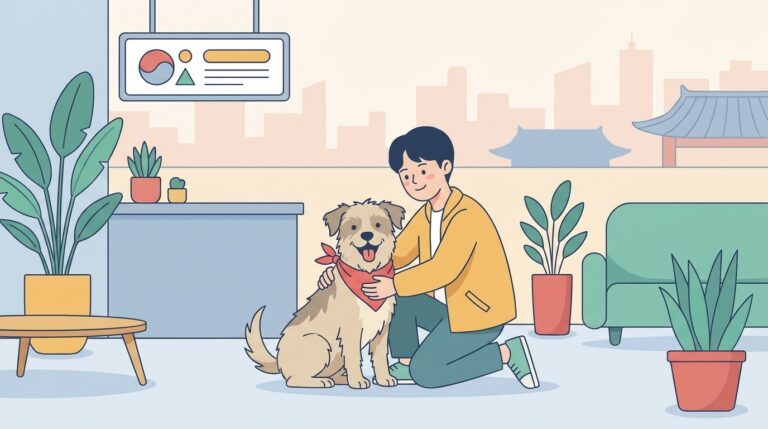
Adopt, Don’t Shop: Navigating Korea’s Pet Culture and Shelter Adoption
Phase 1: 공감 (Empathy & Cultural Opening)
안녕하세요! 매일한글 에디터입니다. (Hello! I’m your Daily Hangul editor.)
If you have ever strolled through Seoul’s trendy Yeonnam-dong on a breezy Sunday afternoon or walked along the Han River parks, you have witnessed a heartwarming phenomenon: South Korea has proudly entered the “Era of 15 Million Pet Companions” (반려동물 천만 시대). Everywhere you turn, adorable dogs dressed in tailor-made pastel harnesses are trotting alongside their doting humans, and pet-friendly bakeries display artisanal dog pastries.
Yet behind the bright showcase windows of commercial pet shops in high-end shopping districts lies a deeper, compassionate cultural movement. More and more Koreans are turning their backs on commercial puppy mills and raising their voices for ethical rescue shelters (유기동물 보호소). Walk into any hip indie cafe or look at the Instagram feeds of K-pop icons, and you will inevitably see the slogan: “사지 말고 입양하세요” (Adopt, don’t shop).
Many of our B1 learners tell us: “I want to talk about animals with my Korean friends or ask how to volunteer at local shelters, but I worry about using outdated words that might sound insensitive or stiff like an old textbook.” That is a completely natural concern! In Korea, language surrounding pets has undergone a massive social revolution over the past decade. Words reflect whether you view an animal as an ornament or as a cherished family member.
As your 10-year cultural navigator, I have crafted this practical, field-tested guide based on real conversations with Korean animal rescue coordinators and companion animal guardians. By mastering these expressions, you will not only sound remarkably natural, but you will also connect deeply with Korean locals who care passionately about animal welfare and responsible pet ownership.
Phase 2: 핵심 표현 3선 심층 분석 (Top 3 Core Expressions)
1. 사지 말고 입양하세요 (Saji malgo ibyanghaseyo)
- Pronunciation: [Saji malgo ibyanghaseyo] (Sounds like: Sah-jee mahl-go eeb-yahng-hah-seh-yo — imagine saying “stop buying, start adopting” with gentle poise)
- Meaning: Literal: “Do not buy, please adopt” | Real Nuance: The definitive Korean rallying cry for “Adopt, Don’t Shop.” It is courteous, warm, and inspiring.
- K-Culture Moment: Seen printed on canvas tote bags championed by artists like Lee Hyori, and posted as official campaign banners across Korean animal rescue foundations.
- Editor’s Insight: The pattern
-지 말고(-ji malgo) is the key here. Directly commanding someone not to do something can sound confrontational in Korean society. However, pairing-지 말고with the respectful honorific-세요(-seyo) transforms the sentence from a rigid command into an uplifting civic invitation. - Situation Spectrum: Casual: ✅ | Semi-formal: ✅ | Formal: ✅
- 🤔 Think About It: In English, “Adopt, don’t shop” relies on a catchy rhyme. Korean contrasts two explicit actions:
사다(to buy) and입양하다(to adopt into a family). How does your mother tongue handle the shift from consumer language to family language for pets?
2. 끝까지 책임질게요 (Kkeutkkaji chaegimjilgeyo)
- Pronunciation: [Kkeutkkaji chaegimjilgeyo] (Sounds like: Kkeut-kkah-jee cheh-geem-jeel-geh-yo — pronounce the initial ‘kk’ with firm, tight vocal tension)
- Meaning: Literal: “I will take responsibility until the end” | Real Nuance: “I promise a lifetime commitment to this companion animal.”
- K-Culture Moment: Spoken by adopters signing shelter pledge contracts on emotional reality programs like SBS’s TV Animal Farm (TV 동물농장).
- Editor’s Insight:
책임(chaegim, responsibility) is a profound moral concept in Korea. Adding끝까지(until the absolute end) explicitly addresses the heartbreak of animal abandonment, signaling that the guardian will stick through vet bills, aging, and life changes. - Situation Spectrum: Casual: ⚠️ (Sounds too dramatic for casual favors) | Semi-formal: ✅ | Formal: ✅
- 🤔 Think About It: Why do you think Korean shelter questionnaires emphasize the emotional pledge of “끝까지” over purely financial metrics?
3. 유기견 보호소에서 봉사하고 싶어요 (Yugigyeon bohoso-eseo bongsahago sipeoyo)
- Pronunciation: [Yugigyeon bohoso-eseo bongsahago sipeoyo] (Sounds like: Yoo-gee-gyon boh-hoh-soh-eh-soh bong-sah-hah-goh sheep-aw-yo)
- Meaning: Literal: “I want to do volunteer work at an abandoned dog shelter” | Real Nuance: “I’d love to help out at a rescue dog sanctuary.”
- K-Culture Moment: K-pop stars like BLACKPINK’s Rosé or actor Lee Do-hyun sharing behind-the-scenes vlogs of cleaning kennels, socializing rescue pups, and walking them at rural shelters.
- Editor’s Insight:
유기견(yugigyeon) refers specifically to abandoned/rescued dogs, while유기묘(yugimyo) refers to cats. If you want to encompass all animals, use유기동물(yugidongmul). Using봉사하다(to volunteer service) immediately conveys genuine humility. - Situation Spectrum: Casual: ✅ | Semi-formal: ✅ | Formal: ✅
- 🤔 Think About It: How does offering your time at an animal sanctuary build community trust in your home country compared to in Korea?
Phase 3: 교과서 한국어 vs 진짜 한국어 (Textbook vs. Real-Life Korean)
Situation 1: Talking about having brought home a rescued dog
- 📖 교과서 한국어: 저는 유기동물 보호소에서 개 한 마리를 분양받았습니다.
(Jeoneun yugidongmul bohoso-eseo gae han marireul bunyangbadasseumnida. / “I was allocated one dog from an abandoned animal shelter.”) - 🗣️ 진짜 한국어: 보호소에서 우리 강아지 입양해서 키우고 있어요!
(Bohoso-eseo uri gangaji ibyanghaeseo kiugo isseoyo! / “I adopted our pup from a shelter and am raising them!”) - 💡 왜 다를까?: Bureaucratic textbooks use formal administrative phrasing like
분양받다(to receive a distributed animal) and numerical counters like개 한 마리(one dog). Real Koreans treat their companion animals as beloved kin, naturally opting for우리 강아지(our pup) and입양하다(to adopt).
Situation 2: Advocating ethical pet culture among friends
- 📖 교과서 한국어: 우리는 펫숍에서 동물을 구매하는 행위를 지양해야 합니다.
(Urineun petsyop-eseo dongmureul gumaehaneun haengwireul jiyanghaeya hamnida. / “We must refrain from the act of purchasing animals at pet shops.”) - 🗣️ 진짜 한국어: 샵에서 사지 말고, 쉼터에서 입양하는 문화가 더 퍼졌으면 좋겠어요.
(Syap-eseo saji malgo, swimteo-eseo ibyanghaneun munhwaga deo peojyeosseumyeon jokesseoyo. / “Instead of pet shops, I really hope the culture of adopting from shelters catches on even more.”) - 💡 왜 다를까?: Terms like
구매하는 행위(the act of purchasing) and지양하다(to avoid/refrain) sound like academic policy papers. Real native speakers casually refer to pet stores as샵(shop) and frame their social ideals with the heartfelt hopeful ending-었으면 좋겠어요.
Phase 4: K-Culture 딥다이브 & 비언어적 매너 (Deep-Dive & Nunchi)
4-1. 눈치 (Nunchi) & Street Etiquette (펫티켓)
- The Yellow Ribbon Code (노란 리본): If you see a dog with a yellow ribbon tied to its leash or collar during a stroll in Seoul Forest, activate your nunchi immediately. This indicates the dog is anxious, recovering from surgery, or adjusting after shelter trauma. Maintain space, avoid prolonged direct eye contact, and do not lean in.
- The Two-Step Approach: Never bend directly over a dog’s head to pet it. First, bow slightly to the guardian and ask: “만져봐도 될까요?” (Manjyeobwado doelkkayo? / May I gently pet them?). If they agree, lower your body to the dog’s eye level and present the back of your curled hand for them to sniff.
- Essential Gear: Carrying a waste pouch (배변봉투) and keeping leashes within the legally required 2-meter length in urban areas is strictly monitored. Forgetting either can result in spot fines and severe social disapproval.
4-2. Cultural Code Analysis: From “애완” to “반려”
Decades ago, pets in Korea were often called 애완견 (aewangyeon) or 애완동물 (aewandongmul), where the Hanja character 완 (玩) literally means a toy or plaything. Today, that term is considered archaic and dismissive. Korean society has unified around the word 반려 (伴侶, banryeo), meaning lifelong companion.
Furthermore, K-celebrity advocacy has created a seismic shift in public perception. Historically, boutique purebreds (품종견) were status symbols. When megastars like BLACKPINK’s Rosé adopted her shelter mixed-breed “Hank,” it ignited a nationwide craze for 믹스견 (mixed breeds), fondly dubbed “시고르자브종” (Sigor-Javjong — a cute mock-French pun on “country mixed breed”). Adopting a mixed-breed rescue is now celebrated as both compassionate and culturally hip.
Phase 5: 실전 롤플레이 시나리오 (Interactive Roleplay Scenario)
Setting: You have signed up for a Saturday morning volunteer session at 행복한 발자국 쉼터 (Happy Paws Shelter) in western Seoul. You meet Manager Minji (민지 팀장님), a dedicated rescuer wearing sturdy work overalls and holding an intake chart.
- Turn 1 (Minji): “어서 오세요! 오늘 유기견 봉사활동 신청해 주신 분 맞으시죠?”
(Eoseo oseyo! Oneul yugigyeon bongsahwaldong sincheonghae jusin bun majeosijyo? / “Welcome! You must be the one who applied for today’s rescue dog volunteering, right?”)
🎭[밝은 미소로 방수 장갑을 건네며](Hands over waterproof work gloves with a welcoming smile) -
Turn 2 (You): “네, 맞아요! 사지 말고 입양하는 문화를 응원해서 꼭 돕고 싶었어요.”
(Ne, majayo! Saji malgo ibyanghaneun munhwareul eungwonhaeseo kkok dopgo sipeosseoyo. / “Yes, that’s right! I support the ‘adopt, don’t shop’ culture and really wanted to help.”)
🎭[두 손으로 장갑을 공손히 받으며 고개를 끄덕인다](Receives the gloves politely with both hands, nodding) -
Turn 3 (Minji): “정말 든든하네요! 오늘은 입양 대기 중인 아이들 산책과 견사 청소를 도와주시면 돼요.”
(Jeongmal deundeunhaneyo! Oneureun ibyang daegi jung-in aideul sanchaek-gwa gyeonsa cheongsoreul dowajusimyeon dwaeyo. / “That gives us so much strength! Today, you can help with walking the dogs waiting for adoption and cleaning the kennels.”)
🎭[견사 안쪽을 가리키며 동선을 차분하게 설명한다](Points toward the kennels and explains the flow calmly) -
Turn 4 (You): “아이들이 다들 너무 순하고 예쁜데, 어떤 사연으로 오게 되었나요?”
(Aideuri dadeul neomu sunhago yeppeunde, eotteon sayeoneuro oge doeeonnayo? / “The dogs all look so gentle and lovely; what kind of backgrounds did they have before coming here?”)
🎭[조심스럽게 강아지들과 눈높이를 맞추며](Carefully crouches down to meet the dogs at eye level) -
Turn 5 (Minji): “대부분 번식장에서 구조되었거나 길가에 유기된 아이들이에요. 사람의 따뜻한 손길이 그리웠던 아이들이죠.”
(Daebubun beonsikjang-eseo gujodoeeotgeona gilgae yugidoen aideurieyo. Saram-ui ttatteut-han songiri geuriweotdeon aideurijyo. / “Most were rescued from puppy mills or abandoned on road sides. They have deeply missed human warmth.”)
🎭[애틋한 눈빛으로 강아지의 머리를 가볍게 쓰다듬는다](Gently pats a dog’s head with an affectionate, bittersweet gaze) -
Turn 6 (You): “마음이 아프네요. 생명 존중과 책임감 있는 반려 문화가 더 자리 잡기를 바라요.”
(Maeumi apeuneyo. Saengmyeong jonjung-gwa chaegimgam inneun ballyeo munhwaga deo jari japgireul barayo. / “That breaks my heart. I truly hope a culture of respecting life and responsible pet ownership takes deeper root.”)
🎭[진심 어린 어조로 가슴에 한 손을 얹으며](Places a hand over heart, speaking with heartfelt sincerity) -
Turn 7 (Minji): “고마워요. 혹시 주변에 반려견 맞이할 고민을 하는 분이 있다면 저희 쉼터 이야기 꼭 전해 주세요!”
(Gomawoyo. Hoksi jubyeone ballyeogyeon majihal gomineul haneun buni itdamyeon jeohui swimteo iyagi kkok jeonhae juseyo! / “Thank you. If anyone around you is thinking about welcoming a companion dog, please share our shelter’s story!”)
🎭[입양 안내 팸플릿을 건네며 격려하듯 미소 짓는다](Hands over an adoption informational brochure with an encouraging smile) -
Turn 8 (You): “그럼요! 평생 끝까지 책임질 좋은 가족을 찾도록 제 SNS에도 널리 알릴게요.”
(Geureomyo! Pyeongsaeng kkeutkkaji chaegimjil joeun gajogeul chatdorok je SNS-edo neolli allilgeyo. / “Of course! I will share this widely on my social media so they can find loving families who will take responsibility for life.”)
🎭[팸플릿을 가방에 소중히 챙겨 넣으며 활짝 웃는다](Tucks the brochure carefully into bag, smiling warmly)
🔀 인터랙티브 분기점 (Interactive Decision Point)
Minji asks how you want to caption your volunteer photo for your international followers. Which message do you choose?
- Option A: “펫숍에서 개 사는 사람들은 모두 나쁜 사람이에요!” (Everyone who buys dogs from pet shops is an evil person!)
- Option B: “유기견들의 사랑스러운 매력과 사지 말고 입양하는 문화를 응원해 주세요.” (Please support the lovely charms of rescue dogs and the ‘adopt, don’t shop’ culture.)
- Option C: “한국어 못하면 유기견 봉사나 입양은 절대 불가능해요.” (If you can’t speak Korean, rescue volunteering or adopting is completely impossible.)
Feedback:
* Option A [Risk]: High conflict! Aggressive public shaming often triggers defensive friction. In Korean social discourse, positive community advocacy (선한 영향력, positive influence) is far more persuasive than hostility.
* Option B [Best]: Spot on! This reflects genuine Korean civic advocacy. It highlights the beauty of rescue animals while encouraging thoughtful change with warmth and respect.
* Option C [Bad]: Inaccurate! Many Korean sanctuaries actively partner with bilingual volunteers and expat foster communities to help overseas and domestic adoptions.
Phase 6: 10초 감정 섀도잉 드릴 (10-Second Emotional Shadowing Drill)
Practice these natural rhythm pauses (marked with /) and match the emotional cues:
[😊 희망차고 다정하게 / Hopeful & Cheerful]
“사지 말고 / 입양하는 문화가 / 널리 퍼졌으면 좋겠어요!”
(Saji malgo / ibyanghaneun munhwaga / neolli peojyeosseumyeon jokesseoyo! / “I really hope the culture of adopting rather than buying spreads far and wide!”)-
[🥺 진지하고 결연하게 / Earnest & Resolute]
“한 번 가족이 되면 / 아파도 / 끝까지 책임질게요.”
(Han beon gajogi doemyeon / apado / kkeutkkaji chaegimjilgeyo. / “Once they become family, even if they fall ill, I will take responsibility until the end.”) -
[🙏 조심스럽고 정중하게 / Gentle & Respectful]
“혹시 / 이 친구 / 살짝 만져봐도 괜찮을까요?”
(Hoksi / i chingu / saljjak manjyeobwado gwaenchaneulkkayo? / “By any chance, would it be alright if I gently pet this little friend?”)
Phase 7: K-Culture 미니 사전 (Mini Dictionary)
-
반려견 (Banryeogyeon) [Noun]
Translation: Companion dog.
Usage: Replaced the outdated word애완견. Standard in vet clinics, pet insurance, rental agreements, and polite social circles. -
댕댕이 (Daengdaengi) [Noun]
Translation: Pup / doggo / pooch.
Usage: A piece of viral internet orthographic slang (Yaminjeongeum). Because the characters멍멍이(meongmeong-i, puppy) visually resemble댕댕이(daengdaengi), Koreans of all ages use it as a super-affectionate term on social media. -
임시보호 (Imsiboho, often abbreviated as 임보) [Noun]
Translation: Foster care for rescue pets.
Usage: Providing a temporary home to socialize and nurse rescued animals until they match with permanent adopters. You will see#임보일기(foster diary) trending across Korean animal community boards. -
펫티켓 (Pettiket) [Noun]
Translation: Pet etiquette.
Usage: A portmanteau of “Pet” and “Etiquette.” Covers carrying waste bags, adhering to the 2-meter leash rule, and putting muzzles on specified fierce breeds (맹견) in public transit or elevators.
Phase 8: 여행자를 위한 생존 키트 (Traveler’s Survival Kit)
Survival Expressions TOP 3
-
강아지 만져봐도 될까요? (Gang-aji manjyeobwado doelkkayo?)
Meaning: May I pet your puppy?
Pro Tip: Always ask before reaching out. Korean owners appreciate the courtesy and will often tell you their dog’s name and rescue background. -
반려견 동반 가능한가요? (Banryeogyeon dongban ganeunghangayo?)
Meaning: Is this venue pet-friendly?
Pro Tip: Essential when hunting down rooftop cafes in Yeonnam-dong, Seongsu, or Jeju Island. Some spots have weight limits (e.g., small dogs under 10kg only). -
입양 절차가 어떻게 되나요? (Ibyang jeolchaga eotteoke doenayo?)
Meaning: What is the adoption procedure?
Pro Tip: Use this when speaking with shelter volunteers at street adoption fairs (입양 바자회).
Editor’s Travel Note
Navigating pet-friendly Korea is a breeze once you know where to look! To locate pet-welcoming cafes and public parks, plan your route directly via the 네이버 지도 앱 다운로드. Simply search for terms like 애견동반카페 (dog-friendly cafe) or 유기동물보호소 (animal shelter). Remember that if you take companion animals on Seoul subways or buses, they must be securely inside an enclosed carrier or covered pet stroller (개모차).
Phase 9: “한 발 더 깊이” (Deeper Cultural Reflection)
In modern South Korea, where single-person households now account for over 40% of the metropolitan population, companion animals have fundamentally redefined the concept of family. In a hyper-competitive, fast-paced society, the unconditional loyalty of a rescue pet offers emotional solace that words cannot capture. When Koreans passionately advocate for 사지 말고 입양하세요, they are not simply arguing against puppy mills—they are challenging the commodification of life itself and reclaiming a collective moral duty to protect the vulnerable.
💬 Your Turn: Have you ever opened your home to a rescue animal or supported a shelter in your home country? How would you describe that experience in Korean using the word 입양 (adoption)? Share your reflections in the comments below!
Phase 10: FAQ & 오해 방지 (FAQ Schema)
Q: Can foreign residents living in Korea legally adopt from local animal shelters?
A: Yes! Foreign nationals holding an Alien Registration Card (외국인등록증) and stable residential tenure in Korea can adopt. Shelters usually require an application form, an interview, and a signed commitment ensuring you will take the companion animal with you if you permanently relocate overseas.
Q: What is the key difference between a 유기동물 보호소 and a 사설 쉼터?
A: A 유기동물 보호소 (municipal shelter) is managed or contracted by local district offices; by law, animals entering municipal shelters have an official notice period (usually 10 to 20 days), after which they may face euthanasia if overcrowded. In contrast, a 사설 쉼터 (private sanctuary) is funded privately through donations and volunteers, generally operating as a no-kill shelter providing lifelong care until adoption.
Q: Why do Koreans call mixed-breed rescue dogs “시고르자브종”?
A: It is an endearing, humorous slang that playfully combines 시골 (countryside) and 잡종 (mixed breed) to sound like an aristocratic French dog breed (Sigor-Javjong). It celebrates the distinct, healthy, and lovable nature of rescued country dogs!
🚨 흔한 실수 (Common Mistakes) Warning Board
- Calling someone’s pet dog “개” (Gae) in front of the owner:
Why it’s wrong: In modern Korean, calling someone’s dog just “개” can sound curt or even dismissive.
Correct Action: Use강아지(gang-aji, pup) or반려견(banryeogyeon, companion dog). - Saying “강아지 샀어요” (I bought a dog) in social settings:
Why it’s wrong: Framing the animal as merchandise clashes with modern Korean sensibilities.
Correct Action: Say입양했어요(I adopted) or데려왔어요(I brought them into our home). - Reaching out to pet a dog without addressing the human guardian:
Why it’s wrong: It bypasses social boundaries and may startle a rescue dog with trauma.
Correct Action: Always make eye contact with the guardian first and politely ask “만져봐도 될까요?”.
Phase 11: 액션 미션 & 참여 유도 (Action Missions)
- 🥉 Bronze Mission (Solo): Read the 3 shadowing sentences in Phase 6 out loud 5 times until the transition between
사지 말고and입양하세요feels smooth and automatic. - 🥈 Silver Mission (Social Media): Search the hashtag
#사지말고입양하세요on Instagram, find a shelter post featuring a rescue pup, and leave an encouraging Korean comment:
“좋은 가족 만나길 응원해요!” (Cheering for you to meet a wonderful family!) - 🥇 Gold Mission (Real World): Visit a dog-friendly cafe in Korea or check out an adoption fair, and naturally ask the staff: “반려견 동반 가능한가요?” or “사지 말고 입양하는 문화를 응원해요!”
- 🎮 K-Culture Mission: Watch an episode of SBS’s TV Animal Farm (TV 동물농장) or trainer Kang Hyung-wook’s YouTube channel (Bodeum TV). Listen closely for how frequently guardians refer to their dogs as
우리 아이(our child) instead of just an animal.
Phase 12: 인터랙티브 퀴즈 챌린지 (Interactive Quiz Challenge)
1. Situational Judgment:
Your Korean friend mentions that their younger sibling wants a dog and is thinking about buying one from a commercial pet shop window in Gangnam. What is the most natural, culturally empathetic way to suggest shelter adoption?
* A. “개 사러 샵에 가자!”
* B. “샵에서 사지 말고 유기동물 보호소에서 입양하는 건 어때?”
* C. “동물 키우면 돈이 많이 드니까 그냥 포기해.”
2. Fill-in-the-Blank:
“반려동물은 장난감이 아니니까 아파도 ________ 책임져야 해요.”
(Companion animals are not toys, so even if they get sick, we must take responsibility [until the very end].)
3. True or False Cultural Quiz:
In South Korea, it is considered perfectly fine petiquette to pet any leashed dog in a park without speaking to the owner, as long as the dog is wagging its tail.
(True / False)
👉 Click here to reveal the answers and detailed explanations!
Answers & Explanations
- Answer: B
Explanation: Option B uses the warm and thoughtful grammar structure-지 말고 ~는 건 어때?(Instead of doing A, how about B?), introducing shelter adoption kindly without aggressive scolding. Option A treats the animal as a retail purchase, while Option C is unnecessarily dismissive. -
Answer: 끝까지 (Kkeutkkaji)
Explanation:끝까지 책임지다(to take responsibility until the end) is the quintessential Korean phrase expressing lifelong commitment to companion animals. -
Answer: False
Explanation: Regardless of tail wagging, you must always observe nunchi and ask the guardian for permission first with “만져봐도 될까요?”. Many rescue dogs may wag their tails from arousal or stress rather than calm happiness!
🎬 Watch Our Daily Videos! (Daily Hangul Official Instagram)
Review the expressions you learned in this article with our fun daily short videos! Check out native pronunciation and real-life nuances in action.
- Instagram @dailyhangul_en







