

Phase 1: Empathy (Story-Driven Opening)
안녕하세요! 매일한글 에디터입니다.
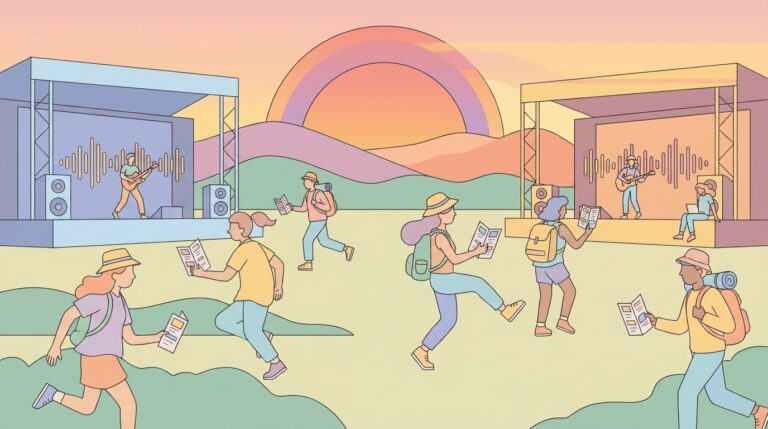
Imagine this: You are standing under the blazing August sun at Songdo Moonlight Festival Park for the Incheon Pentaport Rock Festival, or perhaps basking in the gentle spring breeze at Olympic Park for Beautiful Mint Life (뷰민라 – BML). The air smells of chilled craft beer, fried chicken, and pure summer electricity. You hear the deep rumble of bass vibrating right through your sneakers.
You pull out your phone to check who is playing. Your heart drops: your absolute favorite indie rock band, Silica Gel (실리카겔), is taking the Main Stage at 5:20 PM, but the ethereal singer-songwriter you flew across the world to see, Se So Neon (새소년), is scheduled for 5:40 PM at the Sub Stage across a massive field packed with twenty thousand music fans!
Panic kicks in. Do you sprint? Do you stay? How do you even ask your Korean concert buddy what the plan is without sounding like an automated translator? Many international festival fans end up missing unforgettable encore sets simply because they don’t know the insider vocabulary for navigating stages and schedules. Don’t worry—based on years of mud-stained festival shoes and student field feedback, I’m here to equip you with the essential B1-level phrases and cultural know-how to conquer any Korean music festival timetable like a true Hongdae scene veteran!
Phase 2: Core Expressions Deep Dive
1. 타임테이블 확인했어? (Ta-im-te-i-beul hwa-gin-haess-eo?)
- Pronunciation: [Ta-im-te-i-beul hwa-gin-haess-eo?] (Sounds like: English time-table with bouncy Korean vowels + hwa-gin-hess-uh)
- Meaning: Literal: “Did you check the timetable?” | Nuance: “Do we have our game plan set so we don’t wander aimlessly between stages?”
- K-Culture Moment: The moment you spread your picnic mat (돗자리) on the grass and gather with your friends before the first band kicks off.
- Editor’s Insight: While textbook Korean teaches “시간표” (si-gan-pyo) for schedule, festival culture almost universally borrows the loanword 타임테이블 (timetable). Using 시간표 here makes you sound like you are checking your high school chemistry class schedule!
- Situation Spectrum: Casual: ✅ | Semi-formal: ⚠️ (타임테이블 확인하셨어요?) | Formal: 🚫
- 🤔 Think About It: Why do you think Korean youth culture readily adopts English loanwords for trendy outdoor experiences while retaining strictly native concepts for community etiquette?
2. 동선 어떻게 짤까? (Dong-seon eo-tteo-khe jjal-kka?)
- Pronunciation: [Dong-seon eo-tteo-khe jjal-kka?] (Sounds like: Dong-sun + uh-ttuh-keh + sharp jjal-kka)
- Meaning: Literal: “How shall we weave our movement line?” | Nuance: “What route should we map out between stages to catch both acts efficiently?”
- K-Culture Moment: Crouching over a festival ground map with a highlighter, planning the fastest trek between the standing zone and food zone.
- Editor’s Insight: 동선 (movement path/flow) combined with the verb 짜다 (to construct, plot, or weave) reflects the Korean obsession with efficiency and flow. It is used constantly in travel, date planning, and festival strategies.
- Situation Spectrum: Casual: ✅ | Semi-formal: ⚠️ (동선 어떻게 짤까요?) | Formal: 🚫
- 🤔 Think About It: Does your native language have a specific single word for the spatial route you plot during a single day out?
3. 공연 겹쳐서 쪼개 봐야 해 (Gong-yeon gyeop-chyeo-seo jjo-gae bwa-ya hae)
- Pronunciation: [Gong-yeon gyeop-chyeo-seo jjo-gae bwa-ya hae] (Sounds like: Gong-yun gyup-chyu-suh + snappy jjo-geh bwa-ya heh)
- Meaning: Literal: “The performances overlap, so we must split and watch.” | Nuance: “The sets clash! We’ll have to catch the first half of one band and run over for the second half of the other.”
- K-Culture Moment: The painful realization that two headliners are performing at the exact same hour on opposite stages.
- Editor’s Insight: 쪼개다 literally means to split, crack, or fraction something (like firewood or seconds). Saying you will “split a concert” (공연을 쪼개다) or “split your time” (시간을 쪼개다) is peak conversational intermediate Korean.
- Situation Spectrum: Casual: ✅ | Semi-formal: ⚠️ (공연이 겹쳐서 쪼개 봐야 해요) | Formal: 🚫
- 🤔 Think About It: In many Western festivals, people resign themselves to picking just one artist. What does the Korean habit of “splitting acts” say about their determination to maximize value?
Phase 3: Textbook Korean vs. Real Korean
Situation 1: Asking if a band has started playing
- 📖 교과서 한국어: “공연이 이미 시작되었습니까?” (Gong-yeon-i i-mi si-jak-doe-eoss-seum-ni-kka?)
- 🗣️ 진짜 한국어: “벌써 무대 시작했어?” (Beol-sseo mu-dae si-jak-haess-eo?) / “벌써 들어갔어?” (Beol-sseo deu-reo-gass-eo?)
- 💡 왜 다를까?: In loud festival environments, speakers drop overly polite passive endings. Instead of the formal noun 공연 (performance), locals say 무대 (stage) or use the verb 들어가다 (to enter onto the stage).
Situation 2: Choosing which musician to see
- 📖 교과서 한국어: “어느 가수를 보러 갈 것입니까?” (Eo-neu ga-su-reul bo-reo gal geos-im-ni-kka?)
- 🗣️ 진짜 한국어: “이번 타임에 누구 보러 가? 픽 정했어?” (I-beon ta-im-e nu-gu bo-reo ga? Pik jeong-haess-eo?)
- 💡 왜 다를까?: Real festivalgoers divide the day into “times” (타임) and use the popular pop-culture slang 픽 (pick) instead of formal decision verbs.
Phase 4: K-Culture Deep Dive & Non-Verbal Manners
4-1. Nunchi (눈치) & Non-Verbal Gestures
Navigating a crowded Korean festival grounds requires serious 눈치 (situational awareness). When you are power-walking between stages to make your schedule work, you will inevitably have to weave through the massive picnic mat area (돗자리존).
* The “Sorry-Excuse-Me” Sprint: Never run aggressively. Instead, angle your upper body forward, press one hand vertically near your chest (or bring both palms slightly together), bow your head repeatedly, and utter soft “죄송합니다” (Jwe-song-ham-ni-da) as you slip through the gaps.
* The Mat Border Rule: Never, ever let your muddy festival boots touch the edge of someone else’s mat! Even grazing a stranger’s mat corner while running is considered bad manners.
4-2. Cultural Code Analysis: The Dual Festival Identity
Korean music festivals—especially indie-centric events like Beautiful Mint Life (뷰민라), Grand Mint Festival (GMF), and Pentaport—feature a unique spatial division: the 돗자리존 (Picnic Mat Zone) in the back and the 스탠딩존 (Standing Zone) upfront.
* Koreans bring portable folding chairs, parasols, and gourmet packed food boxes to relax in the mat zone for afternoon acoustic sets.
* When their favorite indie-rock outfit comes on, they dash to the front standing barricade to jump and participate in 떼창 (synchronized crowd singing). Master your timetable so you know exactly when to lounge like a king and when to rage like a rockstar!
Phase 5: Real-World Roleplay Scenario
Setting: You are standing near the F&B zone at Incheon Pentaport Rock Festival with your Korean friend, Minji (민지). The afternoon sun is beginning to set, and the sound of electric guitars echoes across the field.
- 민지: 이제 5시 반이네. 슬슬 다음 무대 정해야 할 것 같아. (I-je da-seot-si ban-i-ne. Seul-seul da-eum mu-dae jeong-hae-ya hal geot gat-a.)
- 🎭 Action: Unfolds the paper timetable pamphlet and points with her drink can.
- English: “It’s 5:30 already. We should slowly decide our next stage.”
- 나 (You): 타임테이블 확인했어? 누구 나오는데? (Ta-im-te-i-beul hwa-gin-haess-eo? Nu-gu na-o-neun-de?)
- 🎭 Action: Leans over Minji’s shoulder to look at the timetable grid.
- English: “Did you check the timetable? Who’s playing?”
- 민지: 메인 스테이지는 실리카겔이고, 서브 스테이지는 새소년이야. (Me-in seu-te-i-ji-neun Sil-li-ka-gel-i-go, seo-beu seu-te-i-ji-neun Sae-so-nyeon-i-ya.)
- 🎭 Action: Gasps softly in despair.
- English: “The Main Stage has Silica Gel, and the Sub Stage has Se So Neon.”
- 나 (You): 헐, 대박… 둘 다 완전 보고 싶었는데! (Heol, dae-bak… dul da wan-jeon bo-go sip-eot-neun-de!)
- 🎭 Action: Holds head with both hands in dramatic disbelief.
- English: “Oh no, seriously? I really wanted to see both of them!”
- 민지: 맞아, 완전 공연 겹쳤어. 동선 어떻게 짤까? (Mat-a, wan-jeon gong-yeon gyeop-chyeoss-eo. Dong-seon eo-tteo-khe jjal-kka?)
- 🎭 Action: Taps her chin thoughtfully.
- English: “I know, their sets completely clash. How should we plan our route?”
- 나 (You): 공연 겹쳐서 쪼개 봐야 할 것 같아. (Gong-yeon gyeop-chyeo-seo jjo-gae bwa-ya hal geot gat-a.)
- 🎭 Action: Traces a line between the two stages on the paper schedule.
- English: “Since the gigs overlap, I think we have to split them.”
- 민지: 좋은 생각이야! 그럼 실리카겔 30분 보고 바로 넘어갈까? (Jo-eun saeng-gak-i-ya! Geu-reom Sil-li-ka-gel sam-sip-bun bo-go ba-ro neo-meo-gal-kka?)
- 🎭 Action: Smiles and adjusts her festival wristband.
- English: “Great idea! Then shall we watch Silica Gel for 30 minutes and run straight over?”
- 나 (You): 응, 새소년 엔딩곡은 꼭 챙겨 보자! (Eung, Sae-so-nyeon en-ding-gok-eun kkok chaeng-gyeo bo-ja!)
- 🎭 Action: Gives a high-five and prepares to head toward the main stage crowd.
- English: “Yeah, let’s make sure we catch Se So Neon’s finale song!”
🔀 Interactive Decision Branch
What would you say next to Minji to finalize your stage-hopping strategy?
- Option A: “실리카겔 앵콜까지 다 듣고 서브 스테이지로 뛰어가자!” (Let’s listen all the way through Silica Gel’s encore and then run to the Sub Stage!)
- Option B: “실리카겔 유명한 곡 끝나면 바로 쪼개서 넘어가자. 늦으면 펜스 못 잡아.” (Once Silica Gel finishes their hit track, let’s split immediately and go. If we’re late, we can’t get close to the barricade.)
- Option C: “귀찮은데 그냥 돗자리에서 맥주 마시면서 멀리서 볼래?” (It’s a hassle, so do you just want to drink beer on the mat and watch from afar?)
Feedback:
- Option A (Risk): You will experience an incredible encore, but by the time you reach the Sub Stage, Se So Neon will already be saying their final goodbyes and the crowd will be locked in tight!
- Option B (Best Choice): Perfect festival strategy! Catching the emotional climax of stage one and arriving just in time for the opening riffs of stage two is the peak indie festival thrill.
- Option C (Bad): While cozy, you’ll miss the electrifying energy of the live crowd and regret coming all the way to Incheon just to sit on plastic grass!
Phase 6: 10-Second Emotion Shadowing Drill
Read these aloud while mimicking the exact tempo and pauses indicated by the slash (/) marks!
[🔥 흥분되고 다급하게 - Excited and rushed]- 타임테이블 보니까 / 무대 겹치는데 / 빨리 동선 짜자!
- (Ta-im-te-i-beul bo-ni-kka / mu-dae gyeop-chi-neun-de / ppal-li dong-seon jja-ja!)
- “Looking at the timetable, the stages overlap—let’s map our route quickly!”
[🤔 진지하게 전략을 세우며 - Serious and tactical]- 앞쪽 곡만 듣고 / 중간에 쪼개서 / 서브 스테이지로 넘어가자.
- (Ap-jjok gong-man deut-go / jung-gan-e jjo-gae-seo / seo-beu seu-te-i-ji-ro neo-meo-ga-ja.)
- “Let’s listen to the opening tracks, split midway, and cross over to the Sub Stage.”
[🎉 후련하고 신나게 - Triumphant and thrilled]- 동선 완벽해서 / 내가 보고 싶었던 무대 / 다 챙겨 봤어!
- (Dong-seon wan-byeok-hae-seo / nae-ga bo-go sip-eot-deon mu-dae / da chaeng-gyeo bwas-eo!)
- “Our route was flawless, so I managed to catch every single stage I wanted to see!”
Phase 7: K-Culture Mini Dictionary
- 돗자리존 (Dot-ja-ri-jon) | Picnic Mat Zone
- The designated lawn area where attendees set up waterproof tarps (돗자리) and base camps. Crucial cultural tip: do not set up your mat in walking lanes or in front of the sound control booth.
- 셋리스트 (Sen-ni-seu-teu) | Setlist
- The list of songs an artist performs. Korean indie fans avidly share predicted setlists on Twitter/X hours before the festival to practice lyrics.
- 떼창 (Tte-chang) | Synchronized Crowd Sing-Along
- The soul of Korean concerts! Bands often pause their vocals just to let the audience belt out entire choruses together in unison.
- 펜스 잡다 (Pen-seu jap-da) | To Grab the Front Barricade
- Literally “to grab the fence.” Refers to rushing early to secure front-row spots right against the stage barricade.
Phase 8: Traveler’s Survival Kit
Survival Phrases TOP 3
- “물품보관소 어디에 있어요?” (Mul-pum-bo-gwan-so eo-di-e iss-eo-yo?)
- Translation: Where is the luggage/bag storage area?
- Pro Tip: Paid locker booths at festivals like Pentaport often sell out before 2 PM. Drop your heavy bag off first thing upon arrival!
- “여기 자리 비어 있나요?” (Yeo-gi ja-ri bi-eo in-na-yo?)
- Translation: Is this spot empty / available?
- Pro Tip: Always ask neighboring mat owners before claiming a patch of grass in the crowded picnic zone.
- “막차 시간 몇 시예요?” (Mak-cha si-gan myeot si-ye-yo?)
- Translation: What time is the last train/bus?
- Pro Tip: Festivals in Songdo or suburban Seoul end late. Missing the last subway line means competing for impossible taxi calls.
Editor’s Travel Note
- Festival Navigation App: Do not rely on Google Maps inside massive Korean parks. Use 네이버 지도 앱 다운로드 to pinpoint festival sub-entrances and restroom clusters.
- Official Timetable Notifications: Follow the festival’s official Instagram account on the day of the event. Severe rain or sound-check delays often shift the timetable by 10 to 20 minutes, which will be posted directly to their Instagram Stories!
- Payment Tip: Nearly all festival food and beverage zones in Korea are 100% cashless. Make sure your international credit card or T-Money/NAMANE card is pre-loaded.
Phase 9: One Step Deeper (Reflective Thought)
In Korean society, the concept of 동선 (movement flow) reflects a broader cultural desire to minimize friction and maximize collective harmony. Even during leisure activities where the goal is simply to “relax,” Korean festival attendees display astonishing tactical coordination—organizing food shifts, mat guarding, and stage transitions down to the minute. This isn’t stress; for many Koreans, executed efficiency is part of the fun! It proves that fun and structure can dance together under the open sky.
💬 Your Turn: How do music festivals in your home country handle conflicting schedules? Are you a “stay at one stage all day” camper, or an aggressive “stage-hopper”? Let us know in the comments below!
Phase 10: FAQ & Avoiding Misunderstandings
Q: Can I bring outside food or drinks into Korean festivals like Pentaport or Beautiful Mint Life?
A: Most major Korean festivals have strict eco-friendly container rules. Single-use plastic takeout containers, glass bottles, and canned beer are usually confiscated at the security gate. However, sealed water bottles (under 500ml) and food stored in reusable airtight containers (like Lock&Lock boxes) are warmly welcomed!
Q: What should I do if two artists I love play at the exact same minute?
A: Employ the famous 쪼개기 (splitting) strategy! Check each artist’s previous setlists online. Indie bands almost always save their most famous anthem or crowd sing-along for the very last two songs. Watch the first 25 minutes of Artist A, then sprint over to catch the grand climax of Artist B!
Q: Is it okay to leave my belongings on my picnic mat while I go to the standing zone?
A: Generally yes—Korea is famous for its low petty-theft rates, and people routinely leave mats with blankets and snacks unattended for hours. However, never leave passports, wallets, or expensive camera gear on the mat. Rent a festival locker (물품보관소) or carry your valuables in a crossbody sling bag.
🚨 Common Mistakes Alert
- Mistake: Standing up with giant umbrellas or blocking view lines in the middle of the picnic mat zone.
- Correct Action: Wear a wide-brimmed bucket hat or sunscreen. If you must use a parasol, sit at the very rear edges of the field.
- Mistake: Asking for “시간표” (siganpyo) at the festival info booth.
- Correct Action: Ask for “타임테이블” (ta-im-te-i-beul) or “리플렛” (leaflet/pamphlet) so the volunteer understands immediately.
- Mistake: Walking directly across strangers’ picnic mats as a shortcut.
- Correct Action: Walk around along the designated white boundary tape pathways, even if it adds an extra 30 seconds to your walk.
Phase 11: Action Missions & Community Engagement
- 🥉 Bronze Mission (Solo Practice): Say aloud three times: “타임테이블 확인하고 동선 짜자!” Record your voice on your phone and listen to your rhythm.
- 🥈 Silver Mission (Social Share): Look up the recent lineup poster of a Korean music festival (like Pentaport, BML, or Busan Rock Festival), pick your 3 favorite acts, and post your stage itinerary on your Instagram story tagging
@DailyHangul! - 🥇 Gold Mission (Real-World Application): Next time you visit a live club in Hongdae or attend a concert, ask the staff or your companion: “오늘 타임테이블 나왔어요?” (Has today’s timetable been released?).
🎮 K-Culture Mission: Go to YouTube, search for “실리카겔 떼창” (Silica Gel crowd singalong) or “뷰민라 브이로그” (Beautiful Mint Life Vlog), and watch how Korean concertgoers balance their picnic chill sessions with explosive barricade cheering!
Phase 12: Interactive Quiz Challenge
1. Situation Judgment Quiz
You and your friend just entered the festival grounds at 2:00 PM. What is the most natural, strategic thing to say first?
* (A) “이제 집에 갈 시간표를 확인하자.”
* (B) “타임테이블 먼저 확인하고 동선 어떻게 짤지 정하자!”
* (C) “공연이 이미 끝났으니 환불해 주세요.”
👉 Click to reveal the answer and explanation!
- Correct Answer: (B)
- Explanation: (B) uses both natural intermediate terms 타임테이블 and 동선 짜다. (A) talks about checking the timetable to go home already, and (C) demands a refund saying the concert ended!
2. Fill-in-the-Blank Challenge
Complete the sentence with the correct slang/verb meaning to divide or split your attendance:
* “두 밴드 공연 시간이 완전히 [ ______ ]서, 중간에 [ ______ ] 봐야 해.”
* Hint: (To overlap / To split)
👉 Click to reveal the answer and explanation!
- Correct Answer: 겹쳐 / 쪼개
- Full Sentence: “두 밴드 공연 시간이 완전히 겹쳐서, 중간에 쪼개 봐야 해.”
- Translation: “The two bands’ performance times completely overlap, so we must split our time midway.”
3. True or False Cultural Etiquette Quiz
* Statement: In Korean outdoor festivals, walking across the corner of another person’s picnic mat (돗자리) with your outdoor shoes is totally acceptable if the path is crowded. (True / False)
👉 Click to reveal the answer and explanation!
- Correct Answer: FALSE!
- Explanation: Stepping onto someone’s picnic mat is considered extremely rude in Korean festival etiquette. Always take the extra seconds to walk around mats or gently squeeze through designated aisles with an excused bow.
🎬 Watch Our Daily Videos! (Daily Hangul Official Instagram)
Review the expressions you learned in this article with our fun daily short videos! Check out native pronunciation and real-life nuances in action.
- Instagram @dailyhangul_en







