

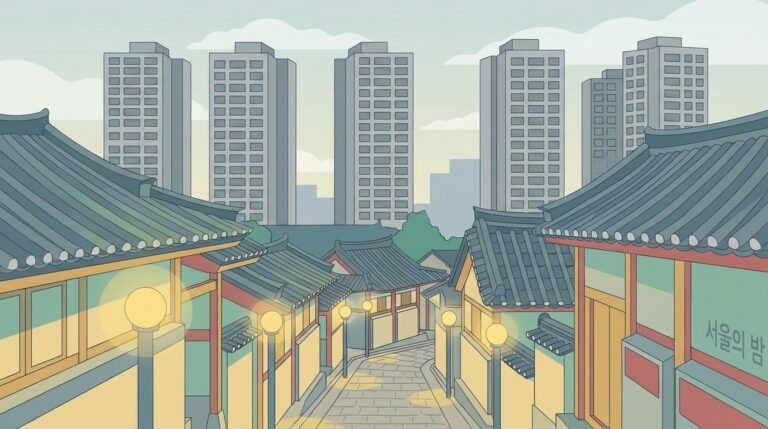
The Vanishing Soul of Korean Cities: Mastering C1 Discourse on ‘Placelessness’ and Apartment Forests
Phase 1: Empathy (Immersive Storytelling Opening)
안녕하세요! 매일한글 에디터입니다. (Hello! I’m your Daily Hangul editor.)
Imagine this: You hop on the KTX bullet train from Seoul, whisking past Daejeon, Daegu, and all the way down to Busan. You eagerly look out the window, hoping to see the distinct architectural soul of each historic province. Yet, whether you are gazing at the outskirts of Gyeonggi or entering the outer districts of Gwangju, the view is startlingly uniform: endless, monochromatic ranks of 30-story high-rise apartments stamped with corporate brand logos like Raemian, Hillstate, or Prugio.
If you have ever felt a sudden disorienting chill—realizing that modern Korean urban landscapes often feel cloned from a single blueprint—you have encountered the reality of 장소 상실 (Jangso sangsil – Placelessness). In critical dramas like My Liberation Notes (나의 해방일지) and films like Concrete Utopia (콘크리트 유토피아), this architectural monotony isn’t just scenery; it mirrors the modern Korean struggle between collective real-estate obsession and the longing for human warmth.
Many of our advanced C1 learners tell us: “I know how to say ‘There are many apartments in Korea’ (한국에 아파트가 많아요), but how do I critically critique modern urban hyper-standardization, loss of identity, and gentrification in a sophisticated, intellectual conversation?” Today, we will elevate your Korean from basic descriptive comments to nuanced cultural and sociological critique. This masterclass is built directly from real-life debates among native architects, urban sociologists, and culturally plugged-in locals. Let’s dive deep into the real cityscape together.
Phase 2: Deep Dive into 3 Core Expressions
📌 C1 Core Lexicon at a Glance
1. 천편일률적이다 (Uniformly monotonous / Cookie-cutter)
2. 고유한 정취를 잃다 (To lose its distinctive local charm and ambiance)
3. 장소 상실감이 심화되다 (The alienation of placelessness deepens)
1. 천편일률적이다 (Cheonpyeon-illyuljeok-ida)
- Pronunciation: [Cheon-pyeon-il-lyul-jeok-i-da] (Sound metaphor: Think of “Chun-pyun”, then glide into “il-ryul” with a soft liquid ‘l’ rolling into “jeok-ee-da”.)
- Meaning:
- Literal: A thousand pieces cut to one identical single ruler/pattern.
- Actual Nuance: Monotonous, standardized, or devoid of individual creative variation (cookie-cutter).
- K-Culture Moment: You will hear this phrase frequently in architectural documentaries or real estate commentary programs on YouTube (such as 14F or EBS DocuPrime) when critics lament modern apartment complexes: “왜 한국의 도시 풍경은 천편일률적일까요?” (Why are Korean cityscapes so cookie-cutter?)
- Editor’s Insight: This is a high-level 4-character idiom derivative (사자성어: 천편일률 – 千篇一律). It carries an intellectual, critical edge. Use it when describing education systems, corporate culture, or urban architecture.
- Situation Spectrum: Casual ⚠️ | Semi-formal ✅ | Formal ✅
- 🤔 Think About It: In English, we say “cookie-cutter” or “monolithic.” How does the Sino-Korean imagery of measuring thousands of fabric pieces against a single wooden ruler reflect Korea’s compressed industrial development?
2. 고유한 정취를 잃다 (Goyuhan jeongchwireul ilta)
- Pronunciation: [Go-yu-han jeong-chwi-reul il-ta] (Pronounce ‘chwi’ like a crisp “chwee” and release ‘ilta’ with a dry, popping ‘t’ sound.)
- Meaning:
- Literal: To lose one’s inherent, intrinsic mood or savor.
- Actual Nuance: To be stripped of local character, historical ambiance, and organic community charm.
- K-Culture Moment: Used by artists and indie shop owners in rapidly gentrifying vintage districts like Euljiro (힙지로) or Seongsu-dong when commercial franchises replace decades-old ironworks and local diners.
- Editor’s Insight: Jeongchwi (정취) is untranslatable by a single English word. It combines atmosphere, emotional resonance, and seasonal or temporal nostalgia accumulated through human living (jeong, 情). A brand-new high-rise can have pyeon-uiseong (convenience), but it can never instantly manufacture jeongchwi.
- Situation Spectrum: Casual ✅ | Semi-formal ✅ | Formal ✅
- 🤔 Think About It: Does your native culture consider aging alleys charming, or are old spaces strictly viewed as targets for modernization?
3. 장소 상실감이 심화되다 (Jangso sangsilgami simhwadoeda)
- Pronunciation: [Jang-so sang-sil-ga-mi sim-hwa-dwe-da] (Keep the vowel transitions sharp: “Jahng-so sahng-shil-gah-mee shim-hwah-dweh-dah”.)
- Meaning:
- Literal: The sensation of losing a place becomes exacerbated.
- Actual Nuance: The existential alienation stemming from modern “placelessness” (as conceptualized in humanistic geography by Edward Relph) intensifies.
- K-Culture Moment: Heard on academic podcasts, urban planning forums, or literary discussions exploring why younger generations feel rootless despite living in hyper-luxurious modern apartment complexes.
- Editor’s Insight: The term Sangsilgam (상실감 – sense of loss/bereavement) attached to Jangso (장소 – place) elevates your commentary to university seminar-level analysis. It contrasts the physical structure of a “house” (집/주택) with the emotional anchor of a “place” (장소).
- Situation Spectrum: Casual 🚫 | Semi-formal ⚠️ | Formal ✅
- 🤔 Think About It: When an old neighborhood is bulldozed to build an apartment complex, do the original residents experience a physical relocation or an emotional bereavement?
Phase 3: Textbook Korean vs. Real Korean
Situation 1: Critiquing the visual monotony of residential areas
- 📖 Textbook Korean:
- 이 도시의 아파트들은 외관이 모두 비슷해서 개성이 없습니다. (I dosi-ui apateudeureun oegwani modu biseuthaeseo gaeseongi eopseumnida.)
- “Because the apartments in this city all have similar exteriors, they lack individuality.”
- 🗣️ Real Native Korean:
- 어딜 가나 똑같은 성냥갑 아파트 숲이라, 도시 고유의 결이 싹 사라진 느낌이에요. (Eodil gana ttokgateun seongnyang-gap apateu sup-ira, dosi goyu-ui gyeori ssak sarajin neukkim-ieyo.)
- “No matter where you go, it’s just a forest of matchbox apartment towers; it feels like the city’s unique grain and texture have been completely wiped out.”
- 💡 Why is it different? Native speakers at the C1 level use vivid metaphors like 성냥갑 아파트 (matchbox apartments) and sensory nouns like 결 (grain/texture of a place), rather than plain adjectives like “비슷하다” (similar).
Situation 2: Expressing regret over commercialized gentrification
- 📖 Textbook Korean:
- 재개발로 인해서 원래 살던 주민들이 다른 곳으로 이사를 가야 합니다. (Jaegaeballo inhayeo wonrae saldeon jumindeuri dareun goseuro isareul gaya hamnida.)
- “Due to redevelopment, the original residents must move to another place.”
- 🗣️ Real Native Korean:
- 골목 상권이 뜨자마자 원주민이 쫓겨나는 둥지 내몰림 때문에 동네 정체성이 완전히 훼손됐어요. (Golmok sanggwoni tteujamaja wonjumini jjotgyeonaneun dungji naemollim ttaemune dongne jeongcheseongi wanjeonhi hwesondwaesseoyo.)
- “As soon as the alley district blew up in popularity, gentrification pushed the original locals out, totally gutting the neighborhood’s identity.”
- 💡 Why is it different? Educated Koreans often use the poetic native Korean expression 둥지 내몰림 (being forced out of one’s nest) alongside analytical terms like 정체성 훼손 (gutting/impairing identity) instead of simple migration verbs.
Phase 4: K-Culture Deep Dive & Non-Verbal Manners
4-1. Nunchi (눈치) & Gestures: Navigating Korean Real Estate Conversations
In Korea, talking about real estate and apartments is both the nation’s favorite pastime and its most dangerous landmine.
* The Paradox: While almost everyone agrees intellectually that identical high-rises cause 장소 상실 (placelessness), owning an apartment in a high-density, branded complex represents middle-class stability, child-rearing efficiency, and wealth accumulation.
* The Non-Verbal Code: When critiquing apartment monotony, never deliver your critique with aggressive arrogance or condescension. Employ a reflective, slightly wistful posture: tilt your head slightly (약 15도), soften your gaze, and let out a gentle sigh (씁쓸한 미소와 가벼운 한숨).
* Linguistic Softening: Always temper your critique with softening endings such as:
* “~하는 면도 없지 않아 있네요.” (One cannot deny that aspect…)
* “편리함을 얻은 대신 잃어버린 게 참 많은 것 같아요.” (It seems we lost quite a lot in exchange for convenience.)
4-2. Cultural Code Analysis: The ‘Apartment Republic’ (아파트 공화국)
French geographer Valérie Gelézeau famously coined the term Apartment Republic (아파트 공화국) to describe South Korea. Following the Korean War, rapid industrialization forced millions into cities. The matchbox apartment complex was an ingenious, ultra-fast solution providing running hot water, district heating, and earthquake resistance.
Today, this architectural standard has bred a cultural irony seen in movies like Concrete Utopia (콘크리트 유토피아): the apartment unit is the safest fortress, but outside its walls, public collective memory is erased every 30 years as buildings are demolished and rebuilt. Understanding this duality is key to demonstrating true C1 cultural fluency.
Phase 5: Real-World Roleplay Scenario
Setting: You are on an urban design walking tour through Mullae-dong (문래동), a gritty neighborhood where legacy metal-machining factories coexist with hip underground artist ateliers. You are conversing with Min-ho (민호), an urban regeneration curator.
[Characters]
* Min-ho (민호): An architectural curator passionate about preserving industrial heritage.
* You (학습자): An advanced researcher observing Seoul's spatial changes.
Turn 1:
* 민호: “여기가 70년대 철공소 골목 원형이 남은 곳인데, 바로 건너편에 초고층 주상복합이 들어서면서 긴장감이 흐르고 있죠.”
* (Yeogiga chilshimnyeondae cheolgongso golmok wonhyeongi nameun gosin-de, baro geonneopyeone chogocheung jusangbokhabi deureoseomyeonseo ginjanggami heureugo itjyo.)
* 🎭 민호가 철공소의 낡은 철문을 쓰다듬으며 씁쓸한 표정으로 건너편 타워크레인을 가리킨다.
* “This is one of the few places preserving the original 1970s ironworks alleys, but with the ultra-luxury high-rise complex going up across the street, the tension is palpable.”
Turn 2:
* You: “아, 맞네요. 현대식 건물이 들어오는 것도 좋지만, 이런 골목의 고유한 정취를 잃어버리는 건 너무 안타까워요.”
* (A, matneyo. Hyeondaesik geonmuri deureooneun geotdo jotjiman, ireon golmok-ui goyuhan jeongchwireul ireobeorineun geon neomu antakkawoyo.)
* 🎭 고개를 끄덕이며 양쪽 건물의 대비되는 풍경을 진지하게 둘러본다.
* “Ah, indeed. Modern buildings have their merits, but losing the distinct, living character of alleys like these is truly regrettable.”
Turn 3:
* 민호: “맞아요. 사실 대단지 아파트가 들어서면 생활 인프라는 정비되지만, 결국 어디서나 볼 수 있는 천편일률적인 풍경이 되어버리거든요.”
* (Majayo. Sasil daedanji apateuga deureoseomyeon saenghwal inpeuraneun jeongbidoejiman, gyeolguk eodiseona bol su inneun cheonpyeon-illyuljeogin punggyeongi doeeobeorigeodeunyo.)
* 🎭 안경을 고쳐 쓰며 목소리를 낮춘다.
* “Exactly. When massive apartment complexes move in, civil infrastructure improves, but it ends up becoming the exact same cookie-cutter landscape you can see anywhere.”
Turn 4:
* You: “결국 도시 공간의 획일화가 장소 상실감을 심화시키는 셈이군요.”
* (Gyeolguk dosi gonggan-ui hoegilhwaga jangso sangsilgameul simhwasikineun sem-igunyo.)
* 🎭 핵심을 짚어내며 민호와 시선을 맞춘다.
* “So in essence, the homogenization of urban space deepens the sense of placelessness.”
Turn 5:
* 민호: “정확한 지적이세요! 오래된 공간이 품은 기억과 시간의 켜를 한순간에 밀어버리는 게 과연 진정한 발전일까 싶어요.”
* (Jeonghwakhan jijeogiseyo! Oraedoen gonggani pumeun gieokgwa sigan-ui kyeoreul hansungane mireobeorineun ge gwayeon jinjeonghan baljeon-ilkka sipeoyo.)
* 🎭 공감대를 형성한 듯 반가운 눈빛으로 미소를 짓는다.
* “Spot-on! Bulldozing the accumulated memories and layers of time embedded in an old space in an instant… can we truly call that progress?”
Turn 6:
* You: “게다가 젠트리피케이션으로 인한 둥지 내몰림 현상도 심각해지겠네요. 예술가들과 장인들이 어디로 가겠어요?”
* (Gedaga jenteuripikeisyeon-euro inhan dungji naemollim hyeonsangdo simgakhaejigetneyo. Yesulgadeulgwa jang-indeuri eodiro gaget-eoyo?)
* 🎭 팔짱을 끼고 깊은 생각에 잠긴 어조로 묻는다.
* “On top of that, the displacement caused by gentrification must be severe. Where will the local artists and craftsmen go?”
Turn 7:
* 민호: “그게 제일 뼈아픈 부분이죠. 결국 특색 있는 가게들이 임대료를 못 견디고 나가면 프랜차이즈만 남게 되니까요.”
* (Geuge jeil ppyeoapeun bubun-ijyo. Gyeolguk teuksaek inneun gagedeuri imdaeryoreul mot gyeondigo nagamyeon peuraenchaijeuman namge doenikkayo.)
* 🎭 무거운 한숨을 내쉬며 손을 내젓는다.
* “That’s the most heartbreaking part. When distinctive local stores can’t withstand rising commercial rents and leave, only corporate franchises remain.”
Turn 8:
* You: “도시 재생이 단순히 건물을 부수고 새로 짓는 게 아니라, 공간의 역사성과 장소성을 보존하는 방향으로 가야겠네요.”
* (Dosi jaesaengi dansunhi geonmureul busugo saero jinneun ge anira, gonggan-ui yeoksaseonggwa jangsoseongeul bojeonhaneun banghyang-euro gayagetneyo.)
* 🎭 진정성 있는 어조로 단단하게 결론을 맺는다.
* “Urban regeneration shouldn’t simply mean razing buildings to build anew; it must evolve toward preserving spatial historicity and placeness.”
🔀 Interactive Branching Decision Point
Min-ho asks you: “그렇다면 당신이 살던 모국의 도시는 이런 장소 상실 문제를 어떻게 다루고 있나요?” (So how does your home country’s city address this issue of placelessness?)
- Option A: “저희 도시는 아파트가 별로 없고 다 개인 주택이라 이런 문제가 아예 없습니다.” (My city doesn’t have many apartments and everyone lives in detached houses, so we have no such issues at all.)
- 👉 Feedback (Bad): Dismissive and culturally flat. It shuts down the comparative sociological inquiry and misses the chance to practice C1 discourse.
- Option B: “옛 건축물의 외관을 보존하면서 내부만 현대화하는 ‘파사디즘’ 방식이나 민관 협력 보존 조례를 적극 활용하고 있어요.” (We actively use facadism—preserving historic building exteriors while modernizing interiors—along with public-private conservation ordinances.)
- 👉 Feedback (Best! ⭐): Exemplary C1 performance! Introduces constructive comparative urban policies while validating Min-ho’s professional perspective.
- Option C: “한국도 그냥 낡은 재개발 규제를 다 풀어버리고 전면 재건축하는 게 경제적으로는 이득 아닌가요?” (Isn’t it economically better for Korea to simply lift old redevelopment restrictions and reconstruct everything completely?)
- 👉 Feedback (Risk): Too blunt and capital-centric. While an interesting contrarian view, stating it without diplomatic mitigation sounds insensitive to heritage preservationists.
Phase 6: 10-Second Emotional Shadowing Drill
Practicing native prosody means pausing at natural clause boundaries and matching the emotional cadence of Korean critical discourse.
[1. Critical & Reflective Tone 🧐]
어딜 가나 / 똑같은 아파트 단지만 들어서니 / 도시 고유의 결이 / 완전히 뭉개지는 것 같아요.
(Eodil gana / ttokgateun apateu danjiman deureoseoni / dosi goyu-ui gyeori / wanjeonhi munggaejineun geot gat-ayo.)
[Pause: 0.5s at each slash | Pitch drops steadily on '뭉개지는']

[2. Bittersweet & Sympathetic 😔]
생활은 더없이 편리해졌지만, / 우리가 기억하던 그 골목길의 정취는 / 영영 되찾을 수 없겠죠.
(Saenghwareun deoeopsi pyeonrihaejyeotjiman, / uriga gieokhadeon geu golmokgil-ui jeongchwineun / yeong-yeong doechajeul su eopgetjyo.)
[Slight rising tone on '편리해졌지만,' then gentle falling cadence on '되찾을 수 없겠죠.']

[3. Analytical & Decisive 🏛️]
진정한 도시 재생은 / 낡은 건물을 허무는 게 아니라, / 공간의 장소성을 / 지켜내는 데서 출발해야 합니다.
(Jinjeonghan dosi jaesaeng-eun / nalkeun geonmureul heomuneun ge anira, / gonggan-ui jangsoseong-eul / jikyeonaeneun deseo chulbalhaeya hamnida.)
[Firm, measured enunciation with sharp stops on '허무는 게 아니라' and '출발해야 합니다']
Phase 7: K-Culture Mini Dictionary
- 성냥갑 아파트 (Seongnyang-gap apateu)
- Translation: Matchbox apartment blocks.
- Usage: Colloquial socio-cultural critique used to describe post-1970s slab-style, grey apartment complexes that prioritize unit maximization over aesthetics.
- 장소성 (Jangsosung)
- Translation: Placeness / Sense of Place.
- Usage: Essential in design, architecture, and academic debates. Refers to the irreplaceable identity, collective memories, and cultural soul tied to a physical geographical coordinate.
- 둥지 내몰림 (Dungji naemollim)
- Translation: Nest displacement (Pure Korean counterpart to Gentrification).
- Usage: Widely used in government policies, social journalism, and neighborhood activist groups to highlight the human toll of surging commercial rents.
- 원도심 (Wondosim)
- Translation: Historic downtown core / Original town center.
- Usage: Used when contrasting the old, organically formed town centers (like Jongno in Seoul or Jung-gu in Busan) with master-planned newly developed satellite cities (신도시).
Phase 8: Traveler’s Survival Kit
Top 3 Field Expressions for Exploring Authentic Neighborhoods
- “여기 옛날 골목 분위기가 그대로 살아있네요.” (Yeogi yennal golmok bunwigiga geudaero sara-itneyo.)
- Pro Tip: Use this compliment when visiting grandfather-owned tearooms (다방) or retro eateries. It immediately triggers warm smiles from elderly shop owners!
- “프랜차이즈 말고 이 동네에만 있는 터줏대감 식당이 어디인가요?” (Peuraenchaijeu malgo i dongne-eman inneun teojutdaegam sikdangi eodiingayo?)
- Pro Tip: 터줏대감 (Teojutdaegam) refers to the venerable guardian or the longest-standing fixture of a neighborhood. Locals will instantly point you to legendary hidden gems.
- “주변 재개발 때문에 조만간 헐린다던데 사실인가요?” (Jubyeon jaegaebal ttaemune joman-gan heollindadeon-de sasiringayo?)
- Pro Tip: A sensitive yet deeply bonding inquiry for cultural heritage explorers visiting historic zones slated for redevelopment.
Editor’s Travel Note: Escaping the Concrete Jungle
If you want to experience Korea’s vibrant local identity before it disappears, search beyond Gangnam’s high-rise corridors. Use the Naver Map app download to pin old architectural pockets like Mullae Art Village (문래창작촌), Euljiro Alleys (을지로 노가리 골목), or Busan’s Sanbokdoro hillside roads (산복도로). When navigating public transit, look for the K-Heritage / Cultural Regeneration markers on city walking tour routes.
Phase 9: A Step Deeper (Reflective Essay)
In the West, historical cities are often palimpsests—centuries of architecture layered gracefully side-by-side. In contrast, modern South Korea endured what sociologists term 압축 성장 (Compressed Modern Growth). Having seen historical landmarks leveled by colonial occupation and the Korean War, an entire generation came of age associating old wooden houses with poverty, freezing drafts, and backwardness.
To our parents’ and grandparents’ generations, moving into a standardized, centrally heated brand-new apartment was an ecstatic victory of safety and modernity. Therefore, our critique of “placelessness” today must remain deeply empathetic. We are not just debating aesthetic monotony; we are witnessing a society transitioning from the desperate necessity of survival architecture to an enlightened hunger for poetic, communal memory.
💬 Your Turn: What is an iconic old space in your city that was sacrificed for modern convenience? Share your story in Korean or English below! Let’s discuss.
Phase 10: FAQ & Common Misconceptions
Q: Why do Koreans keep calling apartments “숲” (forest)? Isn’t a forest made of trees?
A: In Korean, the word 숲 (Sup – forest) is frequently used as a figurative noun to depict any overwhelming, densely clustered mass of vertical objects. Phrases like 빌딩 숲 (building forest) and 아파트 숲 (apartment forest) express how these colossal high-rises visually block the horizon and cast vast concrete shadows, much like a dense canopy of trees.
Q: Is “젠트리피케이션” (gentrification) understood by ordinary Koreans, or should I only use “둥지 내몰림”?
A: Both are widely recognized. 젠트리피케이션 is common in journalism and casual urban discussions. However, utilizing 둥지 내몰림 in advanced writing or official presentations demonstrates an elevated mastery of native public-service vocabulary coined by the National Institute of Korean Language.
Q: Does living in an apartment complex mean there is no community among Koreans?
A: Not necessarily! While high-rises cause physical 장소 상실 (placelessness) on the public street, modern complexes foster hyper-localized, closed digital communities via specialized resident apps, online forums (입주민 카페), and shared community facilities (fitness centers, libraries, daycare). The community still exists, but it has retreated indoors and online behind gated access.
🚨 Common Mistakes Warning Board
- ❌ Mistake 1: Saying “이 동네는 장소가 없어요” when trying to express “This neighborhood has no sense of place.”
- ✅ Correct Action: Say “이 동네는 고유한 장소성이 부족해요.” (장소 simply means physical location; 장소성 denotes the character or sense of place).
- ❌ Mistake 2: Using “천편일률적이다” for positive harmony.
- ✅ Correct Action: This term always carries a negative or critical critique of excessive sameness. For harmonious beauty, use “조화롭다” (harmonious).
- ❌ Mistake 3: Pronouncing 장소 상실감 as separate detached words without nasal and liquid smoothing.
- ✅ Correct Action: Link the syllables smoothly: [Jang-so sang-sil-ga-mi].
Phase 11: Action Missions & K-Culture Hunt
- 🥉 Bronze Level (Solo Drill): Stand in front of a modern complex or commercial street. Record a 20-second voice memo describing it using the words 천편일률적 and 정취.
- 🥈 Silver Level (Social Share): Find a photo of your favorite historic Korean alleyway (e.g., Ikseon-dong or Euljiro). Post it on social media with the caption: “오래된 골목의 고유한 정취를 지키는 도시 재생이 필요합니다.” Tag your fellow Korean learners!
- 🥇 Gold Level (Real-World Engagement): On your next visit to a local neighborhood café in Korea, ask the barista: “이 근처도 재개발 때문에 옛날 모습이 많이 사라졌나요?” Listen to their firsthand take on the area’s changing landscape.
- 🎮 K-Culture Media Mission: Watch Episode 1 of My Liberation Notes (나의 해방일지) or the movie Concrete Utopia (콘크리트 유토피아). Notice how the camera captures the sheer, crushing scale of apartment buildings and how characters speak about commuting from outside the concrete center.
Phase 12: Interactive Quiz Challenge
1. Situation Judgment Quiz:
You are participating in a panel on Seoul’s modern urban identity. Which statement represents the most sophisticated C1-level critique of identical redevelopment?
* A) 아파트가 너무 많아서 길을 잃어버리기 쉽습니다.
* B) 획일화된 고층 아파트 단지의 난립은 도시의 고유한 장소성을 훼손하고 장소 상실감을 가속화합니다.
* C) 새 아파트는 주차장이 넓어서 아주 편리하고 좋습니다.
🔍 Click for Answer & Explanation
Correct Answer: B
* Why: Choice B combines critical high-level vocabulary: 획일화된 (homogenized), 난립 (reckless proliferation), 장소성 훼손 (damage to placeness), and 장소 상실감 가속화 (acceleration of placelessness). Choice A is elementary, and Choice C focuses solely on personal convenience.
2. Fill-in-the-Blank Quiz:
오래된 골목길 상권이 활성화되면서 임대료가 치솟아 기존 상인들이 쫓겨나는 현상을 순우리말로 ‘( ) 내몰림’이라고 부릅니다.
(As old alley commercial areas thrive and rents skyrocket, the phenomenon of original merchants being expelled is called ‘( ) naemollim’ in pure Korean.)
🔍 Click for Answer & Explanation
Correct Answer: 둥지 (Nest)
* Why: 둥지 내몰림 is the beautiful yet poignant Korean term for gentrification, depicting vulnerable residents and craftsmen being cast out of their generational nests.
3. True or False Cultural Quiz:
True or False: In Korean, describing an urban area as a “성냥갑 아파트 숲” is a complimentary aesthetic review praising modern design.
🔍 Click for Answer & Explanation
Correct Answer: False!
* Why: 성냥갑 (matchbox) is a satire on monotonous, uninspired rectangular architecture built purely for density rather than architectural beauty or community identity.
🎬 Watch Our Daily Videos! (Daily Hangul Official Instagram)
Review the expressions you learned in this article with our fun daily short videos! Check out native pronunciation and real-life nuances in action.
- Instagram @dailyhangul_en






