

Phase 1: Empathy & Storytelling
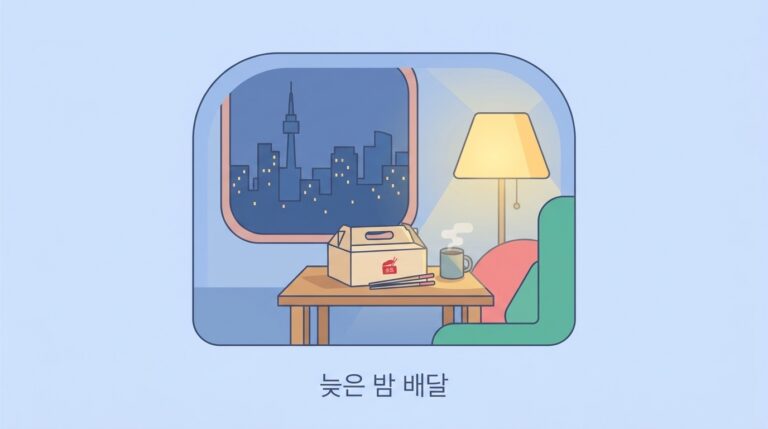
안녕하세요! Daily Hangul editor here! Picture this: It is 11:30 PM on a chilly Friday night in Seoul. You have set up your cozy corner, queued up your favorite K-drama, and used a food delivery app to order crispy Korean fried chicken. The app promised a 40-minute wait. But now, sixty long minutes have slipped by. Your stomach is rumbling, the drama’s main characters are already feasting on noodles, and your delivery rider’s icon on the screen hasn’t budged.
You want to call the restaurant or message customer service, but panic freezes you. What if I sound rude? How do I say my food is late without starting an argument? Many of our learners tell us they end up waiting in hungry silence for nearly two hours just to avoid an awkward phone call. Don’t worry! In Korea, inquiring about late delivery is completely normal and expected. Today, we will master the friendly, respectful phrases you need to check on your food like a seasoned local.
Phase 2: 3 Core Expressions In-Depth
1. 주문한 지 한 시간이 지났어요 (Jumunhan ji han sigani jinasseoyo)
- Pronunciation: [Joo-moon-han jee han she-gahn-ee jee-nahs-saw-yo] (Think of ‘Joo’ like jewelry, and ‘nahs’ like pasta with sauce)
- Meaning: Literal: “Since ordering, one hour has passed.” / Natural nuance: “It has been an hour since I placed my order.”
- K-Culture Moment: You hear this in slice-of-life K-dramas whenever college roommates gather in a semi-basement apartment waiting endlessly for midnight jajangmyeon.
- Editor’s Insight: The grammar pattern
-(으)n 지 [Time] 되었어요/지났어요is an A2 superstar pattern. It lets you state elapsed time objectively without sounding like you are directly blaming the listener. - Situation Spectrum: Casual: ⚠️ (with close friends use 지났어) | Semi-formal: ✅ | Formal: ✅
- 🤔 Think About It: Notice how the sentence highlights time passing rather than saying “You are late.” How does focusing on the timeline soften confrontation in Korean culture?
2. 언제쯤 도착할까요? (Eonje-jjeum dochakhalkkayo?)
- Pronunciation: [Eon-jeh-jjeum doh-chahk-hahl-kkah-yo?] (Think of ‘Eon’ like un-done, ‘jjeum’ like humming ‘mmm’ with a soft ‘j’)
- Meaning: Literal: “Around when will it arrive?” / Natural nuance: “Roughly when might it get here?”
- K-Culture Moment: Used by tired office workers in K-office dramas checking on group catering orders during late-night overtime.
- Editor’s Insight: The particle
쯤 (jjeum)means “approximately” or “around.” Pairing it with-할까요?(a gentle conjectural question) turns a demanding “When is it coming?” into a soft, polite inquiry. - Situation Spectrum: Casual: ⚠️ (too polite for your sibling) | Semi-formal: ✅ | Formal: ✅
- 🤔 Think About It: Why does adding an approximate marker like “around” feel less demanding to service workers?
3. 확인 한번 부탁드려요 (Hwagin hanbeon butakdeuryeoyo)
- Pronunciation: [Hwah-geen hahn-buhn boo-tahk-deu-ryeo-yo] (Sound analogy: ‘Hwah’ like what, ‘buhn’ like hamburger bun)
- Meaning: Literal: “A check, one time, I kindly request.” / Natural nuance: “Could you please look into it for me?”
- K-Culture Moment: Common in Korean chat customer service apps (KakaoTalk Channel) when resolving quick delivery hiccups.
- Editor’s Insight:
한번 (hanbeon)literally translates to “once,” but in polite requests it functions like “just for a moment” or “if you don’t mind.” It instantly removes aggressive pressure. - Situation Spectrum: Casual: 🚫 | Semi-formal: ✅ | Formal: ✅
- 🤔 Think About It: In English, we say “Could you take a quick look?” Notice how both languages use words related to brevity to show courtesy.
Phase 3: Textbook Korean vs. Real Korean
Situation 1: Asking the restaurant about your delayed order
- 📖 교과서 한국어 (Textbook):
- 제 음식이 왜 안 옵니까? (Je eumsigi wae an omnikka?)
- “Why does my food not come?”
- 🗣️ 진짜 한국어 (Real-Life):
- 배달이 조금 늦는 것 같아서 연락드렸어요. (Baedari jogeum neunneun geot gataseo yeollakdeuryeosseoyo.)
- *”It seems the delivery is running a bit late, so I’m calling to check in.”
- 💡 왜 다를까? (Why the difference?): Asking “Why isn’t it here?” sounds accusatory and blunt. Native speakers use softening buffers like
~인 것 같다(it seems like) and state their gentle intent first (연락드렸어요).
Situation 2: Checking arrival estimate on phone or app chat
- 📖 교과서 한국어 (Textbook):
- 지금 바로 오십시오. (Jigeum baro osipsio.)
- “Come right now immediately.”
- 🗣️ 진짜 한국어 (Real-Life):
- 혹시 얼마나 더 걸릴까요? (Hoksi eolmana deo geollilkkayo?)
- *”By any chance, how much longer might it take?”
- 💡 왜 다를까? (Why the difference?):
혹시 (hoksi - by any chance)is Korea’s favorite politeness wand. It signals that you are hesitant to trouble the other person, creating immediate good will.
Phase 4: K-Culture Deep Dive & Non-Verbal Manners
4-1. Nunchi & Phone/Chat Manners
When calling a Korean small business owner (사장님 – Sajangnim) on a busy evening, their kitchen is often loud and hectic. If you call with an angry, raised voice, communication breaks down quickly. Instead, apply Nunchi (눈치):
* Voice Tone: Keep your pitch slightly warm and calm. Start with a quick polite greeting: “안녕하세요, 사장님! (Hello, boss!)”
* App In-Chat Etiquette: Koreans frequently use polite tildes and polite emojis in text messages to show zero anger. Typing 확인 부탁드립니다~^^ signals that you are simply inquiring, not complaining.
4-2. The Realities of K-Delivery Culture
Korea is world-famous for lightning-fast delivery (배달 문화), powered by riders who navigate intricate neighborhood alleys. However, when it rains, snows, or peaks during Friday night Yasik (야식 – late-night snack) hours, delivery platforms switch to multi-drop routes or encounter road safety delays. Understanding this dynamic helps you frame inquiries not as accusations, but as mutual problem-solving. Korean business owners genuinely want you to get your food hot, and asking politely almost always results in a friendly apology or an extra service drink (서비스)!
Phase 5: Real-World Roleplay Scenario
Setting: It is 10:45 PM on a rainy night. Alex is in a rental apartment near Hongdae. He ordered tteokbokki and fried snacks from Chewy Snack Bar over 55 minutes ago. The app status shows “In Transit,” but no rider has appeared. Alex presses the call button in the app.
- Turn 1 (사장님 – Store Owner): 네, 쫄깃분식입니다! (Ne, Jjolgitbunsik-imnida!)
- 🎭 Loud background clatter of pans and frying oil.
- “Yes, Chewy Snack Bar!”
- Turn 2 (Alex): 안녕하세요 사장님! 방금 배민으로 주문했는데요. (Annyeonghaseyo sajangnim! Banggeum Baemin-euro jumunhaenneundeyo.)
- 🎭 Polite, calm, slightly curious tone.
- “Hello boss! I placed an order through Baemin just a while ago.”
- Turn 3 (사장님): 아, 네! 무슨 주문이실까요? (A, ne! Museun jumunisilkkayo?)
- 🎭 Listening attentively while shuffling receipts.
- “Ah, yes! Which order would that be?”
- Turn 4 (Alex): 서교동 떡볶이 세트예요. 주문한 지 한 시간이 지났어요. (Seogyo-dong tteokbokki seteuyeyo. Jumunhan ji han sigani jinasseoyo.)
- 🎭 Stating address and fact clearly without raising voice.
- “It’s the tteokbokki set for Seogyo-dong. It has been an hour since I ordered.”
- Turn 5 (사장님): 아이고, 정말요? 라이더님이 15분 전에 픽업해 가셨는데요! (Aigo, jeongmalyo? Raideo-nimi sibo-bun jeone pikeop-hae gasyeonneundeyo!)
- 🎭 Surprised and apologetic tone.
- “Oh dear, really? The delivery rider picked it up 15 minutes ago!”
- Turn 6 (Alex): 아, 비가 와서 그런가 봐요. 언제쯤 도착할까요? (A, biga waseo geureonga bwayo. Eonje-jjeum dochakhalkkayo?)
- 🎭 Empathetic nod, understanding the rainy weather.
- “Ah, it must be because of the rain. Around when might it arrive?”
- Turn 7 (사장님): 제가 지금 기사님께 바로 전화해 볼게요. 조금만 기다려 주세요! (Jega jigeum gisanimkke baro jeonhwahae bolgeyo. Jogeumman gidaryeo juseyo!)
- 🎭 Reassuring and proactive customer service tone.
- “I will call the rider right now. Please wait just a moment!”
- Turn 8 (Alex): 네, 확인 한번 부탁드려요. 감사합니다! (Ne, hwagin hanbeon butakdeuryeoyo. Gamsahamnida!)
- 🎭 Warm closing with a friendly smile.
- “Yes, please check for me. Thank you!”
🔀 Interactive Choice Point
Imagine the store owner tells you: “기사님이 거의 다 도착하셨대요! (The rider says he is almost there!)” How do you respond?
- Choice A: “알겠습니다! 비 오는데 조심히 오세요. 감사합니다! (Understood! Tell him to take care in the rain. Thank you!)”
- Outcome (Best): 🌟 Perfect Korean manner! Showing care for the rider’s safety warms the shop owner’s heart.
- Choice B: “빨리 오라고 하세요. (Tell him to come quickly.)”
- Outcome (Bad): ❌ Sounds demanding and rude, especially in adverse weather.
- Choice C: “음식 식었으면 환불해 줘. (Give me a refund if the food is cold.)”
- Outcome (Risk): ⚠️ Using informal speech (반말) and premature aggression will escalate into a dispute.
Phase 6: 10-Second Emotion Shadowing Drill
Read aloud focusing on natural pauses (/) and feeling the emotional markers:
[😟 살짝 걱정스럽고 조심스럽게 / Slightly concerned & hesitant]- 주문한 지 / 한 시간이 지났는데 / 언제쯤 도착할까요? (Jumunhan ji / han sigani jinanneunde / eonje-jjeum dochakhalkkayo?)
[🙏 상냥하고 부탁하는 태도로 / Gentle & polite request]- 바쁘시겠지만 / 확인 한번만 / 부탁드려요~ (Bappeusigettjiman / hwagin hanbeonman / butakdeuryeoyo~)
[😊 감사하고 안심하며 / Relieved & grateful]- 네, 알겠습니다! / 조심히 오세요! (Ne, algetseumnida! / Josimhi oseyo!)
Phase 7: K-Culture Mini Dictionary
- 라이더 (Raideo) | Delivery Rider | From the English word “rider.” It is the standard respectful term used by customers and store owners alike to refer to delivery drivers.
- 야식 (Yasik) | Late-Night Snack / Meal | The beloved Korean lifestyle culture of eating fried chicken, jokbal, or ramen late into the night while streaming entertainment.
- 문 앞 (Mun ap) | Front Door | The essential delivery location phrase. Writing
문 앞에 두고 벨 눌러주세요 (Please leave at front door and ring bell)is Korea’s default contactless delivery request. - 도착 예정 시간 (Dochak yejeong sigan) | Estimated Time of Arrival (ETA) | The timestamp displayed on delivery apps showing when your food should arrive.
Phase 8: Traveler’s Survival Kit
Survival Expressions TOP 3
- 문 앞에 두고 가주세요. (Mun ape dugo gajuseyo.)
- *”Please leave it in front of the door and go.”
- Pro Tip: Perfect if you are shy about speaking Korean face-to-face upon delivery.
- 조금 늦어도 괜찮으니 조심히 오세요. (Jogeum neojeodo gwaenchaneuni josimhi oseyo.)
- *”It’s okay if it’s a bit late, so please drive safely.”
- Pro Tip: Write this in delivery notes during heavy rain or snow to earn instant appreciation from riders.
- 주문 번호 12번이에요. (Jumun beonho sibi-beonieyo.)
- *”It is order number 12.”
- Pro Tip: Stating your order number right away helps the store look up your receipt in seconds.
Editor’s Travel Note
When traveling in South Korea, ordering delivery requires a local phone number or an international-friendly app. Foreign travelers often rely on English-friendly delivery apps or ordering assistance services. If you are exploring local options, make sure to check the official Baedal Minjok app overview or download international service solutions. Always double-check your building’s Dong (동) and Ho (호) apartment numbers before finalizing payment, as delivery riders move swiftly between complex residential corridors!
Phase 9: “One Step Deeper” (Cultural Reflection)
In Korean society, the word 좀 (jom - a little) and 한번 (hanbeon - once) are linguistic cushions. Korean communication prioritizes maintaining smooth relational flow (Gibun – 기분). When you say “Check this,” it sounds like an order given by a manager to a subordinate. But when you insert 한번 부탁드려요 (Please check once), you frame the interaction as an equal favor. Language in Korea is not just a conveyor belt of data; it is an active hedge protecting everyone’s emotional space.
💬 Your Turn: In your home country, how do you usually follow up on late food deliveries? Do people prefer calling directly or using text chat? Share your stories below!
Phase 10: FAQ & Common Mistakes
Q: Can I contact the delivery rider directly instead of the restaurant?
A: On apps like Coupang Eats or Baemin Rider, the app provides a temporary masked phone number or live chat connected directly to the rider once pick-up is complete. If the app says “배달 중 (Delivering),” you can text the rider directly with: “기사님, 언제쯤 도착하실까요? (Rider-nim, around when will you arrive?)”
Q: What if an item is missing from my delivery bag?
A: Call the store or app customer center and say: “음식이 하나 빠졌어요. 확인 부탁드려요. (An item is missing. Please check.)” Korean stores will promptly arrange a quick redelivery or process an instant refund through the app platform.
Q: How do I say my apartment passcode in the delivery notes?
A: In the delivery request box (요청사항), type: “공동현관 비밀번호: #1234* (Main entrance passcode: #1234*)” so the rider can easily access your building without buzzing you repeatedly.
🚨 Common Mistakes Alert
- Mistake: Shouting “빨리 와요! (Come fast!)” on the phone.
- Correct Action: Use the polite formula: “언제쯤 도착할까요? (Around when will it arrive?)”
- Mistake: Forgetting to mention your address or order name first.
- Correct Action: The kitchen takes hundreds of orders; always say your location first: “서교동 201호 주문인데요… (Regarding the order for Seogyo-dong #201…)”
- Mistake: Dropping the polite
-요ending when feeling frustrated.- Correct Action: Keep your polite endings (
-요or-습니다) regardless of delay to receive quick and courteous assistance.
- Correct Action: Keep your polite endings (
Phase 11: Action Missions
- 🥉 Bronze Mission (Solo Shadowing): Stand in front of your mirror and practice saying: “주문한 지 한 시간이 지났는데 언제쯤 도착할까요?” three times with a calm, friendly tone.
- 🥈 Silver Mission (SNS & Typing): Open your phone’s memo app or leave a comment on this post typing the request phrase: “확인 한번 부탁드려요!” with natural tildes (
~). - 🥇 Gold Mission (Real Life Action): The next time you order takeout or food in Korea, type a polite note in the rider request section: “조심히 오세요, 감사합니다! (Please arrive safely, thank you!)”
- 🎮 K-Culture Mission: Watch an episode of a modern K-drama where characters order food (e.g., Hospital Playlist or Business Proposal) and spot what phrases they use when answering the door!
Phase 12: Interactive Quiz Challenge
Question 1: Situational Judgment
Your food is 30 minutes late, and you call the store. What is the most natural, polite way to open the conversation?
* A) 왜 음식을 안 만들어요? (Why aren’t you making the food?)
* B) 안녕하세요 사장님, 배달 현황 확인 한번 부탁드려요. (Hello boss, could you please check the delivery status for me?)
* C) 돈 돌려주세요. (Give me my money back.)
Question 2: Fill in the Blanks
Complete the sentence meaning: “It has been an hour since I ordered.”
* 주문한 (____) 한 시간이 (_________).
Question 3: True or False (Culture)
In Korea, it is considered rude to contact the restaurant even after waiting more than an hour for your delivery.
* (True / False)
👉 Click here for answers and explanations
- Question 1 Answer: B. Starting politely with greeting the owner (
사장님) and asking to check status (확인 한번 부탁드려요) gets prompt cooperation. - Question 2 Answer: 지 / 지났어요 (Complete sentence: 주문한 지 한 시간이 지났어요).
- Question 3 Answer: False. Inquiring after a significant delay is standard practice. As long as you maintain polite language (
존댓말), store owners will gladly check your order status.
🎬 Watch Our Daily Videos! (Daily Hangul Official Instagram)
Review the expressions you learned in this article with our fun daily short videos! Check out native pronunciation and real-life nuances in action.
- Instagram @dailyhangul_en






