

Phase 1: Empathy & Storytelling
안녕하세요! 매일한글 에디터입니다. (Annyeonghaseyo! It’s your Daily Hangul editor.)
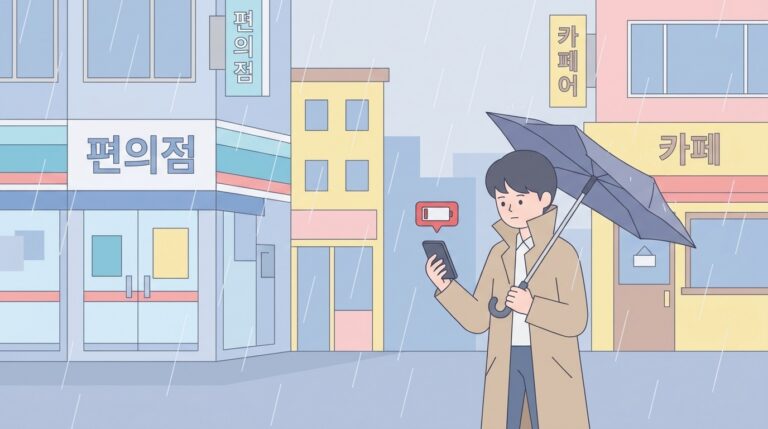
Picture this classic K-Drama scene: You’ve just sprinted across the platform at Gangnam Station only to watch the last subway door slide shut right in front of your nose. You sigh, step out into the freezing midnight air, and suddenly the skies open up in a torrential downpour. You reach into your pocket to call a taxi on your phone, only to see the dreaded 1% battery flashing before the screen goes completely black. In English, you’d probably mutter, “When it rains, it pours” or “Could this day get any worse?”
In Korean, native speakers have a poetic, razor-sharp expression carved specifically for moments like this: 설상가상 (Seol-sang-ga-sang), which literally means “frost added on top of snow.” When I worked with Sarah, an intermediate learner from London living in Seoul, she once tried telling her Korean coworker about her miserable morning by translating every single event literally with 그리고 (and) and 또 (also). Her coworker listened patiently and then gently smiled: “아, 정말 설상가상이었네요! (Ah, that was truly seol-sang-ga-sang!)” Sarah was amazed at how one four-character idiom instantly condensed her entire five-minute emotional rollercoaster into a relatable cultural shorthand. Today, we’re unlocking the art of Korean four-character idioms (사자성어, Sajaseongeo) so you can narrate dramatic dilemmas, cascading chaos, and triumphant twists just like a local.
Phase 2: In-Depth Analysis of 3 Key Idioms
1. 설상가상 (雪上加霜)
- Pronunciation: [Seol-sang-ga-sang] (Sounds like “Soul-sung-gah-sung”, smooth and rhythmic)
- Meaning: Literal: Snow upon frost | Practical Nuance: Adding insult to injury; misfortunes compounding one after another.
- K-Culture Moment: You will hear this constantly on Korean variety shows like Running Man whenever a team member gets a penalty, trips during a mission, and immediately drops their name tag into mud.
- Editor’s Insight: This phrase is remarkably versatile. It fits perfectly in a dramatic workplace crisis update, yet feels equally natural when venting over chimaek (chicken & beer) with your closest friends.
- Situation Spectrum: Casual ✅ | Semi-formal ✅ | Formal ✅
- 🤔 Think About It: In English, we focus on rain pouring; in Chinese characters adopted into Korean, it’s the physical sting of frost freezing over already icy snow. How does weather mirror hardship in your culture?
2. 진퇴양난 (進退兩難)
- Pronunciation: [Jin-toe-yang-nan] (Think “Gene-tway-yahng-nahn”)
- Meaning: Literal: Difficulty in both advancing and retreating | Practical Nuance: Caught between a rock and a hard place; a pure no-win dilemma.
- K-Culture Moment: Frequently featured in Korean webtoons and office dramas like Misaeng, when an employee discovers a huge accounting error committed by their respected senior manager—report it and betray loyalty, or hide it and face legal trouble.
- Editor’s Insight: Use this when you are paralyzed by two equally challenging choices. It implies a strategic stalemate, not just bad luck.
- Situation Spectrum: Casual ⚠️ (can sound slightly dramatic) | Semi-formal ✅ | Formal ✅
- 🤔 Think About It: Why do you think Korean society, with its historical emphasis on decisive hierarchy, preserved such a vivid word for the agony of hesitation?
3. 전화위복 (轉禍爲福)
- Pronunciation: [Jeon-hwa-wi-bok] (Pronounced “Jeon-hwa-wee-bok”)
- Meaning: Literal: Turning disaster into good fortune | Practical Nuance: A blessing in disguise; spinning adversity into golden opportunity.
- K-Culture Moment: Post-match sports interviews in Korea! When a team concedes an early goal, regroups with furious discipline, and executes a miraculous comeback victory.
- Editor’s Insight: This idiom radiates resilience (Ougi-jil, the Korean fighting spirit). Saying this to someone enduring a setback instantly paints you as a supportive, mature communicator.
- Situation Spectrum: Casual ✅ | Semi-formal ✅ | Formal ✅
- 🤔 Think About It: Does your native tongue celebrate the turning point of bad luck into good luck with active agency, or does it attribute it to passive fate?
Phase 3: Textbook Korean vs Real Korean
Situation 1: Explaining a terrible chain of events
- 📖 교과서 한국어 (Textbook):
- 안 좋은 일이 생겼는데 다른 안 좋은 일도 또 발생했어요. (An joeun iri saenggyeonneunde dareun an joeun ildo tto balsaenghaesseoyo.)
- “A bad thing happened, and then another bad thing occurred again.”
- 🗣️ 진짜 한국어 (Real-World Native):
- 지갑 잃어버려서 멘붕인데, 설상가상으로 폰 배터리까지 나갔지 뭐야. (Jigap ireobeoryeoseo menbung-inde, seolsang-gasang-euro pon baeteori-kkaji nagatji mwoya.)
- “I was having a mental breakdown from losing my wallet, and then to top it off, my phone battery died completely.”
- 💡 왜 다를까? (Why the difference?):
Textbooks string together basic causal connectors like -(으)ㄴ데 and 또. Native speakers smoothly inject the idiom with the particle -으로 (설상가상으로) and pair it with emotive colloquial expressions like멘붕(mental breakdown) and-지 뭐야(unexpected surprise).
Situation 2: Being stuck between terrible options
- 📖 교과서 한국어 (Textbook):
- 앞으로 갈 수도 없고 뒤로 돌아갈 수도 없어서 결정을 못 하겠어요. (Apeuro gal sudo eopgo dwiro doragal sudo eopseoseo gyeoljeong-eul mot hagesseoyo.)
- “I cannot go forward or go backward, so I cannot make a decision.”
- 🗣️ 진짜 한국어 (Real-World Native):
- 지금 완전 진퇴양난이야. 이러지도 저러지도 못하겠어. (Jigeum wanjeon jintoeyangnan-iya. Ireojido jeoreojido mothagesseo.)
- “I’m completely stuck between a rock and a hard place right now. I can neither do this nor that.”
- 💡 왜 다를까? (Why the difference?):
Natives use완전 진퇴양난as an emphatic predicate, followed by the idiomatic pair이러지도 저러지도 못하다(unable to do either this or that), expressing the emotional deadlock in fewer, sharper words.
Phase 4: K-Culture Deep Dive & Non-Verbal Manners
4-1. Nunchi (눈치) & Gestures
When using idioms like 설상가상 or 진퇴양난, tone down any aggressive sarcasm. Koreans use these phrases primarily to invite empathy or to show self-deprecating humility.
* The Sincere Exhale: Place your right hand over your upper chest, slightly tilt your head down at a 15-degree angle, and let out a soft sigh (휴… / Hyu…). This signals: “I am sharing a vulnerable disaster, not complaining arrogantly.”
* The Shared Pain Nod: When listening to a friend’s disaster story, furrow your brows gently, click your tongue very softly (쯧쯧 in sympathy, not judgment), and nod while whispering: “아이고… 설상가상이었네 (Aigo… that was truly one thing after another).”
4-2. The Cultural Code: Aek-ddaem (액땜) & Korean Resilience
Why do Koreans love using 전화위복 after cascading crises? It ties directly to the traditional concept of 액땜 (Aek-ddaem)—the belief that enduring a string of minor misfortunes prevents a catastrophic disaster from happening later.
When all your plans fall apart during a trip to Busan or a presentation in Seoul, Koreans often laugh it off over a steaming bowl of sundubu-jjigae, saying: “이번에 액땜 제대로 했다! (We warded off future bad luck for good!)” It’s a psychological buffer that turns misfortune into emotional armor.
Phase 5: Real-World Roleplay Scenario
Setting: A rainy Friday night outside Hongdae Station. You and your Korean project teammate, Min-woo (민우), just wrapped up a 10-hour hackathon, but everything that can go wrong is going wrong.
- Turn 1 (Min-woo):
- 🎭 Checking his umbrella, which has two broken ribs in the wind
- 어라? 지하철 막차 방금 끊겼대. 비도 점점 더 많이 오는데… (Eora? Jihacheol makcha banggeum kkeunkyeotdae. Bido jeomjeom deo mani oneunde…)
- “Huh? The last subway train just stopped running. And the rain is pouring harder…”
- Turn 2 (Learner):
- 🎭 Patting your empty pockets in dismay
- 헐, 저 교통카드 든 지갑을 카페에 두고 온 것 같아요. (Heol, jeo gyotong-kadeu deun jigabeul kape-e dugo on geot gatayo.)
- “OMG, I think I left my wallet with my transit card back at the cafe.”
- Turn 3 (Min-woo):
- 🎭 Staring in disbelief with wide eyes
- 진짜? 카페 문 이미 닫았을 텐데… 택시 잡아야겠다. 폰 줘봐, 호출하게. (Jinja? Kape mun imi dadaseul tende… Taeksi jabayagetda. Pon jwobwa, hochulhage.)
- “Seriously? The cafe must be closed by now… We need to call a cab. Hand me your phone so I can call one.”
- Turn 4 (Learner):
- 🎭 Showing the dead black smartphone screen with an apologetic grin
- 제 폰 배터리 1% 남았었는데 방금 꺼졌어요. (Je pon baeteori il-peosenteu namasseonneunde banggeum kkeojyeosseoyo.)
- “My battery was at 1% and it just shut down completely.”
- Turn 5 (Min-woo):
- 🎭 Holding his forehead while chuckling wryly
- 와, 막차 끊기고 지갑 잃어버리고 폰까지 꺼지다니… (Wa, makcha kkeunkigo jigap ireobeorigo pon-kkaji kkeojidani…)
- “Wow. Missing the last train, losing your wallet, and now a dead phone…”
- Turn 6 (Learner):
- 🎭 Sighing softly and delivering the key idiom with relatable humor
- 그야말로 설상가상이네요. 오늘 액땜 제대로 하네요! (Geuyamallo seolsang-gasang-ineyo. Oneul aek-ddaem jedeoro haneyo!)
- “It’s literally frost on snow—misfortune upon misfortune. We’re definitely warding off bad luck tonight!”
- Turn 7 (Min-woo):
- 🎭 Laughing out loud, clapping you on the shoulder
- 하하, 한국어 표현 완벽하다! 걱정 마, 내 폰으로 택시 부르고 국밥 한 그릇 먹으러 가자. (Haha, hangugeo pyohyeon wanbyeokhada! Geokjeong ma, nae打开 pon-euro taeksi bureugo gukbap han geureut meogeureo gaja.)
- “Haha, your Korean expression was spot on! Don’t worry, I’ll call a cab on my phone and let’s go grab a warm bowl of gukbap.”
- Turn 8 (Learner):
- 🎭 Smiling with relief
- 맛있는 거 먹고 전화위복으로 삼아야겠어요. 민우 씨 고마워요! (Masinneun geo meokgo jeon-hwa-wi-bok-euro samayagesseoyo. Min-woo ssi gomawoyo!)
- “Let’s turn this disaster into a blessing over delicious food. Thank you, Min-woo!”
🔀 Interactive Decision Branch
What would you say if Min-woo had asked: “비 맞으면서 첫차 기다릴래, 아니면 비싼 심야 할증 택시 타고 갈래? (Will you wait for the first train in the rain, or take an expensive late-night surcharge taxi?)”
* Choice A: “완전 진퇴양난이네요! 그래도 얼어 죽는 것보단 택시가 낫겠죠? (Wanjeon jintoeyangnan-ineyo! Geuraedo eoreo jungneun geotbodan taeksiga natgetjyo?)”
* 🌟 Best Outcome: Shows natural grasp of dilemmas, humor, and decisiveness. Min-woo will gladly split the fare.
* Choice B: “설상가상으로 택시를 탑시다. (Seolsang-gasang-euro taeksireul tapsida.)”
* ❌ Bad Choice: Incorrect usage! 설상가상 is an adverbial description of compounded misfortune, not an adjective or adverb for making a decision.
* Choice C: “아무거나 상관없어요. 민우 씨 마음대로 해요. (Amugeona sang-gwaneopseoyo. Min-woo ssi maeumdaero haeyo.)”
* ⚠️ Risk: Sounds disengaged and puts all decision-making burden onto Min-woo in an already exhausting crisis.
Phase 6: 10-Second Emotion Shadowing Drill
Practice these lines with pause cuts (/) and distinct emotion markers:
[😮💨 체념한 듯 깊은 한숨을 쉬며]
지갑을 잃어버렸는데, / 설상가상으로 / 폰 배터리까지 나갔어.
(Jigabeul ireobeoryeonneunde, / seolsang-gasang-euro / pon baeteori-kkaji nagasseo.)
“I lost my wallet, / and as if that weren’t enough, / my phone battery died too.”-
[🤔 진지하고 난감한 표정으로]
사표를 내자니 생활비가 걱정이고, / 계속 다니자니 병날 것 같고… / 진짜 진퇴양난이야.
(Sapyoreul naejani saenghwalbiga geokjeong-igo, / gyesok danijani byeongnal geot gatgo… / jinja jintoeyangnan-iya.)
“If I resign I worry about living expenses, / but if I stay I might get sick… / It’s truly a no-win dilemma.” -
[✨ 미소를 지으며 희망차게]
처음엔 큰 실수인 줄 알았는데, / 덕분에 좋은 기회를 얻었으니 / 완전 전화위복이지!
(Cheoeumen keun silsu-in jul aranneunde, / deokbune joeun gihwoereul eodeosseuni / wanjeon jeon-hwa-wi-bok-iji!)
“At first I thought it was a huge mistake, / but thanks to it I gained a great opportunity, / so it’s a total blessing in disguise!”
Phase 7: K-Culture Mini Dictionary
- 설상가상 (Seol-sang-ga-sang) | Misfortune upon misfortune | Used when an already bad situation is made worse by another unexpected inconvenience.
- 진퇴양난 (Jin-toe-yang-nan) | Dilemma / Stalemate | Essential when analyzing project bottlenecks, career crises, or two tough relationship choices.
- 전화위복 (Jeon-hwa-wi-bok) | Blessing in disguise | The quintessential rebound idiom used to encourage colleagues when a failed deal accidentally opens a better market.
- 동문서답 (Dong-mun-seo-dap) | Irrelevant answer (East question, West answer) | Used playfully when someone completely misunderstands a question or dodges an uncomfortable topic.
Phase 8: Traveler’s Survival Kit
Survival Expressions TOP 3
- “혹시 충전기 잠깐 빌릴 수 있을까요?” (Hoksi chungjeon-gi jamkkan billil su isseulkkayo?)
- “Could I possibly borrow a charger for a short moment?”
- Pro Tip: If your phone dies during a cascading disaster, step into any convenience store or cafe and ask with both hands outstretched.
- “설상가상으로 길까지 잃어버렸어요.” (Seolsang-gasang-euro gilkaji ireobeoryeosseoyo.)
- “To make matters worse, I’ve completely lost my way.”
- Pro Tip: Use this when calling hotel reception or your Airbnb host if you are hopelessly delayed.
- “괜찮아요, 액땜했다고 생각하죠 뭐!” (Gwaenchannayo, aek-ddaem-haetdago saeng-gakhajyo mwo!)
- “It’s okay, let’s just consider it warding off future bad luck!”
- Pro Tip: The ultimate phrase to lift the mood if your travel companion drops their camera or misses a train.
Editor’s Travel Note: Crisis Navigation Apps
When traveling in South Korea, foreign map apps often lack real-time bus and walking updates due to local data mapping regulations. Always install 네이버 지도(Naver Map) 길찾기 앱 다운로드 before departing so you don’t get stuck in a dilemma. If late-night public transit cuts off, hail an official metered taxi directly via 카카오 T(Kakao T) 택시 호출 앱 다운로드 rather than wandering the streets in the rain.
Phase 9: “One Step Deeper” (Cultural Insights)
In western individualism, failure or cascading bad luck is often scrutinized as an error of personal planning or tragic coincidence. In contrast, Korean linguistic culture treats compounding hardship with collective warmth. Phrases like 설상가상 and 전화위복 serve as linguistic pressure valves—by naming the absurdity of bad luck through ancient poetry, Koreans turn private frustration into a communal, shared human experience. It reminds both the speaker and listener that life is cyclical: after deep snow and biting frost, the spring thaw is inevitable.
💬 Your Turn: Have you ever experienced a travel disaster or life moment that felt like pure 설상가상, only to turn out to be 전화위복 in the end? Tell me your story in the comments below!
Phase 10: FAQ & Misconceptions
Q: Can I use 설상가상 for positive surprises?
A: No! 설상가상 strictly applies to negative events compounding upon negative events. If you won the lottery and then got a promotion on the same day, that is not 설상가상; that would be 금상첨화 (錦上添花, Geum-sang-cheom-hwa)—adding flowers onto beautiful silk embroidered fabric!
Q: Is it disrespectful to use 사자성어 with elders or in business meetings?
A: Not at all! In fact, using them correctly signals intellectual polish and cultural literacy. As long as you maintain proper honorific verb endings (such as -습니다 or -세요), elders and corporate executives will be genuinely impressed by your command of intermediate Korean.
Q: What is the grammatical difference between 설상가상 and 엎친 데 덮친 격?
A: Both carry the exact same meaning! 설상가상 is the Sino-Korean idiom (Sajaseongeo), while 엎친 데 덮친 격 (Eopchin de deopchin gyeok) is a native Korean proverb (Sokdam). You can use them interchangeably, though 설상가상 is slightly more compact in written reports and fast dialogue.
🚨 흔한 실수 (Common Mistakes)
- Mistake 1: Saying “진퇴양난을 했어요” as an active verb.
- Correct Action: 진퇴양난 is a noun state. Use it with
-에 빠지다(to fall into) or-이다(to be): 진퇴양난에 빠졌어요 (I fell into a dilemma).
- Correct Action: 진퇴양난 is a noun state. Use it with
- Mistake 2: Using 설상가상 as an adjective modifying a noun directly (e.g., 설상가상 날씨 ❌).
- Correct Action: Always attach the adverbial marker
-으로: 설상가상으로 날씨까지 나빠졌어요 (To make matters worse, even the weather turned bad).
- Correct Action: Always attach the adverbial marker
- Mistake 3: Confusing 동문서답 (answering off-topic) with simple silence.
- Correct Action: Use 동문서답 only when an actual answer is given, but it completely misses the premise of the question.
Phase 11: Action Missions
- 🥉 Bronze Mission (Solo Drill): Stand in front of the mirror and recite the 3 sentences from Phase 6, matching the dramatic facial expressions and breathing pauses.
- 🥈 Silver Mission (Community Drill): Write one sentence on your social media or study notebook describing a recent annoying day using
설상가상으로. - 🥇 Gold Mission (Real-World Test): Next time your Korean friend or tutor shares a stressful dilemma, comfort them using: “완전 진퇴양난이네요… 그래도 전화위복이 될 거예요! (That’s a complete dilemma… but it will turn into a blessing in disguise!)”
- 🎮 K-Culture Mission: Watch an episode of your favorite K-Drama this week. Count how many times characters get hit by back-to-back crises, and see if you can spot the subtitle where 설상가상 or 진퇴양난 appears!
Phase 12: Interactive Quiz Challenge
Test your situational mastery before you head out into the streets of Seoul!
- Situational Judgment: Min-ji studied all night for her college exam. In the morning, her alarm failed to go off, and when she ran outside, her bicycle tire was completely flat. Which expression should she text her friend?
- (A) 금상첨화로 자전거 타이어까지 펑크 났어!
- (B) 설상가상으로 자전거 타이어까지 펑크 났어!
- (C) 동문서답으로 자전거 타이어까지 펑크 났어!
- Fill in the Blank:
새 프로젝트를 수락하자니 야근이 너무 많고, 거절하자니 인사고과가 걱정돼서 완전 ( )에 빠졌어요.
(Accepting means too much overtime, but declining hurts evaluations, so I fell into a complete dilemma.) -
True / False Cultural Check:
True or False? Calling a sudden sudden mishap “액땜 (Aek-ddaem)” implies that you are giving up on life in deep despair.
👉 Click here to reveal answers & explanations!
1. Answer: (B) 설상가상으로
* Explanation: Min-ji is facing one negative event directly compounded by another. (A) 금상첨화 is only for compounded good luck, while (C) 동문서답 is answering off-topic.
2. Answer: 진퇴양난 (Jin-toe-yang-nan)
* Explanation: Being unable to accept or refuse because both options bring negative consequences is the textbook definition of 진퇴양난에 빠지다.
3. Answer: False
* Explanation: 액땜 is an optimistic, resilient concept! It means you believe the minor misfortune has safely absorbed worse luck that was bound to happen, allowing you to move forward positively.







