

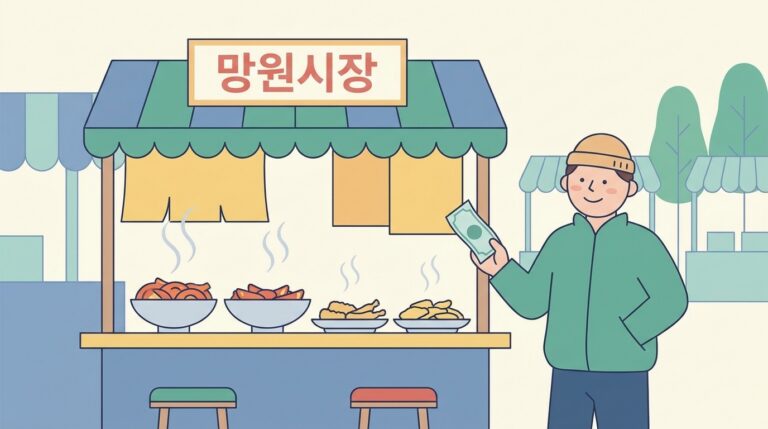
Feast on Korean Street Food Like a Local with Just 10,000 Won
Phase 1: Empathy (Story-Driven Opening)
안녕하세요! 매일한글 에디터입니다. (Annyeonghaseyo! I am your Daily Hangul editor.)
Imagine stepping into the bustling alleys of Seoul’s Gwangjang Market or Mangwon Market. The sizzle of crispy bindaetteok (mung bean pancake) hits your ears, clouds of aromatic steam rise from trays of glossy red tteokbokki, and sugar caramelizes inside golden hotteok. You slide your hand into your pocket and find a crisp 5,000-won or 10,000-won bill ($4 to $8 USD). In most global metropolitan cities, that barely gets you a cup of iced latte. But here in a Korean traditional market, that single blue or green bill is your passport to an unforgettable street food feast.
Yet, many travelers tell me: “Editor, I felt so intimidated! The grandmas look busy, the counters are crowded, and I froze because I didn’t know how to order small portions or ask about prices without sounding rude.” Don’t worry! This guide is crafted directly from real beginner feedback. By learning just a few simple phrases, you will confidently stroll up to any stall, order the tastiest bites, and experience pure budget-friendly happiness.
Phase 2: Core 3 Expressions
1. 이거 얼마예요? (Igeo eolmayeyo?)
- Pronunciation: [I-geo eol-ma-ye-yo] (Sounds like: “Ee-guh ull-mah-yeh-yo”)
- Meaning: Direct translation: “How much is this?” | Actual nuance: A polite, natural way to check prices at street stalls without hesitation.
- K-Culture Moment: You see this constantly in Korean travel variety shows like Street Food Fighter or 2 Days & 1 Night when celebrities point eagerly at piping hot snacks.
- Editor’s Insight: At market stalls, handwritten price tags can sometimes be hidden behind boiling pots. Pointing your index finger near the food and asking “이거 얼마예요?” invites an immediate, cheerful price check.
- Situation Spectrum: Casual (⚠️ with strangers, stick to close friends: 이거 얼마야?) | Semi-formal (✅ Perfect: 이거 얼마예요?) | Formal (🚫 Overly stiff for street stalls: 이것은 얼마입니까?)
- 🤔 Think About It: In English, you might ask “How much for this one?” In Korean, dropping unnecessary pronouns makes you sound infinitely more natural.
2. 1인분만 주세요 (Il-inbun-man juseyo)
- Pronunciation: [Il-in-bun-man ju-se-yo] (Sounds like: “Eel-in-boon-mahn joo-seh-yo”)
- Meaning: Direct translation: “Please give me only 1 serving.” | Actual nuance: “Just one portion for now, please!”
- K-Culture Moment: In K-dramas, friends hit street stalls after work and order “tteokbokki 1인분, sundae 1인분” to share multiple dishes together on a small budget.
- Editor’s Insight: Inbun (인분) means “portion/serving.” Adding -man (만) means “just” or “only.” Because traditional market portions are notoriously generous, ordering just one serving per stall allows you to sample 4 to 5 different snacks across the market without bursting your stomach or wallet!
- Situation Spectrum: Casual (⚠️ 1인분만 줘) | Semi-formal (✅ Highly recommended: 1인분만 주세요) | Formal (🚫 Unnecessarily stiff: 1인분을 주십시오)
- 🤔 Think About It: Korean dining is deeply communal, so foods are counted in “servings for people” (inbun) rather than individual plate units.
3. 만 원으로 배 터지겠어요! (Man woneuro bae teojigesseoyo!)
- Pronunciation: [Man won-eu-ro bae teo-ji-get-seo-yo] (Sounds like: “Mahn won-oo-ro beh tuh-jee-get-suh-yo”)
- Meaning: Direct translation: “My stomach is about to burst with 10,000 won!” | Actual nuance: “I am so happily stuffed on such a tiny budget!”
- K-Culture Moment: Food vloggers in Korea love using this expression when wrapping up a Mangwon Market tour, holding their belly with a grin.
- Editor’s Insight: Bae means stomach, and teojida means to burst or explode. Say this with a warm smile to the market vendor (Imo or Sajangnim), and their face will light up with grandmotherly pride!
- Situation Spectrum: Casual (✅ 만 원으로 배 터지겠다!) | Semi-formal (✅ Friendly & endearing: 배 터지겠어요!) | Formal (⚠️ Too casual a concept for ultra-formal settings)
- 🤔 Think About It: Expressing fullness enthusiastically in Korea is one of the highest compliments you can pay to the cook.
Phase 3: Textbook Korean vs. Real-World Korean
Situation 1: Asking for takeout while standing by a market stall
- 📖 Textbook Korean: 이 음식을 1인분 포장해 주시겠습니까? (I eumsigeul il-inbun pojanghae jusigesseumnikka?)
- 🗣️ Real-World Korean: 이거 1인분 포장해 주세요! (Igeo il-inbun pojanghae juseyo!)
- 💡 Why is it different?: Traditional markets are bustling, energetic places. Long honorific queries sound like a robot reading a manual. A crisp, polite imperative like -해 주세요 (hae juseyo) delivers your intent instantly and warmly.
Situation 2: Asking if card payment or cash is preferred
- 📖 Textbook Korean: 신용카드로 결제해도 괜찮습니까? (Sinyongkadeuro gyeoljehaedo gwaenchansseumnikka?)
- 🗣️ Real-World Korean: 카드 돼요? (Kadeu dwaeyo?) or 현금도 돼요? (Hyeongeumdo dwaeyo?)
- 💡 Why is it different?: At quick-turnover snack carts, asking “카드 돼요?” (Card okay?) takes literally one second, allowing vendors to answer with a swift nod while flipping hotteok.
Phase 4: K-Culture Deep Dive & Non-Verbal Manners
4-1. Nunchi (눈치) & Physical Etiquette
- Handling Cash: When handing over your 5,000-won or 10,000-won bill, use both hands or place your left hand gently under your right wrist. This tiny gesture displays tremendous respect to older vendors.
- Eating Space Nunchi: If you eat odeng (fish cakes) on skewers standing at the stall, don’t block the broth ladles. Step half a step backward so others can reach the soup cups. Never double-dip skewers into communal soy sauce dishes—use the little brush provided!
4-2. Cultural Code: The Joy of “Bunsik” (분식) and “Jeong” (정)
In Korea, snacking on street foods like tteokbokki, kimbap, and twigim (fried snacks) isn’t just cheap dining—it’s a shared nostalgic pastime called bunsik culture. When an elderly market vendor slips an extra fried mandu or an extra ladle of soup into your tray without charging you, that is called Jeong (warm affection). Accept it with a bright “감사합니다!” (Gamsahamnida!).
Phase 5: Real-World Roleplay Scenario
Setting: A cozy, sizzling snack cart at Mangwon Market.
Characters: You (a curious food lover) & Imo (이모, the friendly market auntie).
- You: 안녕하세요! 이거 떡볶이 얼마예요?
(Annyeonghaseyo! Igeo tteokbokki eolmayeyo?)
“Hello! How much is this tteokbokki?”
🎭 Action: Smile warmly and point gently at the bubbling red rice cakes. -
Imo: 1인분에 4,000원이야, 학생!
(Il-inbune sa-cheon-won-iya, haksaeng!)
“It’s 4,000 won for one portion, student!” -
You: 와, 싸다! 떡볶이 1인분만 주세요. 여기서 먹고 갈게요.
(Wa, ssada! Tteokbokki il-inbun-man juseyo. Yeogiseo meokgo galgeyo.)
“Wow, that’s cheap! Just one serving of tteokbokki, please. I’ll eat it here.”
🎭 Action: Hold up one index finger to emphasize 1 portion. -
Imo: 그래, 어묵 국물은 저기서 종이컵에 떠 마셔~
(Geurae, eomuk gukmureun jeogiseo jongikeobe tteo masyeo~)
“Alright, ladle yourself some fish cake broth into a paper cup over there~” -
You: 와, 국물 진짜 맛있어요! 이모, 튀김도 1인분 주세요.
(Wa, gukmul jinjja masisseoyo! Imo, twigimdo il-inbun juseyo.)
“Wow, the soup is delicious! Auntie, please give me one serving of fried snacks, too.” -
Imo: 튀김 3,000원! 김말이랑 만두 섞어줄게.
(Twigim sam-cheon-won! Gimmallirang mandu seokkeojulge.)
“Fried snacks are 3,000 won! I’ll mix seaweed rolls and dumplings for you.” -
You: 만 원짜리 한 장 드릴게요.
(Man wonjjari han jang deurilgeyo.)
“Here is a 10,000-won bill.”
🎭 Action: Hand over the crisp 10,000-won bill with both hands. -
Imo: 7,000원이니까 잔돈 3,000원 여기 있다! 맛있게 먹어!
(Chil-cheon-won-inikka jandon sam-cheon-won yeogi itda! Masitge meogeo!)
“It’s 7,000 won total, so here is your 3,000 won change! Enjoy your meal!”
🔀 Interactive Choice Point
You finished eating both plates, your stomach is full, and you still have 3,000 won in change. How do you finish your conversation?
- Option A: Say cheerfully, “이모, 배 터지겠어요! 잘 먹었습니다!” (Imo, bae teojigesseoyo! Jal meogeotseumnida!)
- 👉 Feedback (Best): Perfect! Imo will beam with joy. You complemented her food and thanked her properly.
- Option B: Wave dismissively and say, “야, 다 먹었어.” (Ya, da meogeosseo.)
- 👉 Feedback (Bad): High disrespect! Calling an elder ya (hey) and using harsh informal speech will stun everyone nearby.
- Option C: Say, “이모, 돈 더 드릴까요?” (Imo, don deo deurilkkayo? – Should I give you more money?)
- 👉 Feedback (Risk): Confusing! Tipping is not customary in Korea. Paying the exact menu price is standard and expected.
Phase 6: 10-Second Emotion Shadowing Drill
Practice these natural rhythm pauses (/) and embody the emotions:
[😊 Cheerful & Curious]
이거 / 얼마예요?
(Igeo / eolmayeyo?)
“How much / is this?”-
[🙋 Confident & Polite]
떡볶이 1인분만 / 주세요!
(Tteokbokki il-inbun-man / juseyo!)
“Just one serving of tteokbokki, / please!” -
[😋 Delighted & Satisfied]
만 원으로 / 진짜 배 터지겠어요!
(Man woneuro / jinjja bae teojigesseoyo!)
“I am / really bursting full on just 10,000 won!”
Phase 7: K-Culture Mini Dictionary
- 1인분 (Il-inbun): “One serving / One portion.” Used across all restaurants and street stalls to specify dining quantity for one person.
- 서비스 (Seobiseu): “On the house / Free extra.” Derived from English “service,” this refers to complimentary food or drinks offered by generous vendors.
- 포장 (Pojang): “Takeout / To-go packaging.” Combine with hae juseyo (포장해 주세요) when you want to take snacks back to your hotel.
- 이모 (Imo): Literally “maternal aunt,” but universally used to affectionately address middle-aged female stall owners in traditional markets.
Phase 8: Survival Kit for Travelers
Top 3 Survival Phrases
- 국물 좀 더 주세요 (Gukmul jom deo juseyo): “Please give me a little more broth.” (Pro Tip: Free refills of warm fish cake broth are a standard market joy!)
- 현금 결제할게요 (Hyeongeum gyeoljehalgeyo): “I will pay with cash.” (Pro Tip: While cards are widely accepted now, cash or bank transfer is deeply loved by stall owners for small items under 3,000 won.)
- 덜 맵게 해 주세요 (Deol maepge hae juseyo): “Please make it less spicy.” (Pro Tip: Lifesaver if market tteokbokki looks intimidatingly fiery red!)
Editor’s Travel Note
- Cash Preparation: Always keep a few 1,000-won and 5,000-won bills ready before entering Gwangjang or Mangwon Market. ATM withdrawal fees inside markets can be high.
- Navigation: Google Maps has limited walking details in Korea. Make sure to download and use the official Naver Map app on app stores to pinpoint market entrances and find famous stalls like Mangwon’s handmade croquette shops.
Phase 9: One Step Deeper
In Western street markets, transactions are often purely commercial. But in a Korean traditional market, exchanging small bills creates a unique social bond called Heungjeong (흥정, friendly bargaining) and Jeong (정, mutual affection). When you order just one portion and express genuine delight at how affordable and delicious it is, vendors feel proud of their craft. A single 10,000-won bill feeds your body, but the warm interactions feed your spirit.
💬 Your Turn: If you had a 10,000-won bill in your hand right now at Gwangjang Market, which Korean snack would you hunt down first? Drop your answer in the comments below!
Phase 10: FAQ & Common Mistakes
Q: Can I sit at a stall if I only order one 3,000 won snack?
A: Yes, absolutely! Street food stalls expect solo diners and quick bites. However, if the bench is packed during peak weekend rush hours, eating promptly and making room for the next guest is courteous.
Q: Is tipping required if I pay with a 10,000 won bill and say “keep the change”?
A: Do not leave tips. In Korea, tipping does not exist and telling vendors to keep the change can create awkward confusion. Wait for your change politely.
Q: Can I use credit cards for cheap street food?
A: Most permanent stalls in modern markets like Mangwon accept cards. However, small outdoor cart stands selling 1,500-won hotteok often prefer cash or account transfers. Keeping 5,000 to 10,000 won in cash is ideal.
🚨 Common Mistakes Alert
- Mistake: Using formal Tangsin (당신) to address stall owners.
Correct Action: Address female owners as 이모 (Imo) or 사장님 (Sajangnim), never 당신. - Mistake: Throwing trash into food preparation bins.
Correct Action: Always hand used paper cups and skewers directly back to the stall owner, asking “쓰레기 버려주세요” (Sseuregi beoryeojuseyo – Please throw this away). - Mistake: Dipping eaten skewers back into shared sauce bowls.
Correct Action: Use the basting brush or ladle sauce onto your individual paper plate.
Phase 11: Action Missions
- 🥉 Bronze Mission (Solo Practice): Stand in front of your mirror and practice saying: “이거 1인분만 주세요!” smoothly 5 times in under 15 seconds.
- 🥈 Silver Mission (Social Sharing): Post a photo of your favorite Korean food on Instagram or Threads and caption it with: “만 원으로 배 터지겠어요! (Full on 10,000 won!)”.
- 🥇 Gold Mission (Real-World Execution): Visit a local Korean supermarket, bakery, or street food truck, hand over a bill with two hands, and order using “1인분만 주세요”.
- 🎮 K-Culture Mission: Watch an episode of a Korean variety show or food vlog and spot whether visitors say “이모” (Imo) or “사장님” (Sajangnim) to the vendor!
Phase 12: Interactive Quiz Challenge
Test your market street smarts before you go! Click the toggle to reveal the answers.
- Situational Judgment: You are at Mangwon Market and want to try tteokbokki, but you also want to save room for hotteok next door. What should you say?
- A) 10인분 주세요 (Give me 10 servings)
- B) 1인분만 주세요 (Just 1 serving, please)
- C) 카드 안 돼요? (Do you reject cards?)
- Fill in the Blank: When you are amazingly full and want to compliment the food on a small budget:
“만 원으로 배 ________!”- A) 고파요 (hungry)
- B) 터지겠어요 (bursting full)
- C) 없어요 (none)
- True or False: In Korean traditional markets, leaving a 2,000-won tip on the counter is a standard and expected custom.
- [True / False]
👉 Click to reveal Quiz Answers & Explanations
-
Answer: B) 1인분만 주세요
Explanation: Asking for 1인분만 (just one portion) lets you savor the food while leaving room for other snacks! -
Answer: B) 터지겠어요
Explanation: 배 터지겠어요 translates figuratively to “my belly is about to burst from delicious fullness!” -
Answer: False
Explanation: Tipping is not practiced in Korea. Simply pay the exact amount and offer a warm “감사합니다!” (Thank you!).







