

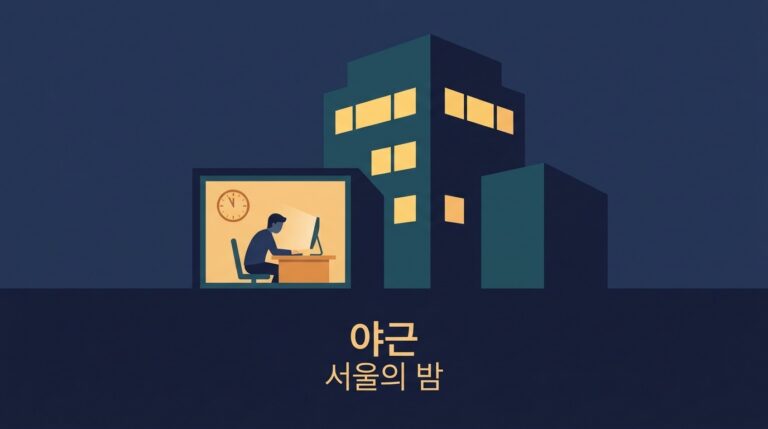
Phase 1: 공감 (스토리 몰입형 오프닝)
안녕하세요! 매일한글 에디터입니다.
Picture this: It is 9:45 PM on a chilly Thursday evening in Pangyo Techno Valley—Korea’s Silicon Valley. While the neighborhood streets are quiet, the monolithic glass office towers remain ablaze with neon-bright fluorescent lights. Inside an open-plan office, developers are furiously typing through a high-stakes sprint, while empty iced Americano cups pile up like miniature monuments to corporate ambition. If you have watched dramas like Misaeng (Incomplete Life) or Start-Up, this high-pressure, late-night scene feels instantly recognizable. Yet behind those glowing office windows lies one of the most fiercely contested socioeconomic debates in modern South Korea: the collision between corporate demands for 근로시간 유연화 (working-hour flexibility) and the urgent, deeply human struggle to prevent 장시간 노동 (chronic long hours) and tragic 과로사 (gwarosa / death from overwork).
As an advanced (C1) Korean learner or a professional working within the Korean corporate ecosystem, talking about work isn’t just about memorizing “야근해요” (I work overtime). When executive boards debate labor market dualism (노동시장 이중구조), tech founders lobby for project-based deregulation, and labor unions protest against rollbacks on the statutory 52-hour cap, navigating these discussions requires razor-sharp nuance. Based on real feedback from expatriate managers, legal researchers, and advanced corporate learners at Daily Hangul, mastering this high-level socioeconomic vocabulary will transform you from a passive outsider into a culturally astute, trusted conversation partner in any Korean boardroom or seminar room. Let’s delve into the linguistic and structural reality of modern Korean labor.
Phase 2: 핵심 표현 3선 심층 분석
1. 근로시간 유연화 (Geunrosigan yuyeonhwa)
- Pronunciation: [Geun-ro-si-gan yu-yeon-hwa] (Sounds like “Gun-row-she-gahn you-yawn-hwah”)
- Meaning: Working-hour flexibility. While textbooks translate this neutrally as “flexible scheduling,” in contemporary public policy it frequently refers to legally expanding the reference period over which working hours can be averaged (e.g., allowing 60+ hour weeks during peak project delivery, balanced by lighter weeks later).
- K-Culture Moment: You will hear corporate executives in dramas like Agency or real-world business conferences say: “글로벌 경쟁력 확보를 위해서는 업종별 근로시간 유연화가 필수적입니다.” (Geulrobeol gyeongjaengryeok hwakboreul wihaeseoneun eopjongbyeol geunrosigan yuyeonhwaga pilsujeogimnida. / To secure global competitiveness, industry-specific working-hour flexibility is essential.)
- Editor’s Insight: Be mindful of who is speaking. When business federations use “유연화” (flexibilization), it sounds inherently modern and dynamic, but labor representatives often interpret it as a euphemism for deregulating caps on overtime.
- Situation Spectrum: Casual: 🚫 | Semi-formal: ⚠️ | Formal: ✅
- 🤔 Think About It: In English, “flexibility” almost exclusively connotes worker convenience (e.g., remote work, early finish). Why might “근로시간 유연화” carry corporate deregulation connotations in Korea?
2. 과로사 우려 (Gwarosa uryeo)
- Pronunciation: [Gwa-ro-sa u-ryeo] (Sounds like “Gwah-row-sah oo-ryuh”)
- Meaning: Deep concerns over death caused by severe occupational overwork. The term combines 과로 (gwaro / extreme overwork), 사 (sa / death), and 우려 (uryeo / concern/apprehension).
- K-Culture Moment: Seen on news banners covering labor walkouts outside the National Assembly: “근로시간 개편안이 통과되면 현장에서는 과로사 우려가 다시 커질 것입니다.” (Geunrosigan gaepyeon-ani tonggwadoemyeon hyeonjang-eseoneun gwarosa uryeoga dasi keojil geosimnida. / If the revised work-hour bill passes, concerns over death from overwork will reignite on the ground.)
- Editor’s Insight: Gwarosa is not just hyperbole; it is a legally recognized category for industrial accident compensation (산재 인정) in South Korea, usually defined clinically by sudden cardiovascular collapse or cerebrovascular stroke following intense chronic overtime.
- Situation Spectrum: Casual: ⚠️ | Semi-formal: ✅ | Formal: ✅
- 🤔 Think About It: Does your native legal and cultural system have an official, codified concept corresponding directly to gwarosa?
3. 노동시장 이중구조 (Nodongsijang ijunggujo)
- Pronunciation: [No-dong-si-jang i-jung-gu-jo] (Sounds like “No-dong-she-jahng ee-joong-goo-joe”)
- Meaning: Dual labor market structure. It describes the stark systemic polarization between the highly protected primary tier (regular employees in conglomerates and public corporations) and the vulnerable secondary tier (contract workers, platform gig workers, and small subcontracting SMEs).
- K-Culture Moment: In socio-political podcasts and economy talk shows: “노동시장 이중구조를 개선하지 않고서는 청년층의 고용 불안을 근본적으로 해소할 수 없습니다.” (Nodongsijang ijunggujoreul gaeseonhaji ankoseoneun cheongnyeoncheung-ui goyong buran-eul geunbonjeog-euro haesohal su eopseumnida. / Without rectifying the dual labor market structure, we cannot fundamentally resolve employment insecurity among youth.)
- Editor’s Insight: When discussing wage gaps or safety nets, using this academic sociological term instantly elevates your discourse from basic complaints about salaries to systemic analysis.
- Situation Spectrum: Casual: 🚫 | Semi-formal: ⚠️ | Formal: ✅
- 🤔 Think About It: How does your home country conceptualize the gap between corporate tenured staff and outsourced contractors?
Phase 3: 교과서 한국어 vs 진짜 한국어
Situation 1: Explaining that a team is working brutal overtime for a deadline
- 📖 교과서 한국어:
- “프로젝트 마감일을 맞추기 위해 야근을 많이 하고 있습니다.”
- (Projeukteu magam-il-eul matchugi wihae yageun-eul mani hago isseumnida. / We are doing a lot of overtime to meet the project deadline.)
- 🗣️ 진짜 한국어:
- “이번 릴리즈 일정 맞추려고 팀원 전체가 거의 영혼까지 갈아 넣는 중이에요.”
- (Ibeon rilrijeu iljeong matchuryeogo tim-won jeonchega geoui yeonghon-kkaji gara neonneun jung-ieyo. / To meet this release schedule, the whole team is basically grinding their very souls into the work.)
- 💡 왜 다를까?
- The textbook expression is grammatically sterile. Native Koreans in fast-paced IT and agency cultures vividly describe intense physical and mental exertion using the vivid idiom “영혼을 갈아 넣다” (to grind one’s soul into something) or adopting the industry loanword “크런치 모드 (crunch mode)”.
Situation 2: Criticizing fixed unpaid overtime systems
- 📖 교과서 한국어:
- “우리 회사는 추가 근무 수당 제도에 대한 개선이 필요합니다.”
- (Uri hoesaneun chuga geunmu sudang jedoe daehan gaeseon-i piryohamnida. / Our company needs improvements regarding the overtime pay system.)
- 🗣️ 진짜 한국어:
- “포괄임금제로 묶여 있어서, 아무리 밤샘 작업을 해도 ‘공짜 야근’ 신세를 못 벗어나요.”
- (Pogwal-imgeumjero muk-yeo isseoseo, amuri bamsaem jageob-eul haedo ‘gongjja yageun’ sinsereul mot beoseonayo. / Because we’re locked under the comprehensive wage system, no matter how many all-nighters we pull, we can’t escape the fate of ‘free overtime’.)
- 💡 왜 다를까?
- The comprehensive wage system (포괄임금제) includes estimated overtime within the fixed salary. Insiders critically refer to this structural loophole as “공짜 야근” (free overtime)—a core flashpoint in current labor flexibilization debates.
Phase 4: K-Culture 딥다이브 & 비언어적 매너
4-1. 눈치 (Nunchi) & Corporate Discourse Etiquette
When debating hot-button workplace policies in a Korean corporate setting, your non-verbal etiquette determines whether your arguments are received as professional commentary or insubordination.
* The Softened Dissent (쿠션어): Never reject a proposal outright. Always cushion your counterpoint: “팀장님 말씀의 취지에는 충분히 공감합니다만…” (I fully understand the intent of what you are saying, Team Leader, however…)
* Posture and Gaze: Maintain a respectful, slightly tilted head posture rather than an unblinking, aggressive stare when discussing sensitive topics like overwork or overtime claims. Keep your hands resting palms-down or clasped softly on the table.
* Reading the Hierarchy Room: If senior directors lament project delays, juniors rarely push back directly in large group meetings. Instead, concerns regarding burnout and the statutory 52-hour limit are typically raised by unit leads during 1-on-1 performance syncs or through formal labor-management council channels (노사협의회).
4-2. Cultural Code: From “한강의 기적” to “워라밸 (Work-Life Balance)”
Korea’s compressed economic development—known globally as the “Miracle on the Han River”—was built upon extraordinary collective sacrifice and industrial discipline. Long hours were historically viewed as tangible patriotism and loyalty to the corporate family. However, the generational paradigm has completely pivoted. Younger millennial and Gen-Z workers prioritize autonomy, predictable boundaries, and mental well-being, while traditional leadership figures emphasize swift responsiveness against global competitors. This generational and structural fracture is the precise engine driving today’s intense legislative and social battles over weekly working-hour reform.
Phase 5: 실전 롤플레이 시나리오
Setting: A modern glass-walled strategy room in Pangyo.
Characters:
* Min-jun (Head of Product): Under tremendous pressure to ship an AI model; advocates for flexible sprint hours.
* Su-jin (Senior Lead Developer & Labor Representative): Passionately defends team sustainability and legal protective caps.
- Turn 1 (Min-jun):
“수진 님, 다음 달 글로벌 론칭 앞두고 개발팀만이라도 2주간 집중 유연근무를 적용해야 할 것 같습니다.”
(Sujin nim, da-eum dal geulrobeol ronching apdugo gaebaltim-man-irado ijugan jipjung yuyeongeunmureul jeog-yonghaeya hal geot gatseumnida.)
“Sujin, with next month’s global launch coming up, I think we need to apply concentrated flexible working hours for the engineering team for just two weeks.”
🎭 (Leans forward over the tablet screen, tapping the Gantt chart with a sense of urgency.) -
Turn 2 (Su-jin):
“취지는 이해하지만, 현재도 인력 부족으로 주 52시간 상한선에 아슬아슬하게 걸려 있는 상황입니다.”
(Chwijineun ihaehajiman, hyeonjaedo illyeok bujog-euro ju osipsi-gan sanghanseon-e aseuraseulhage geollyeo inneun sanghwang-imnida.)
“I understand your intention, but even now, due to understaffing, we are dangerously close to hitting the 52-hour weekly statutory ceiling.”
🎭 (Adjusts her glasses, speaking with a calm yet resolute cadence.) -
Turn 3 (Min-jun):
“론칭 이후에 확실한 대체휴무와 보상을 보장한다면 업종 특성상 일정 부분 유연화가 불가피하지 않을까요?”
(Ronching ihu-e hwaksilhan daechehyumuwa bosang-eul bojanghandamyeon eopjong teukseong-sang iljeong bubun yuyeonhwaga bulgahpihaji aneulkkayo?)
“If we guarantee definite compensatory leave and bonuses after the launch, isn’t a degree of flexibility inevitable given our industry’s characteristics?”
🎭 (Palms open in a persuasive gesture, making direct eye contact.) -
Turn 4 (Su-jin):
“보상도 중요하지만, 이미 지난 분기 연속 야근으로 팀원들의 번아웃과 건강 악화 우려가 심각한 수준입니다.”
(Bosangdo jung-yohajiman, imi jinan bungi yeonsok yageun-euro tim-wondeur-ui beon-aut-gwa geongang akhwa uryeoga simgaghan sujun-imnida.)
“Compensation matters, but after continuous overtime last quarter, the engineering team’s burnout and health risks have reached a critical point.”
🎭 (Places a compiled survey report onto the desk.) -
Turn 5 (Min-jun):
“그렇다고 이대로 데드라인을 놓치면 경쟁사에 주도권을 뺏기고 회사의 존립 자체가 위태로워집니다.”
(Geureotdago idaero dedeurain-eul notchimyeon gyeongjaengsa-e judogwon-eul ppaetgigo hoesa-ui jonnip jachega witaerowojimnida.)
“But if we miss the release deadline like this, we lose our lead to competitors and the company’s very survival will be jeopardized.”
🎭 (Sighs softly, looking at the ceiling for a split second before meeting her eyes.) -
Turn 6 (Su-jin):
“기업의 경쟁력도 결국 지속 가능한 근로 환경이 뒷받침되어야 유지될 수 있는 것 아닐까요?”
(Gieob-ui gyeongjaengryeokdo gyeolguk jisok ganeunghan geunro hwangyeong-i dwitbatchimdoe-eo-ya yujidoel su inneun geot anilkkayo?)
“Can corporate competitiveness truly be maintained unless it is underpinned by a sustainable working environment?”
🎭 (Maintains a polite, steady vocal tone without raising her pitch.) -
Turn 7 (Min-jun):
“그렇다면 외주 개발사를 추가 투입하여 업무 부담을 분산시키는 절충안은 어떻습니까?”
(Geureotdamyeon oeju gaebalsareul chuga tu-iphayeo eommu budam-eul bunsansikineun jeolchung-an-eun eotteoseumnikka?)
“Then what about a compromise where we bring in external vendor developers to distribute the workload?”
🎭 (Nods thoughtfully, pulling up a secondary budget sheet.) -
Turn 8 (Su-jin):
“외주 인력과의 협업 프로세스만 명확히 정립된다면 긍정적으로 검토해 볼 수 있을 것 같습니다.”
(Oeju illyeokgwa-ui hyeob-eop peuroseseuman myeonghwakhi jeongnipdoendamyeon geungjeongjeog-euro geomtohae bol su isseul geot gatseumnida.)
“As long as the collaboration workflow with external personnel is clearly established, I think we can review that favorably.”
🎭 (Smiles slightly, acknowledging the concession.)
🔀 Interactive Decision Point
How should you respond if a Korean department head asks you in a committee meeting:
“우리 팀도 이번 프로젝트를 위해 탄력근로제를 확대 적용해야 한다고 보는데, 어떻게 생각하세요?” (Do you think our team should expand flexible working hours for this project?)”
- Choice A (Best):
“단기적 성과 창출 측면에서는 공감하지만, 팀원들의 누적 피로도와 업무 지속 가능성을 면밀히 검토한 뒤 보완책과 함께 추진하는 것이 바람직해 보입니다.”
Feedback: Best! Demonstrates strategic business understanding while advocating structural safety nets through elegant high-register honorifics. -
Choice B (Bad):
“절대 안 됩니다. 장시간 노동은 불법이고 과로사 위험이 있으니 무조건 반대합니다.”
Feedback: Bad! While legally valid, blunt confrontational language (“절대 안 됩니다”) destroys meeting harmony and isolates you professionally. -
Choice C (Risk):
“회사에서 하라면 해야죠. 야근 수당만 많이 챙겨 주시면 상관없습니다.”
Feedback: Risk! Displays cynical passivity and transactional disregard for labor health and systematic protocol, which damages leadership credibility at C1 levels.
Phase 6: 10초 감정 섀도잉 드릴
Practice these high-level sentences out loud with the designated rhythm markers (/) and emotional coloring.
- [😤 단호하고 논리적으로 / Firm and Analytical]
“업종별 특수성을 고려하지 않은 / 획일적인 규제는 / 산업의 경쟁력을 저하시킬 수 있습니다.”
(Eopjongbyeol teuksuseong-eul goryeohaji aneun / hoeg-iljeogin gyujeneun / saneob-ui gyeongjaengryeog-eul jeohasikil su isseumnida.)
“Uniform regulations that disregard industry-specific characteristics / can degrade industrial competitiveness.” -
[😟 우려 섞이고 진정성 있게 / Deeply Concerned & Sincere]
“근로시간 유연화가 / 자칫 무제한 연장근로로 이어져 / 현장 노동자의 안전을 위협해서는 안 됩니다.”
(Geunrosigan yuyeonhwaga / jachit mujehan yeonjanggeunroro ieojyeo / hyeonjang nodongja-ui anjeon-eul wiheobhaeseoneun an doemnida.)
“Working-hour flexibilization / must not accidentally cascade into unlimited overtime / thereby endangering the safety of frontline workers.” -
[🤝 조율하듯 건설적인 톤으로 / Diplomatic & Constructive]
“생산성 향상과 근로자의 건강권 보호가 / 균형을 이룰 수 있는 / 사회적 대타협이 절실한 시점입니다.”
(Saengsanseong hyangsanggwa geunrojaui geongangkweon bohoga / gyunhyeong-eul irul su inneun / sahoejeok daetahyeob-i jeolsilhan sijeom-imnida.)
“It is a crucial moment / for a grand societal compromise / where productivity gains and workers’ health rights achieve balance.”
Phase 7: K-Culture 미니 사전
-
주 52시간제 (Ju osipsigan-je)
Translation: The 52-Hour Statutory Workweek Cap.
Usage: Codified in Korea’s Labor Standards Act, comprising 40 base hours plus a maximum of 12 overtime hours per week. A frequent benchmark referenced in compliance policies and executive staffing discussions. -
포괄임금제 (Pogwal-imgeum-je)
Translation: Comprehensive Wage System.
Usage: A contract modality calculating contractual base pay together with pre-packaged allowances for overtime and night shifts. Widely critiqued for obscuring real overtime compensation. -
크런치 모드 (Keureonchi modeu)
Translation: Crunch Mode.
Usage: Derived from gaming and software development; refers to periods where staff work extreme consecutive all-nighters right before major software deployments or game launches. -
워라밸 (Worabal)
Translation: Work-Life Balance.
Usage: A blend of “Work” and “Life Balance.” Used universally across casual conversation, HR recruitment campaigns, and corporate branding to indicate a healthy boundary between occupational duties and personal life.
Phase 8: 여행자를 위한 생존 키트 (Professional Expat Edition)
Survival Expressions TOP 3
-
“오늘 혹시 정시 퇴근 가능한가요?”
(Oneul hoksi jeongsi toegeun ganeunghangayo?)
Meaning: “Will it be possible to leave work on time today?”
Pro Tip: Use 정시 퇴근 (often abbreviated as 칼퇴) to respectfully verify expected evening workload before making dinner appointments. -
“추가 근무에 대한 대체휴무를 신청할 수 있습니까?”
(Chuga geunmue daehan daechehyumureul sincheonghal su isseumnikka?)
Meaning: “Can I apply for compensatory time off for the extra hours worked?”
Pro Tip: Standard procedure in modern Korean tech and corporate environments adhering to statutory flex hours. -
“업무 효율을 위해 집중근무시간을 활용하겠습니다.”
(Eommu hyoyur-eul wihae jipjunggeunmusigan-eul hwalyonghagetseumnida.)
Meaning: “I will utilize the designated deep-focus hours to maximize work efficiency.”
Pro Tip: Perfect to state on messaging channels like Slack or Kakao Work when muting notifications for intense work sprints.
Editor’s Professional Note:
- If working or interning in South Korea, check your contractual legal rights through the Ministry of Employment and Labor counseling portal for foreign workers.
- For late-night transit when sprints run beyond subway hours, rely on reliable taxi-hailing platforms like the Kakao T mobile taxi app to safely schedule nocturnal commutes and keep automatic electronic expense receipts.
Phase 9: “한 발 더 깊이” (생각 질문)
South Korea’s modern labor debate is a living mirror of its rapid industrial evolution. The older generation, which powered the country from post-war poverty to an OECD economic powerhouse, understood dedication through collective, round-the-clock endurance. Conversely, today’s digital generation views individual bodily autonomy, mental health, and personal growth outside the company as fundamental rights rather than negotiable privileges. As Korea attempts to harmonize industrial competitiveness in high-tech sectors with humane labor safeguards, language remains the primary arena where these contrasting visions negotiate daily.
💬 Your Turn:
In your own country, how does society balance high-intensity tech/manufacturing sprint cycles against the physical and psychological well-being of employees? Leave a comment below using the phrase “~에 대한 우려가 있다” (There are concerns regarding…) to share your perspective!
Phase 10: FAQ & 오해 방지 (FAQ Schema)
Q: Does the 52-hour workweek cap apply to all businesses in Korea equally?
A: No. While it theoretically covers all companies with five or more employees, several special industries (like transport or essential healthcare services) have specific exemption frameworks. Furthermore, seasonal and startup industries frequently utilize variations like 탄력적 근로시간제 (flexible working hour system) or 선택적 근로시간제 (selective working hour system) under formal agreement with employee representatives.
Q: Is “과로사” (Gwarosa) recognized under Korean insurance and law?
A: Yes. The Korea Workers’ Compensation & Welfare Service (근로복지공단) has medical guidelines assessing whether cerebral or cardiovascular fatalities are directly linked to exceeding acute or chronic overtime standards (e.g., averaging 60+ hours per week over a 12-week span).
Q: What is the primary difference between 탄력적 근로시간제 and 유연근무제?
A: 유연근무제 (Flexible work system) is the overarching umbrella term containing various models such as remote work (재택근무), staggered hours (시차출퇴근제), and self-designed schedules. In contrast, 탄력적 근로시간제 (Flexible working hours system) is a specific legal mechanism averaging hours over a statutory period to exceed standard weekly limits during peak cycles without paying overtime surcharges, provided subsequent hours are reduced.
🚨 Common Mistakes Warning Board
| Mistake | Why It Causes Confusion | Correct Action |
|---|---|---|
| Using “칼퇴할게요!” to your Managing Director during a crisis | Sounds flippant and indifferent to team context in a formal meeting | Say: “금일 업무 마무리 후 먼저 퇴근해 보겠습니다.” |
| Confusing “노동 (Labor)” and “근로 (Work)” haphazardly | “노동자” carries systemic/rights-oriented labor movement connotations; “근로자” is the formal statutory term in standard labor laws | Use 근로자 in legal contracts and HR documents; use 노동자 when discussing labor rights advocacy |
| Saying “야근 싫어요” during policy debates | Sounds like emotional personal whining rather than a reasoned perspective | Express systemic critique: “지속적인 야근은 업무 생산성과 집중도를 저해합니다.” |
Phase 11: 액션 미션 & 참여 유도
- 🥉 Bronze Mission (Solo Shadowing): Read the 3 shadowing lines in Phase 6 aloud three times each. Record your voice on your smartphone and listen back to ensure your pauses match the
/markers. - 🥈 Silver Mission (SNS & Forum Discussion): Post a short reflection on LinkedIn or your language-study blog using the phrase “노동시장 이중구조 해소” (resolving labor market dualism) and tag @DailyHangul.
- 🥇 Gold Mission (Real-life Practice): In your next corporate check-in, language exchange, or professional debate club, use “근로시간 유연화” and balance it with “건강권 보호” (protecting health rights).
- 🎮 K-Culture Mission: Watch Episode 1 or 2 of the classic office drama Misaeng (Incomplete Life) or Agency. Spot at least two scenes where characters subtly negotiate overtime deadlines using non-verbal eye contact and nunchi!
Phase 12: 인터랙티브 퀴즈 챌린지
Test your mastery of Korean labor policy vocabulary!
1. Situational Judgment Quiz
You are participating in a panel discussion regarding startup working hours. Which statement sounds most professional and constructive (C1 register)?
(A) 회사가 망하기 싫으면 무조건 밤새워서 일해야 합니다.
(B) 스타트업의 신속한 시장 대응을 위한 유연근무의 필요성도 인정되지만, 과로를 방지할 수 있는 객관적인 안전장치가 선행되어야 합니다.
(C) 야근을 시키는 사장님들은 전부 노동법 위반으로 신고해야 마땅합니다.
2. Fill in the Blank
“미리 정해진 고정 수당에 연장·야간 근로 수당을 포함시켜 실제 일한 만큼 보상받지 못하게 만드는 제도를 라고 부릅니다.”
3. True or False Cultural Policy Quiz
(True / False): In modern Korean socio-economic discourse, the term “과로사 (Gwarosa)” is purely casual slang used to complain about feeling tired on Mondays.
👉 Click here to reveal answers & explanations!
1. Answer: (B)
Explanation: Option (B) demonstrates sophisticated balanced rhetoric—acknowledging the business imperative (신속한 시장 대응) while establishing necessary ethical protections (객관적인 안전장치). Options (A) and (C) are emotionally extreme and unsuited for professional discourse.
2. Answer: 포괄임금제 (Pogwal-imgeum-je / Comprehensive Wage System)
Explanation: This system bundles baseline pay with pre-determined overtime compensation, making it a pivotal topic in current work-hour reform debates.
3. Answer: False
Explanation: 과로사 is a formal socio-medical and legal category recognized by Korea’s Ministry of Employment and Labor and industrial accident insurance boards for fatalities caused by extreme occupational overexertion.







