

안녕하세요! 매일한글 에디터입니다.
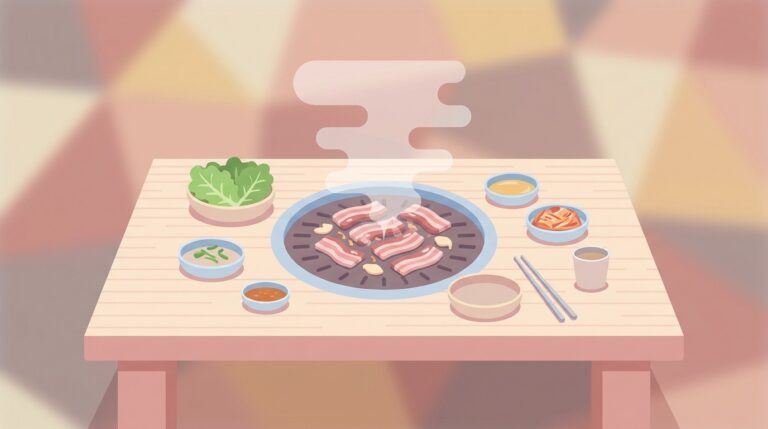
Picture this: You are sitting in a sizzling Korean BBQ restaurant in the middle of Hongdae, Seoul. Golden strips of pork belly (samgyeopsal) are crackling right before your eyes. You’ve already eaten two bowls of rice, finished three refills of kimchi, and your stomach is screaming for mercy. But then, the server drops a smoking stone bowl of cheesy steamed eggs and mentions the magic word: K-Bokkeumbap (fried rice). Suddenly, your chopsticks are moving again on autopilot!
We have all been there. In Korea, food isn’t just fuel—it is an emotional connection and an art form. When foreign learners visit Korea, one of their biggest pain points is sounding too formal or robotic when praising food. Saying standard textbook lines like “The food is pleasant” makes native speakers giggle because real foodies speak with passion! Learning natural slang like “Even though I’m full, I can’t stop eating” will instantly break the ice with locals, restaurant owners (Imo-nim), and your Korean friends. Based on hundreds of real student experiences from Daily Hangul, here is your definitive field guide to praising food like a real Seoulite!
Phase 2: Core Expressions Deep Dive
1. 배불러도 계속 들어가요 (Baebulleodo gyesok deureogayo)
- Pronunciation: [Bae-bul-leo-do gye-sok deu-reo-ga-yo] (Sounds like: Pae-pool-luh-doh gyeh-sawk deu-ruh-gah-yoh)
- Meaning: Literally translates to “Even though my stomach is full, it keeps entering.” The actual nuance is: “I am completely stuffed, but this is so ridiculously good that my body refuses to stop eating!”
- K-Culture Moment: Seen in almost every variety show or K-Drama dinner scene where characters unbutton their trousers slightly while reaching for another spoonful of spicy stew.
- Editor’s Insight: This phrase is the ultimate polite compliment to a home cook or a restaurant host. It proves the food is tastier than your biological limits!
- Situation Spectrum: Casual: ✅ | Semi-formal: ✅ | Formal: ⚠️
- 🤔 Think About It: In English, we might say “I have a dessert stomach.” How does describing food actively “entering” (들어가다) change the way you view the eating experience?
2. 배 터질 것 같아요 (Bae teojil geot gat-ayo)
- Pronunciation: [Bae teo-jil geot gat-a-yo] (Sounds like: Pae tuh-jeel gawt gah-tah-yoh)
- Meaning: Literally “I feel like my belly is going to burst!” Nuance: Exaggerated, happy agony after an incredible feast.
- K-Culture Moment: Used by travel YouTubers and K-Pop idols doing food tours right after taking down a massive round of street food at Gwangjang Market.
- Editor’s Insight: The word 터지다 (to burst) adds a playful drama. Pair this with a satisfied smile, and everyone at your table will feel satisfied watching you enjoy your meal.
- Situation Spectrum: Casual: ✅ | Semi-formal: ✅ | Formal: 🚫
- 🤔 Think About It: Why do many cultures use explosive metaphors to describe absolute food satisfaction?
3. 완전 꿀맛이에요 (Wanjeon kkulmasieyo) / JMT (Jonmattaeng)
- Pronunciation: [Wan-jeon kkul-mas-i-e-yo] (Sounds like: Wahn-juhn kool-mah-she-yoh)
- Meaning: Literally “Totally honey taste!” Nuance: “This is insanely delicious / top tier!”
- K-Culture Moment: In food vlogs, creators flash the acronym JMT on screen whenever they taste something legendary. 꿀맛 (honey taste) is the gentler, universally loved cousin of JMT.
- Editor’s Insight: While younger friends love using “JMT” (존맛탱), 꿀맛이에요 is safe to use in front of elders, restaurant owners, and coworkers without sounding vulgar!
- Situation Spectrum: Casual: ✅ | Semi-formal: ✅ | Formal: ⚠️ (For JMT: Casual: ✅ | Semi-formal: 🚫 | Formal: 🚫)
- 🤔 Think About It: Honey (꿀) in Korean culture symbolizes luxury, pure sweetness, and utmost quality. What food item in your language represents perfection?
Phase 3: Textbook Korean vs. Real Korean
Scenario 1: You are super full, but still reaching for more fried chicken.
- 📖 교과서 한국어 (Textbook): 배가 부릅니다. 하지만 더 먹겠습니다. (Baega bureumnida. Hajiman deo meokgetseumnida.) — “My stomach is full. However, I will eat more.”
- 🗣️ 진짜 한국어 (Real-life): 배부른데 계속 들어가요! (Baebureunde gyesok deureogayo!) — “I’m stuffed, but it just keeps going in!”
- 💡 왜 다를까? (Why the difference?): Textbook sentences treat actions logically and separately. Real Korean links cause and effect with lively emotion using connecting endings like -는데 (but/and yet).
Scenario 2: Complimenting the taste of the food.
- 📖 교과서 한국어 (Textbook): 이 음식은 매우 맛있습니다. (I eumsigeun maeu masitseumnida.) — “This food is exceedingly delicious.”
- 🗣️ 진짜 한국어 (Real-life): 와, 이거 진짜 꿀맛이에요! (Wa, igeo jinjja kkulmasieyo!) — “Whoa, this is straight-up honey taste!”
- 💡 왜 다를까? (Why the difference?): 매우 (very) is mostly reserved for formal writing or news scripts. Real Koreans express excitement with spontaneous exclamations like 와 (whoa) and lively adjectives.
Phase 4: K-Culture Deep Dive & Non-Verbal Manners
4-1. Nunchi & Body Gestures
When saying 배불러도 계속 들어가요, don’t just speak with your voice—speak with your entire body!
* The Belly Rub: Gently tap or pat your belly with your left hand while keeping your chopsticks poised in your right hand. This shows physical conflict: my body says stop, but my heart says yes!
* The Reluctant Shrug: Tilt your head, sigh playfully (하아~), and look at your eating partner as if the food itself has hypnotized you. This makes the cook beam with pride.
4-2. The Holy Rule of “K-Dessert” (볶음밥)
In Korea, “I’m full” does not mean the meal is over. It simply signals the transition to the main event: K-Dessert. Unlike Western dining where dessert means cake or ice cream, Korean dessert at BBQ or hot pot spots is almost always rice stir-fried in the remaining savory sauce right on the grill.
Koreans have a running cultural joke about having a dedicated 볶음밥 배 (Bokkeumbap bae — a separate stomach reserved exclusively for fried rice). Declaring that you are full, yet happily eating the fried rice, is considered the highest form of respect to the dining experience!
Phase 5: Real-Life Roleplay Scenario
Setting: A vibrant, bustling Samgyeopsal grill house in Mapo. Thick savory smoke hangs in the air, and soju glasses clink around you. Your Korean close friend, Min-jun, is busy flipping golden pork belly slices on the grill.
- Min-jun: 고기 더 구울까? 아직 많이 남았어! (Gogi deo gu-ulkka? Ajik mani nam-asseo!)
🎭 Action: Holding tongs, pointing at another fresh plate of pork. - You: 저 이미 배가 너무 불러요! (Jeo imi baega neomu bulleoyo!)
🎭 Action: Holding both hands up in mock surrender. - Min-jun: 그래? 그럼 젓가락 내려놔~ (Geurae? Geurom jeotgarak naeryeonwa~)
🎭 Action: Smiling cheekily, waiting to see your reaction. - You: 근데 진짜 배불러도 계속 들어가요! (Geunde jinjja baebulleodo gyesok deureogayo!)
🎭 Action: Picking up one more sizzling piece of meat wrapped in lettuce. - Min-jun: ㅋㅋㅋ 역시! 맛있는 건 못 참지! (Kkk yeoksi! Masinneun geon mot chamji!)
🎭 Action: Laughs out loud and adds garlic to the grill. - You: 와, 이거 완전 꿀맛이에요. (Wa, igeo wanjeon kkulmasieyo.)
🎭 Action: Nodding enthusiastically with your eyes wide open. - Min-jun: 그럼 이제 볶음밥 비빌까? (Geurom ije bokkeumbap bibilkka?)
🎭 Action: Calling over the server with a grin. - You: 당연하죠! 볶음밥 배는 따로 있어요! (Dang-yeonhajyo! Bokkeumbap baeneun ttaro isseoyo!)
🎭 Action: Patting your stomach and giving a thumbs-up.
🔀 Interactive Decision Point
Min-jun says: “배 터질 것 같은데 이제 그만 먹을래?” (You look about to burst, want to stop eating now?)
What do you reply?
- Option A: “아니에요, 배불러도 계속 들어가요! 더 먹을래요!” (No way, it keeps going in even though I’m full! I want to eat more!)
- Option B: “음식이 너무 많아서 먹기 싫어요.” (There is too much food so I hate eating it.)
- Option C: “존맛탱이니까 닥치고 고기나 더 구워.” (It’s JMT, so shut up and just grill more meat.)
[Feedback]
✅ Choice A (Best): Perfect response! It shows high enthusiasm, flatters your dining partner, and keeps the lively dining rhythm alive.
❌ Choice B (Bad): Sounds ungrateful and harsh! Avoid using words like "싫어요" (hate/dislike) during a meal sharing session.
⚠️ Choice C (High Risk): Using harsh slang like "닥치고" (shut up) can offend even close friends unless you have a deep sibling-like dynamic. Stick to Option A!
Phase 6: 10-Second Emotional Shadowing Drill
Practice these lines with exaggerated rhythm and the exact emotional cues provided!
[🤤 배부른데도 멈출 수 없을 때 / Stuffed but hopelessly addicted]
“배불러도… / 계속 / 들어가요!”
(Bae-bul-leo-do… / gye-sok / deu-reo-ga-yo!)
Pause slightly after 배불러도 with a happy sigh, then emphasize ‘gye-sok’!-
[💥 배가 터질 것 같은 행복한 비명 / Dramatic fullness]
“와… / 진짜 / 배 터질 것 같아요!”
(Wa… / jin-jja / bae teo-jil geot gat-a-yo!)
Stretch out the ‘Wa…’ and accent ‘teo-jil’! -
[😋 감탄하며 엄지 척 / Pure delight]
“이거 / 완전 / 꿀맛이에요!”
(I-geo / wan-jeon / kkul-mas-i-e-yo!)
Pronounce ‘kkul’ crisply with a sweet, smiling tone.
Phase 7: K-Culture Mini Dictionary
-
볶음밥 배 (Bokkeumbap-bae)
Translation: The separate stomach specifically dedicated to fried rice.
Usage: Used whenever someone claims they cannot take another bite of meat, but eagerly orders 2 portions of grilled fried rice. -
순삭 (Sun-sak)
Translation: Instant deletion / Vanished in seconds.
Usage: Contraction of 순간 삭제 (instant deletion). Use it when a whole plate of chicken disappears within 3 minutes: “치킨 순삭했어요!” (The chicken vanished!). -
먹방 (Mukbang)
Translation: Eating broadcast.
Usage: A global cultural staple born in Korea. When someone eats with incredible gusto and makes everyone else hungry, you say: “완전 먹방 찍는 것 같아요!” (You look like you’re filming a mukbang!). -
단짠단짠 (Dan-jjan-dan-jjan)
Translation: Sweet-salty-sweet-salty loop.
Usage: The golden formula of Korean culinary addiction (e.g., Honey Butter chicken followed by spicy Tteokbokki). The reason your stomach never signals full!
Phase 8: Traveler’s Survival Kit
Top 3 Survival Phrases for Travelers
- 배불러요, 그런데 너무 맛있어요! (Baebulleoyo, geureonde neomu masisseoyo!)
Pro Tip: Perfect to say to the restaurant grandma (Halmeoni) when leaving a clean plate. - 볶음밥 하나만 볶아주세요! (Bokkeumbap hana-man bokka-juseyo!)
Pro Tip: “Please stir-fry just one portion of rice for us!” Essential finishing move at hot pot or BBQ spots. - 이거 진짜 꿀맛이에요! (Igeo jinjja kkulmasieyo!)
Pro Tip: Compliment the cook right as they check your table grill.
Editor’s Travel Note
When looking for truly authentic local spots where locals pack the tables, avoid tourist traps by checking real Korean restaurant reviews. Always use Korean search engines! Download the 네이버 지도 앱 다운로드 to check the real local star ratings (별점) and photo reviews from neighborhood foodies. Also, remember that most casual Korean restaurants have a call bell attached to the side of the table—press it gently once instead of shouting across the room!
Phase 9: “One Step Deeper” (Thought Reflection)
In traditional Korean culture, feeding someone generously is the ultimate display of Jeong (정) — affectionate bonding and care. In the past, asking someone “밥 먹었어요?” (Did you eat rice?) was the standard daily greeting born out of care for one another’s survival. When you tell a Korean host or restaurant owner “Even though I’m full, I keep eating,” you aren’t just complimenting their culinary skill; you are validating their warmth and generous hospitality. Food in Korea is not meant to be eaten with calculated restraint—it is shared warmth that overflows.
💬 Your Turn: What is that one comfort food from your own country that makes you say, “I’m completely full, but I can’t stop eating”? Tell me in the comments below!
Phase 10: FAQ & Common Mistakes
Q: Can I say “배 터질 것 같아요” to a business client or boss?
A: No, it is a bit too graphic and casual for formal professional dinners! In formal settings, stick to: “정말 맛있어서 과식했습니다” (It was so delicious that I slightly overate) or “배가 부를 정도로 잘 먹었습니다” (I ate very well to the point of being full).
Q: Is “JMT” offensive in any way?
A: It is not offensive among friends, but its origin comes from an explicit slang intensifier (존나). While youth culture uses JMT universally as an innocent compliment, refrain from saying it to elderly restaurant staff. Use 꿀맛이에요 instead!
Q: Why do Koreans keep offering more food even when I say I’m full?
A: In Korean dining etiquette, an empty plate can sometimes look like the host did not provide enough food. Leaving a tiny bite on the table or enthusiastically rubbing your stomach while waving your hands playfully signals you have reached your genuine limit!
🚨 흔한 실수 (Common Mistakes) Warning Board
- Mistake: Saying “배가 뚱뚱해요” (My stomach is fat).
- Correct Action: Say “배가 불러요” (My stomach is full). 뚱뚱하다 refers to body weight and sounds self-deprecating or awkward here.
- Mistake: Saying “더 이상 먹기 싫어요” (I hate eating any more).
- Correct Action: Say “배불러서 더 못 먹겠어요” (I am so full that I cannot eat more). Focus on ability (못 먹어요), not dislike (싫어요).
- Mistake: Using JMT with your partner’s grandparents.
- Correct Action: Smile warmly and say: “너무 맛있어서 계속 들어가요, 할머니!” (It is so delicious it keeps going in, Grandmother!).
Phase 11: Action Missions
- 🥉 Bronze Mission (Solo Practice): Stand before a mirror with a snack, take a bite, touch your belly, and say “배불러도 계속 들어가요!” three times with authentic expression.
- 🥈 Silver Mission (Social Connection): Take a photo of your favorite meal today and post it on your Instagram story with the caption: “완전 꿀맛! 배불러도 계속 들어가요 🤤” and tag @DailyHangul.
- 🥇 Gold Mission (Real Life Test): The next time you visit a Korean restaurant or eat with a Korean speaker, use “배불러도 계속 들어가요” when they ask if you like the meal!
🎮 K-Culture Mission: Watch any episode of a food-centric K-Drama (like Let’s Eat) or a popular YouTube Mukbang. Count how many times the host gasps or mentions being full before continuing to take huge bites!
Phase 12: Interactive Quiz Challenge
1. Situational Judgment: You are eating dinner at your Korean language exchange partner’s home. His mother cooks endless dishes. You want to express how addictive the food is politely. What do you say?
* A) 배 터질 것 같으니까 치워주세요.
* B) 배불러도 계속 들어가요, 정말 맛있어요!
* C) JMT! 고기 더 줘요.
2. Fill in the Blank:
“음식이 너무 맛있어서 멈출 수가 없어요. 배불러도 계속 ( )!”
3. True or False:
Koreans use the phrase 볶음밥 배 to describe the biological reality of having a separate stomach just for fried rice after a barbecue meal. (True / False)
👉 Click here to reveal answers & explanations!
- Answer: B — 배불러도 계속 들어가요, 정말 맛있어요! is respectful, warm, and highly complimentary to an elder cook. Option A is rude, and Option C uses improper slang and impolite speech.
- Answer: 들어가요 (deureogayo) — Complete sentence: 배불러도 계속 들어가요! (Even though I’m full, it keeps going in!).
- Answer: True (Culturally speaking!) — While not medically true, it is a beloved Korean cultural concept that there is always room reserved for fried rice, no matter how stuffed you are!







