

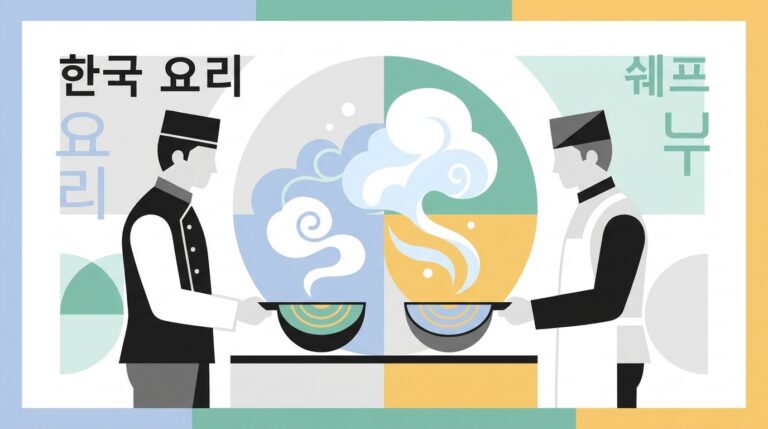
Why Stripping Away Titles in Korean Survival Shows Gives You Chills
Phase 1: 공감 (The Thrill of the Ultimate Equalizer)
안녕하세요! 매일한글 에디터입니다. (Hello! I’m your Daily Hangul editor.)
Picture this: It is 1:30 AM on a Friday night. You are wrapped in your softest blanket, staring unblinkingly at your screen. On the left side of the stainless-steel kitchen counter stands a legendary chef who has cooked state dinners for presidents and boasts a shiny Michelin star. On the right stands a quiet master in an apron who has flipped scallion pancakes in a traditional market alley for thirty years. There are no fancy resumes, no name tags, and no polite deferrals to age or status. A digital countdown timer ticks down: 3, 2, 1… Cook!
If you have been swept up in the global frenzy over Korean OTT survival shows like Netflix’s Culinary Class Wars (흑백요리사) or reality showdowns on TVING, you know that heart-thumping, hair-raising sensation. It is pure, unfiltered catharsis.
Many of my intermediate B1 students tell me: “Teacher, I understand normal Korean dramas, but when I watch these survival variety shows, the subtitles say ‘Let’s compete fairly,’ but the contestants use words that sound so much sharper and punchier! What are they really saying?”
In Korean society, hierarchy, seniority, and titles are woven into every single sentence. That is why watching two people tear those labels off to battle purely on raw talent feels so electrifying. Today, we will decode the authentic vocabulary of high-stakes Korean competitions—straight from the screen to your real-life conversations.
Phase 2: 핵심 표현 3선 심층 분석 (3 Core Expressions)
1. 계급장 떼고 붙다 (Gyegeupjang ttego butda)
- Pronunciation: [Gye-geup-jang tte-go but-da] (Imagine saying ‘get-up’ with a snappy ‘k’ sound, followed by ‘jang’, a tense ‘tte-go’, and ‘boot-dah’)
- Meaning: Literally “To tear off rank insignia and fight.” In nuance: To set aside age, status, resume, and formal hierarchy to go head-to-head purely on merit.
- K-Culture Moment: Used dramatically when an underdog rookie challenges an industry titan in a blind taste test, asking the judges to disregard fame.
- Editor’s Insight: Gyegeupjang (계급장) refers to the military rank patches worn on uniforms. In a country with mandatory military service and strong organizational hierarchies, taking off your badge means zero privileges and absolute equality.
- Situation Spectrum: Casual: ✅ | Semi-formal: ⚠️ | Formal: 🚫
- 🤔 Think About It: Does your native culture have a metaphor derived from uniform badges to describe creating an equal playing field?
2. 폼 미쳤다 (Pom michyeotda)
- Pronunciation: [Pom mi-chyeot-da] (Sounds like the English word “Form” + “me-chut-dah”)
- Meaning: Literally “One’s form is insane.” In nuance: “Performing at god-tier level,” “Unbelievable execution,” or “At the absolute top of their game.”
- K-Culture Moment: Shouted by show judges when a chef slices vegetables at lightning speed while completely blindfolded.
- Editor’s Insight: Borrowed from the English sports term “form” (as in physical/athletic conditioning) and blended with the Korean adjective for crazy (michida). It has become Korea’s undisputed favorite compliment for someone doing something exceptionally cool.
- Situation Spectrum: Casual: ✅ | Semi-formal: ⚠️ | Formal: 🚫
- 🤔 Think About It: Notice how Korean slang effortlessly adopts English loanwords and conjugates them with native Korean adjectives. What does this reveal about contemporary pop culture?
3. 진검승부 (Jingeomseungbu)
- Pronunciation: [Jin-geom-seung-bu] (Sounds like “Gene-gum-seung-boo”)
- Meaning: Literally “A duel with real, sharpened steel swords” (as opposed to wooden practice swords). In nuance: “A no-holds-barred, genuine showdown where neither side pulls punches.”
- K-Culture Moment: The tense soundtrack swells as the host announces the semi-final ingredient, declaring that both competitors are now entering a true duel without handicaps.
- Editor’s Insight: This historical martial arts idiom embodies profound mutual respect. You only draw real steel against an opponent you deem entirely worthy.
- Situation Spectrum: Casual: ✅ | Semi-formal: ✅ | Formal: ✅
- 🤔 Think About It: Why do combat metaphors resonate so deeply when describing peaceful arts like cooking, singing, or dancing?
Phase 3: 교과서 한국어 vs 진짜 한국어 (Textbook vs. Real Korean)
Situation 1: Praising someone’s mind-blowing culinary mastery
- 📖 교과서 한국어: 그 요리사는 요리를 아주 훌륭하게 만들어요. (Geu yorisaneun yorireul aju hullyunghage mandeureoyo. / That cook makes food very excellently.)
- 🗣️ 진짜 한국어: 와, 내공이 장난 아니네요. 손맛이 살아있어요! (Wa, naegongi jangnan anineyo. Sonmasi saraisseoyo! / Wow, their inner mastery is unreal. Their touch is legendary!)
- 💡 왜 다를까?: Native speakers rarely describe food skill with sterile words like “excellent” (hullyunghada). Instead, they praise naegong (years of invisible, dedicated training) and sonmat (the magical culinary instinct residing in one’s fingertips).
Situation 2: Expressing adrenaline while binge-watching an elimination round
- 📖 교과서 한국어: 이 서바이벌 방송은 매우 긴장되고 재미있어요. (I seobaibeol bangsongeun maeu ginjangdoego jaemiisseoyo. / This survival broadcast is very tense and interesting.)
- 🗣️ 진짜 한국어: 숨 멎는 줄 알았어요, 진짜 도파민 폭발이에요! (Sum meonneun jul arasseoyo, jinjja dopamine pokbarieyo! / I thought my breath would stop, it is a total dopamine explosion!)
- 💡 왜 다를까?: Modern Korean viewers describe entertainment engagement through physiological reactions—racing pulses, stopped breathing, and the buzz of neurochemicals.
Phase 4: K-Culture 딥다이브 & 비언어적 매너 (Deep Dive & Manners)
4-1. 눈치 (Nunchi) & Non-Verbal Cues
When a contestant or competitor says “계급장 떼고 붙읍시다” (Let’s strip badges and face off), the body language must match the gravity of the words. It is delivered not with a sneer, but with a firm, respectful bow followed by direct, unwavering eye contact. In everyday Korean life, younger people or subordinates usually soften their gaze and lower their shoulders. However, within the sacred boundary of an agreed survival competition, squaring your shoulders and holding eye contact signals courage rather than rudeness. If you say this jokingly to a Korean friend before playing a round of video games or table tennis, lightly tap both your shoulders as if brushing away invisible epaulets!
4-2. The Cultural Code: Why Equalizer Shows Dominate Korea
South Korea’s modern social fabric remains heavily structured by age (nai), school graduation year (yeondae), and corporate title (jik-geup). Under ordinary circumstances, directly challenging an elder or senior industry figure is unthinkable. Survival reality shows serve as an emotional valve. Seeing a nameless neighborhood bistro owner out-flavor a celebrated culinary maestro proves that sheer dedication can shatter glass ceilings. It satisfies a deep cultural yearning for absolute meritocracy.
Phase 5: 실전 롤플레이 시나리오 (Survival Show Binge Debrief)
Setting: A cozy craft beer and fried chicken pub in Hongdae on a Friday evening.
Characters: You and Minwoo (민우), your foodie Korean colleague who lives and breathes cooking variety shows.
- 민우: 어제 서바이벌 요리 예능 결승전 봤어? (Eoje seobaibeol yori yeneung gyeolseungjeon bwasseo?)
🎭 눈을 반짝이며 맥주잔을 테이블에 내려놓는다.
(Did you watch the culinary survival finale yesterday?) - You: 당연하지! 밤새워서 마지막 회까지 다 달렸어. (Dangyeonhaji! Bamsaewoseo majimak hoekkaji da dallyeosseo.)
🎭 흥분된 표정으로 엄지를 치켜세운다.
(Of course! I stayed up all night and binged until the last episode.) - 민우: 재야의 고수가 스타 셰프를 이길 때 진짜 소름 돋지 않았어? (Jaeyaui gosu-ga seuta syepeu-reul igil ttae jinjja soreum dotji anasseo?)
🎭 자기 팔뚝을 문지르며 닭살 돋은 흉내를 낸다.
(Didn’t you get real goosebumps when the hidden master beat the celebrity chef?) - You: 맞아, 완전히 계급장 떼고 붙은 진검승부였잖아. (Maja, wanjeonhi gyegeupjang ttego buteun jingeomseungbuyeotjana.)
🎭 주먹을 불끈 쥐며 공감한다.
(Totally, it was a genuine showdown with all status completely stripped away.) - 민우: 그 무명 요리사 요리할 때 집중하는 폼 미쳤더라. (Geu mumyeong yorisa yorihal ttae jipjunghaneun pom michyeotdeora.)
🎭 감탄하며 고개를 절레절레 흔든다.
(That unknown cook’s focused form during the challenge was totally insane.) - You: 그 두부 요리는 화면으로만 봐도 침이 꼴깍 넘어가던데. (Geu dubu yorineun hwamyeoneoroman bwado chimi kkolkkak neomeogadeonde.)
🎭 군침을 삼키며 입맛을 다시는 시늉을 한다.
(Even just through the screen, that tofu dish made my mouth water instantly.) - 민우: 인정! 다음 주말에 그 골목 식당 오픈런하러 갈래? (Injeong! Daeum jumare geu golmok sikdang opeunreonhareo gallae?)
🎭 스마트폰 맛집 지도 앱을 켜며 묻는다.
(Agreed! Want to join the open-run morning line at their alley restaurant next weekend?) - You: 완전 좋지! 새벽부터 줄 서보자. (Wanjeon jochi! Saebyeokbuteo jul seoboja.)
🎭 신나게 웃으며 시원하게 맥주잔을 짠 부딪친다.
(Count me in! Let’s line up from the crack of dawn.)
🔀 인터랙티브 분기점 (Interactive Choice)
Minwoo smiles and asks: “If our company held a cooking contest and you faced our team director, would you go all-out?”
- Option A: “부장님 눈치 보느라 그냥 대충 질래요.” (Bujangnim nunchi boneura geunyang daechung jillaeyo. / I’ll read the room and lose on purpose for the director.)
- Feedback (Risk): Realistic corporate survival, but you killed the fun vibe! Minwoo will call you a company conformist.
- Option B: “계급장 떼고 제대로 한판 붙어야죠!” (Gyegeupjang ttego jedaero hanpan buteoyajyo! / We should strip badges and fight a proper match!)
- Feedback (Best): Perfect punchline! Shows intermediate conversational humor while using today’s target phrase.
- Option C: “저는 요리를 못해서 무조건 기권입니다.” (Jeoneun yorireul mot-haeseo mujogeon gigwon-imnida. / I can’t cook, so I forfeit unconditionally.)
- Feedback (Bad): Flat conversational dead end. Keep the playful momentum going!
Phase 6: 10초 감정 섀도잉 드릴 (10-Second Shadowing Drill)
Practice out loud with these punctuation markers and emotional cues!
[🔥 비장하고 당당하게 / Fierce and confident]
이번 라운드는 / 타이틀 다 내려놓고 / 오직 실력으로만 승부합시다!
(Ibeon raundeuneun / taiteul da naeryeonoko / ojik sillyeogeoroman seungbuhapsida!)-
[😲 전율에 차서 / In pure awe and admiration]
우와… / 저 긴박한 순간에 침착한 거 봐, / 진짜 폼 미쳤다!
(Uwa… / jeo ginbakan sungane chimchakan geo bwa, / jinjja pom michyeotda!) -
[🤩 도파민 폭발하여 신나게 / Bouncing with adrenaline]
누가 이길지 전혀 모르는 / 진검승부라서 / 심장이 터질 것 같아요!
(Nuga igilji jeonhyeo moreuneun / jingeomseungburaseo / simjangi teojil geot gat-ayo!)
Phase 7: K-Culture 미니 사전 (Mini Dictionary)
- 재야의 고수 (Jaeyaui gosu): A master or virtuoso who lives quietly away from mainstream fame or official institutions. Often used for self-taught cooks, underground musicians, or street artisans.
- 도파민 폭발 (Dopamine pokbal): A slang phrase meaning a massive rush of exhilaration and thrill, widely applied to binge-watching cliffhangers.
- 내공 (Naegong): Originating from martial arts novels, it means deep-rooted mastery, poise, and experience honed through silent decades of practice.
- 참교육 (Chamgyoyuk): Literally “true education.” Internet slang for decisively humbling an overconfident or arrogant competitor through undeniable talent.
Phase 8: 여행자를 위한 생존 키트 (Traveler’s Survival Kit)
If you are traveling across Korea to visit pop-ups and restaurants run by survival show contestants, keep these three phrases handy:
- 여기 테이블링이나 캐치테이블 예약 돼요? (Yeogi Teibeulling-ina Kaechiteibeul yeyak dwaeyo? / Do you take reservations via Tabling or CatchTable here?)
- Pro Tip: Most famous survival show eateries require virtual queueing apps rather than physical lines.
- 시그니처 경연 메뉴가 뭐예요? (Sigeunicheo gyeong-yeon menyuga mwoyeyo? / Which one is the signature competition dish from the show?)
- Pro Tip: Chefs often add a small badge or TV icon next to the dish they created on air.
- 재료 소진되면 조기 마감하나요? (Jaeryo sojindoemyeon jogi magamhanayo? / Do you close early if ingredients run out?)
- Pro Tip: Trendy spots frequently post “재료 소진” (ingredients sold out) on Instagram by mid-afternoon.
- Editor’s Travel Note: Make sure you complete your setup on the CatchTable restaurant reservation app guide ahead of time using a verified foreign card or mobile number, as walk-in seats at star chef venues are practically non-existent on weekends.
Phase 9: “한 발 더 깊이” (Cultural Essay)
In most traditional Korean spaces, age and title determine who speaks first, who pours the drinks, and whose opinion carries authority. This system preserves harmony and order, but it also creates silent burdens. Survival shows offer a revolutionary space where the rules of everyday society are briefly paused. In that arena, white chef coats, Michelin accolades, and humble street carts stand naked before a spoonful of soup. For ninety minutes each week, audiences experience the sheer thrill of true equality. When you cheer for a contestant, you are not just enjoying cooking—you are sharing in a collective Korean dream of fairness.
💬 Your Turn: Have you ever watched someone strip away rank to win on pure merit in your own culture? How did it make you feel? Drop a comment below!
Phase 10: FAQ & 오해 방지 (FAQ & Common Mistakes)
Q: Can I use “계급장 떼고” with my Korean boss or university professor?
A: Absolutely not! Unless your boss explicitly initiates the joke during a casual team-building retreat (like a bowling match), saying this to a superior can sound aggressive and insubordinate. Keep it strictly between peers, friends, or when discussing media.
Q: Does “폼 미쳤다” only apply to athletic or cooking skills?
A: Not at all! You can say “폼 미쳤다” when your friend dresses exceptionally well for a night out, when an idol hits a perfect live high note, or even when your favorite convenience store drops an incredible new dessert recipe.
Q: Is “재야의 고수” an insult to someone who is not famous?
A: Quite the opposite! It is one of the highest compliments you can pay an independent creator. It implies that while they choose not to seek hollow media fame, their technical mastery matches or surpasses celebrated figures.
🚨 흔한 실수 (Common Mistakes) 경고판
- Mistake: Using “계급장 떼다” in formal written emails.
Correct Action: Use polite equivalents like “동등한 입장에서 검토하다” (to review from an equal standpoint). - Mistake: Pronouncing “폼” with a drawn-out English “F” sound.
Correct Action: Pronounce it with a sharp, crisp Korean bilabial ‘P’ sound: [Pom]. - Mistake: Confusing “진검승부” (genuine battle) with casual play (장난).
Correct Action: Reserve jingeomseungbu for moments involving high stakes, serious effort, and zero excuses.
Phase 11: 액션 미션 & 참여 유도 (Action Missions)
- 🥉 Bronze Level: Shadow phrase #2 (폼 미쳤다!) three times in front of your mirror with expressive hand gestures.
- 🥈 Silver Level: Pick an impressive scene from your favorite Korean show and leave a Korean comment on social media: “오늘 연기 폼 미쳤다!” (The acting today was insane!).
- 🥇 Gold Level: During your next casual gaming session or food debate with a Korean speaker, playfully propose: “우리 계급장 떼고 한판 붙을까?” (Shall we strip badges and duel?).
- 🎮 K-Culture Mission: Watch an episode of a Korean reality survival competition and spot how many times the words 내공, 승부, or 반전 appear in the on-screen captions.
Phase 12: 인터랙티브 퀴즈 챌린지 (Quiz Challenge)
Q1. When would it be MOST appropriate to use the expression “계급장 떼고 붙다”?
a) During a formal corporate job interview with the HR director
b) When playfully challenging your close coworker to an arcade game after work
c) While ordering side dishes from an elderly restaurant owner
Q2. Fill in the blank with the appropriate modern slang:
“그 가수 어제 라이브 콘서트 보셨어요? 가창력 진짜 ( )!”
(Did you see that singer’s live concert yesterday? Their vocal ability was truly insane!)
Q3. True or False:
“진검승부” (Jingeomseungbu) historically refers to bamboo sparring swords used in gentle martial arts practice. (T / F)
👉 Click here to reveal the answers and explanations!
- A1: b) It is best suited for playful, equalized showdowns among peers or friends.
- A2: 폼 미쳤어요! (or casual: 폼 미쳤다!)
- A3: False (F). It refers to authentic, sharpened steel swords (진검), which is why it symbolizes an uncompromising, high-stakes duel!







