

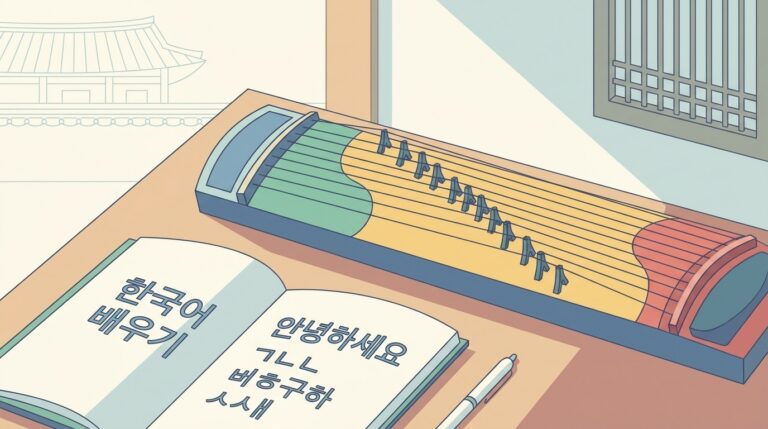
The Art of Restringing the Nation: Mastering ‘해현경장’ and the Eloquence of Korean Statecraft
Phase 1: Empathy & Narrative Opening
안녕하세요! 매일한글 에디터입니다. (Hello! It’s your Daily Hangul editor.)
Have you ever been completely engrossed in an intense political K-drama like Chief of Staff (보좌관) or a sweeping sageuk historical epic like The Crowned Clown, watching an advisor step up to the podium, take a deliberate breath, and utter a four-character phrase that makes the entire assembly room freeze in pin-drop silence? You scramble for your translator app, only to find a bewildering literal translation: ‘Loosening zither strings and restringing them.’ You think to yourself, Why on earth is a high-ranking politician discussing traditional zither maintenance during a national fiscal crisis?
Welcome to the apex of advanced Korean discourse. At the C2 level, Korean isn’t merely about grammatical accuracy; it is an exercise in cultural resonance, intellectual authority, and rhetorical gravitas. The phrase you just heard is 해현경장 (解弦更張, Hae-hyeon-gyeong-jang). When an institution has grown stale, when disciplinary morale is broken, and when incremental band-aids no longer work, you do not just ‘fix the problem’—you restring the zither from scratch.
Foreign executives, diplomats, and advanced Korean learners often hit a painful plateau here: knowing how to say ‘We need a complete structural reorganization’ sounds dry and textbook-flat in Korean. But deploying an idiom like 해현경장 commands immediate respect from senior Korean counterparts, signaling that you grasp not just modern corporate maneuvering, but the foundational Confucian philosophy of governance (경세, Gyeong-se). Today, let us elevate your Korean to the highest corridors of leadership.
Phase 2: Core Expressions Deep Dive
1. 해현경장 (解弦更張)
- Pronunciation: [Hae-hyeon-gyeong-jang] (Think: Hae as in ‘head’ without the ‘d’, hyeon rhyming with ‘pure’ + ‘un’, gyeong like ‘young’ with a ‘g’, and jang like ‘jar’ with a nasal ‘ng’).
- Meaning: Literal: Untying slackened zither (geomungo) strings and restringing them tight. | Nuance: A systemic overhaul, fundamental institutional reform, and the restoration of ethical discipline when old frameworks decay.
- K-Culture Moment: Seen frequently during New Year addresses by corporate chairmen or prime ministers in news broadcasts, or spoken by the righteous Chief State Councilor in historical dramas demanding root-and-branch bureaucratic cleansing.
- Editor’s Insight: Originating from the Han Dynasty scholar Dong Zhongshu’s memorials to Emperor Wu, this phrase implies that society, like an instrument, naturally loses tension over time. If you do not restring it, it produces discord, not music. It is constructive, solemn, and intensely proactive.
- Situation Spectrum: Casual: 🚫 | Semi-formal: ⚠️ | Formal: ✅
- 🤔 Think About It: Does your native culture visualize governance mechanically (like fixing an engine) or harmonically (like tuning an instrument)? How does that shape political expectations?
2. 경세제민 (經世濟民)
- Pronunciation: [Gyeong-se-je-min] (Pronounced fluidly: Gyeong-se-je-min, where min sounds like ‘mint’ without the ‘t’).
- Meaning: Literal: Governing the world and delivering the people from suffering. | Nuance: The noble moral obligation of leadership and the historical root of the modern word 경제 (Gyeong-je, Economy).
- K-Culture Moment: Quoted in economic forums or by visionary protagonists in business dramas like Reborn Rich who remind cynical executives that business exists to serve society, not vice versa.
- Editor’s Insight: Modern speakers forget that 경제 (economy) is actually a truncation of this ancient phrase. Using 경세제민 immediately invokes an ethos of benevolent stewardship rather than raw capitalist profit.
- Situation Spectrum: Casual: 🚫 | Semi-formal: ⚠️ | Formal: ✅
- 🤔 Think About It: When ‘economy’ meant ‘saving the people’ rather than ‘maximizing quarterly earnings,’ how different was the covenant between leaders and citizens?
3. 군주민수 (君舟民水)
- Pronunciation: [Gun-ju-min-su] (Gun like ‘good’ ending in ‘n’, ju like ‘June’, min like ‘mint’, su like ‘soup’).
- Meaning: Literal: The ruler is a boat; the common people are the water. | Nuance: The water carries the vessel, but it can also capsize it. A severe warning about the formidable weight of public sentiment (민심, Minsim).
- K-Culture Moment: Adopted nationwide as the defining idiom during the massive candlelit democratic assemblies in Gwanghwamun, cited prominently in major editorial headlines.
- Editor’s Insight: Derived from Xunzi, this is the ultimate democratic principle encased in classical Hanja. It reminds any authority figure that institutional power is an ephemeral gift granted by collective trust.
- Situation Spectrum: Casual: 🚫 | Semi-formal: ⚠️ | Formal: ✅
- 🤔 Think About It: How does your language express the latent, overwhelming power of the governed over those who govern?
Phase 3: Textbook Korean vs. Real Korean
Situation 1: Calling for Total Institutional Overhaul in an Executive Briefing
- 📖 교과서 한국어 (Textbook Korean):
“우리 회사의 시스템을 근본적으로 바꾸고 규율을 다시 세워야 합니다.”
(Uri hoesa-ui siseutem-eul geunbon-jeog-euro bakkugo gyuyul-eul dasi sewoya hamnida.)
“We need to fundamentally change our company’s system and re-establish rules.” - 🗣️ 진짜 한국어 (Real Boardroom Korean):
“지금이야말로 타성에 젖은 조직을 해현경장의 자세로 쇄신해야 할 적기입니다.”
(Jigeum-iyamallo taseong-e jeoj-eun jojig-eul haehyeongyeongjang-ui jase-ro swaesinhae-ya hal jeokgi-imnida.)
“Now is the precise moment to revitalize our inertia-bound organization with the rigorous mindset of Haehyeongyeongjang.” - 💡 왜 다를까? (Why is it different?):
Textbook phrasing relies on generic verbal combinations (바꾸다, 세우다) which sound like a middle manager’s complaint. The real advanced version combines the classical metaphor (해현경장) with elevated institutional terminology (타성, 쇄신, 적기), instantly raising the strategic altitude of your proposal.
Situation 2: Cautioning Leadership on Stakeholder/Public Sentiment
- 📖 교과서 한국어 (Textbook Korean):
“국민들이 화가 많이 났으니 조심해야 합니다.”
(Gungmin-deur-i hwaga mani nasseuni josimhaeya hamnida.)
“The citizens are very angry, so we must be careful.” - 🗣️ 진짜 한국어 (Real Boardroom Korean):
“군주민수의 경구를 새겨 민심의 향방을 엄중하게 살펴야 합니다.”
(Gunjuminsu-ui gyeonggu-reul saegyeo minsim-ui hyangbang-eul eomjunghage salpyeoya hamnida.)
“We must engrave the warning of Gunjuminsu upon our minds and gravely examine the direction of public sentiment.” - 💡 왜 다를까? (Why is it different?):
Using emotional words like 화가 났다 (got angry) reduces public sentiment to a temper tantrum. C2-level strategic Korean conceptualizes the public as an elemental force (민심의 향방) through classical warnings (경구).
Phase 4: K-Culture Deep Dive & Non-Verbal Manners
4-1. 눈치 (Nunchi) & Non-Verbal Gravitas
When delivering classical statecraft idioms like 해현경장, pacing and physical carriage dictate 70% of your perceived authority.
* The Breath Pause: Never rush into an idiom. Before delivering the four characters, pause for one beat, lower your vocal pitch slightly into your diaphragm, and make steady, respectful eye contact across the conference table.
* Postural Firmness: Keep both hands clasped calmly on the desk or along your centerline. Avoid flippant hand-gesturing or nodding while speaking Hanja four-character idioms; in Korean formal culture, classical wisdom is accompanied by absolute physical stillness (정중동, 静中動 – stillness harboring immense energy).
4-2. Cultural Code: The Zither (Geomungo) and the Philosophy of Tension
In traditional Korean court music (Jeong-ak, 正樂), the geomungo represents the balance of the universe. If the silk strings are too tight, they snap; if too loose, they emit only muffled, discordant thuds. Ancient Korean scholar-officials (Seonbi) regarded the instrument as a daily physical mirror of their own inner ethical discipline. Therefore, proposing 해현경장 does not mean declaring war or violently destroying an organization; it means tuning the instrument back to pitch with precision, devotion, and reverence for harmony.
Phase 5: Real-World Roleplay Scenario
Setting: A tension-filled crisis boardroom in a major Korean public corporation in Yeouido. After months of scandal and plummeting public approval, the Senior Executive Committee is debating whether to issue a mere press apology or overhaul the company.
Characters:
* Director Park (박 전무): An old-school, defensive executive advocating for surface-level cosmetic fixes.
* You (Guest Director / Senior Advisor): An international statecraft strategist invited to steer structural reform.
— Dialogue (8 Turns) —
Turn 1 (Director Park):
이번 사태는 언론의 과장 보도 탓이 큽니다. 성명서 한 장으로 수습하고 지나가시지요.
(Ibeon satae-neun eollon-ui gwajang bodo tasi keumnida. Seongmyeongseo han jang-euro suseubhago jinagasijiyo.)
“This situation is largely due to media exaggeration. Let us settle this with a single public statement and move on.”
🎭 [Leaning back with folded arms, dismissive wave of the hand]
Turn 2 (You):
전무님, 미봉책으로 덮기에는 사안의 본질이 결코 가볍지 않습니다.
(Jeonmunim, mibongchaek-euro deopgi-eneun saan-ui bonjiri gyeolko gabyeopji anseumnida.)
“Director Park, the essence of this matter is far too grave to conceal with makeshift stopgaps.”
🎭 [Maintaining upright posture, voice pitched low, calm direct gaze]
Turn 3 (Director Park):
그럼 이 엄중한 시국에 조직 전체를 뒤흔들자는 말씀입니까?
(Geureom i eomjunghan siguge jojik jeonche-reul dwiheundeuljaneun malsseumimnikka?)
“Then are you suggesting we throw the entire organization into turmoil during such a critical juncture?”
🎭 [Slightly furrowing brows, tapping fingers defensively on the table]
Turn 4 (You):
흔드는 것이 아니라 바로잡는 것입니다. 지금이야말로 해현경장(解弦更張)의 결단이 필요한 때입니다.
(Heundeuneun geosi anira barojamneun geosimnida. Jigeum-iyamallo haehyeongyeongjang-ui gyeoldani piryohan ttae-imnida.)
“It is not shaking it; it is righting it. Now is precisely the time for the resolve of Haehyeongyeongjang.”
🎭 [Placing both palms flat on the table, speaking with unshakeable measured rhythm]
Turn 5 (Director Park):
해현경장이라… 거문고 줄을 고쳐 매듯, 기존 규범을 완전히 재편하자는 뜻이군요.
(Haehyeongyeongjang-ira… geomungo jureul gocheo maedeut, gijon gyubeomeul wanjeonhi jaepyeonhajaneun tteus-igunyo.)
“Haehyeongyeongjang… You mean to completely reorganize existing norms, just like restringing a zither.”
🎭 [Eyes widening slightly, dropping defensive posture to contemplate the phrase]
Turn 6 (You):
그렇습니다. 느슨해진 기강을 다시 조이지 않는다면 더 이상의 존립은 어렵습니다.
(Geureoseumnida. Neuseunhaejin gigang-eul dasi joiji anneundamyeon deo isang-ui jollibeun eoryeopseumnida.)
“Precisely. If we do not retighten slackened institutional discipline, our continued existence is jeopardized.”
🎭 [Nodding once with deliberate solemnity]
Turn 7 (Director Park):
뼈를 깎는 고통이 따르겠지만… 민심을 되돌리려면 피할 수 없는 길이겠지요.
(Ppyeoreul kkakneun gotongi ttareugetjiman… minsimeul doedolliryeomyeon pihal su eomneun girigetjiyo.)
“It will entail excruciating pain… but if we are to win back public trust, it appears unavoidable.”
🎭 [Exhaling deeply, offering a respectful nod of concession]
Turn 8 (You):
네, 낡은 법도를 쇄신하여 경세제민의 본래 사명으로 돌아가야 합니다.
(Ne, nalgeun beopdoreul swaesinhayeo gyeongsejemin-ui bollae samyeong-euro doragaya hamnida.)
“Yes. We must reform archaic frameworks and return to our original mission of true public stewardship.”
🎭 [Offering an earnest, respectful bow of solidarity]
🔀 Interactive Choice Point
Director Park asks how you intend to announce this decision to the public. How do you respond?
* Option A: “그냥 솔직하게 다 우리 잘못이라고 보도자료를 냅시다.” (Just honestly say in a press release that it’s all our fault.)
* Option B: “해현경장의 각오로 뼈를 깎는 내부 쇄신안을 마련해 투명하게 공표하겠습니다.” (With the resolve of Haehyeongyeongjang, we will prepare an excruciating internal reform plan and announce it transparently.)
* Option C: “조용히 지나갈 때까지 대외 소통을 일절 중단하고 버텨야 합니다.” (We must suspend all external communication and endure until this quietly blows over.)
Feedback:
* Option A (Risk): Too blunt and informal. Lacks the dignified statesmanship required of leadership; it sounds reckless.
* Option B (Best): Perfect balance! It couples the philosophical idiom 해현경장 with concrete institutional transparency (내부 쇄신안, 투명하게 공표).
* Option C (Bad): Disastrous. Ignoring 민심 (public sentiment) directly triggers the danger of 군주민수 (the boat being overturned).
Phase 6: 10-Second Emotional Shadowing Drill
Practice reading these out loud. Mind the / pauses and the emotional milestones!
[진중하고 단호하게 - Solemn and Decisive]
지금은 / 미봉책에 기댈 때가 아니라 / 해현경장(解弦更張)의 결단으로 / 체질을 바꿔야 합니다.
(Jigeum-eun / mibongchaeg-e gidael ttae-ga anira / haehyeongyeongjang-ui gyeoldan-euro / chejil-eul bakkwoya hamnida.)-
[경각심을 일깨우며 - Awakening Urgent Awareness]
군주민수(君舟民水)를 기억하십시오. / 민심을 잃은 조직은 / 결코 존립할 수 없습니다.
(Gunjuminsu-reul gieokhasi-psio. / Minsim-eul ireun jojik-eun / gyeolko jolliphal su eopseumnida.) -
[품격 있는 확신 - Dignified Conviction]
낡은 관행을 깨끗이 털어내고 / 경세제민(經世濟民)의 초심으로 / 다시 서겠습니다.
(Nalgeun gwanhaeng-eul kkaekkeusi teoreonaego / gyeongsejemin-ui chosim-euro / dasi seogesseumnida.)
Phase 7: K-Culture Mini Dictionary
- 쇄신 (Swae-sin) [Reform / Cleansing Renewal]
- Meaning: Sweeping away outdated evils to renew an atmosphere.
- Real Usage: Found in board meetings and news broadcasts: 인적 쇄신 (personnel overhaul) or 조직 쇄신 (organizational revitalization).
- 기강 (Gi-gang) [Institutional Discipline / Order]
- Meaning: The foundational rules and moral backbone of an institution.
- Real Usage: 공직 기강을 바로잡다 (to restore integrity and discipline in public service).
- 민심 (Min-sim) [Public Sentiment / Will of the People]
- Meaning: The collective heart, trust, and judgment of everyday citizens.
- Real Usage: Treated as a living organism: 민심을 읽다 (to read the public pulse) or 민심이반 (the alienation of public trust).
- 환골탈태 (Hwan-gol-tal-tae) [Metamorphosis / Reborn From the Bones]
- Meaning: Shedding old bones to completely transform oneself.
- Real Usage: Frequently paired with 해현경장: 환골탈태하는 심정으로 임하겠습니다 (We will approach this with the resolve of complete rebirth).
Phase 8: Traveler’s Survival Kit (For High-Level Delegations & Heritage Explorers)
Survival Expressions Top 3:
- 근본적인 쇄신이 필요합니다.
(Geunbon-jeogin swaesini piryohamnida.)
Pro Tip: Use this in diplomatic or corporate negotiations when surface proposals fail to meet expectations. - 역사의 교훈을 되새기게 됩니다.
(Yeoksa-ui gyohuneul doesaegige doemnida.)
Pro Tip: Elegant phrasing when touring historical sites like Gyeongbokgung Palace or the National Assembly with Korean hosts. - 상생(相生)의 길을 모색해야 합니다.
(Sangsaeng-ui gireul mosaekhaeya hamnida.)
Pro Tip: Indispensable closing statement in strategic partnerships meaning ‘We must seek a path of mutual coexistence.’
Editor’s Travel Note:
If you are visiting Seoul to observe the vibrant nexus of modern democracy and royal statecraft, download the Naver Map application to navigate directly from Gyeongbokgung Palace’s Geunjeongjeon (where monarchs debated statecraft) down to the Gwanghwamun square assembly plazas. When discussing institutional history with Korean counterparts, carrying a physical business card (명함) presented with both hands remains the gold standard of professional etiquette.
Phase 9: “한 발 더 깊이” (One Step Deeper)
In Western classical philosophy, the state is often envisioned as an architectural monument or a mechanical clock—composed of cogs, checks, and balances. But Korean Confucian heritage envisions the community as an orchestra or a living biological body (유기체). A musical instrument left alone in varying seasons will naturally slacken its strings; this is not a sin, but an inevitability of nature. True leadership is not about lamenting that the strings have loosened, but possessing the courage and aesthetic ear to sit down, loosen the pegs, and tighten each string to its rightful tension. When you use 해현경장, you are not announcing destruction—you are promising harmony.
💬 Your Turn: Have you ever experienced a moment in your organization or personal life where small tweaks weren’t enough and you needed a total ‘re-stringing’? Share your thoughts in the comments below!
Phase 10: FAQ & Mistake Prevention
Q: Can I use ‘해현경장’ when talking to friends about personal habits?
A: Generally, no. 해현경장 carries tremendous rhetorical gravity. Using it because you decided to wake up 30 minutes earlier sounds comically hyperbolic (unless used as deliberate self-deprecating irony). For personal habits, use 심기일전 (Sim-gi-il-jeon – turning a new leaf with fresh determination) instead.
Q: How does ‘해현경장’ differ from ‘혁신’ (Innovation)?
A: 혁신 (Hyeok-sin) focuses on introducing something modern, technological, or new. 해현경장 focuses on re-tuning an existing structure back to its principled moral foundation when it has grown slack or corrupted.
Q: Is this idiom understandable to everyday Koreans on the street?
A: Educated native speakers, professionals, and anyone who reads the news or enjoys historical media will instantly recognize and appreciate it. It immediately sets you apart as an extraordinary speaker of high-register Korean.
🚨 Common Mistakes Warning Board:
- Mistake: Using 해현경장 as an adjective directly modifying a person (그 사람은 아주 해현경장이에요 – ❌).
- Correct Action: It must be used with postpositions indicating attitude or action: 해현경장의 자세로 (with an attitude of…) or 해현경장을 단행하다 (to execute a systemic reform).
- Mistake: Pronouncing 해현 as hae-han or hae-hyung.
- Correct Action: Ensure clear distinction between [hyeon] (현) and [hyeong] (형).
- Mistake: Deploying classical statecraft idioms with casual 반말 (informal speech).
- Correct Action: Hanja idioms of this caliber should almost exclusively be framed in 격식체 (하십시오체 or formal 해요체).
Phase 11: Action Missions
- Bronze Mission (Solo Mastery): Practice the Phase 6 Shadowing Drill 3 times into your voice recorder, focusing on the dramatic diaphragmatic pause before 해현경장.
- Silver Mission (Social Sharing): Post a short reflection on LinkedIn or your language journal regarding an institutional change in the news, utilizing the phrase: “낡은 관행을 벗고 해현경장의 길로 나아가야 할 때입니다.”
- Gold Mission (Real Application): Use 해현경장 or 쇄신 in your next high-level Korean business meeting, academic presentation, or formal exchange.
- 🎮 K-Culture Mission: Watch an episode of a political K-drama (such as Chief of Staff) or an episode of SBS 8 News editorial segment, and spot at least one four-character idiom describing national reform!
Phase 12: Interactive Quiz Challenge
1. Situational Judgment
Which of the following scenarios is the most appropriate setting to declare 해현경장 (Hae-hyeon-gyeong-jang)?
* A) When deciding to redecorate your living room furniture.
* B) When an international enterprise overhauls its decade-old corrupted auditing apparatus.
* C) When ordering a new menu item at an upscale Korean restaurant.
🔍 Click to Reveal Answer & Explanation
Correct Answer: B
Explanation: 해현경장 denotes serious systemic overhaul and moral re-tightening within an institution or statecraft framework, making a corporate audit reform the textbook perfect context.
2. Fill-in-the-Blank
Complete the following C2-level strategic sentence:
“조직의 기강이 무너졌을 때는 임시방편이 아닌 (____)의 각오로 근본을 뜯어고쳐야 합니다.”
* A) 작심삼일 (Jak-sim-sam-il)
* B) 해현경장 (Hae-hyeon-gyeong-jang)
* C) 동문서답 (Dong-mun-seo-dap)
🔍 Click to Reveal Answer & Explanation
Correct Answer: B
Explanation: 작심삼일 means giving up after three days, and 동문서답 means giving an irrelevant answer. Only 해현경장 (restringing the slackened zither) fits the context of foundational organizational reform.
3. True or False Cultural Quiz
True or False: The word 경제 (Economy) originally derived from an ancient Confucian phrase meaning ‘to manage the world and deliver the people from suffering’ (경세제민).
🔍 Click to Reveal Answer & Explanation
Correct Answer: True
Explanation: 경제 (Gyeong-je) is an abbreviation of 경세제민 (經世濟民), illustrating that Korean governance traditions historically viewed finance and administration as moral duties toward human welfare.






