

Phase 1: Empathy & Narrative Opening
안녕하세요! 매일한글 에디터입니다.
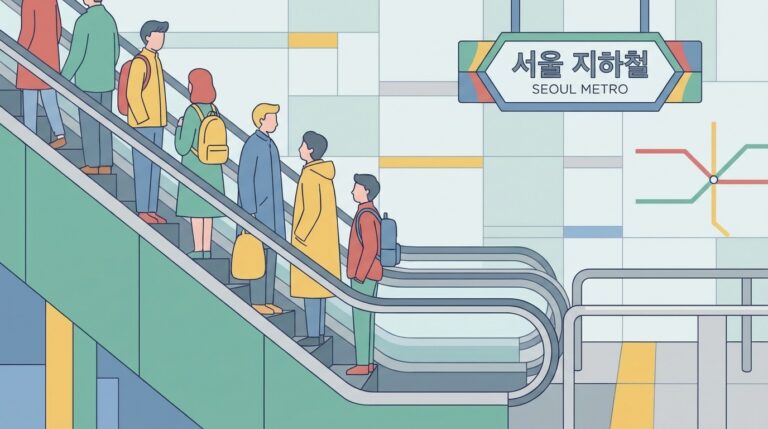
Imagine stepping out of the train doors at Gangnam Station at 8:40 AM. You follow the rhythmic ocean of commuters toward the longest escalator you have ever seen. As you step onto the metallic stairs, you glance around: yellow warning stickers line the steps, digital display boards flash in bright red letters, and everyone seems to know an invisible dance. You freeze for half a second. A yellow sign shows a graphic of a person gripping a bar with the bold caption: 손잡이를 잡으세요 (Hold the handrail). Suddenly, footsteps hurry up behind you on your left, while automated speakers politely chime a soothing safety reminder.
Navigating public transport in Korea is exhilarating, but reading rapid signs and catching subtle social expectations can feel overwhelming when you are just starting out. Today’s guide is crafted from real beginner feedback and everyday commuter life in Seoul. By the end of this lesson, you will read essential safety signs with zero hesitation, understand Seoul’s escalator culture, and use crisp A1 phrases to navigate crowded stations like a pro!
Phase 2: Core Expressions (핵심 표현 3선)
1. 손잡이를 잡으세요 (Sonjabireul jabeuseyo)
- Pronunciation: [Son-ja-bi-reul ja-beu-se-yo] (Think: “Sohn-jah-bee-reul jah-beu-say-yo” – like ‘son’, ‘bee’, and ‘say’)
- Meaning: Literal: “Please grab the handle.” / Nuance: “Please hold the handrail for your safety.”
- K-Culture Moment: You hear this chime continuously in automated station announcements whenever you ride escalators in Seoul Metro Line 2 or Incheon Airport.
- Editor’s Insight: The noun
손잡이 (sonjabi)comes from손 (son = hand)+잡이 (jabi = holder). Adding-세요 (-seyo)turns a basic verb into a polite, respectful request heard everywhere in public services. - Situation Spectrum: Casual: ⚠️ | Semi-formal: ✅ | Formal: ✅
- 🤔 Think About It: In English, signs often say “Hold Handrail.” Notice how Korean signs almost always use the polite
-세요ending, treating every anonymous citizen with respectful speech. How does your language address the public on warning signs?
2. 걷거나 뛰지 마세요 (Geotgeona ttwiji maseyo)
- Pronunciation: [Geot-geo-na ttwi-ji ma-se-yo] (Think: “Guht-gaw-nah twee-jee mah-say-yo”)
- Meaning: Literal: “Do not walk or run.” / Nuance: “Please remain stationary and do not walk up or run on the steps.”
- K-Culture Moment: Seen on yellow triangle stickers pasted on escalator risers across Korea, frequently spotted in transit scenes of K-dramas like Extraordinary Attorney Woo.
- Editor’s Insight:
-지 마세요 (-ji maseyo)is your golden formula for “please do not [do something].”걷다 (geotda)means to walk, and뛰다 (ttwida)means to run/jump. - Situation Spectrum: Casual: ⚠️ | Semi-formal: ✅ | Formal: ✅
- 🤔 Think About It: Official rules state you should stand still, yet in reality, many commuters still use the left side to walk. How do written rules and social habits negotiate space in your hometown?
3. 잠시만 지나갈게요 (Jamsiman jinagalgeyo)
- Pronunciation: [Jam-si-man ji-na-gal-ge-yo] (Think: “Jahm-she-mahn jee-nah-gahl-gay-yo”)
- Meaning: Literal: “Just for a moment, I will pass by.” / Nuance: “Excuse me, please let me pass through.”
- K-Culture Moment: In bustling subway transfers like Sindorim, you will hear hurried commuters say this gently yet swiftly as they slip through crowds.
- Editor’s Insight: Instead of an abrupt “Excuse me,” Koreans combine
잠시만 (jamsiman = just a moment)with지나가다 (jinagada = to pass through). It announces your movement without sounding demanding or accusatory. - Situation Spectrum: Casual: ⚠️ | Semi-formal: ✅ | Formal: ✅
- 🤔 Think About It: Why announce your intention (“I will pass”) instead of commanding someone (“Please move”)? Notice how Korean politeness minimizes friction by stating one’s own action.
Phase 3: 교과서 한국어 vs 진짜 한국어 (Textbook vs. Real Korean)
Situation 1: Asking someone to make way on the escalator
- 📖 교과서 한국어 (Textbook):
- 저를 위해 비켜 주시겠습니까? (Jeoreul wihae bikyeo jusigesseumnikka? – Would you please move aside for me?)
- 🗣️ 진짜 한국어 (Real-Life Native):
- 죄송합니다, 잠시만요! (Joesonghamnida, jamsimanyo! – Sorry, excuse me for just a second!)
- 💡 왜 다를까? (Why the difference?): Real commuters keep requests lightning-fast during rush hours. Saying
잠시만요 (jamsimanyo)with a polite head nod is 100% natural, whereas the textbook sentence sounds like a period drama script.
Situation 2: Reminding a friend to stay safe on a moving staircase
- 📖 교과서 한국어 (Textbook):
- 에스컬레이터 손잡이를 잡는 것이 바람직합니다. (Eseukeolleiteo sonjabireul jamneun geosi baramjikhamnida. – Holding the escalator handrail is desirable.)
- 🗣️ 진짜 한국어 (Real-Life Native):
- 손잡이 꼭 잡아, 넘어져! (Sonjabi kkok jaba, neomeojyeo! – Hold the handrail tight, you might fall!)
- 💡 왜 다를까? (Why the difference?): Native speakers use punchy, protective verbs with close friends.
꼭 (kkok = tightly/surely)conveys warm concern far better than dry grammatical suggestions.
Phase 4: K-Culture 딥다이브 & 비언어적 매너 (Nunchi & Non-verbal Etiquette)
4-1. 눈치 (Nunchi) & Body Language on Korean Escalators
- The Golden Standing Rule: While official safety guidelines encourage standing on both sides, public consensus in Seoul still heavily leans toward standing on the right side (우측 통행 – ucheuk tonghaeng) and leaving the left open for commuters in a rush.
- Eye Contact & Bag Placement: Avoid swinging large backpacks. Take off heavy backpacks and hold them low or place them directly between your feet. Keep your eyes forward or down toward your phone screen—staring directly at the person ahead makes people uncomfortable.
- The Nod-and-Squeeze: If someone murmurs
잠시만요 (jamsimanyo), don’t panic. Simply tuck your shoulders inward, take a slight half-step closer to the right rail, and offer a mini head nod.
4-2. Culture Code: The Tension Between Safety and “Ppalli-Ppalli”
Korea’s famous 빨리빨리 (ppalli-ppalli, hurry-hurry) mindset birthed rapid economic growth and unmatched subway efficiency. In the 2000s, the government launched campaigns promoting “two-line standing” (두 줄 서기 – du jul seogi) for escalator mechanics and passenger safety. However, the sheer pace of Seoul’s working lifestyle kept the “single line with passing lane” alive. When you visit, you will witness this unique harmony: signs saying “Don’t walk,” alongside polite commuters yielding the left side. Observing this duality is like getting a front-row seat to modern Korean cultural pragmatism.
Phase 5: 실전 롤플레이 시나리오 (Real-Life Subway Scenario)
- Setting: Line 9 Express Bus Terminal Station during evening rush hour. A towering multi-story escalator stretches ahead.
- Characters:
- You (민우 / Learner): Visiting Seoul, carrying a shopping bag.
- Sora (소라 / Busy commuter): Rushing to catch the express train.
- Dialogue (8 Turns):
- You: 🎭 (Stepping onto the left side of the escalator, looking up at the high ceiling)
- 와, 진짜 길다! (Wa, jinjja gilda! / Wow, it’s really long!)
- Sora: 🎭 (Approaching quickly from behind on the left steps)
- 죄송합니다, 잠시만 지나갈게요! (Joesonghamnida, jamsiman jinagalgeyo! / Excuse me, coming through for just a second!)
- You: 🎭 (Surprised, turning your head around)
- 네? 아, 죄송합니다! (Ne? A, joesonghamnida! / Pardon? Oh, I am sorry!)
- Sora: 🎭 (Smiling warmly, pointing gently toward the yellow strip)
- 괜찮아요! 오른쪽으로 붙으시면 돼요. (Gwaenchannayo! Oreunjjogeuro buteusimyeon dwaeyo. / It’s alright! You can just step to the right.)
- You: 🎭 (Moving to the right side and holding the black rubber rail)
- 이렇게요? 손잡이 잡았어요. (Ireokkeyo? Sonjabi jabasseoyo. / Like this? I held the handrail.)
- Sora: 🎭 (Passing past you safely with a swift nod)
- 네, 맞아요! 감사합니다! (Ne, majayo! Gamsahamnida! / Yes, that’s right! Thank you!)
- You: 🎭 (Looking at the sign ahead with realization)
- 표지판에 ‘손잡이를 잡으세요’라고 써 있네요. (Pyojipane ‘sonjabireul jabeuseyo’rago sseo inneyeo. / The sign says ‘Hold the handrail’ indeed.)
- Sora: 🎭 (Looking back briefly before walking ahead)
- 맞아요, 안전제일이에요! 조심하세요! (Majayo, anjeonjeirieyo! Josimhaseyo! / Exactly, safety first! Take care!)
🔀 인터랙티브 분기점 (Interactive Choice)
Scenario: You step onto an escalator, and someone carrying a large wheeled suitcase is standing right in the middle, blocking everyone while checking their phone.
- Choice A: Stand silently behind them, sighing loudly so they hear you.
- Choice B: Gently tap their shoulder and say,
저기요, 잠시만 지나갈게요.(Jeogiyo, jamsiman jinagalgeyo.) - Choice C: Yell in English, “Move aside, the sign says keep right!”
Feedback:
* Choice A (Risk): Sighing creates passive-aggressive tension in public Korean spaces. Korean etiquette prefers polite, clear verbal cues.
* Choice B (Best): Perfect! Adding a soft 저기요 (jeogiyo = excuse me) before 잠시만 지나갈게요 is the gold standard for polite social efficiency.
* Choice C (Bad): Shouting breaches public peace (민폐 – minpye) and causes embarrassment. Keep it calm and gentle.
Phase 6: 10초 감정 섀도잉 드릴 (10-Second Emotion Shadowing Drill)
Practice reading these out loud. Pay attention to the pauses (/) and embody the emotional tag!
- [📢 차분하고 또렷하게 – Calm and Clear Public Announcement Tone]
- 에스컬레이터에서는 / 손잡이를 / 꼭 잡으세요.
(Eseukeolleiteoeseoneun / sonjabireul / kkok jabeuseyo.) - “On the escalator, / please make sure to hold / the handrail.”
- 에스컬레이터에서는 / 손잡이를 / 꼭 잡으세요.
- [🏃 급하지만 정중하게 – Hurried yet Ultra-Polite Tone]
- 죄송합니다! / 잠시만 / 먼저 지나갈게요!
(Joesonghamnida! / Jamsiman / meonjeo jinagalgeyo!) - “Excuse me! / Just a second, / I will pass ahead!”
- 죄송합니다! / 잠시만 / 먼저 지나갈게요!
- [🤝 다정하고 안도하며 – Friendly, Reassuring Warm Tone]
- 네, / 괜찮아요. / 천천히 조심해서 가세요.
(Ne, / gwaenchannayo. / Cheoncheonhi josimhaeseo gaseyo.) - “Yes, / it is completely fine. / Go slowly and safely.”
- 네, / 괜찮아요. / 천천히 조심해서 가세요.
Phase 7: K-Culture 미니 사전 (Mini Dictionary)
- 손잡이 (Sonjabi) | Handrail / Handle | Composed of ‘hand’ + ‘holder’. Used for escalator handrails, bus straps, and door handles.
- 안전선 (Anjeonseon) | Safety line | The yellow demarcated line on train platforms and escalator steps. Crucial word on station safety warnings.
- 우측 통행 (Ucheuk tonghaeng) | Right-hand walking rule | The universal guideline in Korean transit hubs for walking on the right side of corridors and stairs.
- 민폐 (Minpye) | Nuisance / Inconvenience to others | A core social concept in Korea. Actions that disrupt communal harmony (blocking paths, loud music) are considered
민폐.
Phase 8: 여행자를 위한 생존 키트 (Traveler’s Survival Kit)
Survival Expressions TOP 3
- 조심하세요! (Josimhaseyo!) – Be careful! / Watch your step!
- Pro Tip: Use this anytime a friend is stepping onto a slippery escalator or getting off an elevator.
- 오른쪽으로 가요. (Oreunjjogeuro gayo.) – Let’s go to the right side.
- Pro Tip: Great to guide your travel buddy in busy subway transfers.
- 천천히 가세요. (Cheoncheonhi gaseyo.) – Please go slowly / Take your time.
- Pro Tip: A warm phrase to say to an elderly commuter in front of you.
Editor’s Travel Note
- Essential Navigation Apps: Never rely on general web maps for Seoul subways. For real-time car transfer positions, exit numbers, and escalator locations, download the 네이버 지도 앱 (Naver Map App) or 카카오맵 지하철 길찾기 가이드 (KakaoMap Navigation Guide). They show you precisely which subway door aligns with the nearest exit escalator!
- Stroller & Luggage Etiquette: If your rolling suitcase is taller than knee-height or you have a stroller, take the elevator instead. Seoul Metro stations are exceptionally equipped with glass elevators near turnstiles.
Phase 9: “한 발 더 깊이” (Cultural Insight Mini-Essay)
Korea’s public spaces represent an ongoing dialogue between strict institutional rules and considerate community mindfulness. While the Seoul Transportation Corporation posts “Do Not Walk” notices to safeguard against machinery breakdowns and falls, commuters still voluntarily leave the left corridor open for those rushing to work. This behavior is not disregard for the law; rather, it is communal empathy for a fellow citizen’s demanding schedule. When you hold the handrail and stand on the right, you are doing more than following a sign—you are participating in a silent social contract of mutual consideration.
- 💬 Your Turn: In your home country, is there an unspoken rule on escalators or public transit that differs from the official signs? Share your experience in the comments below!
Phase 10: FAQ & 오해 방지 (FAQ Schema)
Q: Why do people walk on escalators if the signs say “Do not walk”?
A: Official safety campaigns urge everyone to stand still on two lines to prevent mechanical imbalance and injury. However, Korea’s deeply ingrained “ppalli-ppalli” work culture causes commuters to intuitively leave a passing lane on the left for those in a hurry. You are encouraged to stand still on the right side.
Q: What should I say if someone accidentally bumps into me on an escalator?
A: A simple and sincere 괜찮아요 (Gwaenchannayo - It's okay) accompanied by a gentle nod will resolve the situation smoothly and courteously.
Q: Can I hold both handrails if I feel dizzy?
A: Yes, absolutely. Your safety comes first. If you need both hands on the handrails, position yourself carefully on the step, and if someone comes up behind you, simply turn slightly and say, 먼저 가세요 (Meonjeo gaseyo - Please go ahead).
🚨 흔한 실수 (Common Mistakes) 경고판
- Mistake: Standing side-by-side with your friend on both the left and right sides during morning rush hour while chatting.
- Correct Action: Form a single file line on the right side. Keep the left open unless the station is so packed that attendants instruct everyone to fill both sides.
- Mistake: Forgetting to lift your luggage when boarding or exiting the escalator comb.
- Correct Action: Wheels can get caught in the escalator teeth. Lift your luggage slightly when getting on and off, watching the yellow safety line (
안전선).
- Correct Action: Wheels can get caught in the escalator teeth. Lift your luggage slightly when getting on and off, watching the yellow safety line (
- Mistake: Saying an abrupt “비켜요! (Bikyeoyo! – Move!)” when you are in a rush.
- Correct Action: Always use polite mitigation:
죄송합니다, 잠시만 지나갈게요! (Joesonghamnida, jamsiman jinagalgeyo!).
- Correct Action: Always use polite mitigation:
Phase 11: 액션 미션 & 참여 유도 (Action Missions)
- 🥉 Bronze Mission (Solo Shadowing): Stand in front of your mirror and practice saying:
손잡이를 잡으세요 (Sonjabireul jabeuseyo)three times with a bright, welcoming smile. - 🥈 Silver Mission (Social Share): Snap a photo of any transit sign or escalator in your neighborhood, write the Korean phrase
손잡이를 잡으세요on it, and tag@DailyHangulon Instagram stories! - 🥇 Gold Mission (Real-Life Test): Next time you step onto an escalator or elevator in Korea, stand on the right, hold the rubber rail, and silently read the Korean caution stickers.
- 🎮 K-Culture Mission: Watch any episode of a workplace K-drama (like Misaeng or Start-Up). Spot a subway or office building escalator scene and observe which side the characters stand on!
Phase 12: 인터랙티브 퀴즈 챌린지 (Interactive Quiz)
Q1. Situational Judgment
You are standing on the escalator on the left side holding your phone with both hands. You hear running steps behind you. What is the most natural native response?
* A) Stare at them and say “안 돼요! (An dwaeyo!)”
* B) Step to the right side, hold the rail, and say 잠시만요 or 죄송합니다.
* C) Run up the escalator faster than them.
👉 Click to reveal Answer & Explanation
Correct Answer: B
Moving smoothly to the right while offering a courteous 죄송합니다 (Joesonghamnida) prevents collisions and aligns perfectly with public commuter etiquette.
Q2. Fill-in-the-Blank
Look at the caution sign: “에스컬레이터에서는 걷거나 [ ] 마세요.” (Please do not walk or run on the escalator.)
* Hint: The Korean verb for ‘to run’ or ‘jump’ is 뛰다.
👉 Click to reveal Answer & Explanation
Correct Answer: 뛰지 (ttwiji)
The grammar structure -지 마세요 (-ji maseyo) attaches to the verb stem 뛰-, making 뛰지 마세요 (Please do not run).
Q3. True or False
In Korea, it is considered completely acceptable and polite to block both sides of the escalator with friends during morning peak rush hour because official guidelines advise against walking.
👉 Click to reveal Answer & Explanation
Correct Answer: False (F)
Even though official posters advise holding the handrail and standing still, standard Korean commuting etiquette (nunchi) expects the left lane to remain open for people in urgent transit.







